
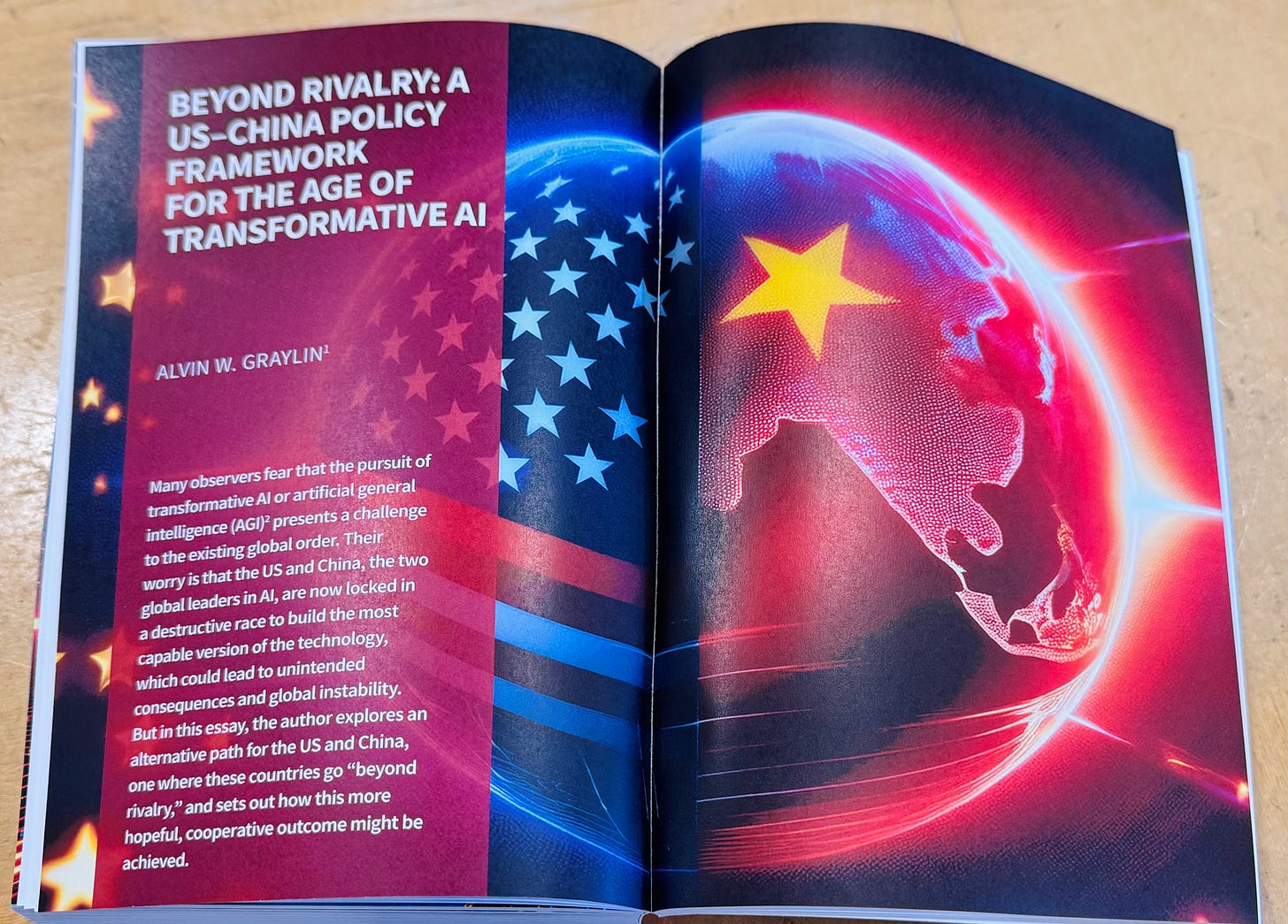
I am excited to share my paper, “Beyond Rivalry: A US-China Policy Framework for the Age of Transformative AI” has been published in this year’s Stanford Digitalist Papers. It is an attempt to answer a question that keeps getting more urgent: How can the U.S. and China get past the current AI arms race mindset without a major crisis, and what does the transition plan look like that would allow us to bypass the numerous risks associated with advanced AI? This AI race is a trap and it’s making America and the world less safe! No one has a clear definition of “winning” and there is no clean finish line. The current U.S. strategy will create the opposite result from what its authors desire and the world needs. The faster America achieves AGI without the proper technical safeguards and social safety net programs, the faster we drive the country and the globe into economic and societal crisis. There is a better way…
What the paper is really about?
This paper lays out a pragmatic multi-pronged path to move the global powers away from an unwinable zero-sum rivalry toward selective, structured cooperation where it matters most: safety, standards, joint innovation and the shared foundations that will shape the coming transformative AI into a global public good versus a massive destabilizing force.
Key themes and solutions proposed:
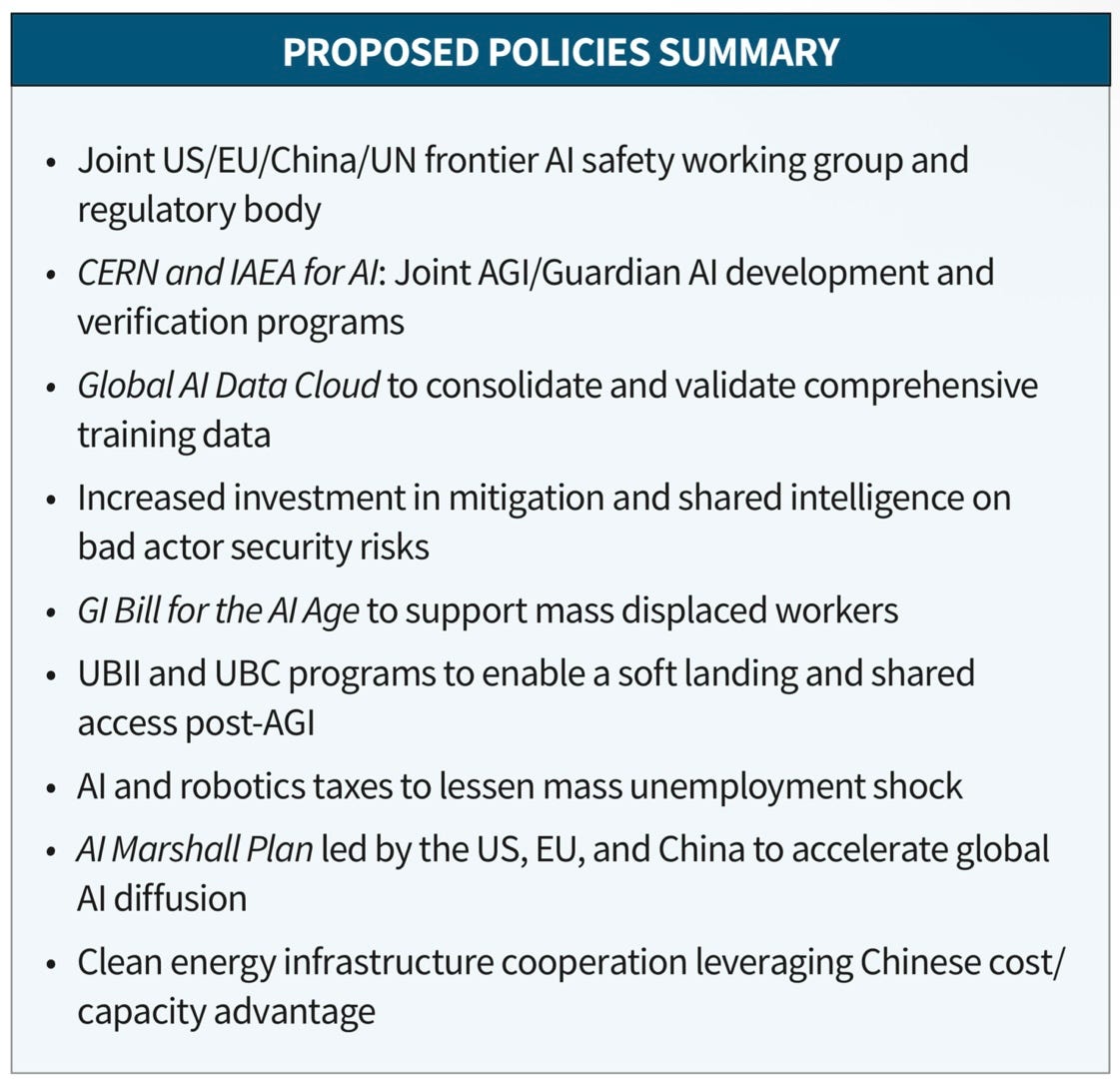
• A dual track approach: cooperate on safety and the public good, compete responsibly elsewhere.
• Build institutions that match the scale of the risk: a joint frontier AI safety working group, verification programs modeled on the spirit of “CERN and IAEA for AI,” and a Global AI Data Cloud so advanced systems are trained and evaluated on globally representative data.
• Focus on the risks that are most relevant right now: near term bad actor and societal misuse dominate long-term alignment fears, so we should fund mitigation and shared intelligence accordingly, and cooperate on a global Guardian AI vs local-optimized Sovereign AIs.
• Prepare for the domestic and global economic shocks: proposals like a GI Bill for the AI Age, Marshall Plan for AI, UBII and UBC style mechanisms, and reskilling at scale to create a soft landing rather than a chaotic transition.
• Treat energy as strategy: clean energy cooperation is not charity; it is the physical substrate for safe AI diffusion and shared prosperity globally.
I am grateful to the Stanford Digital Economy Lab and to the editorial leadership behind this volume, including the faculty editors (Ajay Agrawal, Erik Brynjolfsson, Anton Korinek, Alex “Sandy” Pentland) and Senior Editor Daniel Susskind. I also have deep respect for the other contributors in Volume 2, which brings together voices spanning economics, policy, and technology, including Yoshua Bengio, Eric Schmidt, Joseph Stiglitz, Nick Bostrom, Susan Athey, David Autor, Sarah Friar, Daniela Rus, Steve Jurvetson, and others.
If you care about AI safety, geopolitical stability, and what a workable transition could look like in the real world (not just in theory), I hope you will find time to read the full essay (and the entire volume) and share below what resonates or what you disagree with. If you find the ideas in the essay useful, please share it with others that can benefit from reading it.
Full Essay (free online):
https://www.digitalistpapers.com/vol2/graylin
Full Digitalist Papers Volume 2 (free online):
https://www.digitalistpapers.com/volume2
Physical Copy available on Amazon:
https://a.co/d/6USBjsH

Comments
Nothing yet. Say the first thing.
Sign in to join the conversation.