
Before you read my entry about losing my primary election, sign up for our September Happy Hour on Tuesday 9/15 to brush elbows with folks who actually won theirs! We’re planning something special (TBA), so reserve your spot now.
Losing an election is no fun. (I’ve done it twice now, so I know!) But to paraphrase Tolstoy, every loss is no fun in its own way. Over the last seven weeks, as the city’s dew point has persistently been in “please delete me from this hellscape” territory, I’ve spent a lot of time indoors reflecting on mine.
This isn’t a self-pity-party post. Running for office is a chutzpahdik endeavor, and I’m proud to have done it. Finishing 748 votes out of first place in a race with well over 17,000 ballots cast is nothing to sneeze at, either, even for someone as allergic to the outdoors as I am. Most of all, I’m grateful for the community that came together to support my campaign with their—your!—financial, organizing, and moral support.
That being said, I want to share reflections on the race.
First, though Assembly District 66 is a unique slice of the city—relatively white and affluent, light on DSA presence, heavy on both NIMBYism and density—my learnings can be generalized to how we think about winning elections all over New York. I saw what voters are thinking about, what parts of campaigns swing results, and what bases of power matter at this moment in New York politics.
Second, Catherine and I started Abundance New York in 2024 in part to help candidates like me win elections: driving needed policy change requires more champions in Albany and City Hall. I came up short in my challenge to the incumbent in 2022, inspired by insurgents who won in 2018 and 2020—but also following in the footsteps of pro-housing, pro-transit, pro-growth progressives like Sara Lind and John Sanchez who lost primaries in 2021. We have to confront what it means for Abundance’s power-building strategy if we still can’t reliably elect our preferred candidates.
Third, I know many folks on this email list are thinking of running for office themselves, and that many more are working or volunteering on aligned campaigns. Hopefully this peek behind the curtain will be edifying! And unlike Anna Karenina, we won’t let our frustrated attraction to trains go overboard.
Nancy Pelosi says that the “three Ms” of message, money, and mobilization are the legs of the stool of effective campaigns, and she’s right. A candidate must raise the funds needed to hire a professional staff and consultants, buy digital ads, and send mail to voters. They must activate a real community of supporters to talk to voters face-to-face. And they must have a legible reason for running—an inspiring story to tell.
That was certainly true in my race, where there were six candidates. Three each earned over 21% of the vote; the other three collectively earned less than 21%. All six worked hard, personably engaged voters, and had compelling stories. But money and mobilization split the field in two. The three top-finishing candidates each maxed out on public matching funds, enabling the most competitiveness in supporting mobilization and message amplification—and reflecting the most on-the ground support. We were also the three who earned endorsements from the Democratic Clubs, advocacy groups, unions, elected officials, and others that weigh in on these races.
That institutional support both reflected and enabled money and mobilization. It’s true broadly: think of the key role DSA’s support played in driving the victories of Darializa Avila Chevalier and Claire Valdez. They earned DSA backing because of their deep ties to the organization, and the endorsement then translated into tens of thousands of volunteers knocking on hundreds of thousands of doors. Full coffers and expansive volunteer corps—both inputs and outputs of institutional endorsements—are must-haves to jump from also-ran to true contender.
At the beginning of this month, I went to Washington, D.C., to speak to college students and recent graduates who were participating in the first “Camp Abundance” conference put on by the Abundance Corps (formerly known as Students for Abundance). One young woman hoping to work on campaigns asked what I’ve learned as a campaign manager-turned-candidate about what factors are dispositive. Is it the fundraising, the door knocking, the endorsements? I said that the moment matters most—the fourth M Pelosi doesn’t mention. The campaign you run can be decisive at the margins (and, as my race showed, the margins can be the whole ballgame) but macro factors will set the floor and ceiling for how any given candidate will do.
When I first ran in 2022, I earned strong institutional support, raised more money than my opponent, and knocked on more doors than she did. But my race wasn’t ultimately in toss-up territory. Joe Biden was president, the Covid-era crime spike was still top of mind, and rents were still demand-depressed. It was a moderate moment, and every single incumbent Assembly member in NYC won their primary that year.
This year, outsider candidates surged, and affordability was top of mind. DSA endorsees won all but one of their races, dispatching multiple incumbents along the way. The incumbents ousted in 2026 didn’t all happen to run worse races than the incumbents in 2022, but the electorate had changed: many voters are alienated from establishment Democrats because of Trump 2.0, the war in Gaza, astronomical costs, and more.
Every cycle, there’s a set of races that end up fully determined by the escape velocity of macro forces. Abundance NY endorsee Brad Lander beat incumbent Dan Goldman on this anti-establishment wave while fellow ANY favorite Antonio Reynoso lost to Claire Valdez for the same reason. In this environment, in progressive districts, facing the headwinds of the Mayor’s endorsement, there’s likely nothing at all Reynoso or Goldman could have done to change the outcome. Of course, hindsight is 20/20: you don’t know what moment you’re in until the ballots are counted. But the lesson stands. Most of what determines the outcome of an election is far outside a candidate’s control, and for some races it’s the whole ballgame.
If I raised the most money, earned the most endorsements, and ran in an opportune moment to focus on affordability and democracy, what went wrong? The macro moment will determine what issues are on voters’ minds and will largely dictate which voters will turn out. But if a race doesn’t reach that escape velocity—for example, with an endorsement from an extremely popular mayor in an anti-establishment year—there’s nothing more powerful than hyper-local networks and relationships in dictating who a voter will choose. Especially downballot, street-level support is more important than bigger names and better vibes.
My two main competitors were law professor David Siffert, a former president of the Village Independent Democrats, and district leader Jeannine Kiely, a former president of the Downtown Independent Democrats and CB2 chair. On Election Day, David and I chatted about how the race felt like a three-way toss-up; David observed that it was predictable, because each of us had gotten one of the “big three” institutional endorsements in the district. David and Jeannine had each won their club’s backing, and I got the Working Families Party nod—important progressive validation.
Plenty of politicos predicted I would win. I’d been endorsed by big citywide names beyond the WFP: Comptroller Mark Levine, the Stonewall Democrats, and many important labor unions. After I focused early on getting my message out broadly, including through (excellent!) social videos, many in the political class—including my opponents—perceived me as the frontrunner. That vibe was helpful for fundraising and earning endorsements. (Of course, it also meant being the only candidate drawing attacks.)
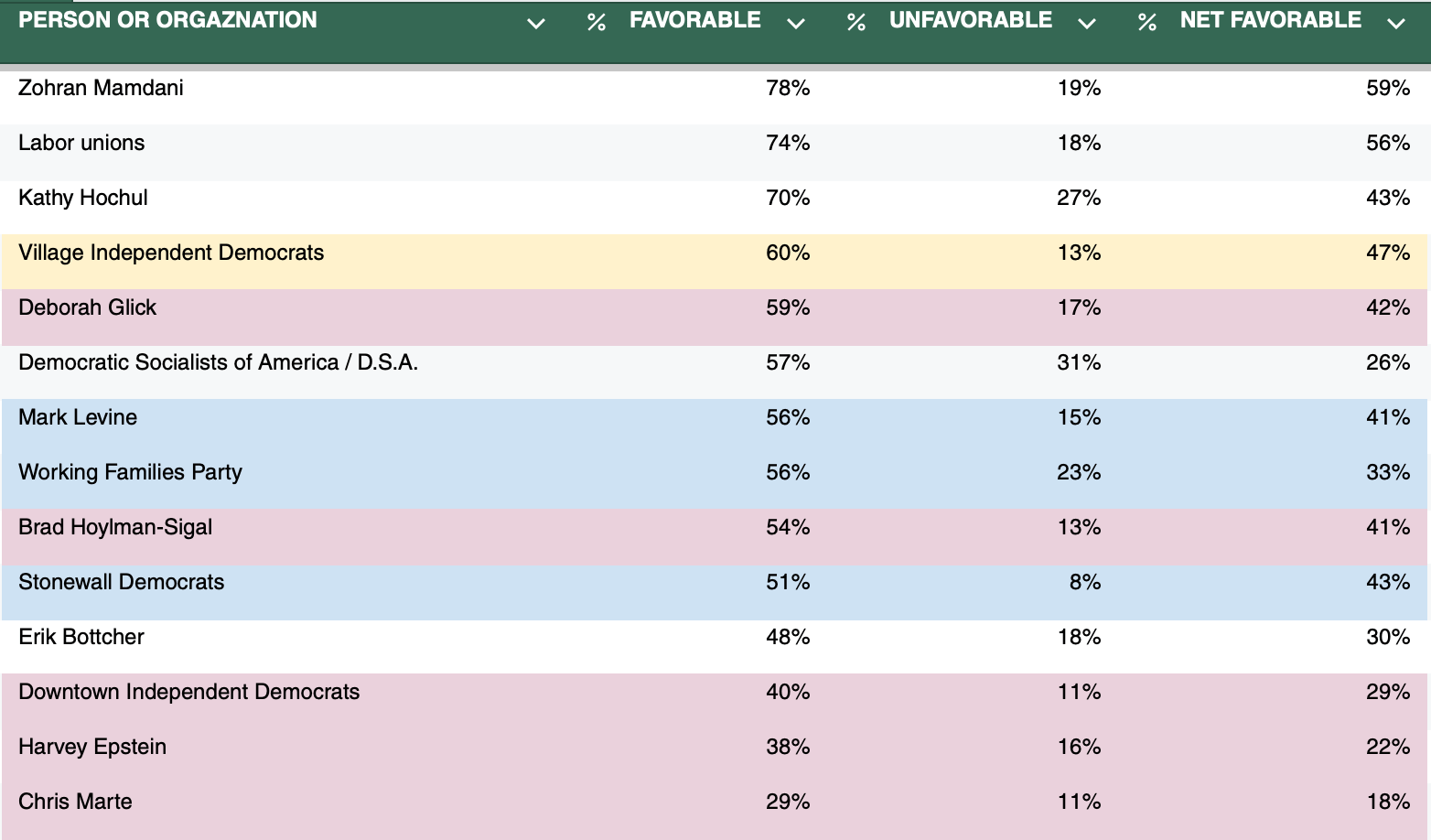
We were never so sure. Early in the race, my campaign had polled the district to learn more about the issues and institutions most important to voters, and many of these validators were roughly equally well-liked. When push came to shove, the more local the validator, the more meaningful the support. It’s not just that my (wonderful) citywide backers like Levine, WFP, Stonewall, and unions didn’t carry quite as much weight as the very local Democratic Clubs and elected officials in moving voters. It’s also that David and Jeannine were able to leverage those clubs and electeds more directly in their voter outreach.
We all knew the real work wasn’t vibe-setting or endorsement-collection: it was reaching the fraction of registered AD66 Democrats who could actually show up in June. My team and volunteers (the best in the business!) knocked over 30,000 doors. We often saw David’s literature in the same buildings: it was clear they and their team were pounding the pavement hard, too. Jeannine’s team sent the most mail, getting her message in front of the electorate in the broadest sweep. While less active on the doors, her complementary relational organizing—activating deeply formed and long-cultivated networks of supporters throughout the district—clearly did its work. I spent all day every day talking to voters at their doors and on the streets, but I ultimately couldn’t penetrate trusted networks the way the club leaders could.
Perhaps no race tells this tale more than the NY12 one to succeed Jerry Nadler. Big personalities like George Conway and Jack Schlossberg got headlines, but Micah Lasher got the votes. Alex Bores was endorsed by more elected officials, but Lasher was endorsed by the ones who mattered—the ones representing the district. Further, he was deeply known and trusted in hyper-local circles across the district. Indeed, the fewer social followers the candidate had, the better they did on Election Day.
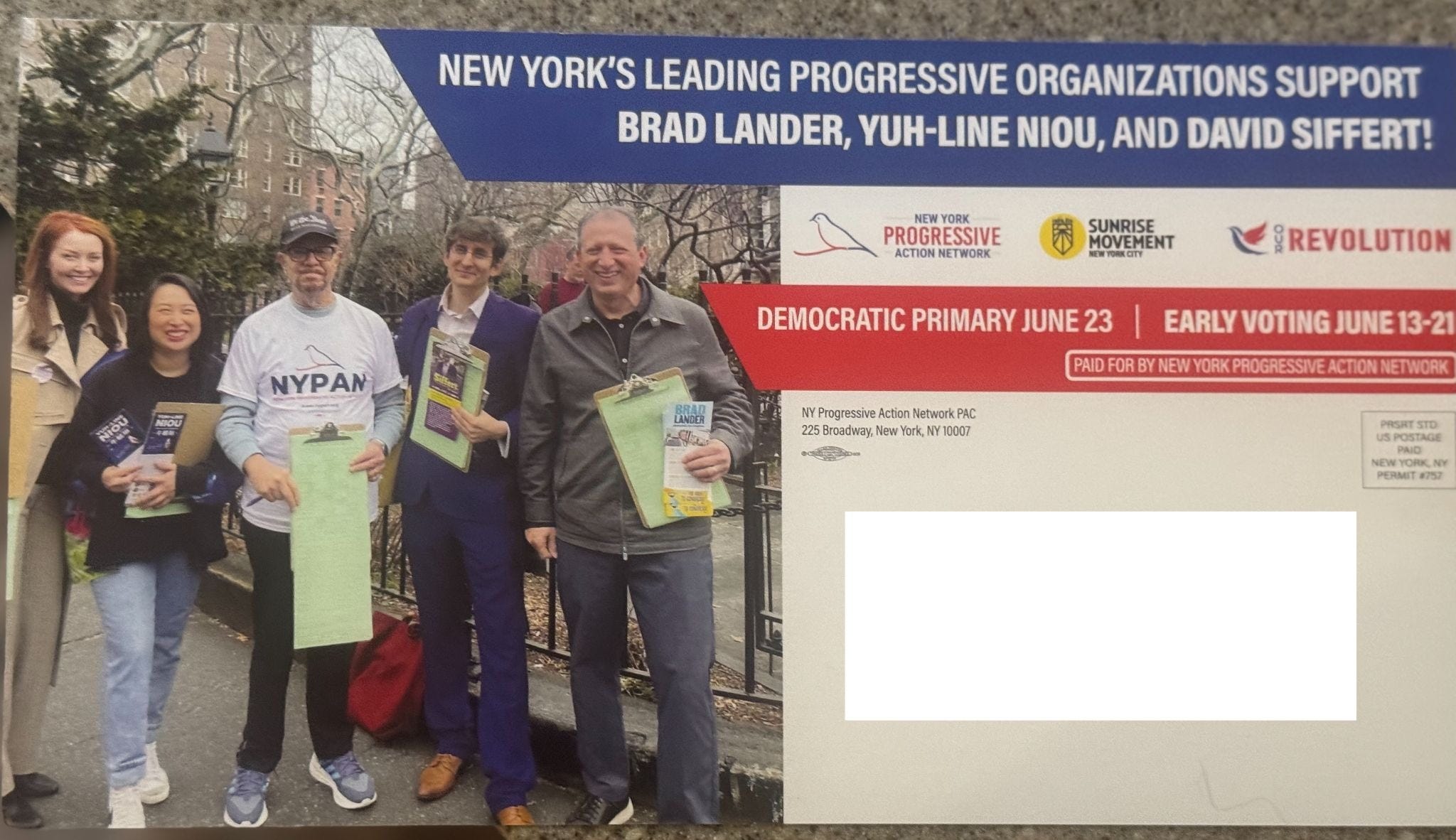
Ultimately, David Siffert won an incredibly close election with 4,388 votes to Jeannine Kiely’s 4,373 votes and my 3,641 votes. David and I ran well in the same neighborhoods, each vying for progressive voters dissatisfied with the status quo. I had the same problem as Antonio Reynoso in his race against Claire Valdez: I was the Working Families Party endorsee, but I didn’t own the left lane outright. Anti-establishment voters looking to reject the incumbent’s chosen successor had two good options. David could read as a lefty outsider to these voters, having received institutional backing from notable progressive organizations like the Sunrise Movement, NYPAN, Our Revolution, and the Jim Owles Liberal Democratic Club, as well as DSA-aligned legislators like Jabari Brisport and Emily Gallagher.
As we’ve discussed before, “Abundance” isn’t an electoral lane in itself. As was true in 2022, I was running in the left lane of my race, which I thought would be enough for first place in a six-way field. Earning endorsements from the WFP, many of its affiliates, and progressive elected officials was key. However, many voters in June 2026 were simply looking for the farthest-left option to express their anti-establishment energy—which wasn’t always the WFP. Electoral “lanes” still rule the day in how voters conceive of Democratic primary candidates; this year, many were looking for the farthest left one.
When AD66 primary voters came to the polls to vote for Brad Lander—or otherwise express their anti-establishment energy—they had a legitimate choice between me (on the same WFP slate as Brad) and David (on the same NYPAN slate). Indeed, David’s endorsers might have coded as being even further left than mine, especially since I also had the support of a broader coalition of less-lefty elected officials and organizations. David’s Village Independent Democrats high-turnout voters combined with their younger, further-left voters equaled a winning coalition.
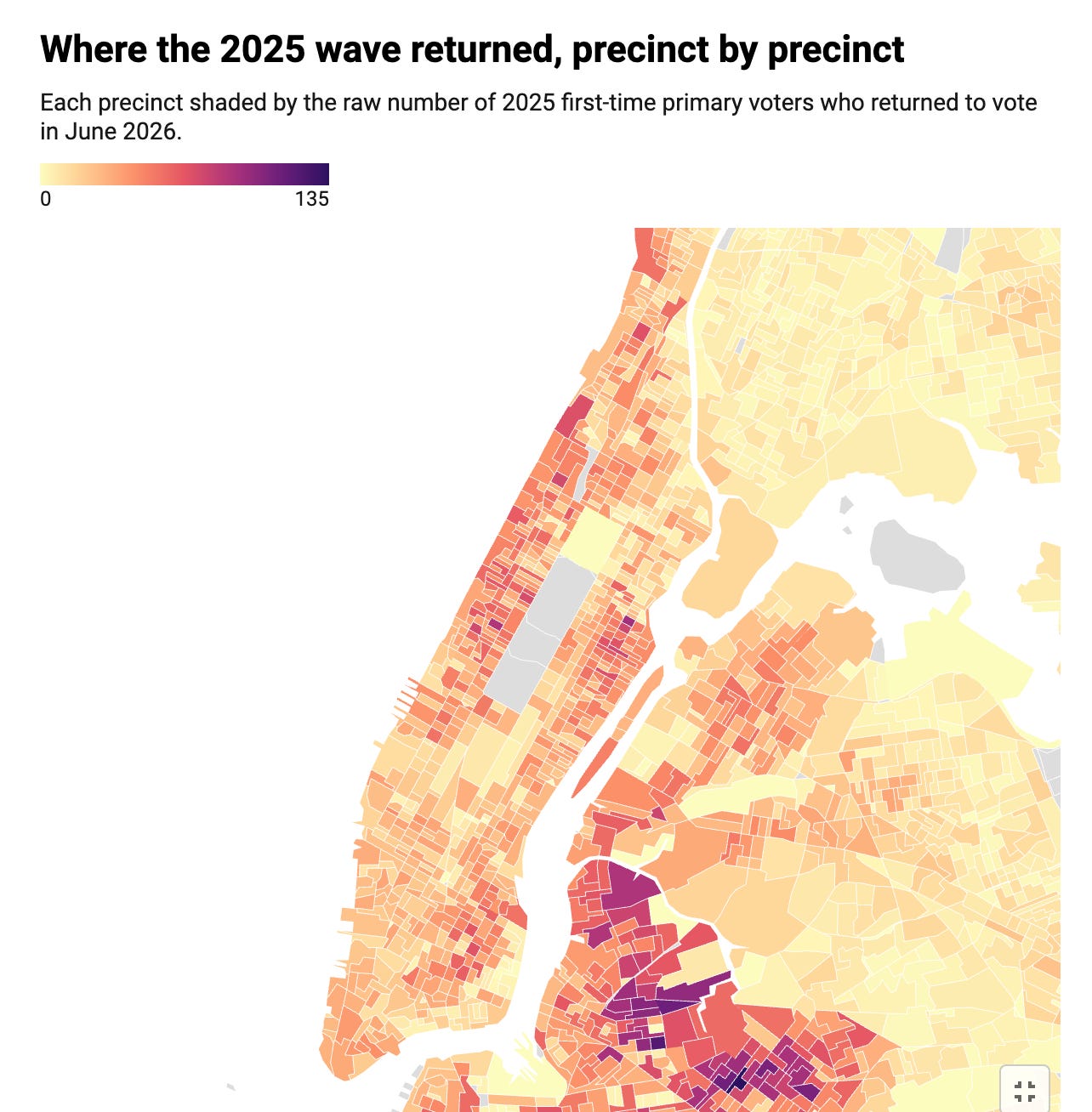
Even if I disproportionately won lefty voters given the power of the WFP brand in a race with no DSA candidate, there simply weren’t as many of those voters as we’d hoped. My campaign predicted turnout in the 18,000-20,000 range. We thought the usual (older, more affluent) suspects who always vote in primaries would come out; but we also projected that a portion of newly activated voters in their 20s and 30s would return after voting in the 2025 mayoral primary and general. With turnout closer to 17,000, it was that younger group that didn’t materialize, whereas the DID and VID voters did. Indeed, our district had some of the lowest “wave returner” rates in Manhattan.
Finally, there’s the elephant in the room: Abundance. Pro-housing politics in particular still code “moderate” to many voters. Local leaders were sure to make the case that YIMBYism was more than moderate—it was corporate, and it was dangerous. For example, Arthur Schwartz, a District Leader and longtime progressive activist in the Village, wrote a long editorial in his Village View newspaper—distributed for free to building lobbies throughout the district—calling me a “fake progressive” real estate candidate. Schwartz suggested David was the real progressive choice instead and backed David in the NYPAN and Jim Owles endorsement processes, though he officially endorsed Jeannine in the race.
I attempted to remind progressive voters that my support for pro-housing measures like the 2025 charter amendments, the City of Yes for Housing Opportunity rezoning, and Haven Green were positions shared by Brad Lander and Zohran Mamdani—and opposed by all my opponents. My endorsements from pro-housing progressive champions like Chi Ossé helped. However, YIMBYism doesn’t feel progressive to many voters who are still skeptical of developers.
That imbalance persists even though the Abundance movement has clearly succeeded in generating an electoral imperative to address skyrocketing rents. Both Jeannine and David centered housing affordability in their campaigns (though David explicitly rejected the role of market-rate housing development in ameliorating lower Manhattan housing costs). Jeannine even wrote in an ad that she was “running to tackle our housing supply crisis head-on.” She expressed openness to regional upzonings and other pro-housing measures in questionnaires.
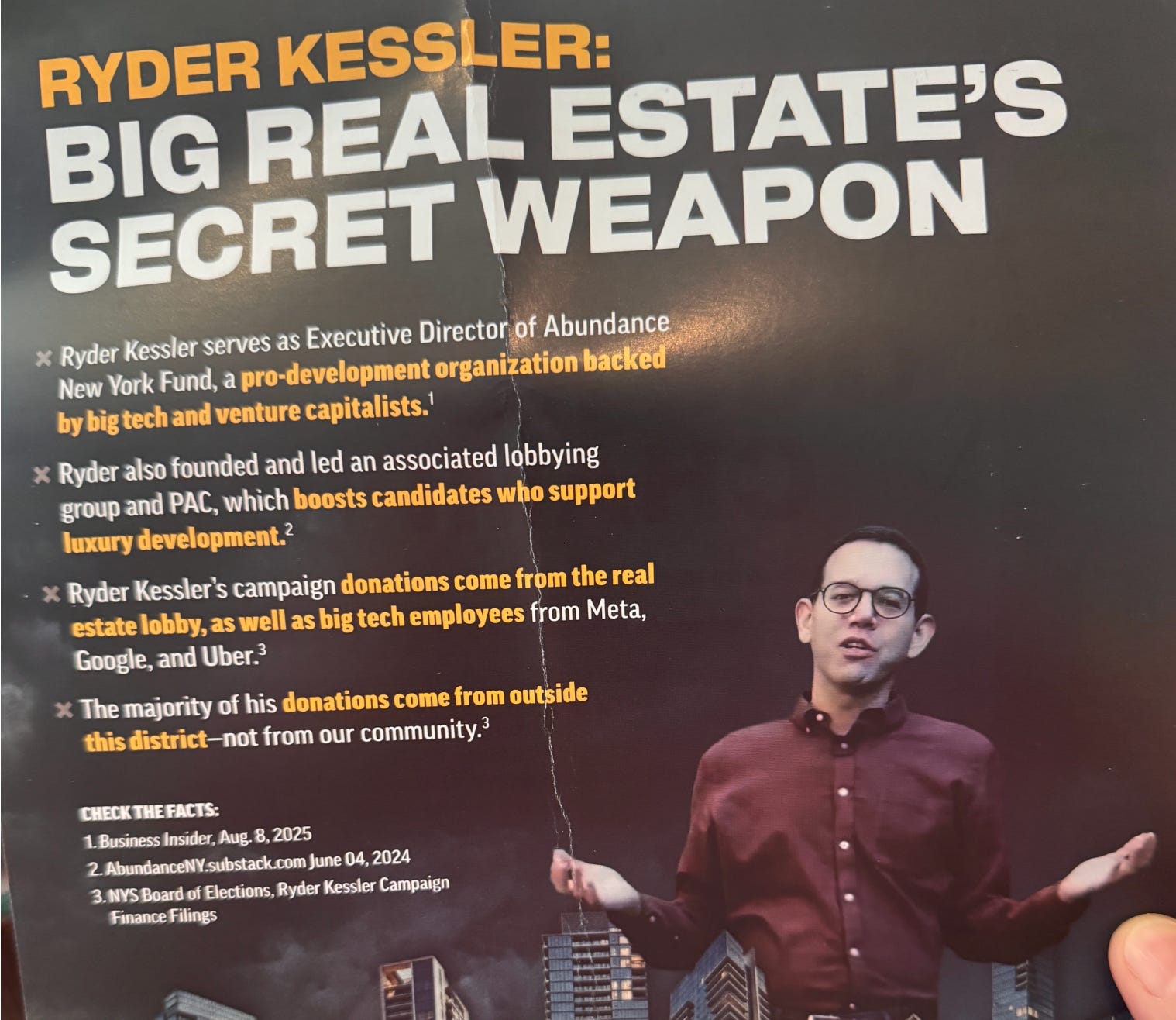
However, that didn’t mean embracing Abundance altogether. Kiely’s campaign sent out one mailer calling me “Big Real Estate’s Secret Weapon,” and another quoting Schwartz’s Village View article calling me the “pro-development Assemblyman.” And the Downtown Independent Democrats wrote in their mailer to members that I was a “honcho in a pro-developer lobbying group,” leading off with their argument about why not to vote for me rather than about why to support their endorsee.
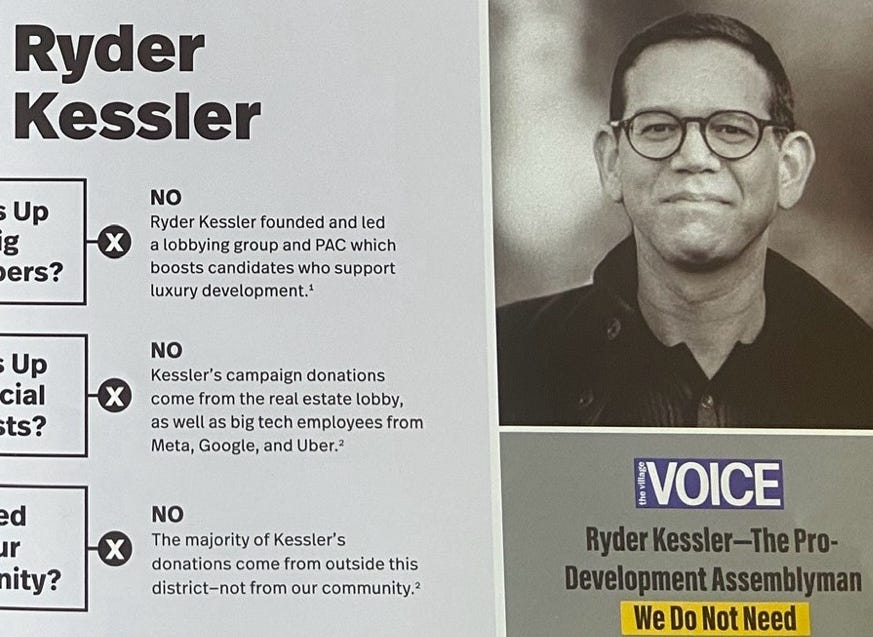

Zooming out, it’s still clear that pro-housing politics are confusing to voters—and that there’s often an electoral incentive to run away from them. During the campaign, Claire Valdez hit Reynoso for his “big real estate” ties. Brad Lander backtracked on his support for the Brooklyn Marine Terminal plan in attempting to differentiate from Dan Goldman. Alex Bores equivocated on the need for Fulton and Elliott-Chelsea redevelopment to provide new homes for NYCHA residents. All Abundance champions—including Mayor Mamdani and his allies—would benefit from doing more work to highlight the essential conservatism of NIMBY politics and the progressivism of meeting the material needs of marginalized communities.
Over the last two years, Abundance NY has endorsed legislative and executive candidates for city and state offices, as well as the charter amendments on city ballots last November. The majority of our endorsees won their elections, and that includes some of our strongest citywide voices—not least Mayor Mamdani, Comptroller Levine, and future congressmen like Micah Lasher and Brad Lander. We made some bolder bets on Abundance all-stars like Keith Powers, Jess Coleman, Sarah Batchu, and Ben Wetzler (and me!), which didn’t pan out. And though our voter guide’s recommendations have been seen by hundreds of thousands of New Yorkers and our PAC has generated hundreds of thousands of dollars for candidates, it’s not clear how decisive our support is when we are indeed aligned with the winners.
We’re not leaving electoral politics behind, especially as we keep building our bench and building our community’s power. However, we’re thinking about how to best advance our mission over the coming two years—two years very light on elections.
Here are a few things we’re thinking. (We welcome your feedback!)
Our next big opportunity to elect our preferred candidates in critical legislative primaries will be in June 2028. Until then, our focus will be on building relationships with policymakers: legislators and executives, their staffers at the city and state level, policy advocates, think tankers, business leaders, and others who help set the agenda for New York. We’ll be arming them with the ideas they need to make it easier, faster, and cheaper to build what New Yorkers need to thrive (a la our Abundance Agenda), and we’ll be providing backing to help them make those ideas a reality. As I wrote in my recent Daily News op-ed, electoral lanes are less important than where they lead. Thanks in large part to the work of this organization and community, more and more leaders from Mayor Mamdani to Governor Hochul are governing on Abundance ideas.
Of course, there are still important votes where New Yorkers are looking for guidance, and where we have a comparative advantage to inform them. This November, most of the state legislative and statewide races will be faits accomplis based on the primary winners; however, the COGE ballot propositions may be contested. We’ll be publishing a general election Voter Guide that advises New Yorkers on how to think about their five ballot questions. As we learned last year, these ballot props are confusing, good information is hard to come by, and these votes can be far more impactful at delivering new homes, better transit, and climate action than electing any individual candidate would be. The Voter Guide is just one part of our work to arm New Yorkers with clarifying, motivating information about the political and policy fights we’re facing between elections. We’re excited to double down on high-quality content and events.
This year, NYC-DSA surpassed 15,000 dues-paying members, and they reported knocking on hundreds of thousands of doors. That’s not where Abundance NY is at—yet. However, we want to keep growing our constituency, and we want to help our community’s leaders take and use their power. Over the next two years, that mostly won’t be through door knocking. Instead, it may be through joining a community board or an elected official’s staff, becoming an urbanist influencer, or prepping a run for office down the line. As we iterate on our community programming, we’ll be focusing on cultivating Abundance leaders and connecting them with opportunities to grow. Next year, term limits for Community Boards kick in and many District Leaders are up for election. In 2028, the state legislature is again on the ballot. In 2029, most of the City Council will be termed out. There’s plenty more work to do, and we can’t wait to help you shape New York’s future for the better.
No posts
Comments
Nothing yet. Say the first thing.
Sign in to join the conversation.