
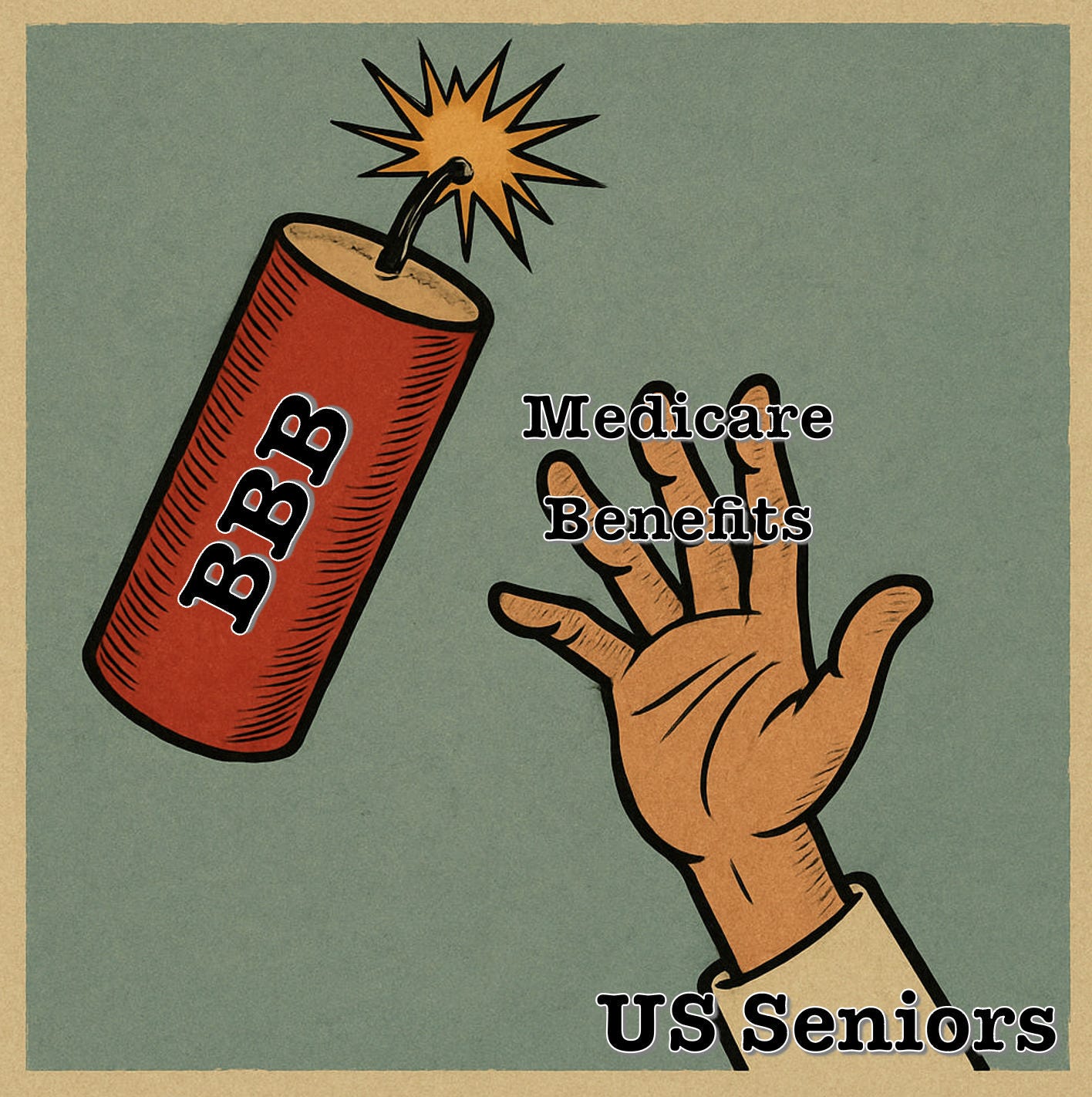
The One Big Beautiful Bill (BBB) just dropped onto the President’s desk, and here is what it was promised to do to Medicare in the US:
…but, that is not the case.
This was a politically wise promise to make, given that Medicare is a perpetual sacred cow -covering comprehensive healthcare costs for America’s seniors, a majority of whom are financially vulnerable, and all of whom are medically vulnerable. Trump specifically promised that Medicare would not be touched in his signature legislative effort. He even posted as much on the official website of the White House -which can only be read in English since the Spanish version was eliminated hours after he took office to thank the efforts made by Latinos for Trump in getting him elected.
I am not going to cover anything about the BBB other than its implications for Medicare because it is MASSIVE, but I shouldn’t be able to write anything at all about Medicare since it was explicitly guaranteed protection.
Truth is often stranger than fiction -particularly when truth is concealed by fiction. Consider that this is a bill that was so bad that Lisa Murkowski needed special guarantees that her own constituents in Alaska would be protected from it in order for her to vote “yes,” so the rest of us schmucks in the other 49 states could suffer under it -a masterclass in mercenary politics that the confederacy would be proud of!
Senior citizens are the demographic most interested in preserving socialism in the form of Medicare, and are also the demographic most opposed to expanding Medicare access, indicating that seniors value Medicare so much that they don’t want to risk surrendering even a fraction of their entitlements to younger enrollees who would still have to buy in -socialism for me, but not for thee. Seniors are also the demographic most in favor of electing Trump into office in 2024 (since they account for slightly more than 50% of those who identify as MAGA), and as such we can assume that they were also the most in favor of passing the BBB -since it is inarguably the capstone of MAGA legislation.
Let’s see how well those particular political interests mesh in reality now that the bill will become law.
Your Medicare will be touched the same way your creepy uncle always wanted to touch you (via sequestration) because both fly under the radar despite the trauma they bring:
The BBB adds roughly $3.3 trillion to the deficit, so the Statutory Pay-As-You-Go (PAYGO) Act triggers across-the-board cuts -including to Medicare. This will be to the tune of roughly $500 billion in Medicare cuts over the next ten years, beginning in FY 2026 (October 1, 2025), with an initial OMB sequestration order of about $330 billion in mandatory cuts by January 2026.
These cuts are to Medicare providers: physicians, nurses, hospitals, and purveyors of drugs and supplies. Basically everything that one might construe as healthcare. So while Medicare patients will not see a change in deductibles, copays, and covered services on paper, they will see diminished reimbursement translate into narrowed availability of care via reduced overall appointment availability in hospitals and clinics, as well as longer ER waits (people seek inappropriate ER care when they can’t see their regular doctor). Sustained payment cuts will force many physicians, hospitals, and suppliers to not accept Medicare in order to keep the lights on, which will dramatically thin networks and force beneficiaries to travel farther and wait longer for care.
The timeline of cuts is important specifically because it indicates that your elected officials were all well aware that this bill would drastically reduce Medicare benefits, and that they have worked very hard to conceal that fact from you, the beneficiary, so that they could maximize their chances of being re-elected in 2026. What you don’t know can hurt you, but if you don’t know -it hurts your representatives less, and they aren’t about to miss out on the gravy train of being a Senator or a Congressman in service of themselves. Better by far to vote against their people’s best interests and hope they forget. And they just might, but I don’t want them to. So keep reading.
Downstream effects of sequestration cuts are devastating, including:
Section 71111 of the BBB imposes a 10-year freeze on CMS’s yet to be implemented, minimum-nurse-staffing rules for skilled-nursing and long-term-care facilities under Medicare and Medicaid. This is ghoulish, because CMS already established that having too many patients per nurse is a bad thing for the patients, but the BBB said, “yeah, but that’s too expensive, so let’s just stick with having way too few nurses for the next decade.” Enjoy dying alone in a nursing home, because your call light will almost certainly go unanswered in your final moments. Your nurse is BUSY.
Section 71101 blocks CMS’s rule to expand and simplify Medicare Savings Plan (MSP) eligibility, eliminating access to assistance with Part B premiums. 1.3 million low-income Medicare enrollees will now lose MSP help with premiums and coinsurance, leading to higher out-of-pocket costs. For example, a dual-eligible senior earning $967 monthly will see their Medicare Part B premium jump to $185 per month (about 20% of their income) on top of full cost-sharing obligations. Another example of the BBB neglecting to act upon CMS rules that were implemented to help Medicare recipients survive, but I guess they don’t count because they are poor, and perhaps playing too many video games in their (presumably dead) parents’ basement instead of being gainfully employed in their 8th decade of life.
Effective January 1, 2028 (so that your representatives can maximize their odds of re-election if you aren’t paying attention), section 71203 expands exemptions of “orphan drugs” from Medicare Part D negotiation, shielding high-cost therapies from price limits. This means that Medicare beneficiaries who are unlucky enough to contract a disease that requires niche therapy, will continue paying full price plus 25% coinsurance, rather than benefiting from lower, government-negotiated rates. In test marketing, “Section 71203” polled more favorably than “if you have a kind-of-rare disease, fuck you and God Bless America.”
Because Pharma is also not your friend, annual costs for specialty drugs will soar into the tens of thousands in the absence of effective regulatory caps, and the BBB unilaterally eliminates those caps. Open your wallet, or open your casket in order to Make America Financially Healthy Again, because the federal government is positively BEGGING for another Martin Shkreli in this line item.
Just in case anyone is wondering, drugs classified by the FDA as orphans, which are to be excluded from discounts include those that treat certain kinds of leukemia, multiple myeloma, lymphoma, pancreatic cancer, myelodysplastic syndromes, pulmonary fibrosis, pulmonary hypertension, myelofibrosis, and many other diseases -ALL of which are more likely to strike people 65 years of age and older. So don’t feel like this can’t happen to you as a Medicare beneficiary -what is uncommon in the population overall, is surprisingly common for you in old age.
In the midst of a nationwide shortage of physicians projected to last well past 2036, BBB-induced sequestration cuts to Medicare will reduce the number of residency training positions available to mint them at pre-2025 numbers -because residencies are funded primarily by Medicare and Medicaid dollars. So now that shortfall will be deeper and longer as the Boomers age and require more services from physicians. Awesome, right? It gets better: residents are basically slave labor, providing services that generate hundreds of thousands of dollars of revenue per resident for their hospital while working at wages below entry level jobs at Walmart. A smart politician would have included a clause to increase funding for their training, as it would have killed three birds with one stone: grow the availability of low-cost high-skill medical labor, reduce physician shortfalls, and meet the increased demands from Medicare beneficiaries. Too bad we don’t have any smart politicians.
Section 71201 bars most non-citizen beneficiaries (except certain Cubans/Haitians and COFA migrants) from enrolling or remaining in Medicare. Somewhere in January of 2027, this will strip coverage from everyone -new or already in the program, even enrollees who made decades of prior payroll-tax contributions. Naturalization will save you from taking on 100% out of pocket costs, but that process takes 5 years to complete, which will leave a 3 year gap in coverage for those who haven’t started working on it yet. This will not concern most MAGA-folk (because even asylum-seekers are now undeserving of medical attention in the nation of immigrants), but this change will unavoidably add to the bad debt of providers and hospitals across the land when people who used to be insured seek emergency care as new members of the uninsured.
Speaking of hospitals -yours may not survive:
About 40 million Americans -roughly 12% of the population, receive some or most of their care in rural hospitals, which rely most heavily on Medicare’s cost-based reimbursement and on Medicaid matching dollars to stay afloat. Both sources are directly strangled by the OBBB. Up until now, rural hospitals were reimbursed at 101% of their allowable costs, giving them a 1% margin to work with. The mandatory medicare sequestration cuts mentioned earlier will require all Medicare provider payments to be cut by 2-4 percent beginning October 1, 2025. Rural hospitals will then receive 97-99% reimbursement from then on, erasing the small cushion that cost‐based reimbursement was designed to provide. Most rural hospitals operate at break-even or slight loss margins prior to the BBB, so these cuts are a direct reduction in operating revenue. State-administered Medicaid payments are also set to drop by $20–30 billion annually in matching funds by 2031, which will further erode rural hospital revenues over the next 5–10 years.
Rural hospitals were already stressed prior to this legislation: over 200 closed in the last two decades, and 700 more are on the precipice. Even if you don’t think you would ever go to one, its often the closest source of emergency care when you are traveling, and every second counts when you are find yourself in need of emergency medical services.
The other 88% of the country relies on large hospitals in urban and suburban areas, and guess what? They are also getting squeezed in all the same ways. A combined cut on Medicare plus billions lost in Medicaid matches and Disproportionate Share Hospital payments will push many large hospitals below break-even, leading to layoffs, reduced hours, delayed upgrades, and as a result -poorer care. To offset revenue losses, hospitals will raise uninsured and out-of-pocket charges, shifting additional costs onto privately insured and self-pay patients. You may think that will spare Medicare patients the pain of decline, but you would be wrong. Closures of low-margin service-lines (like… trauma care, which is kind of important) in suburban and urban hospitals will increase travel and wait times, undermining quality for all.
I know I said I wasn’t going to mention Medicaid, but it just so happens that it also helps keep the lights on in hospitals that Medicare patients go to as well.
In full transparency, the BBB does have a few measures that increase medicare reimbursement, namely a small and temporary raise for physicians and directed allotments to hospitals, but that’s it -and neither measure comes close to offsetting the damage done as outlined above. Overall, the BBB’s deep revenue cuts, stacked upon existing margin pressures, threaten the financial health of hospital systems large and small, forcing reductions in service capacity, staffing, outcomes, and affordability.
Does Sacred Cow taste like chicken, or is that just the residual stench of cowardly politician?
In a political display of something that was either grossly incompetent or overtly malicious to citizens (but entirely consistent with the administration’s performance over the last six months), American seniors can now patriotically enjoy global reductions in services offered, quality of care, access to care, and access to medicines and medical supplies through the once sacred cow that was Medicare, courtesy of the Big Beautiful Bill and the elected officials who knowingly made it possible.
Obviously the electorate shares some responsibility in this as well, since their own laser-focused self-interest demanded cuts that were both ham-handed and arbitrarily rushed. But it does teach us that whenever the self-interest of the electorate conflicts with the self-interest of politicians -politicians win and citizens lose, each and every time. While I hope that this can be undone at some point prior to my own need of Medicare, I am not an optimist at heart. Nothing will stop sequestration short of enacting $3.3 trillion in budget cuts and/or new taxes in the next 6 months. Not going to happen.
So be careful with fireworks next year, because hand and eye surgeries are expensive, and you may not find a place to have it done on Medicare, assuming you can even afford it.
Happy Independence from Medicare Benefits Day!
No posts
Comments
Nothing yet. Say the first thing.
Sign in to join the conversation.