

David Frum’s new Atlantic piece, “The ‘Resistance’ Is Over,” makes a confident claim: Democratic primary voters have gotten bored with Trump and are indulging in “factional politics” instead, putting winnable Senate seats at risk. It’s a well-written piece. It’s also a piece that requires Frum to miss the point he understands perfectly well, in order to land a point he wants to make.
Missing the point isn’t always an accident of confusion. Sometimes it’s a choice, made by someone smart enough to know better, because the real version of the argument is harder to beat than the one they’d rather answer.
That’s what’s happening in this piece.
After several paragraphs setting up his thesis, Frum writes: “That agenda seems to argue as follows,” and then presents a block-quoted paragraph, styled like testimony, in which the “insurgent left” supposedly declares that Trump’s attacks on democracy are “mere symptoms of a disease, not the disease itself” and that they’d rather “risk losing than ‘win’ on Schumer’s terms.”
No Democratic primary voter said that. No candidate said that. Frum wrote it; he composed it, in italics, shaped like a quotation, specifically so he could argue against it:
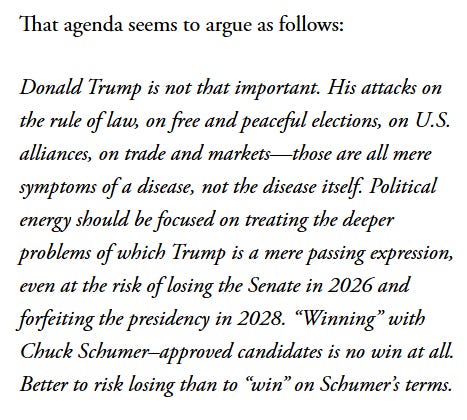
That’s not summarizing a position and then critiquing it. That’s manufacturing the position to have something beatable to critique.
A real strawman doesn’t look evasive; it looks like engagement. That’s exactly what makes it effective, and exactly what makes it worth calling out.
The entire piece runs on an assumption Frum never actually argues for: that there was a coalition: establishment leadership picks electable candidates, the base falls in line, everyone beats Trump together, and the “insurgent” left is now reneging on it. He doesn’t build that premise [because it’s faulty]; he just asserts it structurally, treating every “insurgent” primary win as leadership’s plan getting sabotaged:
“Democratic leaders—the dreaded ‘Establishment’—have promoted highly plausible candidates for statewide office in North Carolina, Texas, and other suddenly competitive states. But the insurgent left has again and again upset leadership plans with high-risk choices to serve its own factional agenda.”
“Upset leadership plans” does a lot of work in that sentence.
It frames voters [and candidates] as saboteurs of an agreement they never signed, rather than as people who simply voted for someone else, which is, notably, what primaries are for.
What it requires Frum to skip past is something he knows as well as anyone who’s covered American politics for decades: all politics is local.
He strings together Florida, Michigan, Maine, Texas, and North Carolina as if they’re chapters of one national story — a unified “far-left agenda” steamrolling the party — when primaries are famously idiosyncratic. Different electorates, different local grievances, different candidate quality, different histories in each state.
Nate Silver’s one-line vibe check about a rough stretch for “Heroes of the Resistance 1.0” becomes, in Frum’s hands, a verdict on the whole party’s priorities, rather than what it actually is: a handful of separate races getting reduced to a trend because the trend is more useful to the argument than the races are.
Frum’s real thesis is that Democratic voters are “bored” with Trump; that they’ve moved on to factional squabbling because the resistance, like a fashion trend, is simply “out.”
His best piece of evidence is the Florida Senate primary, where Democrats chose Angie Nixon, who ran as an explicit socialist, over Alex Vindman, the former national security official who blew the whistle on Trump’s 2019 attempt to pressure Ukraine into fabricating dirt on Joe Biden.
Frum’s read: voters picked the socialist over the whistleblower, so they must not care about Trump anymore. What he doesn’t ask is the more obvious question: whether Vindman read to primary voters as an institutionalist whose entire brand is inside a political establishment they’re furious isn’t fighting hard enough.
That’s not evidence of Trump-fatigue. It’s evidence of establishment-fatigue caused by Trump; Trump is the first domino, not a spent one.
Voters watch a Democratic leadership that holds office, issues statements, and produces no visible, unified plan for actually stopping him or recovering from him, and they conclude (not unreasonably) that voting for the person leadership didn’t pick is the only lever they have left, and better yet, voting for someone who has fought for community in their own backyards.
That’s not indifference to Trump. It’s a verdict on the people claiming to resist him.
Frum’s version treats these as separate stories: apathy toward Trump on one hand, factional infighting on the other. But the more coherent explanation is that they’re the same story: the “insurgent” vote isn’t a distraction from the fight against Trump, it’s a response to the sense that the fight isn’t being fought.
What makes the piece worth taking apart isn’t its data; it’s its architecture. A writer with Frum’s experience knows the difference between “the base doesn’t care about Trump” and “the base doesn’t trust leadership’s plan for Trump or after him.”
Forcing the second into the first is a choice, and it’s a choice that happens to produce a much more convenient villain: an ungrateful, self-indulgent left, rather than a leadership class that has failed to give voters a reason to believe in its strategy.
A sincere misunderstanding can be corrected; you clarify, they update. A strategic one can’t, because accuracy was never the goal, building reader understanding was never the goal, and helping the establishment understand why their candidates are losing wasn’t the goal either.
David Frum simply chose to miss the point, to make his own intellectually dishonest and biased claims about why people are voting for Black women and Muslims (and by extension the ‘sus’ intentions of said candidates whom he describes as “insurgents,” as if they are terrorists), instead of the fall-in-line candidates the establishment Dems want to protect.
Missing the point is a strategy for people who understand the point too well to argue with it honestly.
David Frum knows the difference; he is just betting he won’t get checked on it.
Comments
Nothing yet. Say the first thing.
Sign in to join the conversation.