
*Photos and story are shared with permission. Names are changed. Special thanks to friends Norma, Ana and Christa for contributing their efforts, work and presence to assist Belinda. Gratitude to all the friends who sent support from near and far.
Holding Belinda’s Choices (Part 4 of 4)
This is a hard story to tell the end of. When things go differently than planned, I fear that people will judge my efforts as an advocate to be ineffective—or be deterred, themselves, from helping strangers on the street.
But the only way I know how to process it, and to honor your trust, is by sharing the entire truth.
The collective heart and effort of my community poured into helping Belinda, an elder woman too sick to work and unable to afford rent, off the streets, as she requested. She wanted to reunite with her family and go home. I rented a room for her in a budget motel while my friends and I worked to locate her father, Dwayne. He drove down from Kansas, excited to drive her back to the rural family land. Their reunion was full of palpable love, joy and positivity. At the end of the evening, I slipped Dwayne $400 donated by my friends.
“Here’s $100 for gas, $100 for a motel on the way back, and the rest to get Belinda what she needs,” I said. After dinner, I left them at the motel to get a good night’s sleep before they headed out early.
The next morning when I got to the motel, ready for the bon voyage, Dwayne met me in the parking lot.
“I honestly don’t understand what’s going on,” he said. “There’s been a lot of chaos all night long.” His face was confused. My heart fell.
“Tell me,” I said. “What happened? Can I help?”
“She won’t come out of the bathroom since about four in the morning. It’s been crazy. I’ve got to get back to Kansas before the storm comes in,” he said, “but she won’t talk to me and she won’t come out.”
Dwayne said she stayed up all night long locked in the tiny motel bathroom, peeling the laminate veneer off the bathroom door in strips. She played loud music on the radio and Dwayne couldn’t sleep all night. She came out and got on top of one of the hotel room’s queen beds and jumped like a little kid. The leg broke the leg off the bed. It collapsed and she ran back into the bathroom and locked the door again.
Overnight, it seemed, Belinda had become unsure about going to Kansas. This was her right. The choice was hers.
Dwayne left for some air and got locked out of the room. I went to the front desk and got another key card.
“Let’s go see what’s happening,” he said.
I walked into the hotel room and heard her in the bathroom, banging on something. The radio was on loud static. “Belinda, are you in there?” I called out. She didn’t answer. The room was filled with the scent of bleach and cigarettes.
“Are you ready to go? Your dad has to go because of the storm.”
“Stop rushing me!” she yelled. “There’s no reason to rush me, dammit!” She yelled so loud and long I imagined it hurt her throat.
Dwayne and I waited a long while, then walked outside the hotel room to talk.
“Can you stay another night or two if I extend the hotel room?” I asked. “Maybe she needs more time to work out her feelings. Maybe it can’t happen overnight. Could you wait out the storm? This is her chance and she asked to go back to Kansas so many times. I think she might be scared."
“I don’t think I can take care of her,” he said. “I’m 85, I can barely take care of myself.”
“Is there anyone else who can help you take care of her there?”
“Not one soul,” he said, cracking a sad smile. “We are sixteen miles from the nearest gas station. My son burned down the house so I’m living in the trailer and cooking on a barbecue. I had to cut the water off because they charge you even if you don’t use it. I fill up my water jugs in town at the Y when I go there to shower and they last me all week long. I don’t have a lot extra for her. I was going to insulate and build out the Fifth Wheel trailer for her but that’s going to take some time.”
“Do you want to stay in touch with her?”
“Well, yes, I do. She’s my little girl and I never left her behind. I’ll call her and send her a little bit whenever I can. I have to go now otherwise I’ll be driving in the blizzard and I can’t see right,” he said.
“I’ll keep her service on,” I said.
Dwayne wanted to help. He tried to help. And he had to get back in his car and drive away. It cracked my heart, though I’m not supposed to be attached to outcomes when working with people.
Belinda wanted a way to get back to Kansas. But when the opportunity was right there in front of her, she chose not to take it. She responded with avoidance, maybe rooted in fear and trauma. This was her choice and it had to be honored. Perhaps hiding in the bathroom was a kind of self-preservation. Maybe it was her wisdom at work.
I went back in the hotel room and waited for Belinda to come out. She was wearing severe, haphazard makeup and my friend’s old hand-knit hat. “Belinda, your daddy said he had to go, he couldn’t wait on you any longer because of the snowstorm coming. I’m so sorry.”
Then she spoke her reason: “I can’t go home with my daddy because if I am with him, I have to put my mind into his. His mind will take over my mind. I won’t be able to keep my own mind.”
She burst into tears, gasping between her sobs. I hugged her and my shoulder got wet.
I understood. She asked for this, but also didn’t want it. Even though she is unhoused here, she feels safer here. Aloneness is the safest feeling for many people. When the mind is unsteady, proximity to a person’s mind can skew the compass and impede autonomy.
I’d rallied a huge community effort and felt ashamed that it didn’t work. I tried to see the big picture: in Austin she has access to a medical system and busses every few blocks. People she can connect to. Convenience stores. Food stamps. A hospital she’s getting sporadic treatment at. Passersby she asks for help. She has an intersection that she feels is her own. She has resources.
There in Kansas, the basic safety hub of a gas station was a full day’s walk away. The snow could kill a person outside. She made a decision for herself.
“Where do you want to go now?” I asked.
“Can you get me a tent and take me to my spot?” she asked.
“You bet. Give me an hour or two, and I’ll be back. Pack up all your stuff, okay?”
I’d already given the gear I’d bought for Belinda to another camp. My sweetheart Christa and I went to buy a tent, tarp, flashlight and groceries. We loaded her stuff up then drove her through the city to her old stomping grounds.
Belinda asked to stop at a food trailer. It was bright red and cheerful, with the smell of fresh tortillas and sizzling oil. She ran up to the window and said Hola, hola! The two women cooking clapped with joy when they saw her. They reached through the window to clasp hands with her, then she sat on the picnic bench. I walked up to the counter, unsure if I should buy her food.
¡Ustedes la conocen! I said. You know her!
“Si, la damos comida todos los días. Es tan linda, y tan viejita y enferma. Nos alegra que esté bien. La extrañamos,” I think they said. We give her food everyday. She is so cute, so old and sick, we are happy she is okay. We missed her.
I thanked them. ¡Muchísimas gracias por sus corazones!
They handed me a bag of chicken tacos wrapped in tin foil for Belinda. She sat on the picnic table to eat. This was her place.
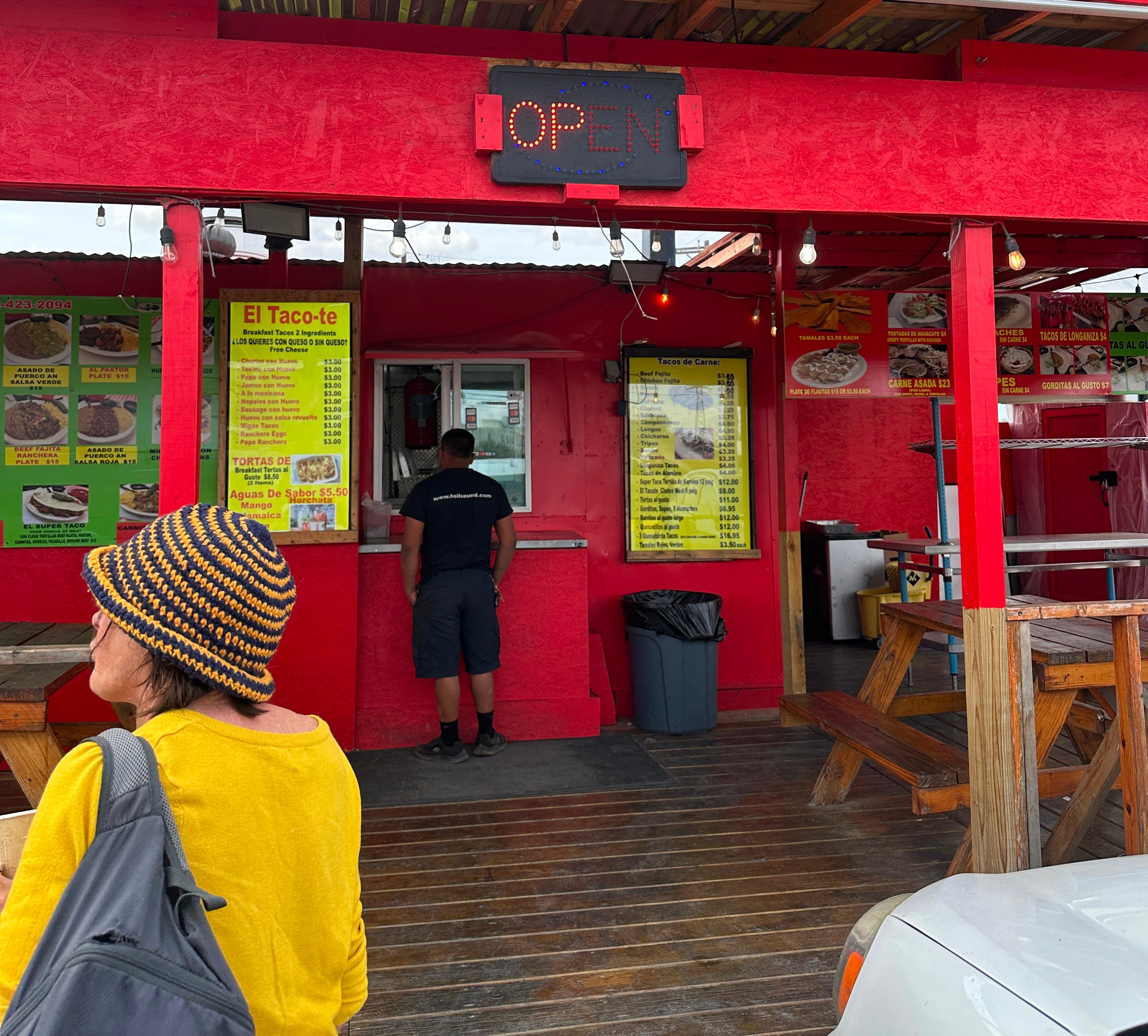
When she was ready, we crossed the street to the patch of ground she wanted to set up her little fabric home. It was littered with trash from the previous dismantled group camp. Christa pitched the tent as I sat with Belinda on a concrete retaining wall.
“Are you sad about not going to Kansas?” I asked. “That was a whirlwind.”
“No,” she said. “My daddy will come get me again sometime. Now I have his phone number, we can talk all the time.”
“Do you want us to try to get you a bed at the Marshalling Yard shelter?” I asked. “Or to call all the shelters and see if they have any options? The Women’s and Children’s shelter might make a space for you, even though the waiting list is long, your score is probably pretty high.” (In Austin, unhoused people are assigned a prioritization score based on risk and vulnerability, and the score determines who gets help to housing first.)
“Hell no,” she said. “I’m not going in a shelter to be around a lot of people. I’m not like those other people. I’m a faith believer and they’re not. I’m different from them and I don’t let anyone see me like them. I’m not like them.”
“I see you,” I said. “I hear you.”
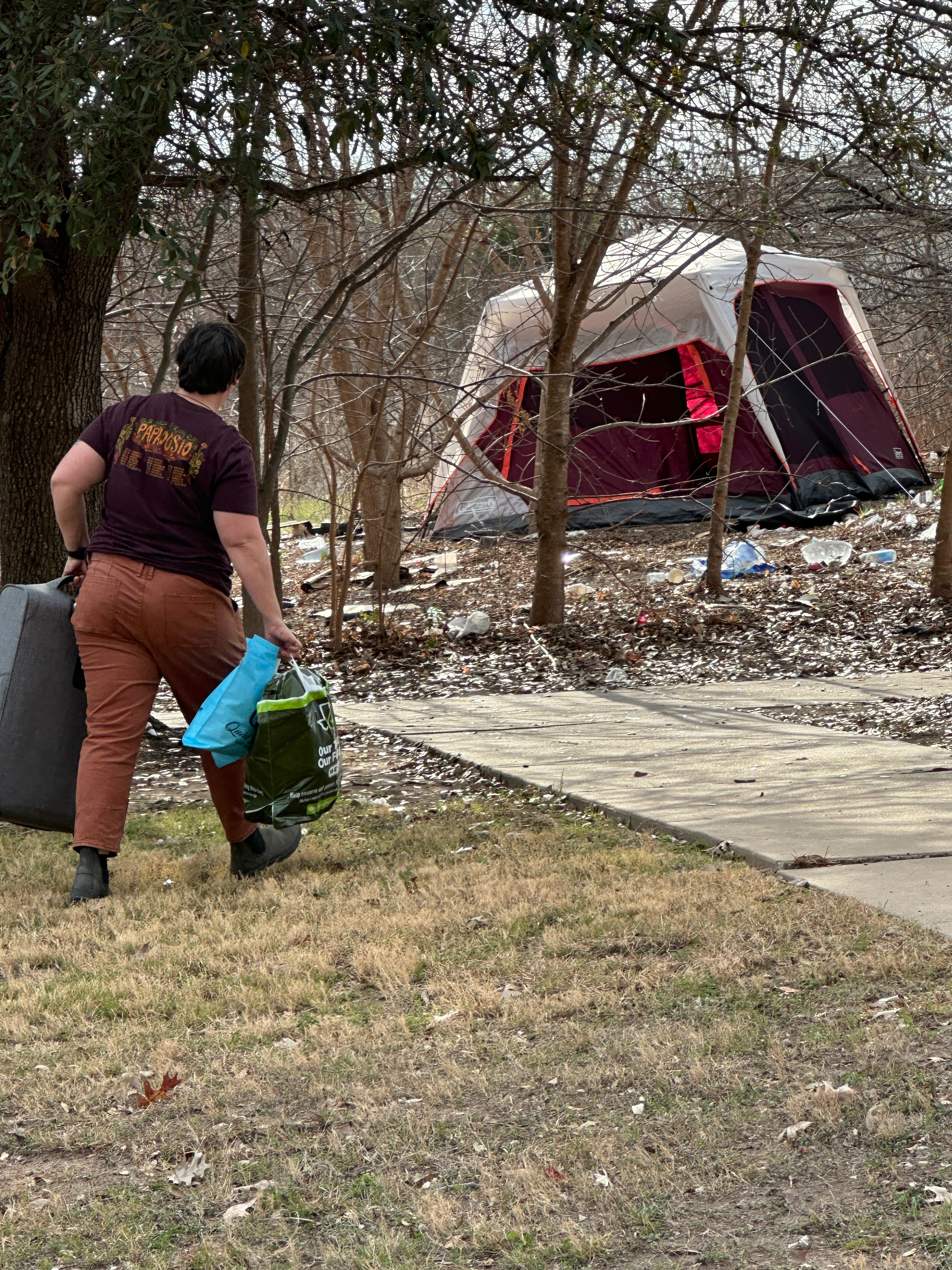
We got her tent set up as best we could. It was windy. Christa tied the cords to tree trunks and staked them down. We carried all her bags in, filling one side of the tent with food, warm blankets, her new clean clothes and survival supplies. I laid out her new sleeping bag and pillow. Belinda went in and zipped herself up. The tent could be swept or bulldozed anytime. But somehow, she was home.
We got back in the car. I was in shock. We did our best and the river simply didn’t flow that way. I was afraid that might break the trust of everyone who was cheering her journey, sending support to make her homecoming real.
I felt ashamed, like there was some grave mistake I couldn’t name—a mistake of hope or storytelling. A mistake of raising funds to help a situation that couldn’t be resolved. I’d written a hopeful story using the threads of Belinda’s hopes, gotten donations from many friends for her, spent them all and tapped my own bank account, yet she was still going to live outside. Would people trust me with mutual aid and help me to help someone else, next time? Funds are so precious and needs are everywhere.
I didn’t know how to describe what happened. Life is so unpredictable. I shut down for a few weeks, nursing a concussion (unrelated to advocacy). I tried to get my paid professional work back on track.
I asked friends, What did we do wrong and what did we do right?
I arrived at this: Helping the community means helping even the people who seem impossible to help, who nobody bothers to help. We have to take our chances and give what we can in the moment. Even though it may not work immediately, a person may be only one more offer of help away from what they need; may use just one more handhold to live freely again. Every gift given is real and necessary, even if we don’t see its fruit.
On the wrong end, I moved too quickly in celebration of Belinda’s departure. The planned homecoming she envisioned and asked for wasn’t actually what she truly could do.
In the future, I will spend even more time getting to know unhoused neighbors in order to understand their desires and capacity. Something can always go sideways. The process of getting off the streets (for people who want to) is like other processes of recovery. It can be long, circuitous and repetitive. Sometimes people’s minds, mental health or nervous systems simply won’t let them get shelter, no matter how many doors open or how badly they want the safety.
On the right end, we listened to her and provided the help she asked for. I was faithful from the first night, when a security guard friend called asking for help for a sick woman sleeping on the sidewalk outside of Walmart.
We found Belinda’s family, located their contact information and reconnected her with her dad. He can now call her and send her money again; she now has the means to call and text on her own. Instead of garbage bags for her belongings, she has suitcases that roll. She has clothing for each season. She got a week of much-needed sleep, rest and safety, and food provided without limitation. She got to feel the love of a community.
Ralllying around Belinda gave me and my friends who volunteered or sent money something as well: a specific way to help a specific person, to express compassion and values, shared resources, words and care. We reject the social norms of isolation and the normalization of poverty and widespread homelessness. Every group effort that comes together to help a stranger is beautiful, regardless of the outcome.
Thank you for holding her story with me.
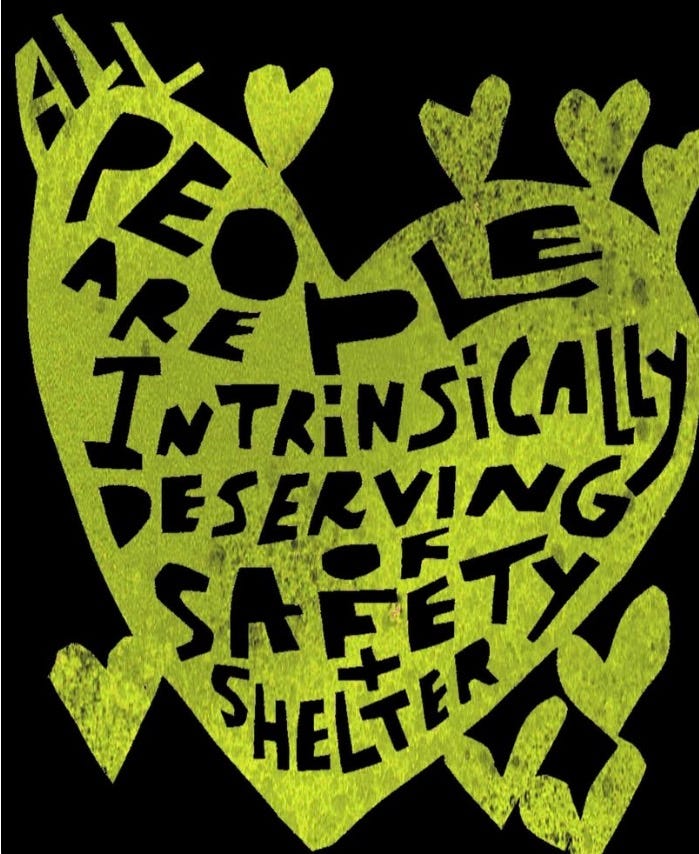
(Paper cut by Kate Laster)
Comments
Nothing yet. Say the first thing.
Sign in to join the conversation.