
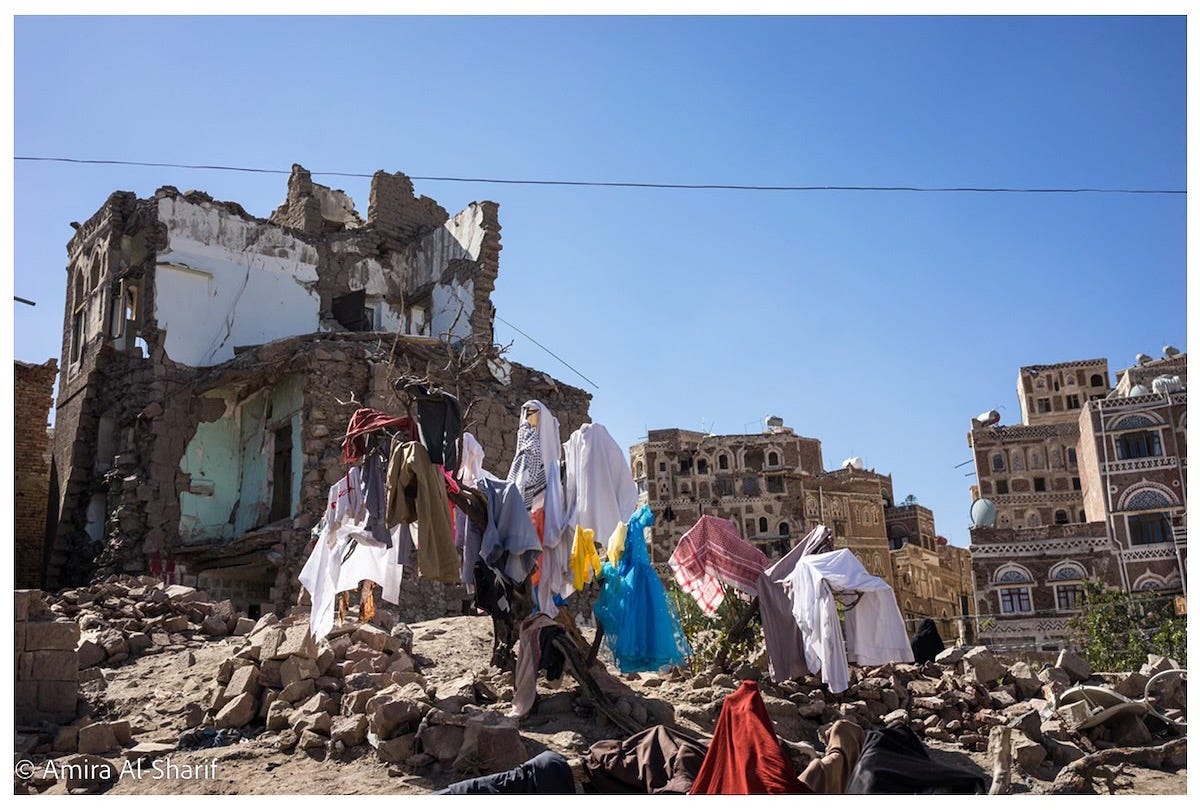
STOCKHOLM, SWEDEN — Just after midnight on March 26, 2015, Saudi Arabia broke with its traditional approach to Yemen when it launched heavy airstrikes on the capital, Sana’a. The Saudi aim, leading a military coalition that included other Gulf states, was to drive Houthi rebels out of Sana’a after they had effectively ousted the Yemeni government of then-President Abdrabbuh Mansur Hadi. The Saudi-led military intervention, including its aerial bombing campaign that alone killed some 24,000 Yemenis, was not “limited in nature,” as the Saudis promised, nor did it “protect the people of Yemen.”
Instead, Saudi Arabia’s disastrous intervention further fragmented Yemen. Control of the country today is still split between the Houthis, who are much stronger than they were in 2015 and have become the dominant force across northern Yemen; the weak internationally recognized government, mostly confined to Aden; and the separatist Southern Transitional Council (STC) backed by the United Arab Emirates, Saudi Arabia’s one-time partner in its military coalition against the Houthis.
Ten years after the airstrikes began, the Saudi-led war against the Houthis has left Yemen in ruins, with no clear winners, only devastation. Every faction involved, from the Houthis to the Saudi-led coalition and their local allies to the coalition’s Western backers, has contributed to the suffering. When the Houthis seized Sana’a in 2014, they set the stage for a long, unresolved war that risked drawing in outside powers. In another era, perhaps Saudi Arabia would have been more cautious, but with Crown Prince Mohammed bin Salman assuming more power under his father, King Salman, the prince pushed for what was widely seen by observers as “his war” — what quickly became “Saudi Arabia’s Vietnam.”
For Yemenis, the past decade has been a cascade of wasted years, shattered hopes, and unimaginable suffering. The youngest generation has known nothing but the horrors of this brutal conflict. In gatherings today, people recount everything they have had to endure. A mother points to her nine-year-old son: “I gave birth to my son in a hospital while coalition bombs fell on the funeral hall. Remember that day? That’s when he was born.” Another father calmly describes how he lost his teenage son to a bullet fired by a Houthi sniper in Taiz. Yemenis joke darkly that by the time there is any real redress for all the war’s destruction, it won’t be enough to just rebuild. They would need these lost 10 years given back to them — an impossible demand for an irreparable loss.
Excerpt from Afrah Nasser’s article, “Ten Years After Saudi Arabia’s Intervention in Yemen, There Is Only Irreparable Loss,” one of the most popular pieces of 2025 across Democracy in Exile, the online journal of Democracy for the Arab World Now (DAWN).
Afrah Nasser is a longtime Yemeni journalist, researcher, and human rights advocate living in exile. For more than 18 years, she has worked at the intersection of journalism, policy, and human rights to make complex political realities accessible, grounded, and useful for decision-makers and wider audiences. Her professional background includes roles with the Office of the UN Special Envoy of the Secretary-General for Yemen, the Arab Center Washington DC, and Human Rights Watch. In 2017, Afrah was recognized with the Committee to Protect Journalists’ International Press Freedom Award.
Comments
Nothing yet. Say the first thing.
Sign in to join the conversation.