
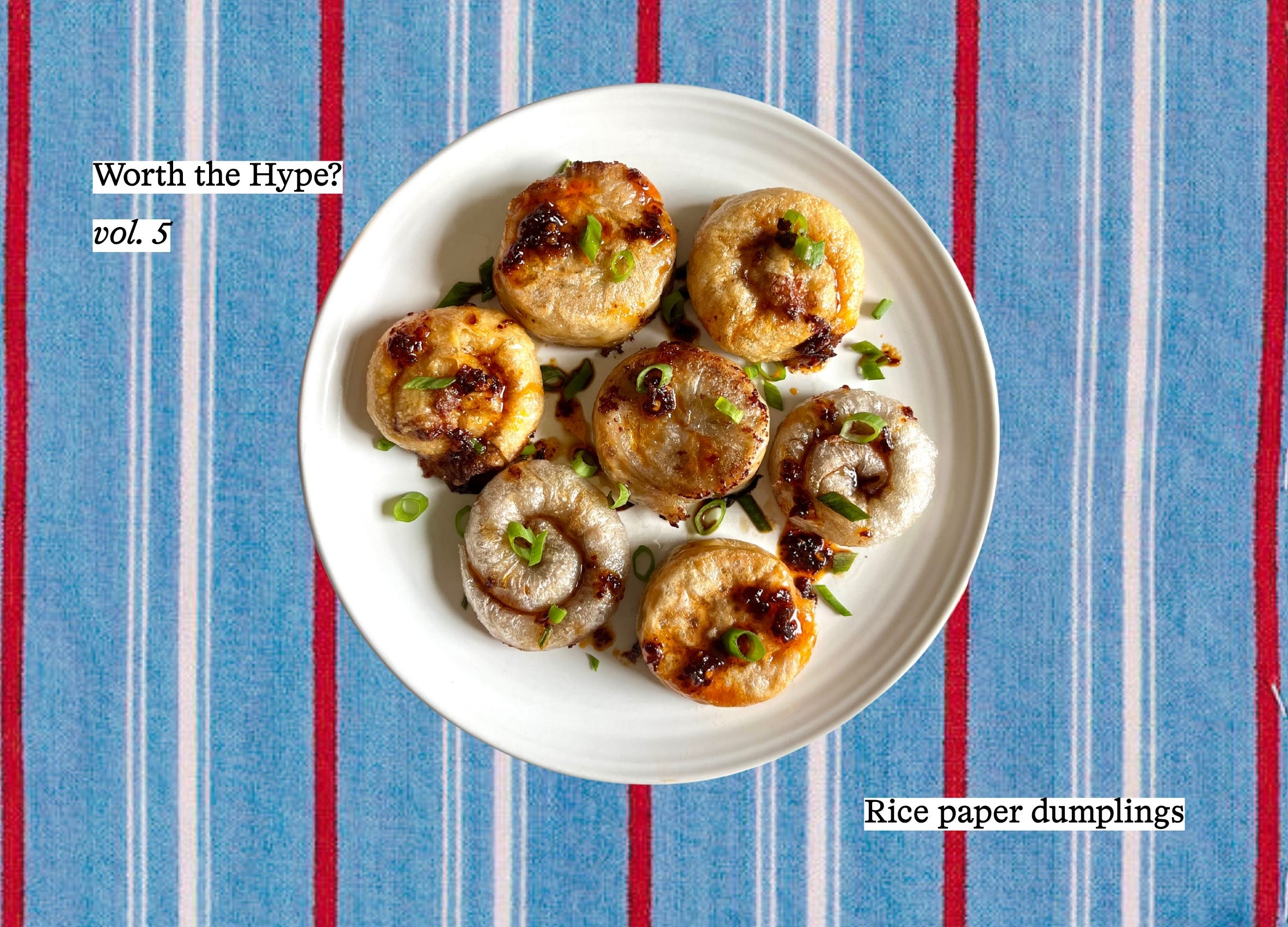
Welcome to the fifth and final installment of Dumpling Hacks with Mei Li. (Btw: If you’re new to this series, here’s where to catch up on the rest of it! Part 1: Smash dumplings; Part 2: Soup dumpling casserole; Part 3: Dumpling noodles; Part 4: “No fold” dumplings)
Since early 2026, we’ve been test-driving the dumpling hack universe of social media, where creators have been increasingly seeking ways to engineer the pleasures of dumpling-eating at home while decreasing the labor of dumpling-making. Writing this conjures images of those old infomercials for hair removal devices where they flash back to someone violently hacking away at their leg with a razor as an illustration of what “shaving your legs” looks like—a painful bloodbath, which can be avoided if only you buy this new device where something that looks like a round parmesan cheese grater yanks your hair out one by one instead!
More often than not, as Mei has articulated so well across this series, these hacks are more often labor-transference than they are labor-savors. Or, when the latter happens, something functionally (moisture levels, dough texture, flavor) is lost along the way. But maybe it’s less about solving a problem, as these all purport to do, than it is about experimenting and playing with the form and function of a dumpling to see what sticks. There have been some genuine winners, in that regard. There’s more to say on all of this, which will come at another time, because I have a fantasy of turning this series into a one-off print zine of its own, which I hope to turn into a reality come fall.
We’re wrapping up this series (wink!) with the genre of dumpling hack that got the internet obsessed with dumpling-hacking to begin with: Rice paper dumplings, which I wrote about back in 2021. What was then one simple idea—use rice paper wrappers in lieu of dumpling wrappers—has since exploded into a multitude of variants. Mei digs into a whole bunch of them below.—Leah Mennies
The premise of rice paper dumplings is simple: use thin sheets of dried rice paper instead of dumpling dough to wrap up your dumpling filling. One reason it’s a “hack” is that the size and flexibility of hydrated rice paper allows you to fold your dumplings in so many different ways. There’s the original folded packet or envelope style, originally popularized by Okonomi Kitchen, as well as her rolled-style dumplings. You can also make jumbo half moons, dumpling spirals, and any number of other shapes with the large, pliable rice paper sheets. They can also fit into the no-fold category of dumpling recipes: as Lisa from Okonomi Kitchen says, you don’t have to make dumpling dough or know how to pleat to use these rice paper wrappers. But is using rice paper wrappers really any easier than a classic dumpling dough?
Let me start by saying that if you can’t eat wheat or gluten, these rice paper wrappers are an absolute game-changer. Gluten-free doughs are quite tricky to make (at Mei Mei Dumplings, we hired a special consultant to help develop our gluten-friendly dough) and you can’t buy them fresh like you can with wheat dough wrappers.
Dried rice paper wrappers are inexpensive, versatile, and easy to use. How do they make them so paper-thin and perfect? They are, quite honestly, kind of a food engineering miracle. It’s mind-blowing what you can make from rice paper. (Seem like an overstatement? Go poke around social media channels like @thechefoutwest for everything from rice paper bagels to croque monsieurs.)
That being said, I obviously have more opinions. Using rice paper wrappers isn’t quite as easy as it seems in many of these videos. You have to rehydrate them by soaking in water until they soften, then use them to wrap your filling. A few videos have you soak them in a water-soy mixture, others use beaten egg, which I tried as well. It seems easy, but the temperature of your water and length of time soaking makes a big difference.
There’s a sweet spot: too little time in the liquid and they won’t fold or coil easily. Too long in the liquid and they’re slippery (especially with the egg), and they stick to everything, including themselves, like Saran Wrap. Either way, it’s easy to tear the wrappers and leave air pockets behind when folding. I make a lot of summer rolls with these wrappers and I still had some trouble using them to fold up dumplings.
I started by making the original rice paper dumplings, which require a simple packet or envelope style fold (although I experienced both the aforementioned tearing and air pockets with these).
But the biggest problems arose in cooking: I used pork instead of the originally suggested tofu, which meant more frying time to ensure the meat was fully cooked. (When cooking wheat wrappers, the cooking time generally stays the same no matter the filling, as the time needed to steam and brown the wrapper will cook whatever is inside.)
However, with the meat center of the much-larger envelope-shaped dumplings, I was worried I would burn or dry out the wrapper before I’d fully cooked the meat. To solve this problem, after a bit of pan-searing, I added water and steamed the packets the way I always cook regular dumplings.
Unfortunately, the rice paper wrappers didn’t hold up to the vigorous bubbling and steaming, and the dumplings started to pop and leak. The finished dumplings were tasty, but the wrappers ended up too chewy and gelatinous in places, and the packets were broken all over.
So I tried smaller dumplings next: specifically, the coiled spiral dumplings seen here in @klopokitchen_’s video.
These dumplings took some effort. I did appreciate the plastic piping bag hack, which made it much easier to shape the (for lack of a better term, my apologies) “meat tube” across the rice paper wrapper. But again, the pliability was hard to nail, especially with the beaten egg. Some were very difficult to roll, because the wrapper was too wet. I overcorrected, and found others were too hard to coil because the wrapper was too dry.
The cooking was easier though, as the smaller amount of meat allowed me to avoid any steaming. Instead, I just pan-fried the dumplings with a bit of oil in a nonstick pan for longer on each side, maybe five minutes each, until the meat was done (this is a great time for an instant-read thermometer since you can’t see the inside at all). I also cooked half of them in the air fryer for 400F for 12 minutes, spraying the dumplings with a bit of oil and sprinkling with salt,
When you combine a flavorful filling with a good quality wrapper and fry the results: well, unsurprisingly, the rice paper dumplings are perfectly delicious. If someone handed me a piping hot plate, I’d eat them all. Overall, I prefer the crispy and supple texture of wheat wrappers vs. the chewy texture of rice paper that some people adore, but they’re both great!
However. Since we’re talking hacks here, let’s consider exactly how easy these rice paper dumplings are compared to the classics.
To be honest, I find the rice paper wrappers fussier and more difficult than a typical wheat-based wrapper. Assuming both are store-bought (if you’re making rice paper wrappers from scratch, you’re insane but also I applaud you), then the wheat wrappers only require a bit of water to press them closed, while the rice paper wrappers need to be completely rehydrated in a large container of water. They’re stickier and easier to break. But, an important caveat: I’ve been working with wheat wrappers my whole life and have made many fewer rice paper dumplings. I’m sure practice would help immensely, just as practice with wheat wrappers makes them very easy to handle.
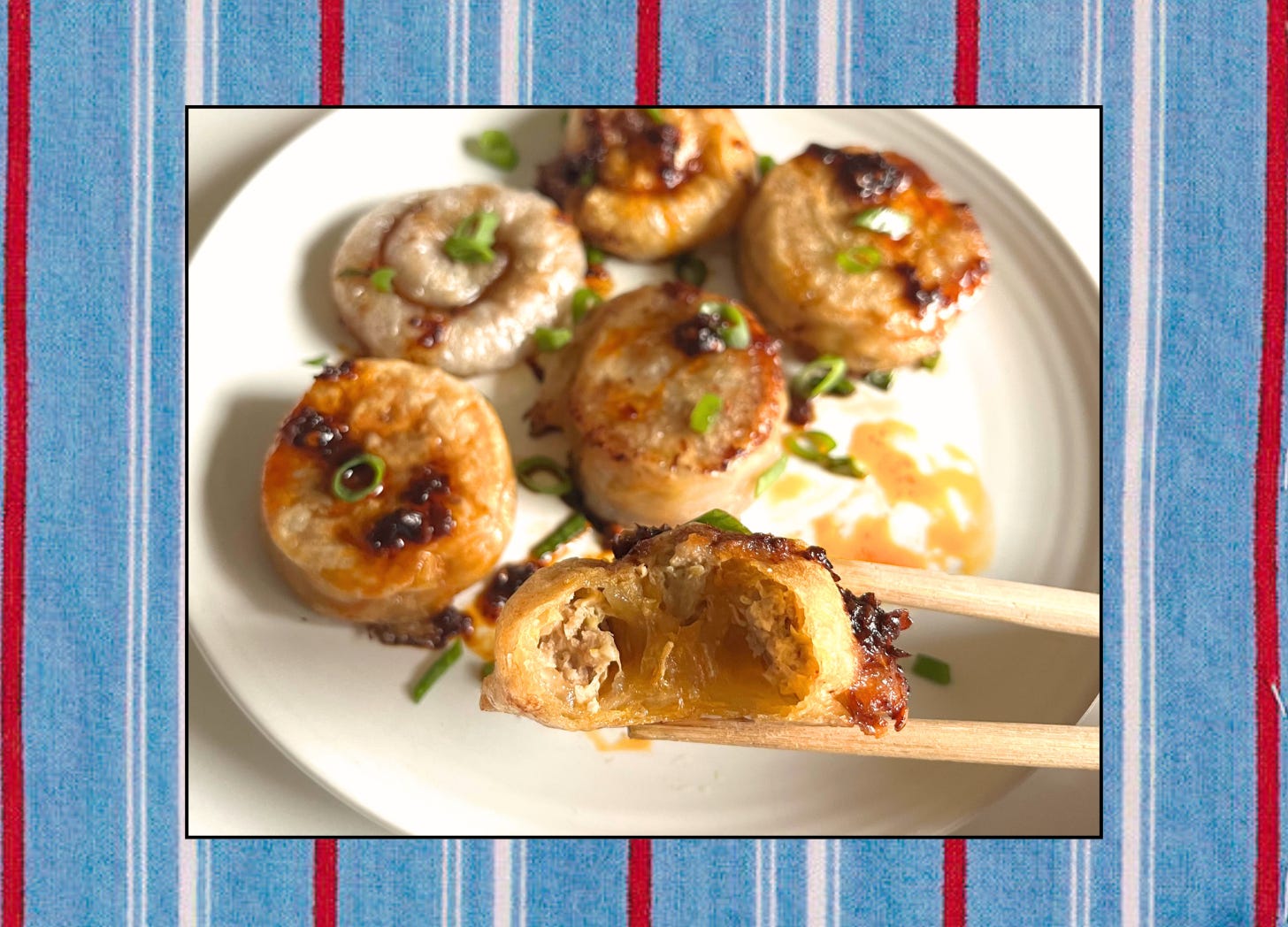
When it comes to cooking, it’s fun that the size of rice paper allows for different larger shapes, like dumplings the size of an empanada or a Jamaican beef patty. But the rice paper breaks easily when cooking larger dumplings, and it’s easier to achieve a crispy brown crust on wheat wrappers.
All that being said, it’s nice to have rice paper wrappers as an option in your repertoire. If I don’t have dumpling wrappers, and I don’t feel like making dough from scratch, it’s nice to have rice paper wrappers hanging out in the pantry as another option. (Keep in mind they don’t last forever. I had a packet in my pantry for…let’s say, many months, and they shattered into tiny shards when I tried to use them for this column.) And the importance of this hack for non wheat-eaters can’t be overstated: Homemade dumplings are back in the game without making your own gluten-free dough!
Air fryer vs. pan sear: For ease, I’m giving it to the air fryer. You don’t get quite the browning on the top (you could stop halfway and flip if you wanted) compared to searing on both sides in the pan, but otherwise you get to set it and forget it. Always a win in my book! Bonus note from Leah, who tried the “roll-in-a-tube, snip-em, and douse in potato starch” method: Said potato starch sucks up every drop of oil in a pan, meaning I had to add much more than I’d use for typical pan-frying; I bet these would have been excellent in an air fryer.
Egg vs. water hydration: I’ll be honest, I forgot to taste them both before drizzling soy sauce and chili oil on top, so I didn’t taste them plain. But once sauced up, I couldn’t tell the difference between the two. Thus, given the ease in folding the plain wrappers vs. the slippery, slide-y egg ones (not to mention the amount of wiping and hand-washing needed to prevent raw egg from touching every surface of my kitchen) I’d pick only water to rehydrate the wrappers next time.
Overall, I appreciate the convenience and novelty of the rice paper wrappers and will be very happy to have them as an option when my celiac relatives come over. But otherwise, I’ll be sticking with wheat wrappers. That’s just me though—have you tried a rice paper wrapper dumpling and what do you think? Do you have a favorite shape or style? Let us know!
No posts
Comments
Nothing yet. Say the first thing.
Sign in to join the conversation.