
Lorne Trottier was born on the 15th of June in 1948 in Montréal. Trottier describes himself as a space and science geek, and he’s had a lifelong interest and passion in both space and electronics. In particular, Alan Shepard’s suborbital flight on the 5th of May in 1961 and Apollo 11 in July of 1969 made a lasting impact on him. He attended Baron Byng High School and McGill University. He attained his master’s in engineering in 1973. Realizing that there was a market to be had in interfacing CPUs and video output, Lorne had an idea for a company. He and his friend, Branko Matić, started working on some ideas in their spare time. Trottier had a second telephone line installed at his family home, his mother served as the receptionist, and he kept a day job. It was in 1976 that Trottier and Matić founded Matrox (Ma from Matić and Tro from Trottier) in Dorval, Quebec, and they launched their first product the same year. As with many other technology companies at this time, success was built and failure found via the press, and more specifically, via magazines catering to specific interests. For Matrox, the publication was Electronics. They secured free placement in the new products section, and they managed to get $20,000 worth of orders for their Video RAM (MTX-1632). This made the company immediately profitable, and they were able to make more products in rapid succession.
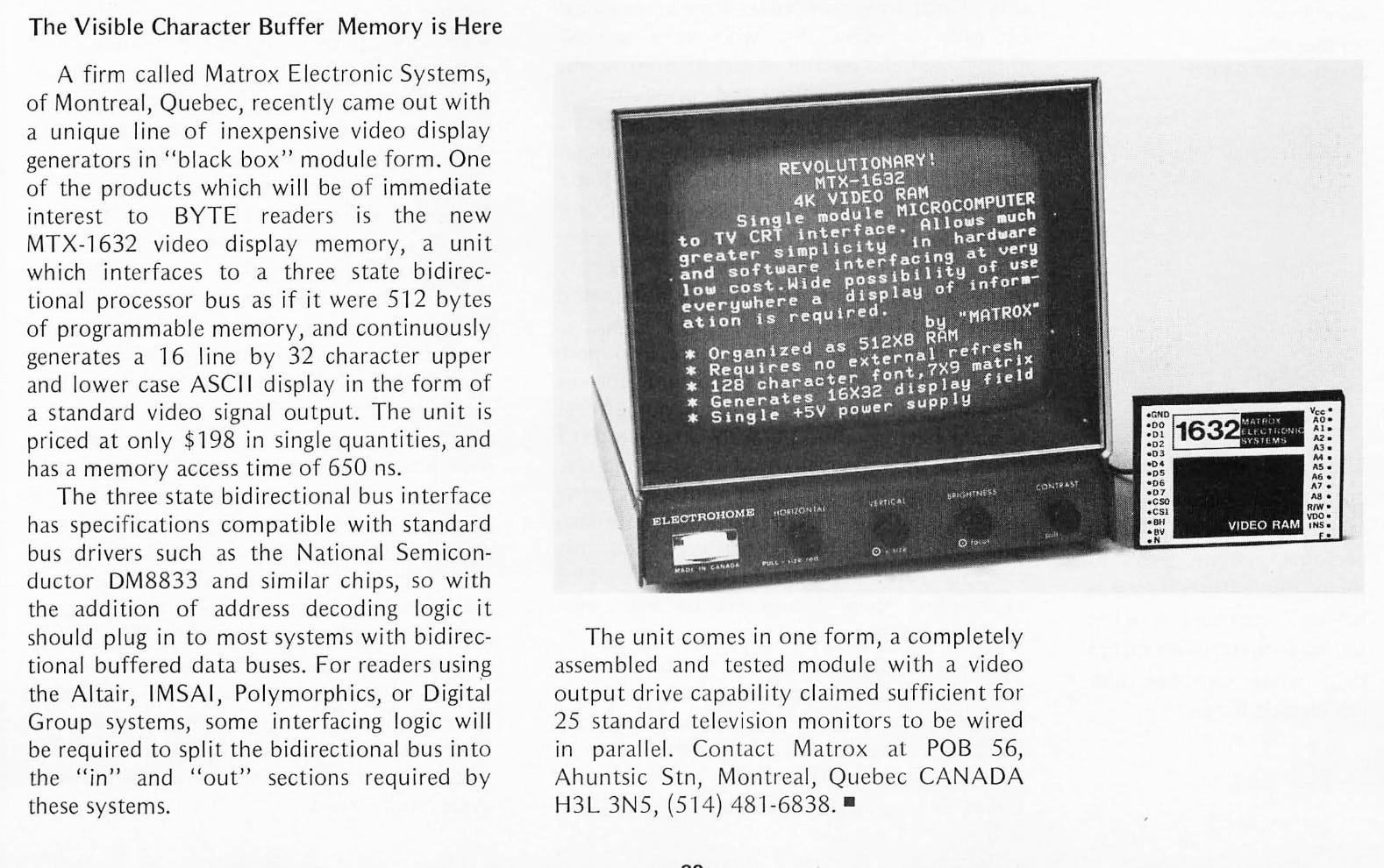
Trottier and Matić undoubtedly read about the launch of the Altair 8800, but despite appearances, their first products weren’t intended for the S-100 bus machines despite being used with them. This was the MTX-1632 which provided 512 bytes of 650ns video memory while generating 32x16 ASCII display output. It was priced at $198 (~ $1166 in 2026 dollars).
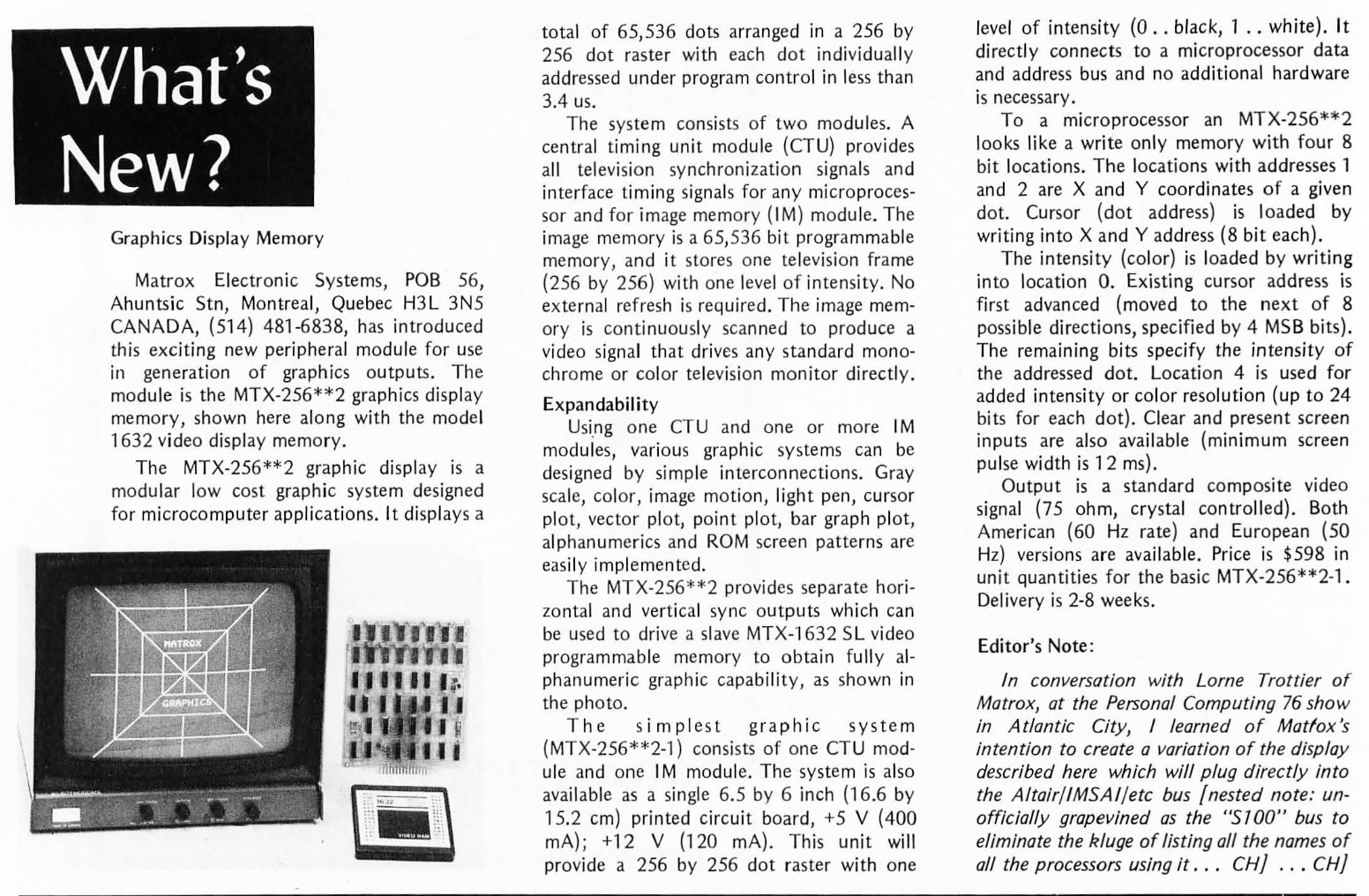
Just shortly after the release of the 1632 came the MTX-256**2. This provided 256 by 256 dot raster resolution and was built of at least two separate units: central timing unit (CTU), image memory (IM). As noted, this wasn’t initially intended for the home microcomputer market, and it wasn’t plug compatible with any home system. Yet, around August of 1976, this was the best display adapter setup per dollar and interfacing with a bidirectional microcomputer bus wasn’t particularly difficult. At this time, for around $100, one could have purchased a 96 by 64, byte parallel, display adapter kit that required programmed I/O for each point. Moving up the scale, you had the Matrox MTX-256**2 at $630 (~ $3710 in 2026 dollars) interfaced with DMA providing multiple video modes and 256 by 256. For around $14,000, one could purchase the DEC GT-40 which offered hardware vector graphics and character generation, DMA, a built in display, a resolution of 1024 by 768, and a whole PDP-11/05 to drive the thing. For the financially successful or radically enthusiastic hobbyist, the Matrox was an obvious choice. Nothing else in the market offered a “high resolution” display with DMA for under $1000.


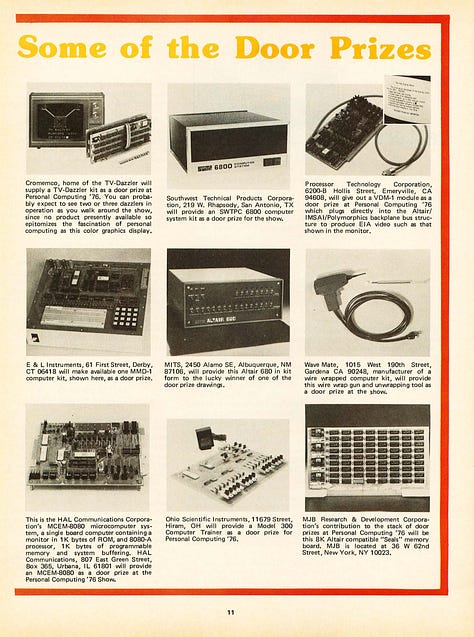


With two products (technically three, as there had been a less refined version of the MTX-1632 with no product designation, it was just “Video RAM”) on the market, Trottier made his way to the Personal Computing Consumer Trade Fair (better known as the Personal Computer Festival or PC ‘76) held at the Shelburne Hotel in Atlantic City, New Jersey on the 28th and 29th of August in 1976. This was an extremely important event for the industry with around five thousand people attending. Companies like Apple, Byte, Cromemco, SWTPC, DEC, Processor Technology (Sol computer series) among others were present, and rather importantly, it was Apple’s first major public debut with Jobs and Dan Kottke manning the booth (Woz mostly hung out at the Hotel working on AppleSoft BASIC) and showing off the Apple I in a fully enclosed wooden case with integrated keyboard. At this time, however, the hot product was the Altair 8800, and next hottest products were S-100 bus cards and Altair clones. Trottier collected every computer data sheet and other documentation he could get his hands on.
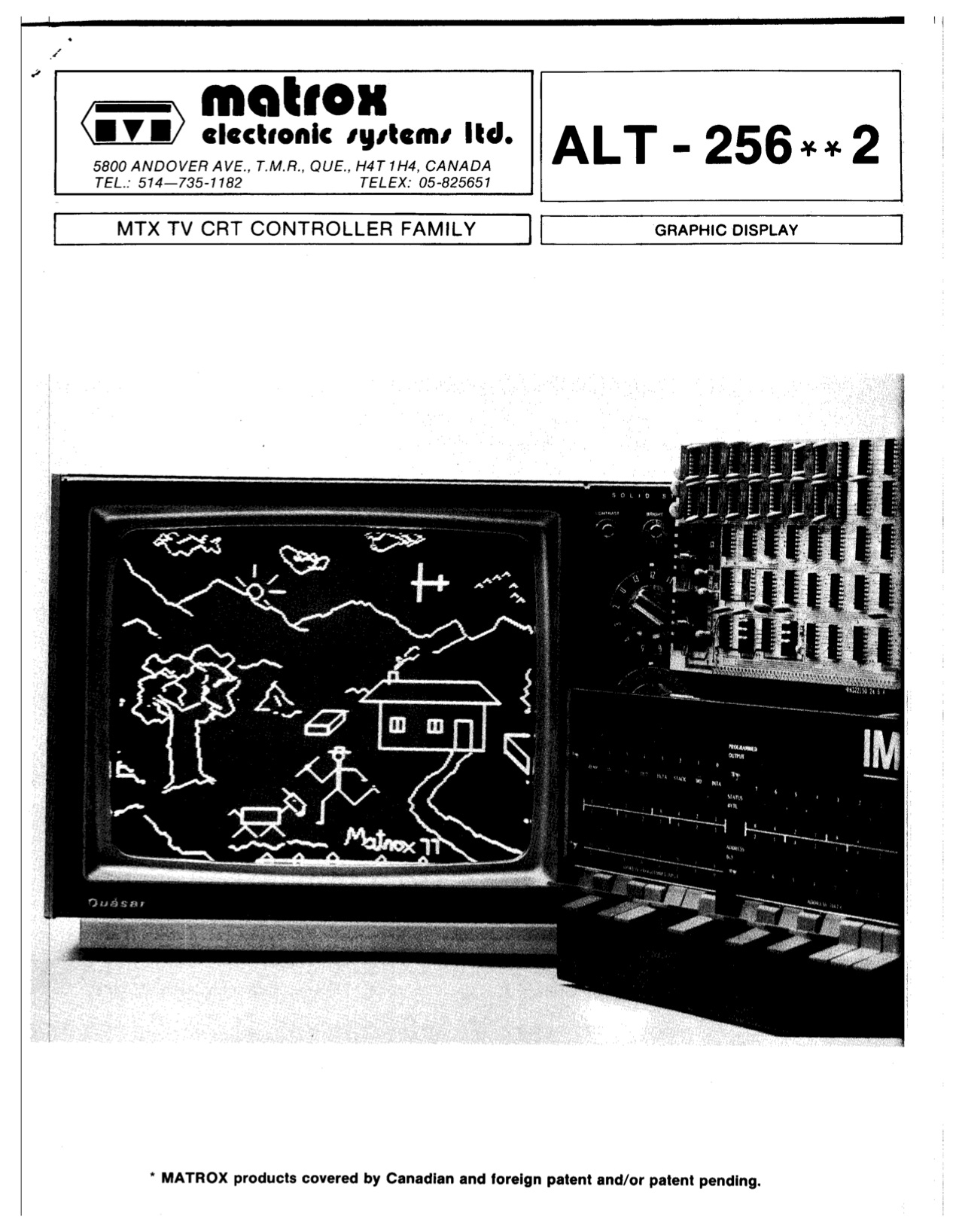
Having had this experience with PC ‘76, surrounded by S-100 technology, it is no surprise that Matrox’s next product would be an S-100 bus card. The manuals make reference to 1977, but my suspicion is that the product was completed in 1977, and it was almost certainly released early in 1978. From the manual’s introduction:
The Matrox ALT-256**2 is a fully tested, assembled, and burned-in interface card which provides capability for a complete graphic system at a fraction of the cost of any other commercial graphic system. The card contains all interface electronics, a TV sync generator, and its own 65,536 x 1 bit refresh memory. It plugs directly into one slot of any S-100 bus compatible computer. The built in refresh memory allows much greater flexibility and speed since no CPU time is required to refresh the screen.
The output is a composite video signal which can be connected to any TV monitor or the video portion of a TV set. The unit produces a high resolution 256 by 256 dot raster. The complete screen can be cleared or preset by a single instruction.
The ALT-256**2 board occupies a single S-100 bus slot and requires 4 output ports and 1 input port (port address is selectable on the card with jumpers).
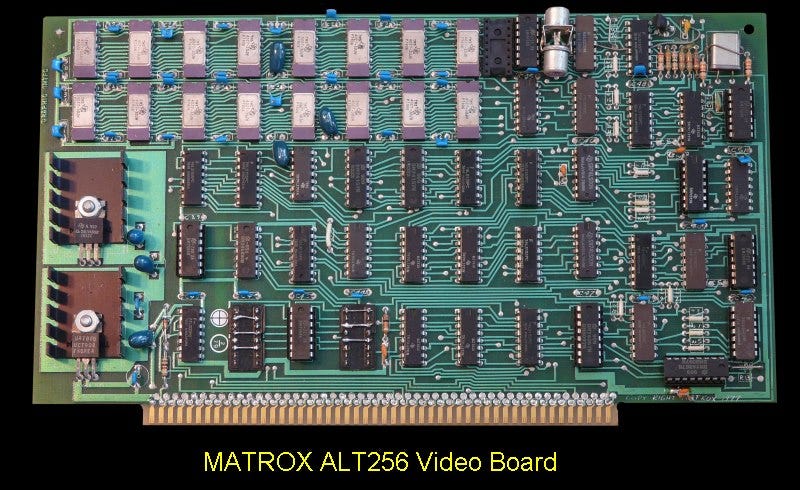
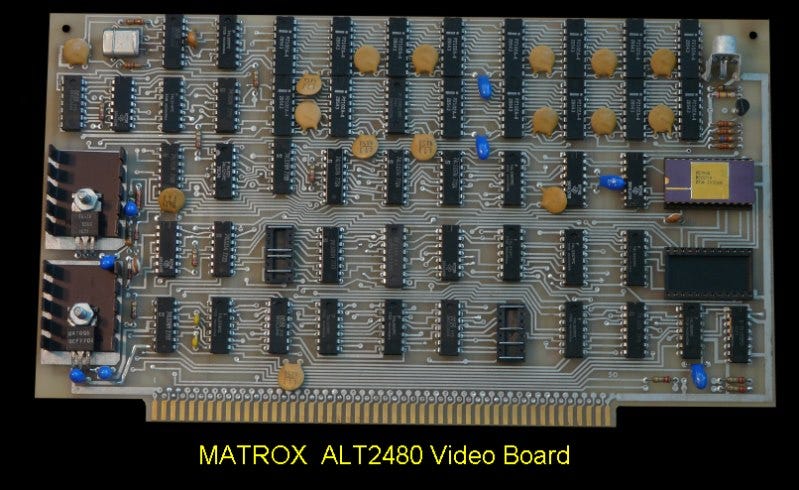
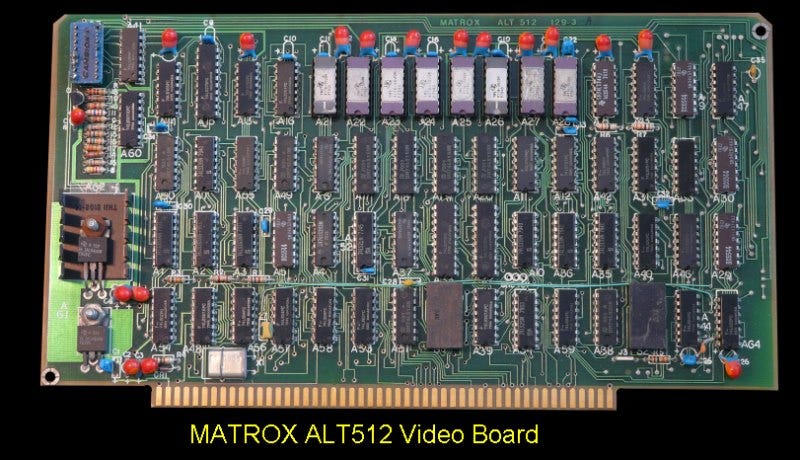
Compared most other S-100 bus graphics adapters, the ALT-256**2 offered around four times the resolution. It also offered both color and gray scale, as well as compatibility with both European and US TV standards. Combined with the ALT-2480, an S-100 machine would now have the power of both alpha-numeric display and graphics display. The ALT-256**2 was quickly followed by the ALT-512 which increased the resolution to 512 by 256, or if a user wanted, could be used to provide two 256 by 256 displays. The York University Computer Museum lists two paper tapes that shipped with these cards: Matrox 8080 Graphics Package, Graphics Package Demo.
In 1978, Matrox was able to boast that their products had been used “in more than 10,000 installations” and they made sure to state that these installations included the ground control displays for NASA’s Viking mission. The company then moved into Wall Street in 1979 providing the Quad Video to system integrators supplying financial companies, which true to the name, was a single board display adapter that could drive four displays.
As the company began to grow, Trottier made an intentional decision to engage in profit sharing with employees, offer daycare and recreational facilities at the company’s offices, and try to keep a rather relaxed and informal atmosphere. He credits the managerial styles of Bill Hewlett and David Packard as the inspiration for this. The company was built of fifty people by 1979, and it was growing at around 200% per year.
By 1980, Matrox was still heavily advertising the ALT-256, ALT-512, and ALT-2480, but they produced cards of roughly equivalent capabilities for Multibus, DEC PDP-11, and several others.
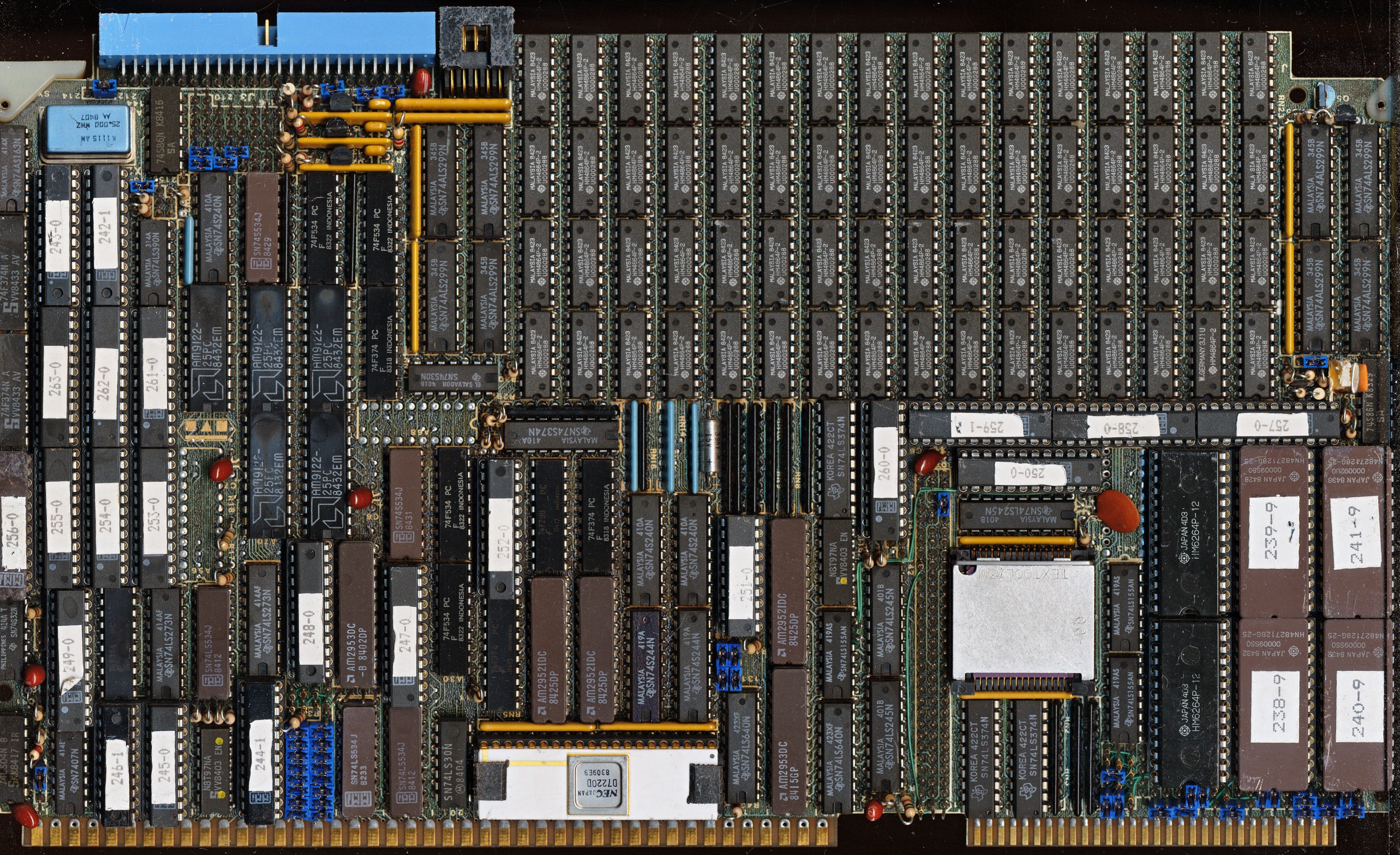
Between 1983 and 1985, Matrox demonstrated and released the GXT-1000 color graphics terminal, the GXB-1000 graphics controller made of two boards and supporting a maximum resolution of 1000 by 1000, and the SX-900 which was a less expensive single card derivative of the GXB-1000 offering 640 by 480 at 60Hz and supporting 256 colors on screen. The SX-900 was around $2000, the GXB-1000 was around $3500. This cheaper card was capable of a 20 MPixels/sec fill rate, which is quite impressive given the time. This was made possible by using an Intel 80286 at 4MHz as the processor handling all of the high level commands and controlling the rest of the hardware. The actual processor handling the graphics primitives and pixel processing was an NEC uPD7220. These CPUs were backed up 640 bytes of 25ns ECL SRAM and 16K of 120ns CMOS SRAM. The firmware was the same on the both high-end and low end cards. Sadly, I can’t find reliable information on the more expensive unit.
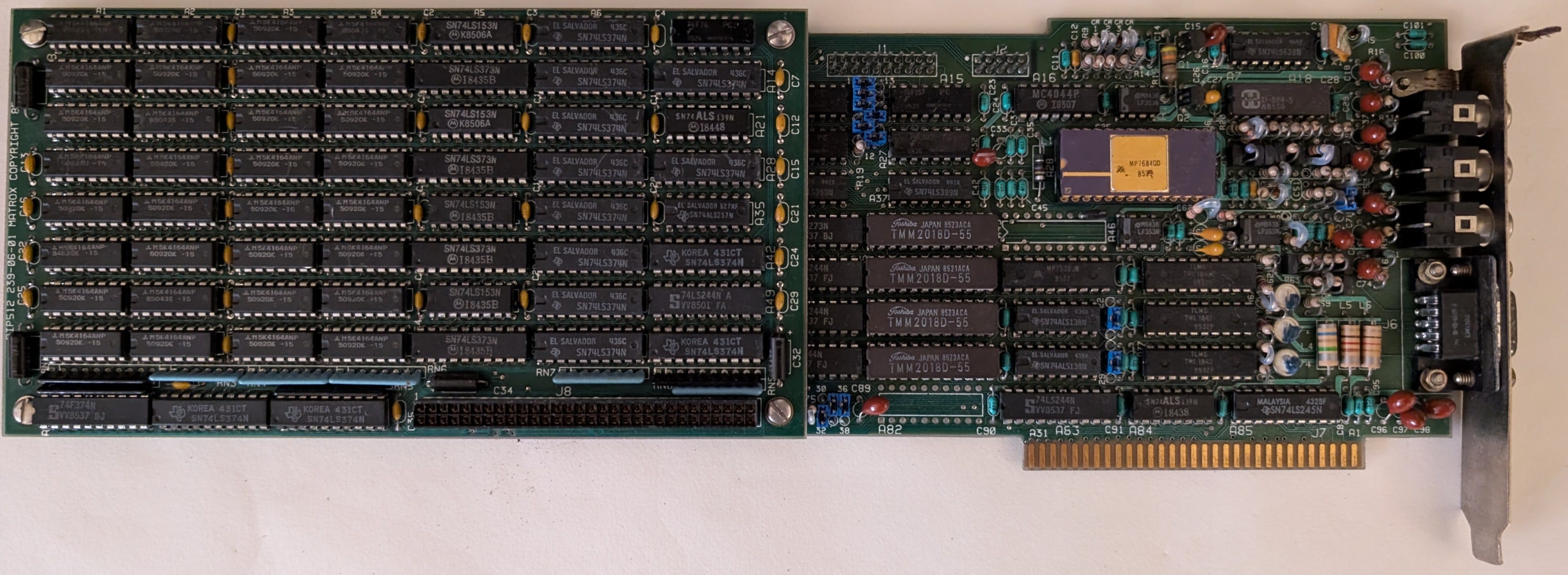
Despite having rather awesome kit available for Multibus, by 1985, the IBM PC and XT had achieved market dominance, and the AT was available. To address this, the company adapted the ALT-512 series hardware for yet another platform and it became the PIP-512 frame grabber and MIP-512 video adapter, but now on the 8bit ISA bus.

In 1986, the company won a major contract worth around $72 million with the US Army to build a multimedia computer system for the training of soldiers. This was the EIDS (Electronic Information Delivery System) that offered real-time video simulation at a far lower cost than more common graphical simulators. In the earliest versions of EIDS that I could find any reference to, the system utilized Sony SM-70GP microcomputer combined with the Sony LDP-1400 LaserDisc player, and 5.25 inch floppy disk drives for caching video sequences. The contract Matrox received was to implement the best possible graphics on IBM-compatible hardware. Matrox was chosen for their expertise in simultaneously generating color graphics, grabbing frames, and handling digital audio in a single add-in card. In particular, this allowed some other components to remain unchanged, such as the LaserDisc systems and their discs. This also meant that the Army was no longer reliant on a single computer or LaserDisc player vendor.
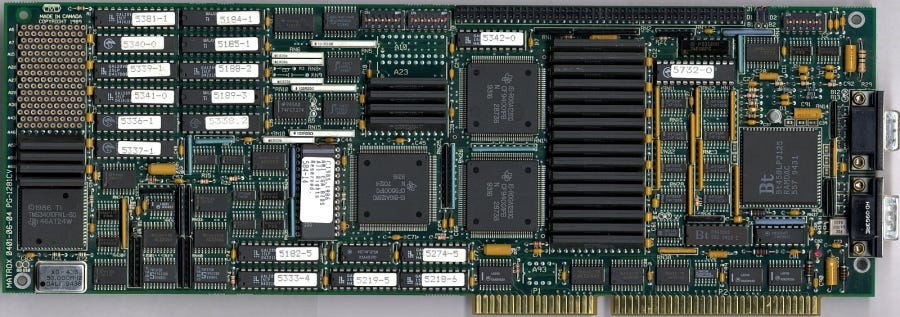
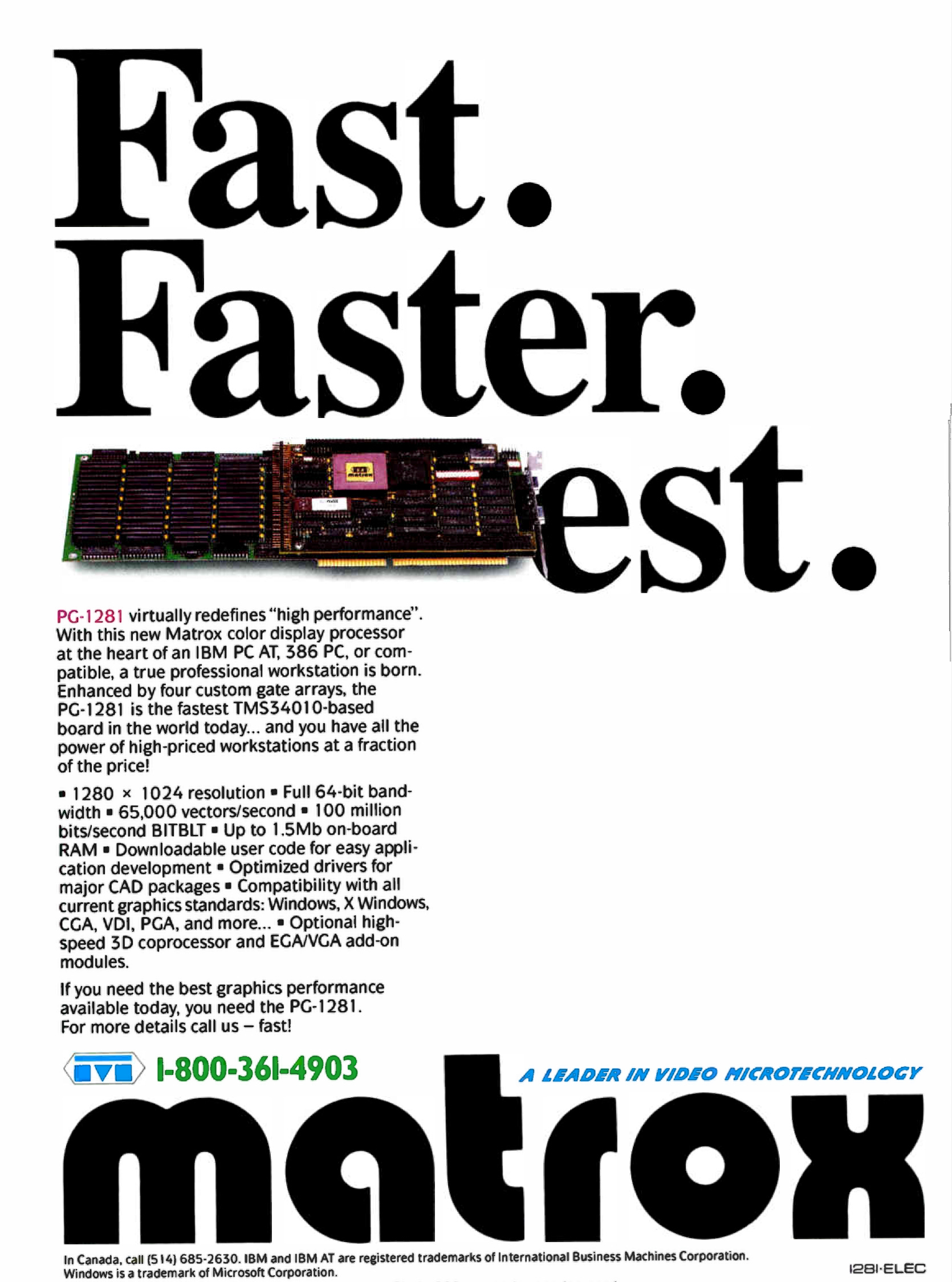
The company released the Matrox PG-1281 in 1987 as a relatively high-end card at $2995. This was on 16bit ISA and offered up to 1.5MB of VRAM. This card was built around the 32bit TMS34010 at 50MHz; the same chip used in arcade games like Mortal Combat, NBA Jam, and Hard Drivin’. The 1281 offered a maximum resolution of 1280 by 1024, could push 65,000 vectors per second, and had drivers available for Microsoft Windows, UNIX and UNIX-like systems using X Windows, and it had optional add-ons for more modes and 3D coprocessors. Later revisions would push the RAM limit to 4.5MB, and later variants were made for Microchannel, Multibus, and VMEBus.
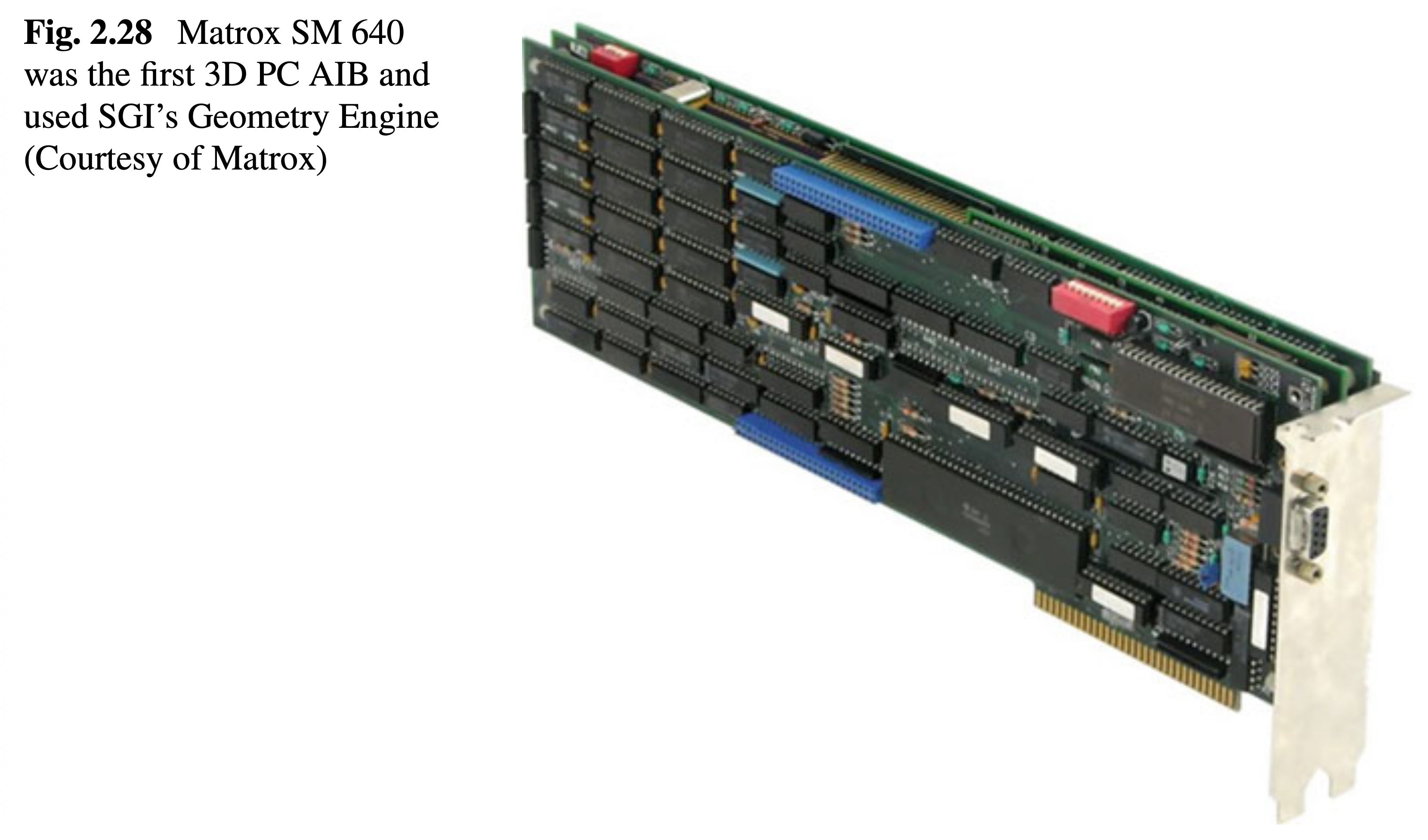
Also in 1987, Matrox launched the SM-640 with the Geometry Engine. This was the first 3D AIB and it utilized Matrox’s PG-640 as the 2D part (640 by 480 with 256 colors at 60Hz), and the Geometry Engine was on a second layer mezzanine board. The card was capable of 6000 shaded polygons per second, and it was priced at $4995. With this card, Matrox was counting on the IBM’s PCs popularity to draw 3D software vendors to the platform. By offering a high quality and high performance part for the PC, Matrox would have naturally become a market leader. Sadly, this was not the outcome. The SM-640 was a failure in the market as there were too few applications capable of making any use of it. Minicomputers and workstations continued to hold that particular market segment for a while longer.
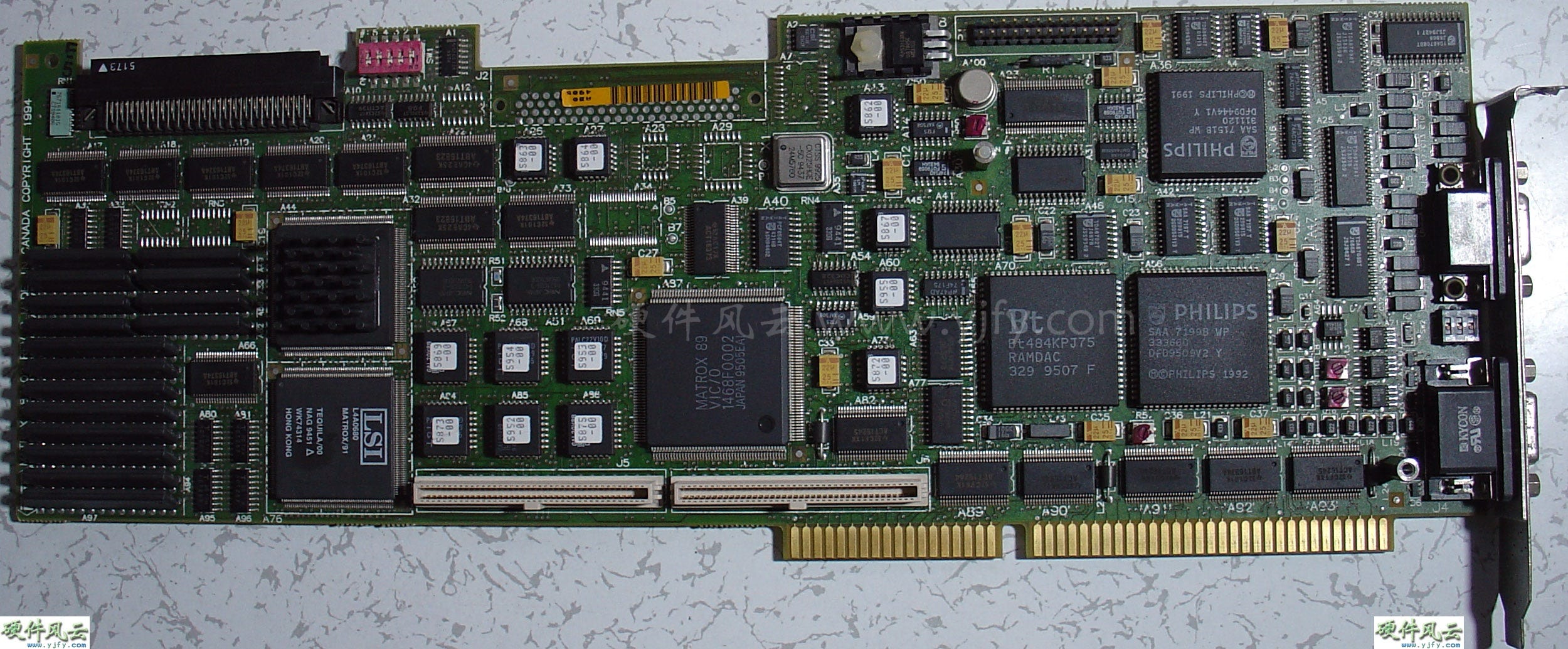
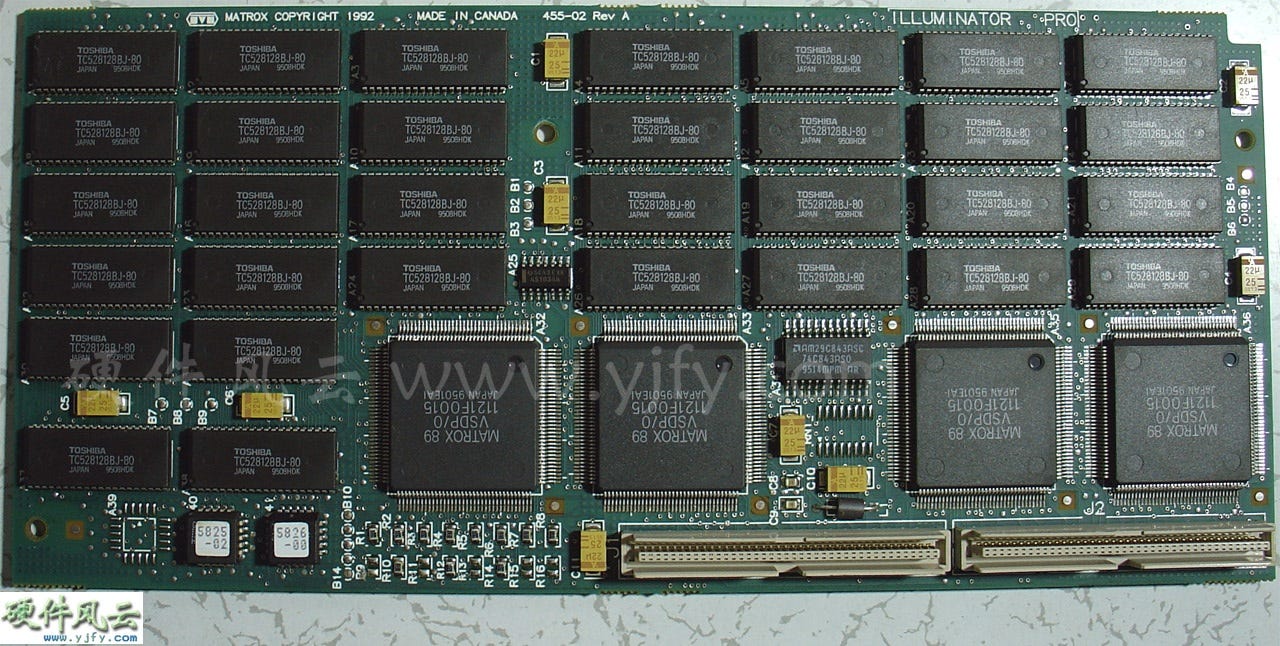
In 1989, Matrox began making chips of their own design. These were used in multi chip cards such as the Matrox IP-8, Illuminator 16, and Illuminator Pro.
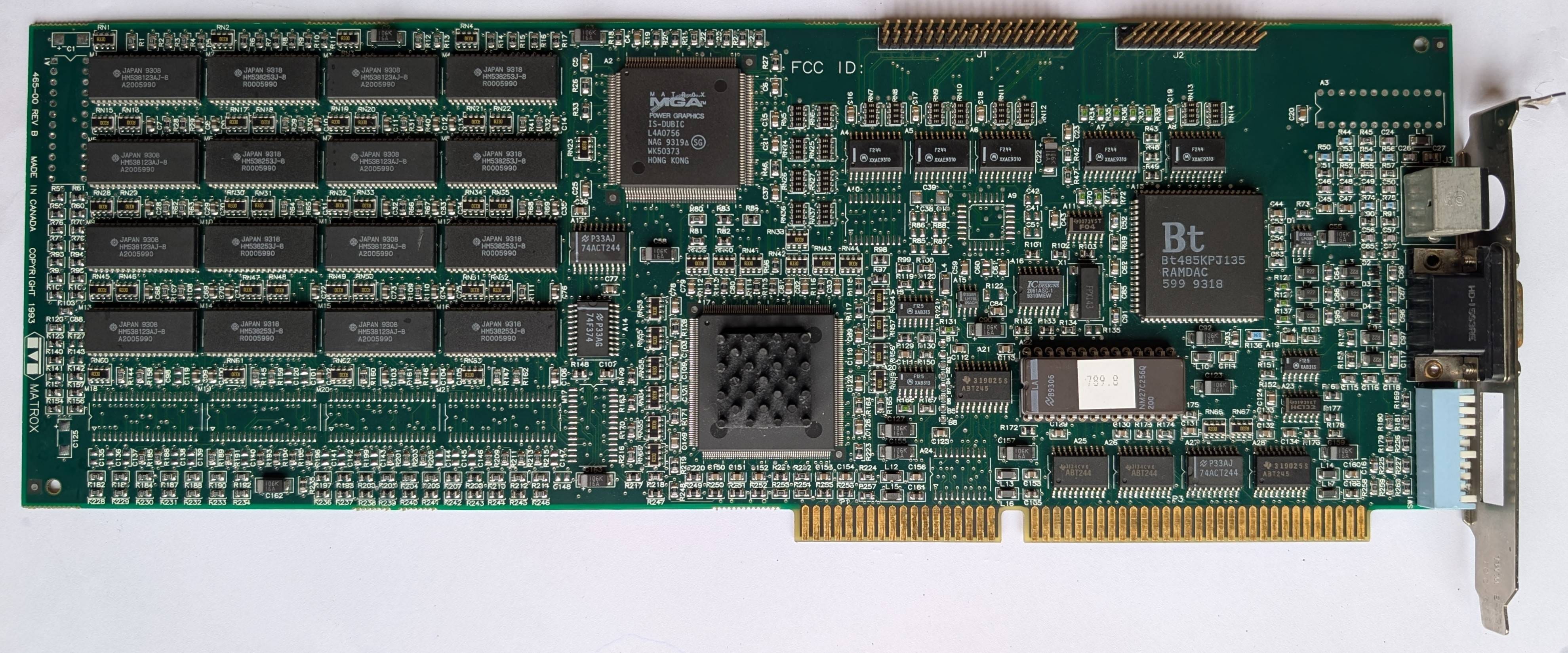
In 1993, Matrox produced their first cards utilizing a single chip video processor known as the MGA which offered some 3D acceleration. These went on sale in 1994 and offered XVGA support with a maximum resolution of 1600 by 1200 on 16bit ISA, 32bit VLB, or MCA, and the Ultima supported a maximum 2MB of VRAM while the Impression supported a maximum of 3MB. These were intended for professional markets.
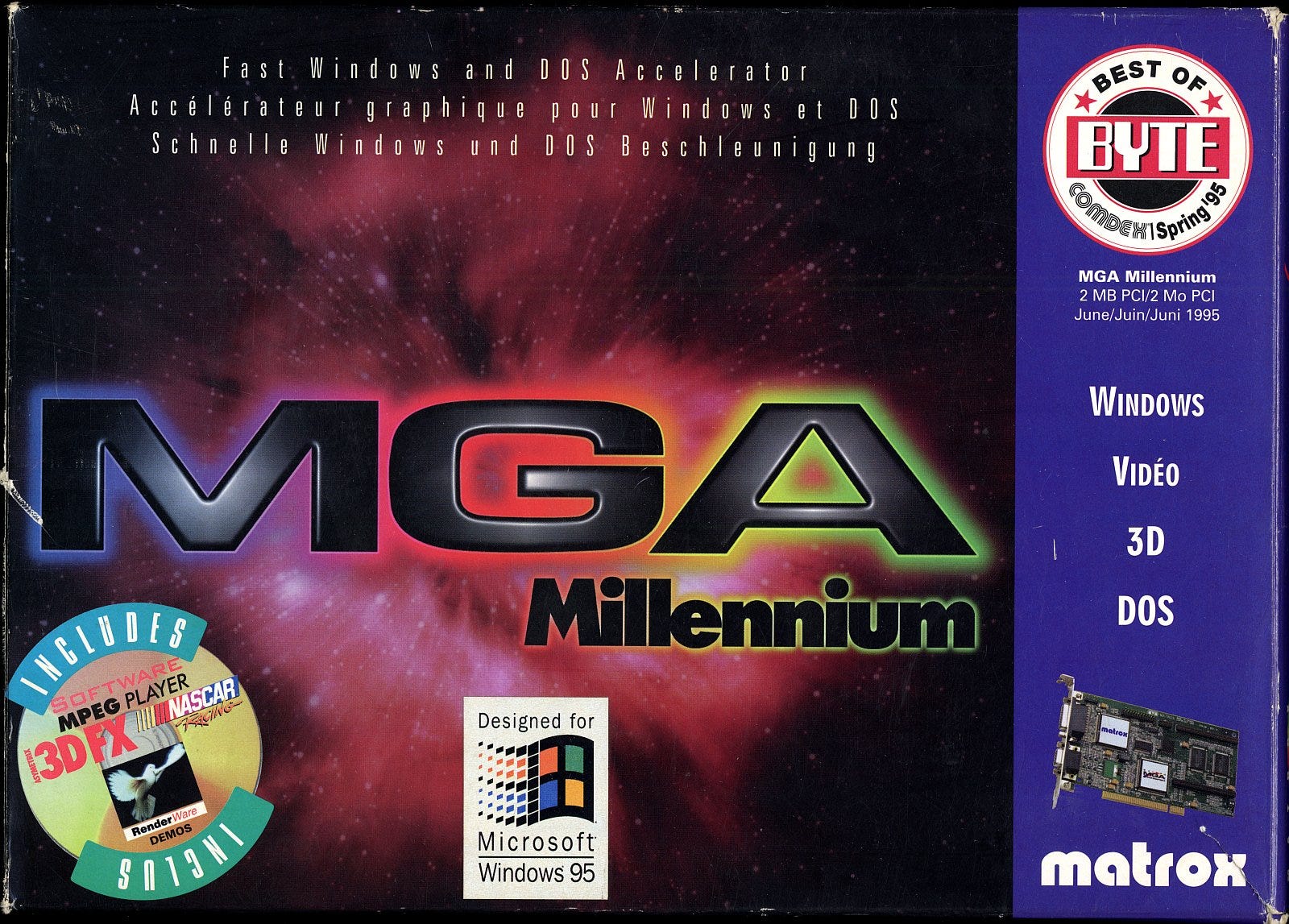
The Matrox Millenium was released in October of 1995, and it set the standard for 2D image quality and Windows GUI acceleration. The PCI card offered 2MB or 4MB of WRAM, was expandable to 8MB, and offered a maximum resolution of 1600 by 1200. It also supported OpenGL and Direct3D.
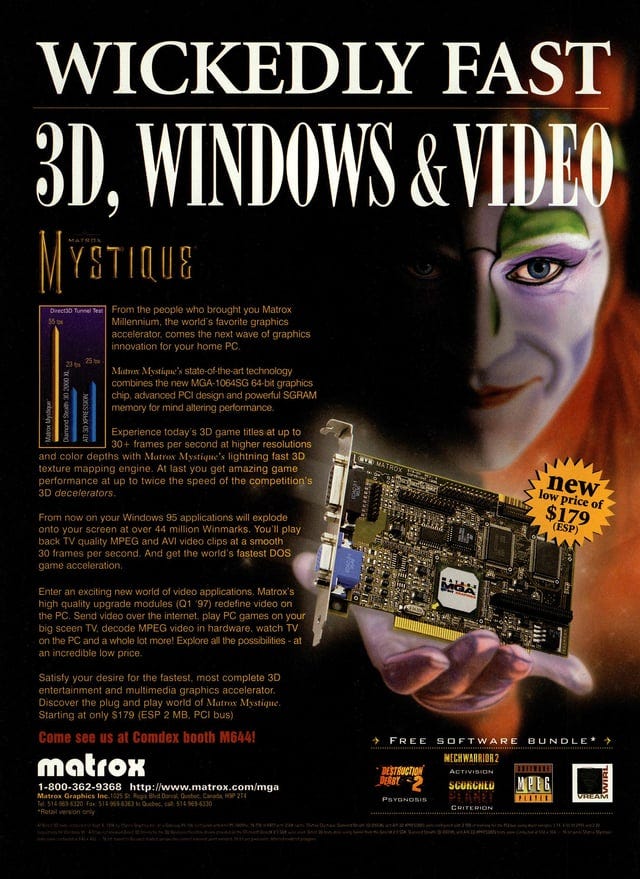
The Matrox Mystique was released to the market in May of 1996. Like the Millenium, the card offered a maximum of 8MB of memory, but this board utilized 64bit SGRAM rather than the more expensive WRAM. With 256 colors, the card could achieve 1600 by 1200; with 64k colors the card could achieve 1024 by 768; and with 16.7m colors the card could offer 800 by 600. It supported Hercules, CGA, EGA, VGA, VESA VBE 2.0, and SVGA standards, and offered a new texturing engine with perspective correction, transparency lookup table, lighting with true color, and dithering. What it lacked was bilinear filtering, fogging, mip-mapping, and anti-aliasing. Despite those limitations, the card wasn’t bad at launch given little competition and the fact that the Mystique could produce 25 million perspective correct, Z-buffered, transparent, Gouraud shaded texels per second for just $499. It also shipped with MechWarrior 2, Destruction Derby 2, and Scorched Planet. The issue was, Matrox’s first consumer-targeted card gained very serious competition a few months later. The first 3dfx Voodoo card would launch on the 7th of October in 1996, and it made Matrox’s performance quite unimpressive. The answer from Matrox was to increase the clock speed. The first Mystique shipped with an MGA chip running at 50MHz and memory at 75MHz, while later revisions would push these figures to 60MHz and 90MHz respectively. The Mystique 220 would launch in August of 1997 and push these clock rates still higher to 66MHz and 99MHz. Ultimately, the Mystique still offered excellent 2D performance but 3D quality (frame rates were generally still good) trailed that of the S3 ViRGE, ATI Mach 64, and Voodoo. Paired with a Voodoo, however, one could have the best 2D and 3D experience on offer.
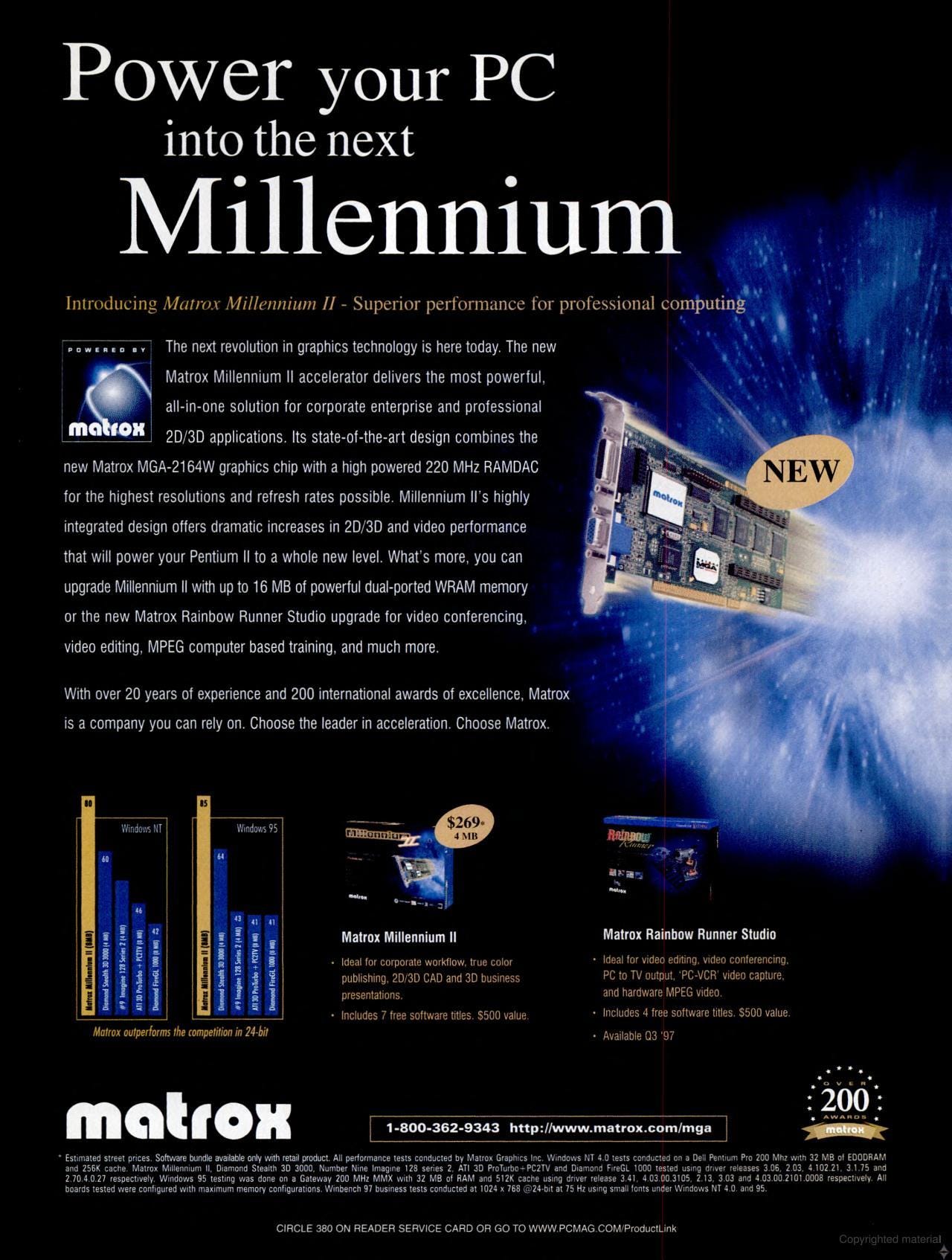
The Matrox Millennium II was released in August of 1997 with a version for PCI and another for AGP. The MGA chip was clocked at 62MHz for PCI and at 66MHz for AGP. The Millennium II wasn’t too different form the Mystique in most regards, but it offered up to 16MB of WRAM, a 32bit Z-buffer, faster and higher quality video playback performance, and up to four monitors offering a combined desktop real estate of 3600 by 2880. Like the elder Millennium, this was a business market card. Prices ranged from $299 to $498 depending upon the RAM size (4MB to 16MB).
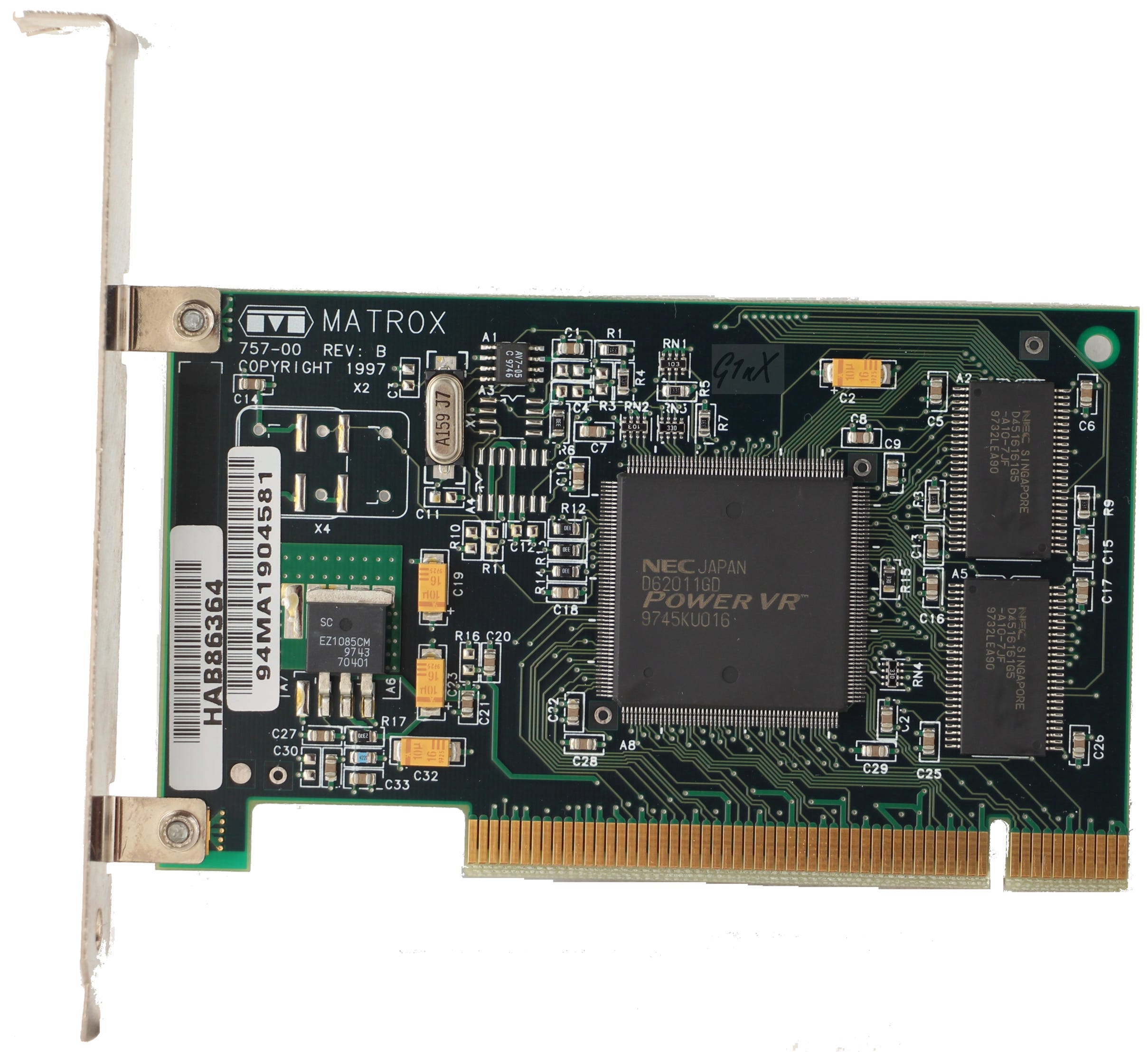
In early 1998, Matrox released the Matrox m3D. This was a dedicated 3D accelerator board designed to work alongside another Matrox graphics card. This was a PCI card that utilized an NEC PowerVR PCX2 (NEC had licensed the IP from VideoLogic), 4MB of SDRAM, and a robust set of drivers. Those drivers were critical for this product as it lacked VGA passthrough, and this also meant that the buyer needed a Mystique, Mystique 220, Millennium, or Millenium II to make full use of the card (any VGA card with at least 2MB of video RAM could be used but with fewer features). In exchange, however, an owner of the m3D could enjoy 3D accelerated gaming at 640 by 480 to 1024 by 768 at 30fps or higher. This AIB provided perspective correct texture mapping, bilinear filtering, MIP-mapping, fogging, alpha-blending, a 32bit Z-buffer, Gouraud shading, and full DirectX 5 support.
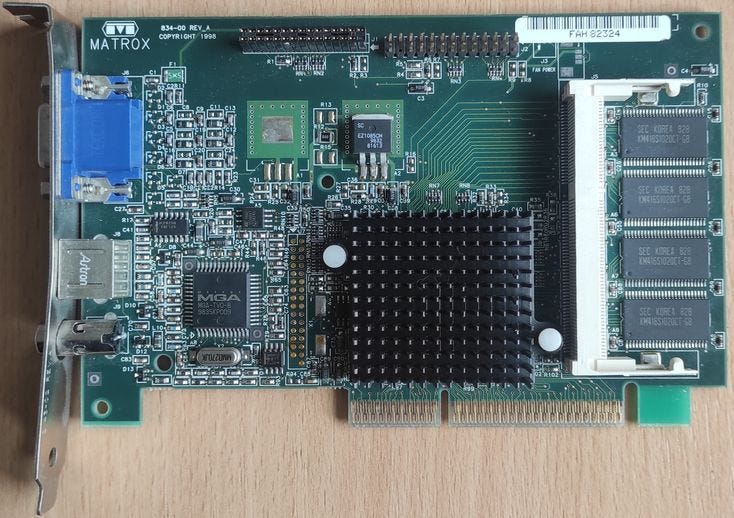
After the m3D, Matrox released the Mystique G100, Mystique G200, and Millennium G200. The G200 was the first fully AGP compliant card from Matrox. The upgraded MGA chip in use on the G200 is a 128bit core with two 64bit unidirectional buses. One bus was used for write and the other for reads allowing some instructions to perform a read and write in the same cycle. With a Ramdac at 230MHz on SDRAM (Mystique line), local memory offered 900MB/s bandwidth. This was higher for the Millennium G200 which used SGRAM and a Ramdac at 250MHz. These cards supported full 32bit color depth, trilinear MIP-mapping, filtering, antialiasing, Direct 3D, and OpenGL. In the early years, the drivers made use of an OpenGL to Direct3D wrapper which hurt performance, but this situation was significantly improved overtime. Overall performance was up to 84 million pixels per second, and the maximum resolution was 1600 by 1200 at 85MHz. Most cards shipped with 8MB of memory, but 16MB versions could support up to 1920 by 1200. The Mystique G100 and Productiva G100 were price-reduced versions of the same cards, but performance on those was closer to the original Mystique than to the G200. Generally, while the G200 was technologically sophisticated and the performance was good, it still couldn’t beat the Voodoo 2, but it was fairly competitive with the RIVA and S3 Savage 3D. Over the years, the G200 saw many revisions and rereleases. It also saw process shrinks that reduced heat, reduced manufacturing costs, and enabled higher clocks. These improvements combined with continued software support from Matrox (with some embedded versions still seeing driver releases as recently as 2025) enabled the MGA chip to be the longest lived video processor in history. The chip found its way into servers from the likes of Dell, HPE, and Fujitsu, and into management platforms from American Megatrends, Cisco, Dell, Intel, Fujitsu, Lenovo, and HP.
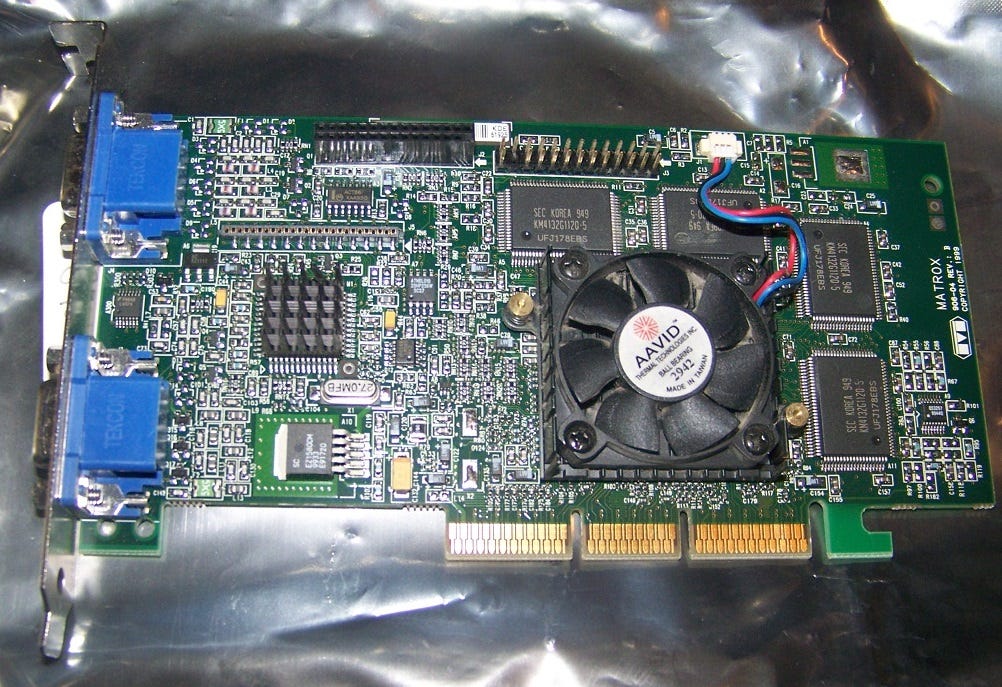
The Matrox G400 was released in 1999. All variants were intended for the AGP bus, and this card provided both 3.3V and 1.5V keys. The result being that this card could operate in either an AGP 1.0 slot or in an AGP 2.0 slot. As is natural, the SKU chosen determined price, RAM, and time of release with lowest cost having been $149 with 16MB released early in the year, mid-range was $199 with 32MB around September, and the high-end was the G400 Max at $249 with 32MB released in December. Those SKUs and prices are also somewhat misleading, as cheaper cards utilized SDRAM at 166MHz while more expensive cards utilized SGRAM at 200MHz. The G400 utilized a 256bit processor with two 128bit buses, a 128bit memory interface, and the 3D engine utilized two pixel pipelines supporting one texture on each, and thus offering dual texturing. The Max was capable of pushing 333 megapixels per second at 166MHz, offered 32bit precision on 3D calculations at 32bit color depth, and supported Direct3D 6.
The G400 was quite a capable card. It offered the ability to drive two monitors and this was fully supported in the drivers Matrox made available. Oddly, the software package also included a DVDMAX mode which could handle video overlays, but the card only accelerated video decompression while accelerating neither DCT nor motion compensation.
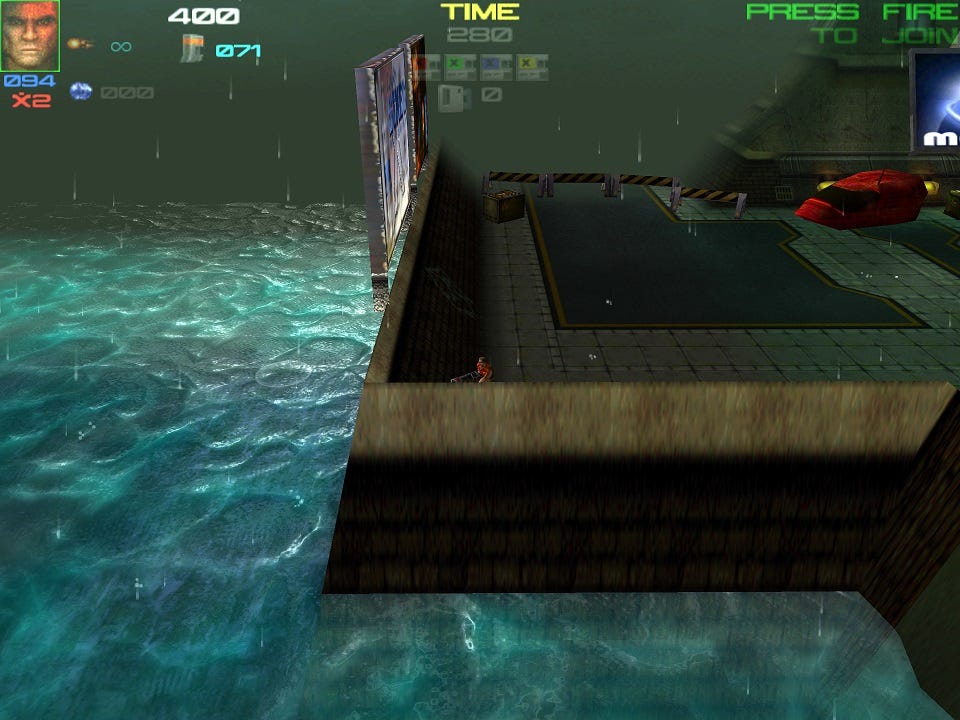
Given a good host CPU, performance on the G400 was great for DirectX titles and not as great for OpenGL titles. Like its predecessors, support for OpenGL began with an OpenGL to DirectX wrapper, but this was eventually replaced with TurboGL which remedied this failing. The card was comparable to the RIVA TNT2, Voodoo 3, and Rage 128 Pro. In some titles, the G400 was better. The issue at the time was more due to a lack of standardization in the software market. Had all popular titles at the time been DirectX, the G400 would have been a clear winner, at least until the launch of DirectX 7. Yet, Glide and OpenGL had some decent market adoption, and this led many to other GPUs. Late in the year, Matrox released the Matrox Tweak Utility allowing users to add V-Sync and tinker with overclocking settings. For some, this may have helped to mitigate any performance drawbacks in some titles, and this especially so as the market was moving quite rapidly at the time.
In the autumn of 2000, the G400 saw a die shrink from 250nm to 180nm, and this was released as the G450. Costs were reduced, memory speeds were increased, and TMDS support was added. The G450 also began using DDR SDRAM and shrank the bus width. This mean higher latencies, but far lower costs. Notably, a variant from Marvel added a TV tuner and some enhancements to the DualHead software.
The G550 supported DirectX 8 with an increase in register count, implementation of a vertex shader, and the addition of hardware transform and lighting. In July of 2005, this card was released for PCIe making it the first PCIe GPU.
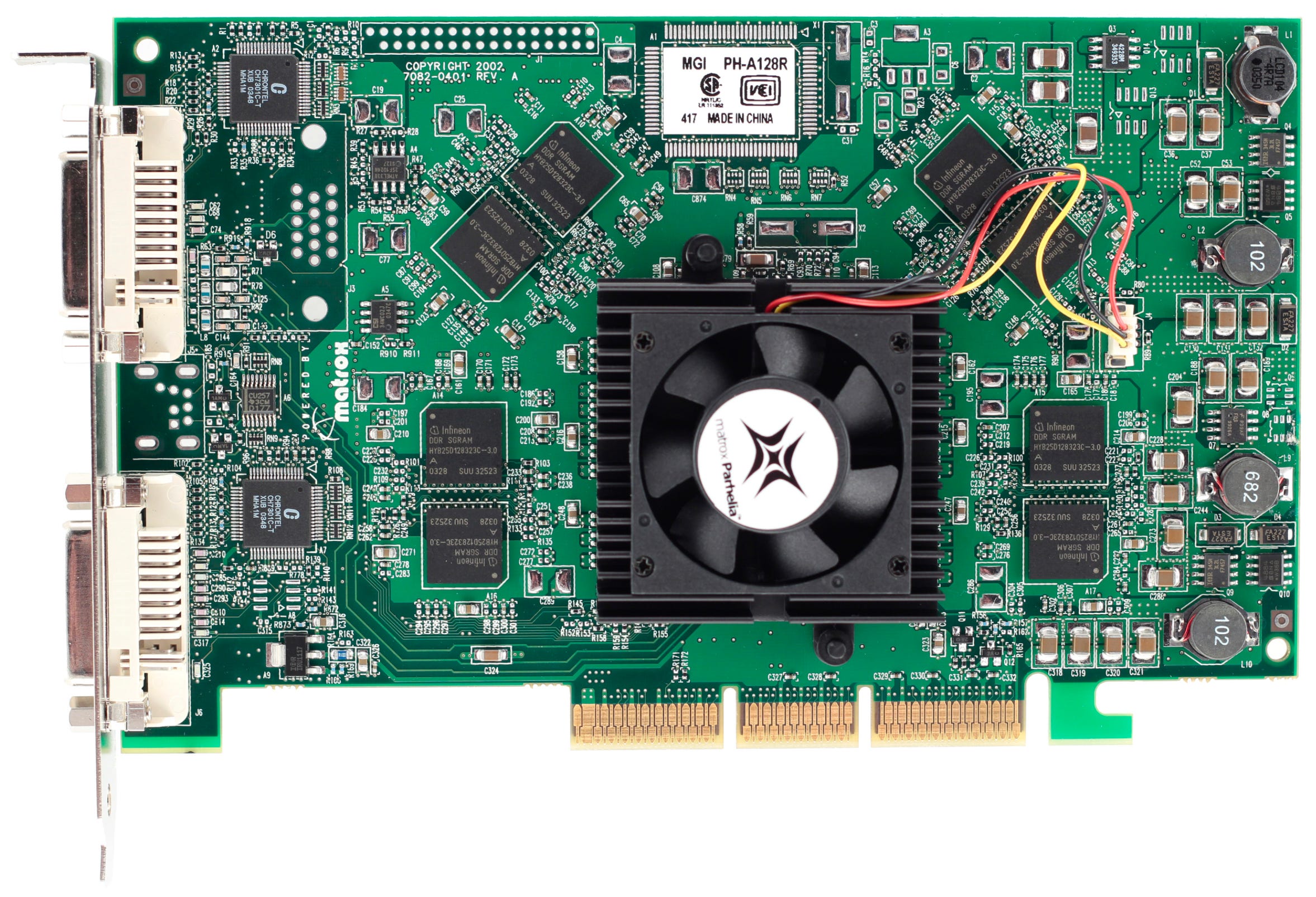
Test samples of the Matrox Parhelia were shipped on the 17th of June in 2002 arriving in testers’ hands over the next few days. The press embargo (in the form of an NDA) was lifted on the 25th, which made for a very short testing phase for the tech press. At this time, the Parhelia shipped in two versions. The cheaper had a clock of 200MHz with 128MB of 256bit DDR at 250MHz, while the more expensive (at nearly $400) had a clock of 220MHz and 128MB of 256bit DDR at 275MHz. The silicon was built on a 150nm process and packed 80 million transistors on chip. The card featured four vertex shaders, four pixel pipelines, three monitor outputs (when using adapters), FSAA, anisotropic filtering, 10bits per color channel, and a max resolution of 3840 by 1024. The gaming performance of the Parhelia was, on average, slightly behind the ATI R8500 128MB which in turn was slightly behind the NVIDIA GeForce 4600 Ti. In around half of the most popular gaming titles of the time, the Parhelia could pull ahead of ATI, but it didn’t best the Nvidia. Where the Parhelia excelled was screen real estate and image quality, and in those realms it was unmatched. Despite being an excellent contender, for the price of a Parhelia one could have bought two Radeons. As the Parhelia failed to gain traction, Matrox abandoned the gaming market in 2003.
On the 17th of December in 2004, the company announced the QIP LP PCIe where the QIP meant Quad Information Display. This was the industry’s first PCIe x16 graphics card, and it was a derivative of the Parhelia. It shipped with 128MB of DDR, a core clock of 300MHz, dual 128bit memory buses yielding a memory bandwidth of 9600MB/s, two pixel pipelines, eight texture units, two vertex shaders, two pixel shaders, and pixel filtrate of 600MP/s. The card could drive four displays with a maximum resolution of 1600 by 1200 per display, but these were attached with the proprietary KX20 connector. The card supported DirectX 8.1. Derivatives of this card were sold until June of 2011.
The company continued to make embedded graphics chips, but the focus shifted to external multi display adapters, graphics wall adapters like the M9188, digital signage controllers, advanced video capture devices, and some encode/decode accelerators.
In September of 2014, Matrox released the C680 and C420 GPUs that made use of AMD’s Cape Verde chips. The C420 was a low-profile half-length card supporting four displays over mini-displayport 1.1 with a 128bit memory interface, 2GB of GDDR5, and a maximum resolution per display of 2560 by 1600. The C680 was full-height, half-length, and actively cooled. This card could drive six displays at 4K 30Hz or three displays at 4k 60Hz. These were still not expected to be consumer parts.
On the 6th of September in 2019, Lorne Trottier acquired 100% of the company. At this point, Matrox had seven hundred employees, and consisted of Matrox Imaging focused on machine vision hardware and software, frame grabbers, smart cameras, and deep learning, Matrox Graphics focused on display controllers, AV-over-IP encoders/decoders, KVMs, and associated software, and Matrox Video which focused on broadcast hardware and software technologies.
On the 6th of June in 2022, Zebra Technologies purchased the Matrox Imaging division which focused on machine vision hardware and software.
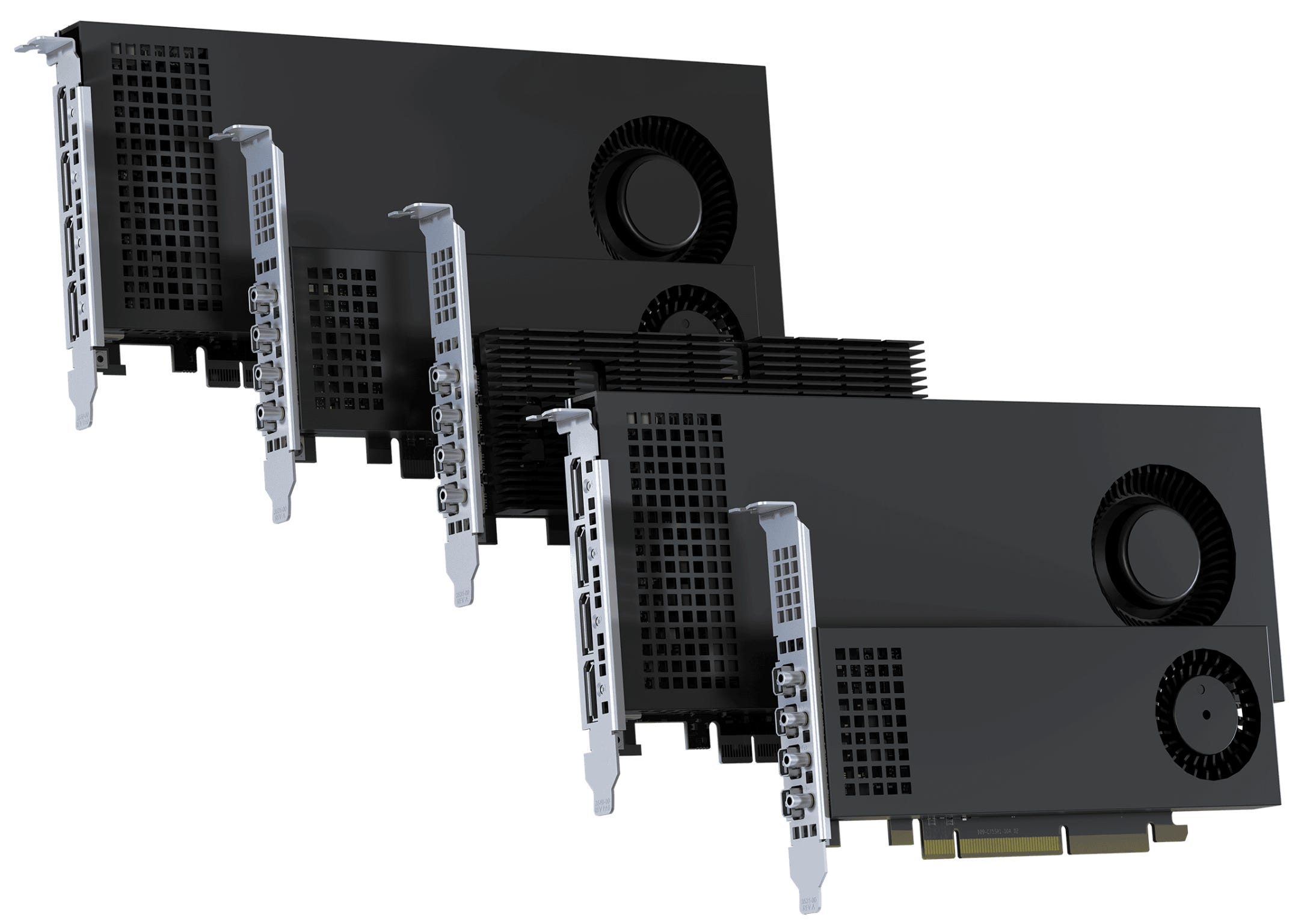
In the Spring of 2023, Matrox released the Luma series of GPUs build around the Intel ARC A310 and A380. These cards were intended for industrial, digital signage, and medical use cases supporting up to two 8K displays at 60Hz, or 5K displays at 120Hz, or four displays at 5K 60Hz. All configurations supported HDR 12b and had a TDP of 75W drawing all power form the PCIe expansion slot and requiring no supplemental power via PCIe power connectors.
Matrox is an amazing company whose story spans quite a breadth of time. They were first in many technologies and a powerful contender in others. My own history with Matrox involved a Mystique. Games like Destruction Derby, Mechwarrior, Quake, Unreal, SimCity 2000, and Civilization II were brought to life by the card, and while some may have said that the Mystique was a poor performer, I certainly didn’t think so. The many statements about the picture quality offered by the card are accurate. At the time, it was superb. Then, later in life, Matrox chips were in many servers I happened to work with, and I was pleased to see the company name. Thank you to Mr. Trottier and all of the many Matrox employees over the decades!
My dear readers, many of you worked at, ran, or even founded the companies I cover here on ARF, and some of you were present at those companies for the time periods I cover. A few of you have been mentioned by name. All corrections to the record are sincerely welcome, and I would love any additional insights, corrections, or feedback. Please feel free to leave a comment.
No posts
Comments
Nothing yet. Say the first thing.
Sign in to join the conversation.