
In the summers, we visited my grandparents at Leisure Village, a planned retirement community near the Jersey shore. First developed in 1968, the Village was a series of red-brick duplexes scattered between manicured walkways, bordered by hostas and garden gnomes. All paths led to the Clubhouse—where Elsie and Clifford would meet their friends for swimming, Canasta, Mah Jong and square dancing.
Its name was very intentional; when it was founded, the concept of leisure was still unique, certainly a luxury to my grandparents’ Depression-era generation. Theirs was a community who’d scrimped and saved their pennies, and were ready for the reward.
In the garage, my grandfather’s stamp and coin collections were laid out on aluminium folding tables. To the side, my grandmother’s painting easels. Also in the garage: an oversized, 3-wheeled bicycle we could take turns riding, slowly, along the empty streets. If we (their five grandchildren) went to the Clubhouse, there were strict rules of conduct: No running, no shouting—and for God’s sake, keep that bathing cap firmly suctioned to your head.
I thought about my grandparents after I was diagnosed with Stage 4 cancer, facing a decidedly uncertain future. After my diagnosis, I decided there was no more need to dwell in the midlife mindset, grinding it out with work and obsessing about saving for the future. If I wanted a full life, I was going to have to fast-track a few things.
It was time for my Golden Years.
Making a Plan
In the first few months after my diagnosis, thoughts of cancer kept me in a fog. First, I was waiting for body scan results and news of where the cancer had spread to. In those weeks, the world seeming to move in slow motion and my mind raced with constant thoughts of, “This may be my last time doing this…my last time being at this place...”
Dr Gary Rodin, a psychosocial oncology expert I’ve had on my podcast, describes the period following a stage 4 diagnosis as a kind of PTSD for some patients. That was my experience. Looking back…I was not entirely present. We were all grieving as a family, too. Not just the losses we knew, but those we were anticipating.
We held each other closer and that was comforting. But the air felt thinner, too
Then I had surgery and things changed again. During recovery, time compressed into the immediate moment—a bowl of soup, a phone call, a walk to the patio and the wonder of sunlight. After I was healed from surgery and I had the diagnostic information I needed (+ my new meds), I began contemplating: Since I didn’t know how much time I had left, what parts of life had I missed? What did I want to pursue?
I took the opportunity to re-organize how I lived, arranging my choices into 3 categories: Quitting, Doing the Things, and Basking.
Quitting
My first step in semi-retirement was to give up all the freelance work I didn’t like, and just take the jobs I like. I don’t have the same energy I used to, and there’s no way I’m going to spend my Golden Years—my Golden Years! —writing grants or ghostwriting inspirational whatnot. I was ruthless in dumping clients, with no exceptions. (Because I’d also quit falling for guilt trips.)
Another thing I quit was social media. I know there are spaces there to find support for my cancer struggle, but I weighed this against the exhaustion of having 2,000 acquaintances and debating whether to use a heart or thumb emoji. The socials had to go. I kept only my Substack (where I publish) and WhatsApp (for my volunteer & friend groups.)
I also did a “quiet-quit”; I stopped listening to people talk about their futures. Gone were the days when I was willing to sit on a restaurant patio on an absolutely gorgeous, God-given day and listen to someone yammer about their retirement savings plan. Socializing in my golden years is about being in the moment, telling stories, connecting and having fun. More than ever, I’m drawn to people who are grounded in this week/this moment, and enjoying life.
I will be long dead before these folks are Nordic-walking to the Soylent café or whatever they’ll be doing—so I’ve tuned out
Which brings me to the next part of my grow-old-fast project: Doing.
Doing The Things
Once I figured out what I’d quit, I had to decide what to keep. There were some easy choices for now: my podcasts and writing; volunteering (a big part of my life); and religion. Each of these I can tailor based on what I feel up for, but they also require a commitment (in body and spirit) that keeps me from sinking into solitude. I do not want to lose a sense of purpose, and I can’t live a life without greater meaning. Ergo, my days have to centre on things other than myself and my cancer.
There’s another part of this step: New adventures. I’m not talking about a bucket list, with its grim sense of urgency. I’m talking about my grandparents’ sense of the quotidian—hobbies and pursuits that require slowing down while still doing. I got Elsie’s Mah Jong set down from my linen closet and joined a Mahj meetup. I also started saying yes to more social things that I liked doing but had tended to skip in favour of work.
I now read more (awesome) books that aren’t related to my work. I’d been denying myself time for this—time I’d really always had
And by the way, cancer wasn’t invited along to any of The Things. I learned quickly not to have conversations about my health when I’m out, because these conversations (which the other person can easily pivot from) are a big fucking drag for me. So now, when people ask how I’m feeling, I tell them they can give me a call if they want an update…another time.
Speaking of the telephone, I started picking that up more, too. Now that I am pseudo-elderly, my friends and family expect to see my name light up in their hand, interrupting the doomscroll. And here, I have some advice: If you get along at all with your family, phone them up more often. Listen closely to their mundane stories, as if they are the masterful story-weavers of our times. Because these are stories that matter. Each becomes a volume in a reassuring internal library, one you can only access later if you are present for them now.
Basking
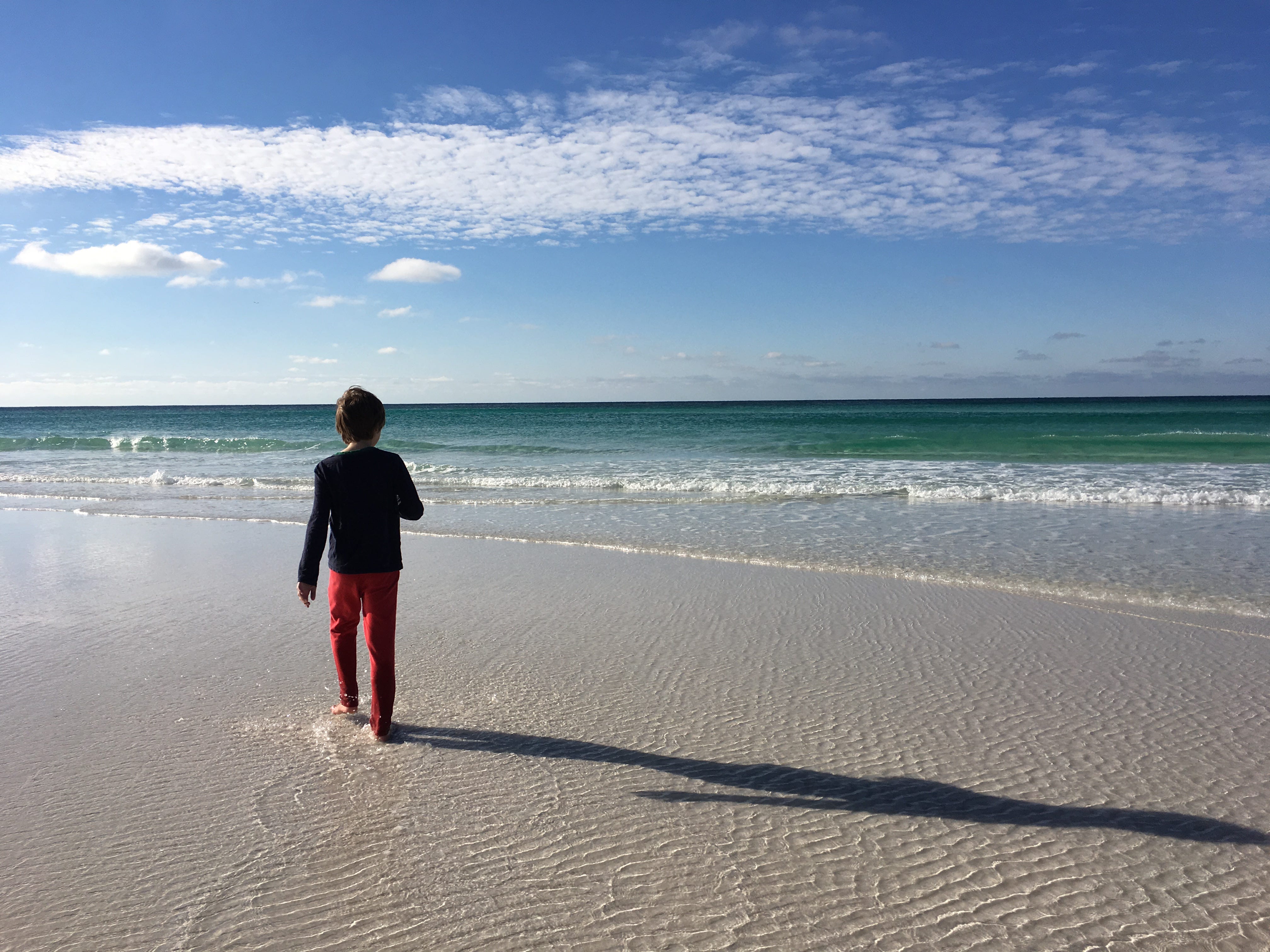
Sometimes, my grandparents would take a break from their leisure routine to drive us to the Jersey shore. The beach was a place we could run like gazelles and shriek like hyenas, racing down the sand past my grandparents, who stood like shadows drifting in the brilliant light of the sea.
When we got back to the Village, Elsie would get to work on dinner, and Clifford would retire to his La-Z-Boy, napping in the centre of the living room as we continued to run about, giddy with exhaustion.
I used to wonder why my grandfather didn’t just go take a nap, with his bedroom door closed. But now I know why: He was basking.
It’s quite difficult to be slowed down when everyone around you has more energy. But the wisdom of age is knowing that even though you’re not as fast as everyone else, you’re still present. For the elderly, this might be a gradual process, over years. For those with illness, it can be very sudden. Basking is an art that takes practice.
It’s about knowing you still belong, somewhere adjacent to the clatter of family & community
Looking back on my retirement so far, I’ve realized something that’s weirdly quite comforting: None of us really know how much time we have left. If indeed there is a book of life, we don’t get to peek in the covers. No matter what, even if we make the cosmic promises, or beat our chests as we sing to the skies, we do not know what the future holds. My approximation of being old, like all the guesswork of this life, just brings me a little closer to the plans and hopes I had.
Comments
Nothing yet. Say the first thing.
Sign in to join the conversation.