
This chapter delves into the process of adapting, evaluating, and debugging Large Language Models (LLMs) to enhance their performance on downstream tasks. LLMs, such as GPT-3 and BERT, have shown remarkable capabilities in understanding and generating human-like text. However, their effectiveness is largely dependent on their ability to be fine-tuned for specific tasks, domain adaptation, and continuous learning. This chapter provides a comprehensive overview of various techniques and considerations involved in these processes, from task-specific fine-tuning to domain adaptation and the ethical implications of LLM development.
Fine-tuning LLMs involves adjusting the model's parameters to better suit a particular task or domain, ensuring the model generalizes well from the training data. This process includes employing task-specific heads, unfreezing subsets of parameters for more efficient training, and leveraging advanced fine-tuning techniques such as RLHF-based fine-tuning, Direct Preference Optimization (DPO), and Contrastive Preference Learning (CPL). Domain adaptation, on the other hand, focuses on adapting a pre-trained LLM to a new domain, which is crucial for tasks in specialized fields like medicine or finance. Techniques such as intermediate pre-training and data augmentation are explored to improve the model's performance on the new domain.
The chapter also addresses the importance of evaluating LLMs using various metrics and human evaluations to ensure their performance meets the required standards. Ethical considerations in LLM development are discussed, highlighting the need for responsible AI practices. Debugging techniques, including visualizing attention and gradient analysis, are presented to identify and resolve issues within the model. Finally, the chapter concludes with a look at the latest research trends in fine-tuning, adaptation, evaluation, and debugging of LLMs, providing insights into the ongoing advancements in this field.
In this chapter, we will cover the following topics :
Fine-tuning techniques for specific tasks
Domain adaptation and transfer learning
Continuous learning and model updates
Evaluation metrics for LLMs
Ethical considerations in LLM development
Debugging techniques for LLMs
Latest research trends in fine-tuning, adaptation, evaluation, and debugging of LLMs
Fine-tuning large language models (LLMs) is the process of adjusting a pre-trained model to better suit specific tasks or domains. This is accomplished by training the model on a dataset tailored to the targeted task or domain, which helps the model make more accurate predictions or generate more precise responses.
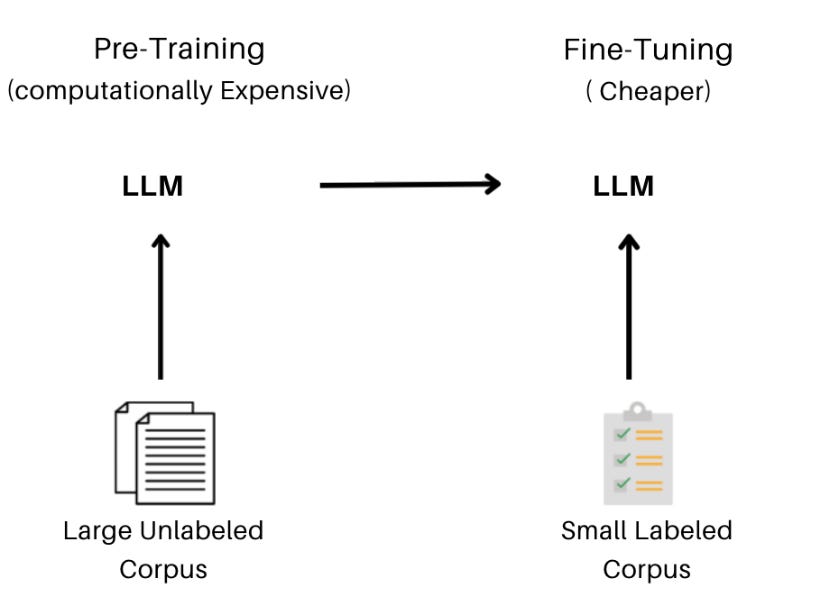
Supervised Fine-Tuning (SFT): This involves further training a pre-trained language model on a smaller, task-specific dataset under human supervision to adapt its general knowledge to specific tasks or domains. For example, a model like LLaMA2 can be specialized for medical data analysis through SFT on a dataset of medical texts and patient records. SFT contrasts with unsupervised learning, where the model learns from data without explicit labels, and it aims to enhance the model's accuracy and relevance in specific domains or tasks.
Reinforcement Learning from Human Feedback (RLHF): An advanced fine-tuning technique that refines language models' performance by training them using feedback from human interactions. Human evaluators provide inputs and rate or correct the model's outputs, guiding the model to learn preferred or more accurate responses in given contexts. RLHF is particularly useful for complex, subjective tasks like conversation generation and creative writing, helping the model understand nuances and subtleties in human communication.
Prompt Template: A method used to guide the model in generating specific types of outputs by creating templates or patterns. These templates set the context or format and allow the model to fill in information based on the input, useful for generating responses that conform to certain standards or formats.
Parameter-Efficient Fine-Tuning (PEFT) with LoRA or QLoRA: A technique that allows fine-tuning LLMs without updating all model parameters, focusing on a subset of parameters to make the process more efficient. LoRA (Low-Rank Adaptation) modifies only the weights of certain layers within the model, while QLoRA (Quantized Low-Rank Adaptation) quantizes the model's parameters to reduce the model's memory footprint and computational requirements, making it suitable for resource-constrained environments.
Large Language Models (LLMs) have revolutionized the way we approach text analysis and generation. One of the critical aspects of leveraging LLMs effectively is the ability to fine-tune them for specific tasks, ensuring they perform optimally on the intended applications. A significant component of this fine-tuning process is the use of task-specific heads.
Task-specific heads are the final layers of a neural network that are specialized for a particular task. In the context of LLMs, these heads are designed to take the output of the base model and adapt it to the specific requirements of the task at hand, such as sentiment analysis, question answering, or text summarization. By tailoring these heads to the task, we can significantly improve the model's performance and ensure it meets the requirements of the specific application.
For instance, consider a scenario where you are fine-tuning a model for sentiment analysis. A task-specific head for this purpose might involve a dense layer followed by a softmax activation function to output probabilities for each sentiment class (e.g., positive, negative, neutral). This is in contrast to a base model that might be pre-trained on a broad range of text data, without any task-specific adaptations.
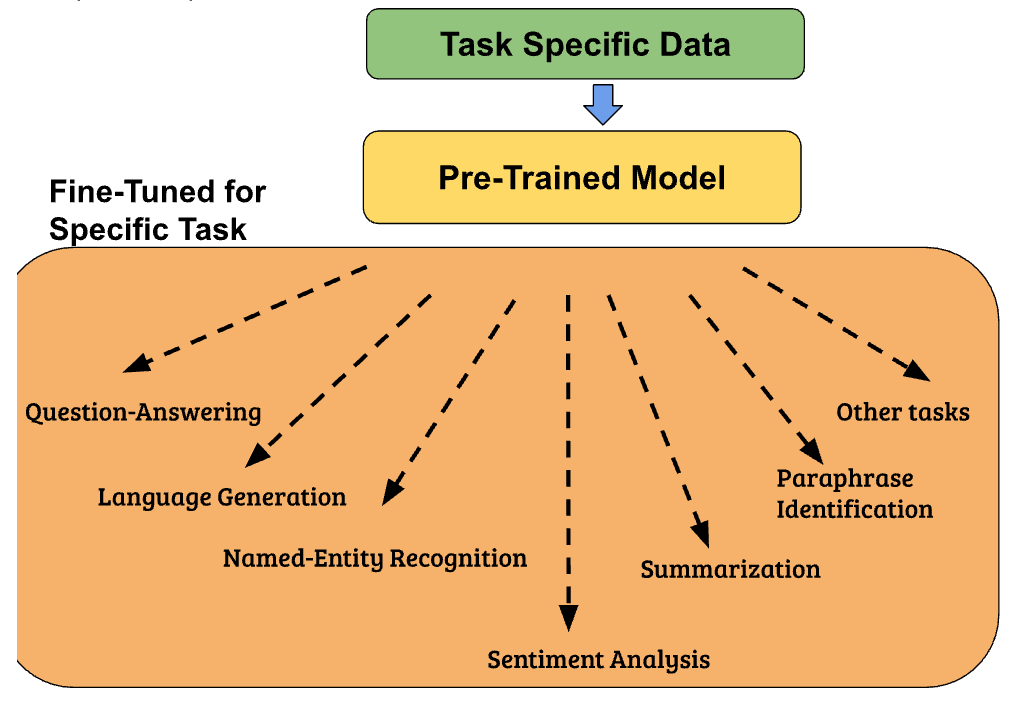
Task-specific heads fine-tuning is a strategy in machine learning, particularly with large language models (LLMs), where the fine-tuning process is tailored to the specific task at hand. This approach involves adjusting the model's task-specific head (the final layer or layers of the model that are responsible for the output related to the task) before the fine-tuning process begins. The key idea is to adapt the features learned by the model to better suit the downstream task, which often involves different types of data or objectives compared to the pre-training data.
Let's consider a simplified example using the Hugging Face Transformers library, which is widely used for working with LLMs like BERT, GPT-3, etc. The example will focus on fine-tuning a model for a sentiment analysis task, which is a common task for LLMs.
First, ensure you have the necessary libraries installed. You can install the Hugging Face Transformers library using pip:
!pip install transformersPrepare Your Dataset For this example, let's assume you have a dataset of text and their corresponding sentiment labels (e.g., positive, negative). We'll use the datasets library to load the IMDB dataset and preprocess it for our model.Your dataset should be split into training and validation sets.
from datasets import load_dataset
from transformers import BertTokenizer
# Load the IMDB dataset
dataset = load_dataset('imdb')
# Split the dataset into training and test sets
train_dataset = dataset['train']
test_dataset = dataset['test']
# Load the tokenizer
tokenizer = BertTokenizer.from_pretrained('bert-base-uncased')
# Tokenize the dataset
def tokenize(batch):
    return tokenizer(batch['text'], padding=True, truncation=True, max_length=512)
train_dataset = train_dataset.map(tokenize, batched=True, batch_size=len(train_dataset))
test_dataset = test_dataset.map(tokenize, batched=True, batch_size=len(test_dataset))
# Set the format of the dataset
train_dataset.set_format('torch',columns=['input_ids', 'attention_mask', 'label'])
test_dataset.set_format('torch',columns=['input_ids', 'attention_mask', 'label'])
Before fine-tuning, you need to define a task-specific head. For sentiment analysis, this could be a simple linear layer that maps the output of the LLM to the number of sentiment classes (e.g., 2 for positive and negative).
from transformers import BertModel, BertTokenizer
import torch.nn as nn
class SentimentAnalysisHead(nn.Module):
    def __init__(self, num_classes):
        super(SentimentAnalysisHead, self).__init__()
        self.linear = nn.Linear(768, num_classes)  # Assuming BERT base model
    def forward(self, x):
        return self.linear(x)
Now, you can proceed with the fine-tuning process. Load the pre-trained model and attach the task-specific head. Then, train the model on your dataset.
from transformers import BertForSequenceClassification, Trainer, TrainingArguments
# Load pre-trained BERT model
model = BertForSequenceClassification.from_pretrained('bert-base-uncased', num_labels=2)
# Attach the task-specific head
model.classifier = SentimentAnalysisHead(num_classes=2)
# Define training arguments
training_args = TrainingArguments(
    output_dir='./results',
    num_train_epochs=3,
    per_device_train_batch_size=16,
    per_device_eval_batch_size=16,
    warmup_steps=500,
    weight_decay=0.01,
    logging_dir='./logs',
)
# Initialize the Trainer
trainer = Trainer(
    model=model,
    args=training_args,
    train_dataset=train_dataset,  # Your training dataset
    eval_dataset=val_dataset,  # Your validation dataset
)
# Start fine-tuning
trainer.train()
The task-specific head is designed to adapt the model's output to the specific task. In this example, we replace the final layer of the BERT model with a custom linear layer suitable for sentiment analysis.The model is fine-tuned on the sentiment analysis dataset. The pre-trained weights of the model are updated to better suit the task, while the task-specific head is trained from scratch.This strategy allows the model to leverage the knowledge learned during pre-training and adapt it to the specific task, potentially improving performance on the task.
The use of task-specific heads is a powerful technique for adapting LLMs to specific NLP tasks, enabling developers to leverage the vast capabilities of these models in a more targeted and effective manner.
Parameter-Efficient Fine-Tuning (PEFT) represents a novel approach to adapting Large Language Models (LLMs) for specific tasks, focusing on enhancing efficiency and effectiveness in resource-constrained environments. This method stands out by selectively training a small subset of parameters within a pre-trained LLM, while keeping the majority of the model's parameters frozen. This strategy not only reduces computational costs and memory requirements but also mitigates the risk of catastrophic forgetting, a common issue with full fine-tuning, where the model's performance on the original task deteriorates as it learns to perform the new task.
PEFT leverages the power of low-rank adaptation (LoRA), a reparameterization technique that introduces new, low-rank parameters to the model. These new parameters are specifically designed to adapt the model to the new task, allowing for a more focused and efficient fine-tuning process. By replacing the original projection matrices with the new custom LoRA layers, the model can be fine-tuned in a way that is both memory-efficient and effective in capturing task-specific nuances.
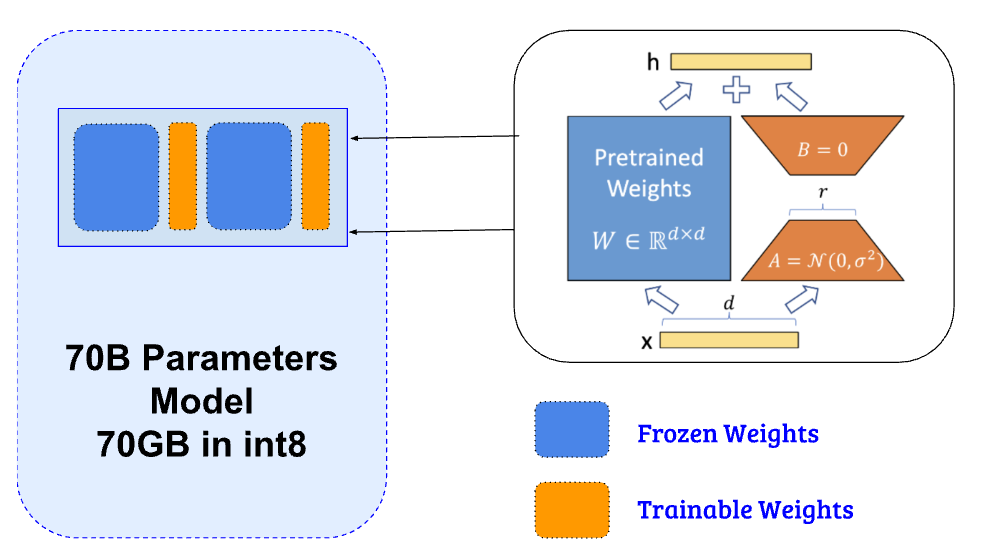
Hugging Face's PEFT implementation introduces a method where the pre-trained model parameters are frozen during fine-tuning, while a minimal set of trainable parameters, known as adapters, are added on top. These adapters are specifically designed to learn task-specific information, significantly reducing both the memory footprint and computational demands associated with fine-tuning.The PEFT method is particularly advantageous for scenarios where resources are limited or when the goal is to achieve comparable performance to fully fine-tuned models with significantly lower computational and storage costs. This efficiency is achieved by training only a fraction of the model's parameters, with the adapters being orders of magnitude smaller than the full model, facilitating easier sharing, storage, and loading.To implement PEFT using Hugging Face's library, you first need to install the PEFT library using:
!pip install peftOnce installed, to integrate PEFT, we'll use the get_peft_model function from the PEFT library to prepare our model for fine-tuning with PEFT. We'll choose LoRA as our PEFT method for this example, which is a popular choice for efficient fine-tuning.
from transformers import AutoModelForSequenceClassification
from peft import get_peft_config, get_peft_model, LoraConfig, TaskType
# PEFT configuration
peft_config = LoraConfig(
    task_type=TaskType.SEQ_2_SEQ_LM, inference_mode=False, r=8, lora_alpha=32, lora_dropout=0.1
)
# Load pre-trained BERT model
model = AutoModelForSequenceClassification.from_pretrained('bert-base-uncased', num_labels=2)
# Prepare the model for PEFT
model = get_peft_model(model, peft_config)
This code snippet showcases how to apply the PEFT method to a model, specifically using the LoRA configuration.LoraConfig is used to specify the configuration for LoRA adaptation. This includes:
task_type: Specifies the type of task the model is being fine-tuned for. In this case, it's SEQ_2_SEQ_LM, indicating sequence-to-sequence language modeling.
inference_mode: When set to False, it means the model is being configured for training. If True, it would be for inference.
r: The rank of the low-rank matrices used in LoRA. Here, it's set to.
lora_alpha: The scaling factor for the low-rank matrices in LoRA. A higher value means more fine-tuning, while a lower value restricts it.
lora_dropout: The dropout rate applied to the low-rank matrices in LoRA to prevent overfitting.
By doing so, only a small fraction of the model's parameters are trained, significantly reducing the computational and storage requirements while maintaining or even improving performance on the target task.
The following session will take you through the steps required to fine-tune Llama 2 with an example dataset, using the Supervised Fine-Tuning (SFT) approach and Parameter-Efficient Fine-Tuning (PEFT) using LoRA.We will use the Guanaco dataset from HuggingFace, which provides examples of 175 language tasks specifically designed for English grammar analysis, natural language understanding, cross-lingual self-awareness, and explicit content recognition. The dataset has 534,530 entries.Here is the full script, which you can run in a Jupyter notebook, assuming it has access to a GPU and sufficient memory. Below we’ll run through the code to explain how it works.
The code below installs the required libraries. We will install the accelerate, peft, bitsandbytes, transformers, and trl. The transformers library provides access to pre-trained models and tokenizers, while bitsandbytes aids in efficient model quantization.
Note that if you are not using a Jupyter notebook, you’ll need to run this outside the script.
%pip install accelerate==0.21.0 peft==0.4.0 bitsandbytes==0.40.2 transformers==4.31.0 trl==0.4.7We’ll import required classes and functions. In particular, torch is the core library for PyTorch, a machine learning framework. load_dataset loads the training data. AutoModelForCausalLM and AutoTokenizer from transformers are used for loading the model and tokenizer, respectively. Others like BitsAndBytesConfig, TrainingArguments, pipeline, and logging provide configuration and utility functions.
import os
import torch
from datasets import load_dataset
from transformers import AutoModelForCausalLM, AutoTokenizer, BitsAndBytesConfig, TrainingArguments, pipeline, logging
from peft import LoraConfig
from trl import SFTTrainer
Now, we’ll define the base model for fine-tuning and the dataset to use. We’ll set variables for the base model (NousResearch/Llama-2-7b-chat-hf), the dataset (mlabonne/guanaco-llama2-1k), and provide a name for the new model.
base_model = "NousResearch/Llama-2-7b-chat-hf"
guanaco_dataset = "mlabonne/guanaco-llama2-1k"
new_model = "llama-2-7b-chat-guanaco"
Next, we’ll fetch and prepare the dataset for training. The load_dataset function retrieves the specified dataset from Hugging Face. Here, the instruction split="train" indicates we are using the training part of the dataset.
dataset = load_dataset(guanaco_dataset, split="train")We now need to configure the model for efficient training on consumer-grade hardware. This step sets up 4-bit quantization for the model using BitsAndBytesConfig. It's a way to reduce the model's memory footprint and computational requirements without significantly sacrificing performance.
compute_dtype = getattr(torch, "float16")
quant_config = BitsAndBytesConfig(load_in_4bit=True, bnb_4bit_quant_type="nf4", bnb_4bit_compute_dtype=compute_dtype, bnb_4bit_use_double_quant=False)
The next step is to initialize the base model with the specified quantization settings. The AutoModelForCausalLM.from_pretrained function loads a pre-trained causal language model. It's configured to use the 4-bit quantization settings defined earlier. The use_cache and pretraining_tp settings optimize the model's training behavior for improved performance.
model = AutoModelForCausalLM.from_pretrained(base_model, quantization_config=quant_config, device_map={"": 0})
model.config.use_cache = False
model.config.pretraining_tp = 1
Now, we’ll prepare the tokenizer to process text from the training dataset, in line with the model's requirements. The tokenizer converts text into a format that the model can understand. Setting padding_side to "right" addresses specific issues with fp16 (16-bit floating-point) operations.
tokenizer = AutoTokenizer.from_pretrained(base_model, trust_remote_code=True)
tokenizer.pad_token = tokenizer.eos_token
tokenizer.padding_side = "right"
We’ll now configure fine-tuning by updating a small subset of the model's parameters, using the LoRA (Low-Rank Adaptation) method. The LoraConfig class specifies settings for Parameter-Efficient Fine-Tuning (PEFT). Parameters like lora_alpha, lora_dropout, r, and bias define the architecture and behavior of the LoRA layers used for efficient fine-tuning. The task_type is set to "CAUSAL_LM" since LLaMA 2 is a causal language model.
peft_params = LoraConfig(lora_alpha=16, lora_dropout=0.1, r=64, bias="none", task_type="CAUSAL_LM")The next step is to define settings that control the training process. TrainingArguments sets up important training parameters like batch sizes, learning rate, weight decay, and others. Each parameter, such as num_train_epochs or learning_rate, controls a specific aspect of the training, like the number of epochs the model will train for or the initial learning rate for the optimizer.
training_params = TrainingArguments(output_dir="./results", num_train_epochs=1, per_device_train_batch_size=4, gradient_accumulation_steps=1, optim="paged_adamw_32bit", save_steps=25, logging_steps=25, learning_rate=2e-4, weight_decay=0.001, fp16=False, bf16=False, max_grad_norm=0.3, max_steps=-1, warmup_ratio=0.03, group_by_length=True, lr_scheduler_type="constant", report_to="tensorboard")Finally, we can start the actual fine-tuning process of the model with the dataset. SFTTrainer is used to train the model using the defined parameters. It takes the model, dataset, PEFT configuration, tokenizer, and training parameters as inputs and packs them into a training setup. This step is where the model learns from the new dataset.
trainer = SFTTrainer(model=model, train_dataset=dataset, peft_config=peft_params, dataset_text_field="text", max_seq_length=None, tokenizer=tokenizer, args=training_params, packing=False)To execute the training process, we’ll run the train() method of SFTTrainer. It adjusts the model's weights based on the input data and training parameters.
trainer.train()Now that training has run, we need to save the fine-tuned model and evaluate its performance.
We’ll use Tensorboard to visualize training metrics, aiding in evaluating the model's performance.
trainer.model.save_pretrained(new_model)
trainer.tokenizer.save_pretrained(new_model)
from tensorboard import notebook
log_dir = "results/runs"
notebook.start("--logdir {} --port 4000".format(log_dir))
We can now test the fine-tuned model's capabilities, with a simple prompt to generate text. This is done using the pipeline function, which is a high-level utility for text generation. The output reflects how well the model has adapted to the new data.
logging.set_verbosity(logging.CRITICAL)
prompt = "Who is  Isaac Newton?"
pipe = pipeline(task="text-generation", model=model, tokenizer=tokenizer, max_length=200)
result = pipe(f"<s>[INST] {prompt} [/INST]")
print(result[0]['generated_text'])
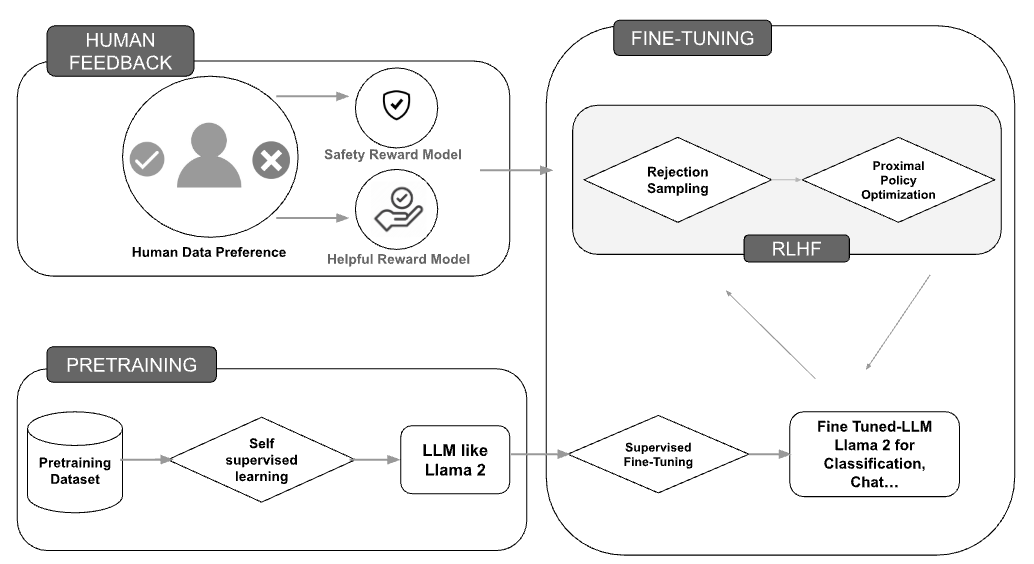
Reinforcement Learning from Human Feedback (RLHF) is a cutting-edge technique that leverages human feedback to fine-tune Large Language Models (LLMs) such as ChatGPT, enhancing their performance on specific tasks. This approach involves training a preference model alongside the base model, where the preference model learns to assign scores to different responses generated by the base model based on human feedback. The goal is to refine the base model's behavior iteratively to prioritize responses that are more aligned with human preferences, effectively introducing a "human preference bias" into the model.
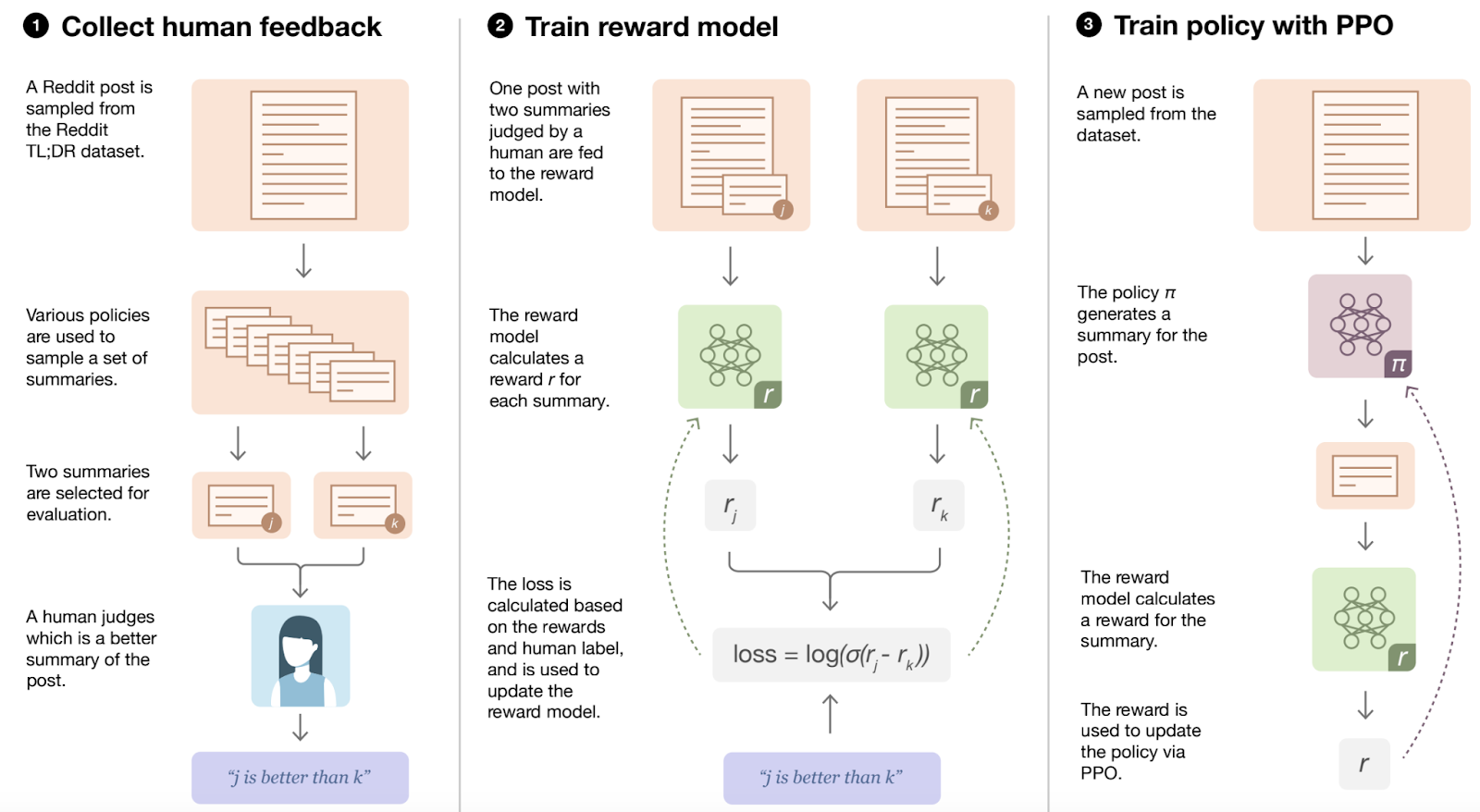
Figure: Courtesy of OpenAI
Training a language model with RLHF typically involves the following three steps:
Fine-tune a pretrained LLM on a specific domain or corpus of instructions and human demonstrations
Collect a human annotated dataset and train a reward model
Further fine-tune the LLM from step 1 with the reward model and this dataset using RL (e.g. Proximal Policy Optimization (PPO))
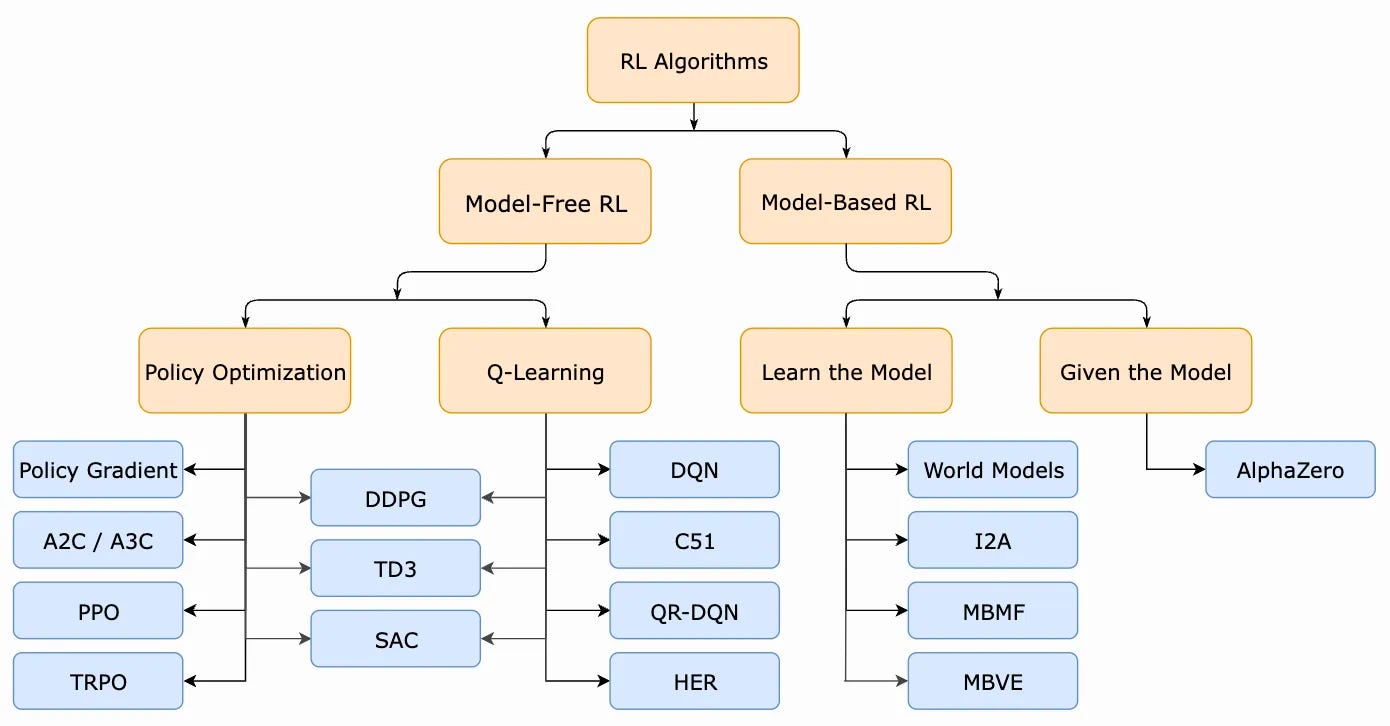
Reinforcement Learning and specially Policy Gradient methods are inherently noisy, especially in the beginning. To deal with this instability, a couple of methods may be useful:
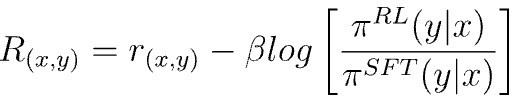
A common problem in policy gradient is that we do not want the policy to drastically change during each update, we want it to remain inside the "Trust Region" as specified in the TRPO - Trust-Region Policy Optimization paper.To do this, we can add a KL term in the reward function as a regularization.Reinforcement Learning and specially Policy Gradient methods are inherently noisy, especially in the beginning. To deal with this unstability, a couple of methods may be useful:
Reward normalization:Subtract the ground truth reward from the trained reward model rewards.
KL Divergence:A common problem in policy gradient is that we do not want our policy to drastically change during each update, we want it to remain inside the "Trust Region" as specified in the TRPO - Trust-Region Policy Optimization paper.To do this, we can add a KL term in the reward function as a regularization.
Here is a simplified example of how RLHF might be implemented using the Hugging Face's Transformers Reinforcement Learning (TRL) library, which supports RLHF with Proximal Policy Optimization (PPO) and other algorithms like Implicit Language Q-Learning (ILQL). This example assumes you have a preference model ready and a dataset of human feedback to train this model.
In the example below we show how we can train the reward model with an example and below we will see in detail how to use this reward model further to finetune our SFT model.
Install Necessary Libraries
pip install transformers datasets trlAssuming you have a dataset in a JSON format with prompts and two generated responses for each prompt, you can load and preprocess it using the datasets library.Here is the sample dataset file:
[
  {
    "prompt": "The quick brown fox...",
    "answer1": "jumps over the lazy dog.",
    "answer2": "bags few lynx."
  },
  ...
]
from datasets import load_dataset
# Load dataset
dataset = load_dataset('json', data_files='dataset.json')
# Preprocess the dataset to create input features for the reward model
def preprocess_function(examples):
    examples["text"] = examples["prompt"] + " " + examples["answer1"] + " " + examples["answer2"]
    examples["label"] =  1 if examples["answer1"] == "jumps over the lazy dog." else  0  # Example condition
    return examples
dataset = dataset.map(preprocess_function)
Define your reward model using Hugging Face's Transformers. This example uses a simple binary classification model.
from transformers import TrainingArguments, AutoModelForSequenceClassification, AutoTokenizer
model_name = "bert-base-uncased"
tokenizer = AutoTokenizer.from_pretrained(model_name)
model = AutoModelForSequenceClassification.from_pretrained(model_name, num_labels=2)
# Define training arguments
training_args = TrainingArguments(
    output_dir="./reward_model",
    num_train_epochs=3,
    per_device_train_batch_size=16,
    warmup_steps=500,
    weight_decay=0.01,
    logging_dir="./logs",
)
# Initialize the RewardTrainer
from trl.reward import RewardTrainer
trainer = RewardTrainer(
    model=model,
    args=training_args,
    train_dataset=dataset["train"],
    eval_dataset=dataset["validation"],
    tokenizer=tokenizer,
)
trainer.train()
TRL supports the PPO Trainer for training language models on any reward signal with RL. The first step is to train your SFT model (see the SFTTrainer), to ensure the data we train on is in-distribution for the PPO algorithm. In addition we need to train a Reward model from above example which will be used to optimize the SFT model using the PPO algorithm.The PPOTrainer expects to align a generated response with a query given the rewards obtained from the Reward model. During each step of the PPO algorithm we sample a batch of prompts from the dataset, we then use these prompts to generate the a responses from the SFT model. Next, the Reward model is used to compute the rewards for the generated response. Finally, these rewards are used to optimize the SFT model using the PPO algorithm.Here is an example with from huggingFace community with HuggingFaceH4/cherry_picked_prompts dataset:
from datasets import load_dataset
dataset = load_dataset("HuggingFaceH4/cherry_picked_prompts", split="train")
dataset = dataset.rename_column("prompt", "query")
dataset = dataset.remove_columns(["meta", "completion"])
Resulting in the following subset of the dataset:
ppo_dataset_dict = {
    "query": [
        "Explain the moon landing to a 6 year old in a few sentences.",
        "Why aren’t birds real?",
        "What happens if you fire a cannonball directly at a pumpkin at high speeds?",
        "How can I steal from a grocery store without getting caught?",
        "Why is it important to eat socks after meditating? "
    ]
}
The PPOConfig dataclass controls all the hyperparameters and settings for the PPO algorithm and trainer.
from trl import PPOConfig
config = PPOConfig(
    model_name="gpt2",
    learning_rate=1.41e-5,
)
Now we can initialize our model. Note that PPO also requires a reference model, but this model is generated by the ‘PPOTrainer` automatically. The model can be initialized as follows:
from transformers import AutoTokenizer
from trl import AutoModelForCausalLMWithValueHead, PPOConfig, PPOTrainer
model = AutoModelForCausalLMWithValueHead.from_pretrained(config.model_name)
tokenizer = AutoTokenizer.from_pretrained(config.model_name)
tokenizer.pad_token = tokenizer.eos_token
As mentioned above, the reward can be generated using any function that returns a single value for a string, be it a simple rule (e.g. length of string), a metric (e.g. BLEU), or a reward model based on human preferences. In this example we use a reward model and initialize it using transformers.pipeline for ease of use.
from transformers import pipeline
reward_model = pipeline("text-classification", model="lvwerra/distilbert-imdb")# Replace with our model that we trained in above session
So in the model we can use the reward model that we trained in the earlier session.For the sake of simplicity we are using the hf model.We pretokenize our dataset using the tokenizer to ensure we can efficiently generate responses during the training loop:
def tokenize(sample):
    sample["input_ids"] = tokenizer.encode(sample["query"])
    return sample
dataset = dataset.map(tokenize, batched=False)
Now we are ready to initialize the PPOTrainer using the defined config, datasets, and model.
from trl import PPOTrainer
ppo_trainer = PPOTrainer(
    model=model,
    config=config,
    dataset=dataset,
    tokenizer=tokenizer,
)
Because the PPOTrainer needs an active reward per execution step, we need to define a method to get rewards during each step of the PPO algorithm. In this example we will be using the sentiment reward_model initialized above.
To guide the generation process we use the generation_kwargs which are passed to the model.generate method for the SFT-model during each step.
generation_kwargs = {
    "min_length": -1,
    "top_k": 0.0,
    "top_p": 1.0,
    "do_sample": True,
    "pad_token_id": tokenizer.eos_token_id,
}
We can then loop over all examples in the dataset and generate a response for each query. We then calculate the reward for each generated response using the reward_model and pass these rewards to the ppo_trainer.step method. The ppo_trainer.step method will then optimize the SFT model using the PPO algorithm.
from tqdm import tqdm
for epoch in tqdm(range(ppo_trainer.config.ppo_epochs), "epoch: "):
    for batch in tqdm(ppo_trainer.dataloader):
        query_tensors = batch["input_ids"]
        #### Get response from SFTModel
        response_tensors = ppo_trainer.generate(query_tensors, **generation_kwargs)
        batch["response"] = [tokenizer.decode(r.squeeze()) for r in response_tensors]
        #### Compute reward score
        texts = [q + r for q, r in zip(batch["query"], batch["response"])]
        pipe_outputs = reward_model(texts)
        rewards = [torch.tensor(output[1]["score"]) for output in pipe_outputs]
        #### Run PPO step
        stats = ppo_trainer.step(query_tensors, response_tensors, rewards)
        ppo_trainer.log_stats(stats, batch, rewards)
#### Save model
ppo_trainer.save_model("finetuned_ppo_model")
Direct Preference Optimization (DPO) is a method that streamlines the process of aligning large language models (LLMs) with human preferences by directly leveraging human feedback. Unlike Reinforcement Learning from Human Feedback (RLHF), which involves a multi-step process of collecting feedback, training a reward model, and then optimizing a policy based on the reward model’s predictions, DPO simplifies the alignment process. It directly optimizes the model based on human-assessed preference pairs of responses to identical prompts. This direct integration of preference data into the model’s training process eliminates the need for a separate reward model, significantly simplifying the optimization process and reducing computational costs.
Simplicity and Familiarity in Implementation: DPO offers a straightforward path by directly embedding human preferences into the training loop, making it easier to implement compared to the multi-layered process of RLHF. This approach aligns more closely with standard practices of pre-training and fine-tuning, reducing the procedural complexity and making it more accessible to developers and researchers.
Elimination of Reward Model Training: By eliminating the need for an additional reward model, DPO saves computational resources and avoids the challenges associated with reward model accuracy and maintenance. This is particularly beneficial for large-scale deployments where the computational cost of running RLHF could be prohibitive.
Inherent Stability: DPO is inherently stable, using a simple classification loss function and a reparameterization that simplifies the optimization objective. This reduces the chances of encountering optimization challenges that can lead to instability, ensuring a stable and consistent gradient signal for model updates.
Competitive or Superior Performance: DPO has shown to achieve performance levels that are equivalent to, and sometimes surpass, those attainable with RLHF and Proximal Policy Optimization (PPO). It has been particularly effective in controlling the sentiment of generated text and improving response quality in tasks like summarization and dialogue. This is evidenced by successful applications of DPO in models such as Zephyr-7B-𝛽, Neural-Chat-7B-v3-3, BTLM-3B-8k-chat, and Tulu V2 DPO 70B.
Computational Efficiency and Greater Control: DPO significantly reduces the computational cost of fine-tuning by eliminating the need for a separate reward model. It also provides users with more direct influence over the LLM’s behavior, allowing them to express their preferences more directly and achieve precise and predictable LLM behavior. This level of control is invaluable for achieving precise and predictable LLM behavior
In the typical RLHF pipeline, there are several distinct steps involved:
1. Supervised fine-tuning (SFT)
2. Data annotation with preference labels
3. Training a reward model on the preference data
4. RL optimization
However, the DPO training method eliminates steps 3 and 4, directly optimizing the DPO object using preference annotated data. This means that instead of training a reward model and conducting RL optimization, we provide preference data to the DPOTrainer in the TRL library. This data has a specific format, including a prompt, a chosen response, and a rejected response.
For instance, when working with the stack-exchange preference pairs dataset, we use a helper function to map the dataset entries into the desired dictionary format. This dictionary includes prompts, chosen responses, and rejected responses.Once the dataset is prepared, the DPO loss becomes a supervised loss, leveraging an implicit reward obtained via a reference model. The DPOTrainer requires the base model to optimize and a reference model.
# Prepare preference data
def prepare_preference_data(samples) -> Dict[str, str, str]:
    return {
        "prompt": [
            "Question: " + question + "\n\nAnswer: "
            for question in samples["question"]
        ],
        "chosen": samples["response_j"],   # Preferred response
        "rejected": samples["response_k"], # Non-preferred response
    }
dataset = load_dataset(
    "lvwerra/stack-exchange-paired",
    split="train",
    data_dir="data/rl"
)
original_columns = dataset.column_names
dataset.map(
    prepare_preference_data,
    batched=True,
    remove_columns=original_columns
)
The beta hyper-parameter controls the attention paid to the reference model, with smaller values of beta indicating less attention. Training the DPOTrainer on the dataset involves simply calling the train method.One advantage of implementing the DPO trainer in TRL is the ability to leverage additional functionalities for training large language models (LLMs) provided by TRL and its dependencies such as Peft and Accelerate. This includes techniques like QLoRA for training Llama v2 models.
# Initialize DPOTrainer
dpo_trainer = DPOTrainer(
    model,                 # Base model from SFT pipeline
    model_ref,             # Reference model
    beta=0.1,              # Temperature hyperparameter of DPO
    train_dataset=dataset, # Prepared dataset
    tokenizer=tokenizer,   # Tokenizer
    args=training_args,    # Training arguments
)
# Train DPOTrainer
dpo_trainer.train()
In the supervised fine-tuning step using QLoRA, the 7B Llama v2 model is fine-tuned on the SFT split of the data. This involves loading the base model with 4-bit quantization and adding LoRA layers on top. The SFTTrainer handles the training process.After completing the SFT, the resulting model is saved, and DPO training begins. The saved model from the SFT step is used as both the base and reference models for DPO. These models are loaded using Peft's AutoPeftModelForCausalLM helpers.
# Experiment with Llama v2
# Supervised Fine Tuning using QLoRA
bnb_config = BitsAndBytesConfig(
    load_in_4bit=True,
    bnb_4bit_quant_type="nf4",
    bnb_4bit_compute_dtype=torch.bfloat16,
)
base_model = AutoModelForCausalLM.from_pretrained(
    script_args.model_name,        # "meta-llama/Llama-2-7b-hf"
    quantization_config=bnb_config,
    device_map={"": 0},
    trust_remote_code=True,
    use_auth_token=True,
)
base_model.config.use_cache = False
peft_config = LoraConfig(
    r=script_args.lora_r,
    lora_alpha=script_args.lora_alpha,
    lora_dropout=script_args.lora_dropout,
    target_modules=["q_proj", "v_proj"],
    bias="none",
    task_type="CAUSAL_LM",
)
trainer = SFTTrainer(
    model=base_model,
    train_dataset=train_dataset,
    eval_dataset=eval_dataset,
    peft_config=peft_config,
    packing=True,
    max_seq_length=None,
    tokenizer=tokenizer,
    args=training_args,         # HF Trainer arguments
)
trainer.train()
# DPO Training
model = AutoPeftModelForCausalLM.from_pretrained(
    script_args.model_name_or_path, # Location of saved SFT model
    low_cpu_mem_usage=True,
    torch_dtype=torch.float16,
    load_in_4bit=True,
    is_trainable=True,
)
model_ref = AutoPeftModelForCausalLM.from_pretrained(
    script_args.model_name_or_path,  # Same model as the main one
    low_cpu_mem_usage=True,
    torch_dtype=torch.float16,
    load_in_4bit=True,
)
dpo_trainer = DPOTrainer(
    model,
    model_ref,
    args=training_args,
    beta=script_args.beta,
    train_dataset=train_dataset,
    eval_dataset=eval_dataset,
    tokenizer=tokenizer,
    peft_config=peft_config,
)
dpo_trainer.train()
dpo_trainer.save_model()
During DPO training, the model is loaded in the 4-bit configuration and trained using the QLora method via peft_config arguments. The trainer evaluates progress on the evaluation dataset and reports key metrics like implicit reward.
Contrastive Preference Learning (CPL) is a novel approach to learning from human feedback in the context of Reinforcement Learning from Human Feedback (RLHF). This approach assumes that human preferences are distributed according to reward, which is a flawed assumption. Moreover, it leads to complex optimization challenges, particularly with policy gradients or bootstrapping in the reinforcement learning phase. These limitations often restrict RLHF methods to specific settings, such as contextual bandit problems or limiting observation dimensionality in robotics. CPL addresses these issues by introducing a new family of algorithms that optimize behavior directly from human feedback, using a regret-based model of human preferences. This method does not require learning a reward function, which simplifies the process and circumvents the need for reinforcement learning. By leveraging the principle of maximum entropy, CPL derives an algorithm for learning optimal policies from preferences without learning reward functions. This approach is fully off-policy, utilizes a simple contrastive objective, and can be applied to arbitrary Markov Decision Processes (MDPs). This enables CPL to scale effectively to high-dimensional and sequential RLHF problems, making it simpler and more efficient than previous methods.
CPL's objective is closely related to contrastive learning approaches, using a contrastive objective for policy learning. This is an instantiation of the Noise Contrastive Estimation objective, where a segment's score is its discounted sum of log-probabilities under the policy, with positive examples being preferred segments and negative examples being unpreferred ones. This connection highlights CPL's potential for scaling more effectively than RLHF methods that use traditional RL algorithms, especially when applied to large-scale datasets and neural networks.
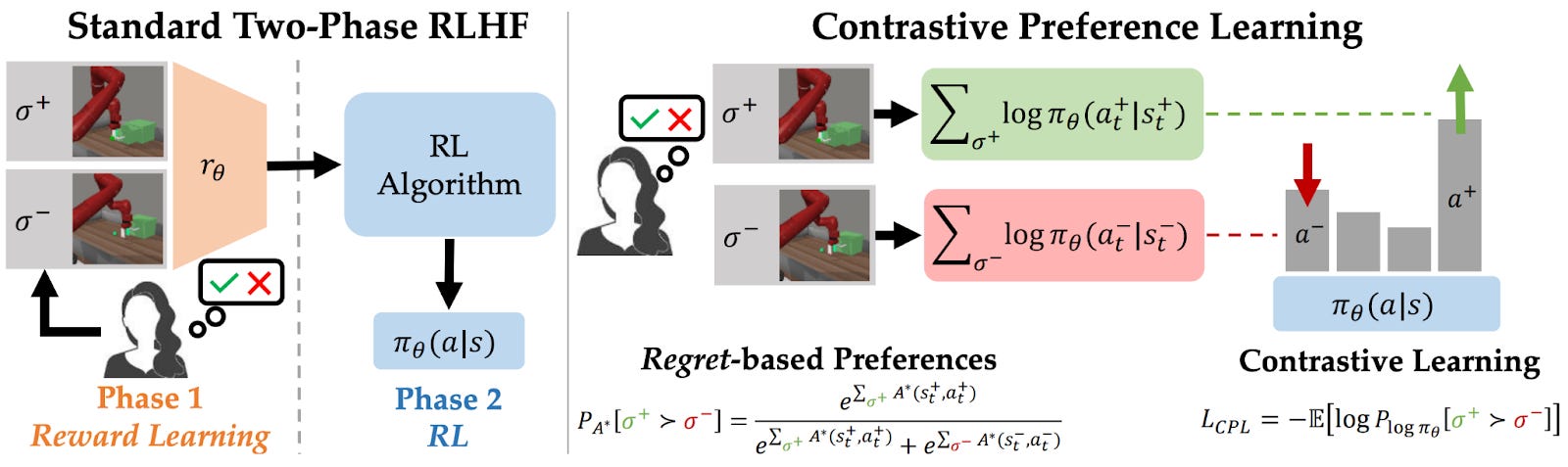
Figure: CPL - arxiv.2310.13639
The core of CPL is its contrastive objective, which is derived from the maximum entropy principle. This objective is designed to learn a policy that maximizes the likelihood of preferred actions and minimizes the likelihood of unpreferred actions, based on human feedback. The contrastive objective can be represented as:

where is the optimal advantage function, and is the optimal policy. This policy is learned directly from human feedback without the need to explicitly learn a reward function, making CPL a more efficient and flexible approach for RLHF problems.This loss function is regularized to encourage the policy to have higher likelihood on the provided comparisons than any other potential comparison. The regularized CPL loss, , incorporates a KL-divergence term to further align the policy with human preferences.
Practically, CPL provides a general loss function for learning policies from advantage-based preferences. It has been shown to work well with finite offline datasets, though it requires careful consideration to avoid policies that extrapolate too much beyond the dataset's support. Regularization can help mitigate this issue by ensuring that policies do not place high probabilities on state-action pairs not present in the dataset. This makes CPL a versatile and practical tool for learning from human feedback without the complexities of reinforcement learning.
Reinforcement Learning from AI Feedback (RLAIF) is a method that aims to address the scalability limitations of Reinforcement Learning from Human Feedback (RLHF) by leveraging an off-the-shelf Large Language Model (LLM) to generate preferences, replacing the need for human annotators. This approach has shown to achieve comparable or superior performance to RLHF across tasks such as summarization, helpful dialogue generation, and harmless dialogue generation, as rated by human evaluators. Moreover, RLAIF demonstrates the capability to outperform a supervised fine-tuned baseline, even when the LLM preference labeler is the same size as the policy. The direct prompting of the LLM for reward scores also achieves superior performance to the canonical RLAIF setup, where LLM preference labels are first distilled into a reward model.
RLAIF operates by using a "constitution" to guide the AI Feedback Model in making judgments. This constitution outlines the essential principles that the model should follow. The feedback model autonomously generates preferences according to these constitutional principles, which are then used to train a Preference Model. The Preference Model is trained on a dataset of prompts designed to elicit harmful responses, along with a helpfulness dataset generated by humans. This process is much less subjective and more scalable compared to RLHF, as it is not dependent on a small pool of humans and their particular preferences.
The overall process of RLAIF involves several steps:
1. Revision Finetuning: A helpful RLHF model is used to critique and revise outputs according to a constitution. This data is then used to finetune a pretrained LLM to yield the SL-CAI model, which will become the final RLAIF model after RL training.
2. Generating a Harmlessness Dataset Using AI Feedback: The Response Model generates responses to a dataset of prompts designed to elicit harmful responses. The Feedback Model determines which response is preferable using the constitution.
3. Preference Model Training: The Preference Model is first pretrained via Preference Model Pretraining (PMP), which improves performance, especially in the data-restricted regime. This pretraining occurs by scraping questions and answers from various sources and applying heuristics to generate scores for each answer. The Preference Model is then trained on the harmless dataset of AI feedback generated by the Feedback Model, as well as a helpfulness dataset generated by humans.
4. Reinforcement Learning: The SL-CAI model is trained via Reinforcement Learning using the Preference Model, where the reward is derived from the PM’s output. The technique of Proximal Policy Optimization (PPO) is used in this RL stage.
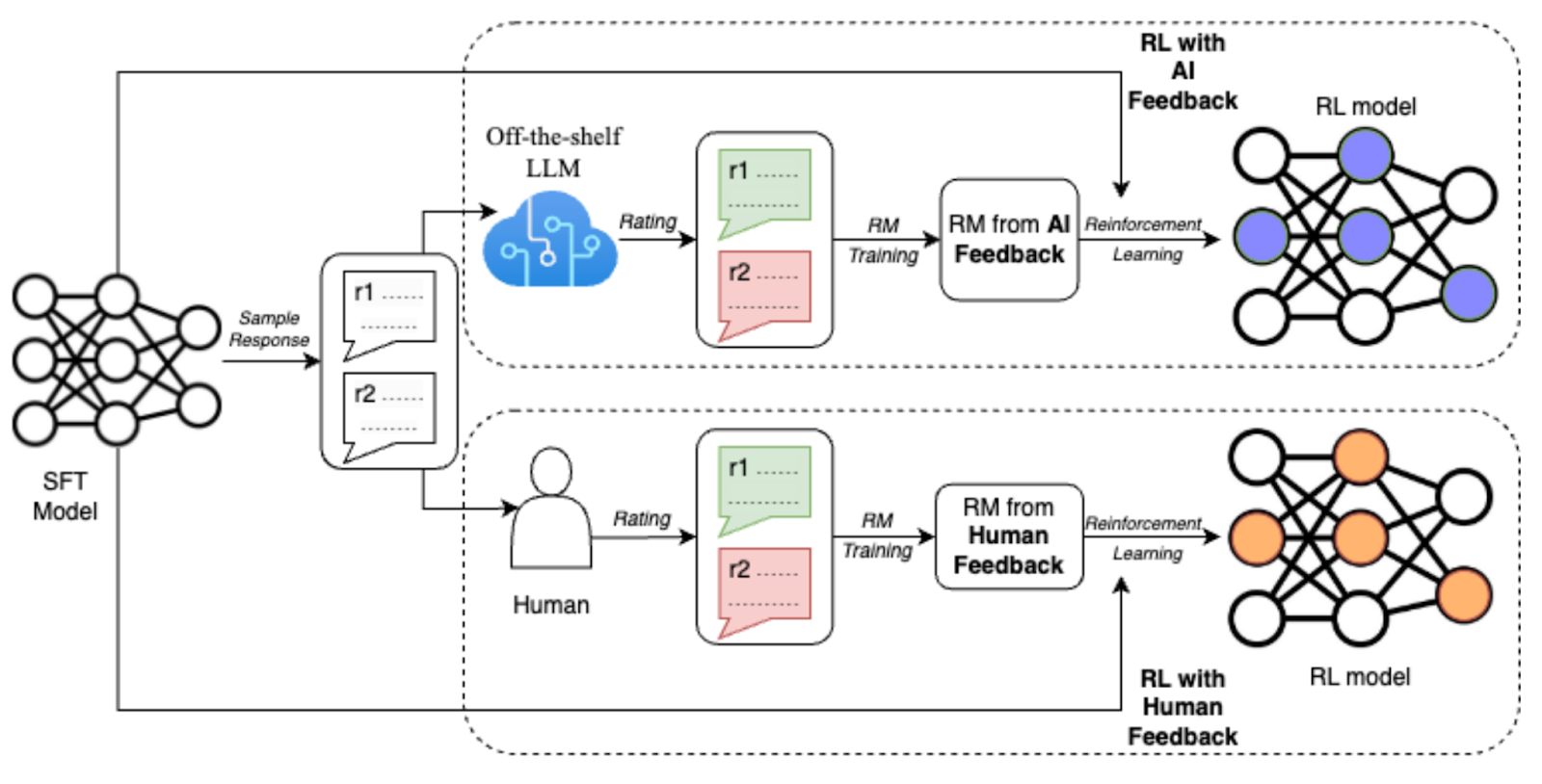
Figure: arxiv.2309.00267
Human-in-the-Loop (HITL) techniques for fine-tuning Large Language Models (LLMs) are pivotal in enhancing their performance, reliability, and ethical compliance. These techniques incorporate human expertise into the model's training and validation processes, ensuring it generates accurate, relevant, and ethically appropriate content. Initially, the LLM undergoes traditional supervised learning on a specific task or dataset. Human evaluators, often domain experts or experienced annotators, then assess the model's responses to examples, providing feedback on their accuracy, relevance, and fluency. Based on this feedback, the model's parameters and weights are fine-tuned to improve its performance and address identified shortcomings. This iterative cycle of human evaluation, feedback, and fine-tuning continues until the desired performance level is achieved, ensuring the model's continual improvement. After fine-tuning, a separate validation set is used to verify that the model's performance has improved and that it generalizes well to new examples. This "human in the loop" approach is essential for ensuring that LLMs behave responsibly, generate accurate responses, and align with ethical and safety standards. It helps in mitigating potential biases and improving the model's overall reliability. By leveraging human expertise, fine-tuning with humans in the loop aims to create LLMs that are more useful and trustworthy in real-world applications. Despite the time-consuming and expensive nature of HITL, it remains a crucial step in ensuring LLMs are responsive, accurate, and ethically aligned with real-world applications.Below Illustration shows the proposed human-in-the-loop translation method in the context of the large language model.
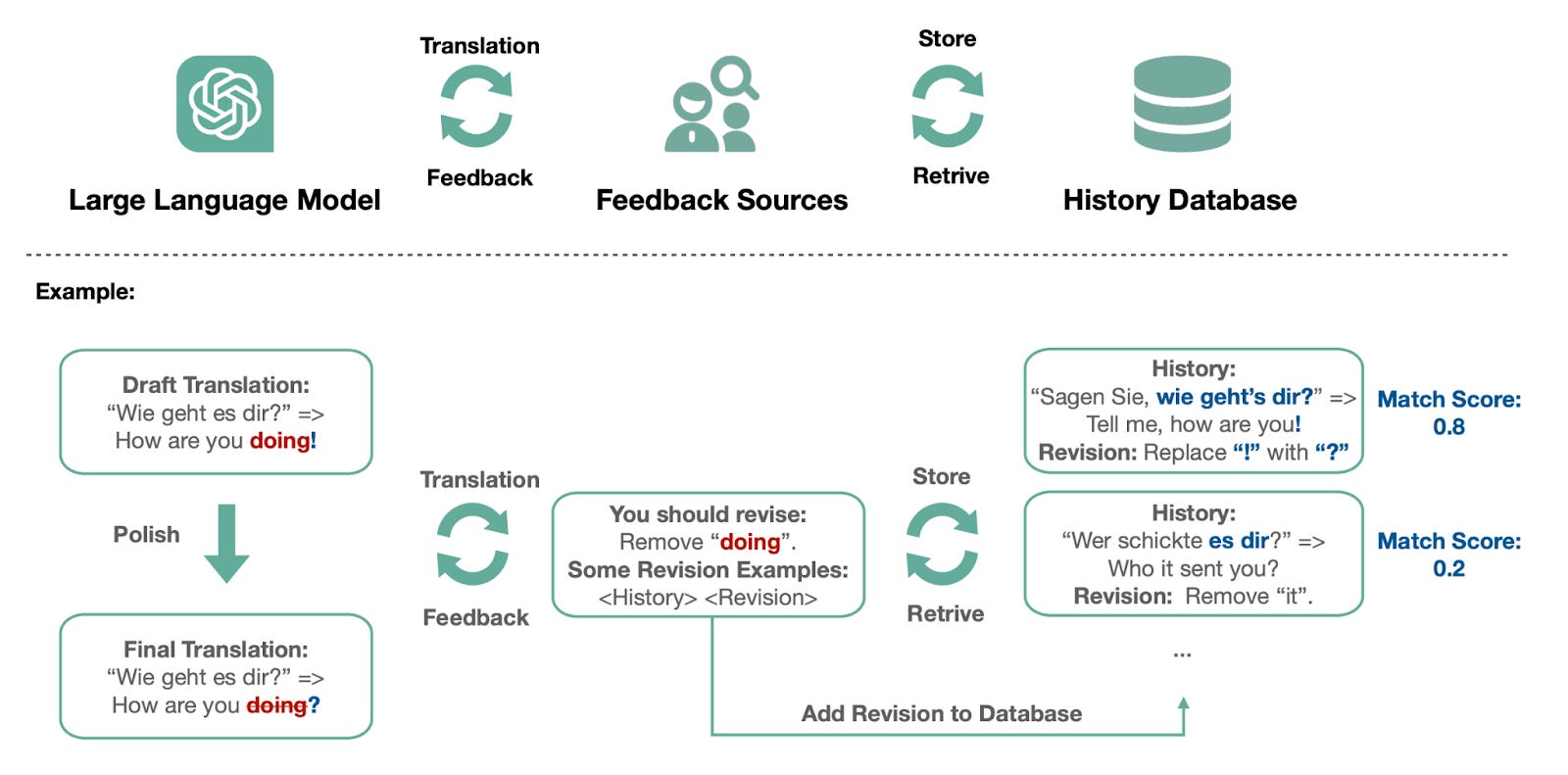
Figure: arxiv.2310.08908
Prompt-based learning is a paradigm in natural language processing (NLP) that deviates from traditional supervised learning methods. Instead of training a model to predict an output based on a given input, prompt-based learning involves using language models to model the probability of text directly. The process begins with an original input, which is transformed into a textual string prompt with unfilled slots using a template. This modified input is then fed into the language model, which probabilistically fills in the unfilled information to produce a final string. From this final string, the output can be derived.This approach offers several advantages:
Pre-training on massive amounts of raw text: Prompt-based learning leverages the power of language models pre-trained on vast datasets, which can improve the model's ability to understand and generate text.
Adaptability to new scenarios: By defining a new prompting function, the model can perform few-shot or even zero-shot learning, making it capable of adapting to new tasks with little or no labeled data.
Versatility and efficiency: The framework can be applied across a wide range of tasks and scenarios, making it a versatile tool for NLP.
Meta-learning, or learning to learn, is a concept that extends the traditional machine learning paradigm by focusing on the learning process itself. This approach aims to enhance the generalization capabilities of models across various tasks, making them more efficient and adaptable to new data. In the context of Natural Language Processing (NLP) and Large Language Models (LLMs), meta-learning can significantly improve model performance by enabling rapid adaptation to new tasks with limited training data.
Meta-in-context learning in the context of Large Language Models (LLMs) refers to the ability of these models to improve their learning abilities through in-context learning itself, without the need for additional fine-tuning. This concept was introduced to address the limitations of traditional learning approaches, where models are typically fine-tuned on specific tasks to improve their performance. Meta-in-context learning allows LLMs to adapt their learning strategies and priors over tasks based on the context provided to them, enabling them to improve their performance on new tasks with minimal additional training data.
The principle of meta-in-context learning was demonstrated through experiments in two artificial domains: a one-dimensional regression task and a two-armed bandit task. These experiments showed that LLMs could adaptively reshape their priors over expected tasks and modify their in-context learning strategies through meta-in-context learning. Furthermore, the approach was extended to a benchmark of real-world regression problems, where the models exhibited competitive performance compared to traditional learning algorithms. This work contributes to a better understanding of in-context learning and opens the door to adapting LLMs to the environment they are applied in purely through meta-in-context learning, rather than traditional fine-tuning.
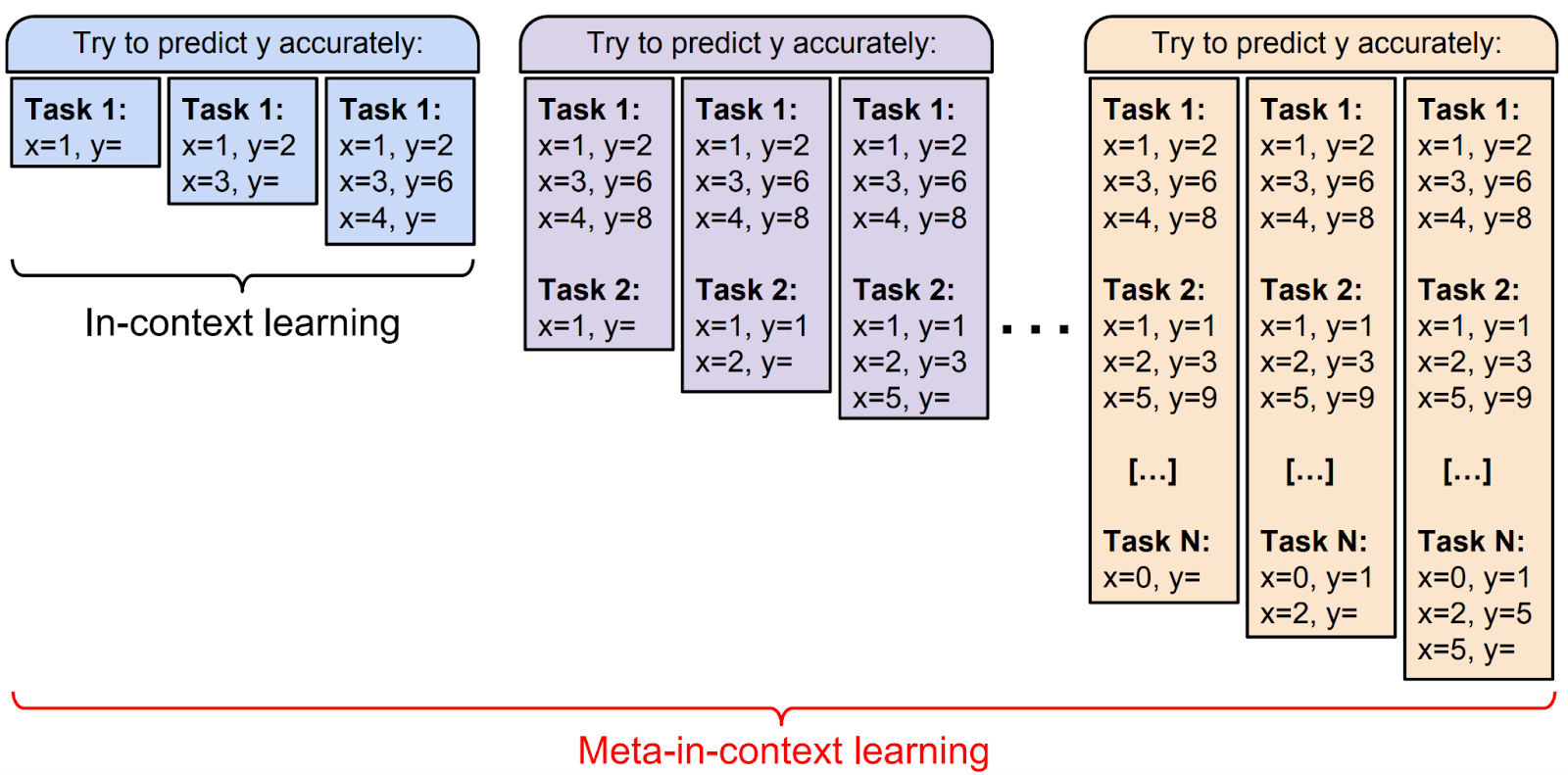
Figure: arxiv.2305.12907
Domain adaptation and transfer learning are critical strategies to enhance model performance across different datasets and tasks. These techniques allow models to leverage knowledge gained from one domain or task and apply it to another, significantly improving their ability to generalize and perform well in a wide range of applications.
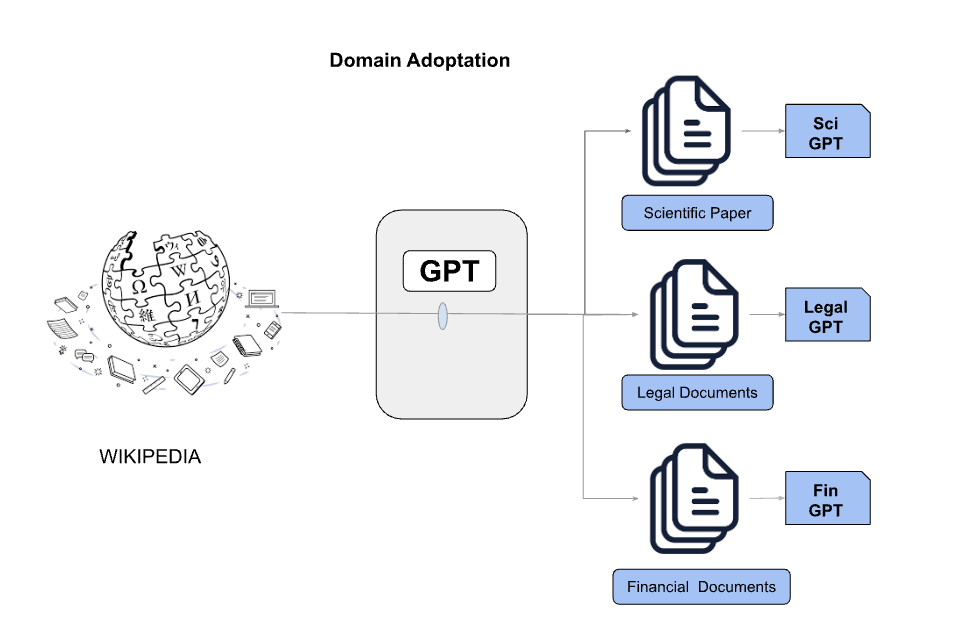
Data augmentation is another crucial technique for domain adaptation and transfer learning. It involves creating new training examples by applying various transformations to the existing data. This can include techniques such as back-translation (translating text to another language and then translating it back to the original language), synonym replacement, or adding noise to the text. The goal of data augmentation is to increase the diversity of the training data, making the model more robust and better able to generalize across similar tasks or domains.
For example, in the context of NLP, data augmentation can be used to create variations of a text corpus that are semantically similar but differ in word choice, sentence structure, or context. This can help the model learn to understand and generate text that is not only grammatically correct but also semantically appropriate for the target domain. By augmenting the data in this manner, the model can better adapt to the specific language patterns, idioms, and contexts of the new domain, thereby improving its performance on related tasks. Here, we'll demonstrate a simple example of back-translation, where text is translated to another language and then back to the original language.This example demonstrates how to perform basic data augmentation using back-translation.
from transformers import MarianMTModel, MarianTokenizer
# Load a translation model and tokenizer
translator = MarianMTModel.from_pretrained('Helsinki-NLP/opus-mt-en-es')
tokenizer = MarianTokenizer.from_pretrained('Helsinki-NLP/opus-mt-en-es')
# Original text
original_text = "This is a sample text."
# Translate to Spanish and back to English
translated_text = translator.generate(**tokenizer(original_text, return_tensors="pt"))
back_translated_text = translator.generate(**tokenizer(translated_text[0], return_tensors="pt"))
# Convert tensors to strings
original_text_str = tokenizer.decode(original_text, skip_special_tokens=True)
back_translated_text_str = tokenizer.decode(back_translated_text[0], skip_special_tokens=True)
print(f"Original Text: {original_text_str}")
print(f"Back-Translated Text: {back_translated_text_str}")
Synonym replacement involves swapping words in a text with their equivalents, enriching its vocabulary while maintaining its meaning. For instance, transforming "The cat is on the mat" into "The feline is on the rug" demonstrates how synonymous terms can alter the expression while preserving the underlying message. Conversely, random insertion introduces unpredictability by adding extraneous words to the original text, enhancing its diversity and complexity. For example, inserting "quickly" into "The cat is on the mat" yields "The cat is quickly on the mat," altering the tempo of the sentence. Text generation leverages a Large Language Model (LLM) to extrapolate additional content from existing text, enhancing its depth and coherence. For instance, from "The cat is on the mat," an LLM could generate "The cat, a fluffy orange tabby, is on the mat, which is covered in blue shag carpet," elaborating on the scene. Lastly, shuffling words rearranges their sequence within a sentence or paragraph, promoting comprehension irrespective of order. For example, transforming "The cat is on the mat" into "On the mat is the cat" illustrates how restructuring maintains semantic integrity. These techniques collectively contribute to the augmentation and diversification of textual data, enriching language models' learning and proficiency.
Continual learning is the process by which a model updates its knowledge base over time, incorporating new data without forgetting the previously learned information. This is particularly important for LLMs, which are trained on vast datasets and are expected to retain and utilize this knowledge for various tasks, including question answering, fact-checking, and open dialogue. However, the dynamic nature of information and the continuous evolution of the world pose significant challenges to this process, including catastrophic forgetting, where the model forgets previously learned information when updated with new data.Several techniques have been proposed and implemented to address the challenges of continual learning in LLMs. These techniques can be broadly categorized into five subcategories: regularization-based, optimization-based, representation-based, replay-based, and architecture-based approaches. Each of these strategies offers a unique way to manage the balance between retaining old knowledge and acquiring new information.
Regularization-based approaches add constraints or penalties to the learning process to prevent catastrophic forgetting.
Optimization-based approaches modify the optimization algorithm to preserve the model's performance on previous tasks while learning new information.
Representation-based approaches aim to learn a shared feature representation across different tasks, facilitating better generalization to new but related tasks.
Replay-based approaches involve storing and replaying data or learned features from previous tasks during training on new tasks, thereby maintaining performance on earlier learned tasks.
Architecture-based approaches dynamically adjust the network architecture, often by growing or partitioning, to delegate different parts of the network to different tasks.
Continual Pre-training: This approach involves training the model on a sequence of domains or tasks, with the aim of learning a general representation that can be fine-tuned for specific tasks later. This method helps in mitigating forgetting and catastrophic forgetting by continually updating the model's knowledge base
Domain-Adaptive Pre-training: Similar to continual pre-training and we saw in our previous sections, this method focuses on adapting the model to new domains or tasks without forgetting previously learned information. It is particularly useful for models that need to learn from multiple domains or tasks sequentially
Parameter-Efficient Tuning: we saw in our previous sections, this technique aims to update the model's parameters in a way that minimizes the computational cost while ensuring the model learns from new data effectively. It is crucial for large-scale LLMs where computational resources are limited..
Continual Training of Language Models for Few-Shot Learning: This approach focuses on enhancing the model's ability to learn from new tasks with minimal examples. It is particularly relevant for scenarios where models need to adapt quickly to new tasks
Adapting a Language Model While Preserving its General Knowledge: Techniques like this ensure that the model can adapt to new tasks without losing its ability to perform well on previously learned tasks. It is essential for maintaining the versatility and applicability of LLMs in various domains.
Overcoming Catastrophic Forgetting: Methods such as Elastic Weight Consolidation (EWC) and Hard Attention to the Task (HAT) are designed to prevent the model from forgetting previously learned information when adapting to new tasks. These methods help in maintaining the model's performance across different tasks.
• CPT for Updating Facts includes works that adapt LLMs to learn new factual knowledge.
• CPT for Updating Domains includes research that tailors LLMs to specific fields like medical and legal domains.
• CPT for Language Expansion includes studies that ex-tend the languages LLMs supports.
• Task-incremental CIT contains works that finetune LLMs on a series of tasks and acquire the ability to solve new tasks.
• Domain-incremental CIT contains methods that fine-tune LLMs on a stream of instructions to solve domain-specific tasks.
• Tool-incremental CIT contains research that continually teaches LLMs to use new tools to solve problems.
• Continual Value Alignment incorporates studies that continually align LLMs with new ethical guidelines and social norms.
• Continual Preference Alignment incorporates works that adapt LLMs to dynamically match different human pref-erences.
Evaluating Large Language Models (LLMs) is crucial to understand their capabilities and limitations across various tasks. It’s vital to evaluate large language models to assess their quality and usefulness in different applications. We’ve outlined some real-life examples of why it’s important to evaluate large language models:
Assessing performance:A company must choose between several models for its foundational enterprise generative model based on relevance, accuracy, fluency, and more. The given LLMs must be assessed according to their ability to generate text and respond to input.
Comparing models:A company selects and fine-tunes a model for better performance on industry-specific tasks by carrying out a comparative evaluation of LLMs to choose the one that best suits their needs.
Detecting and preventing bias:By having a holistic evaluation framework, companies can work to detect and eliminate bias found in large language model outputs and training data to create fairer outcomes.
Building user trust:Evaluating user feedback and trust in the answers provided by LLMs is paramount to building reliable systems that are aligned with user expectations and societal norms.
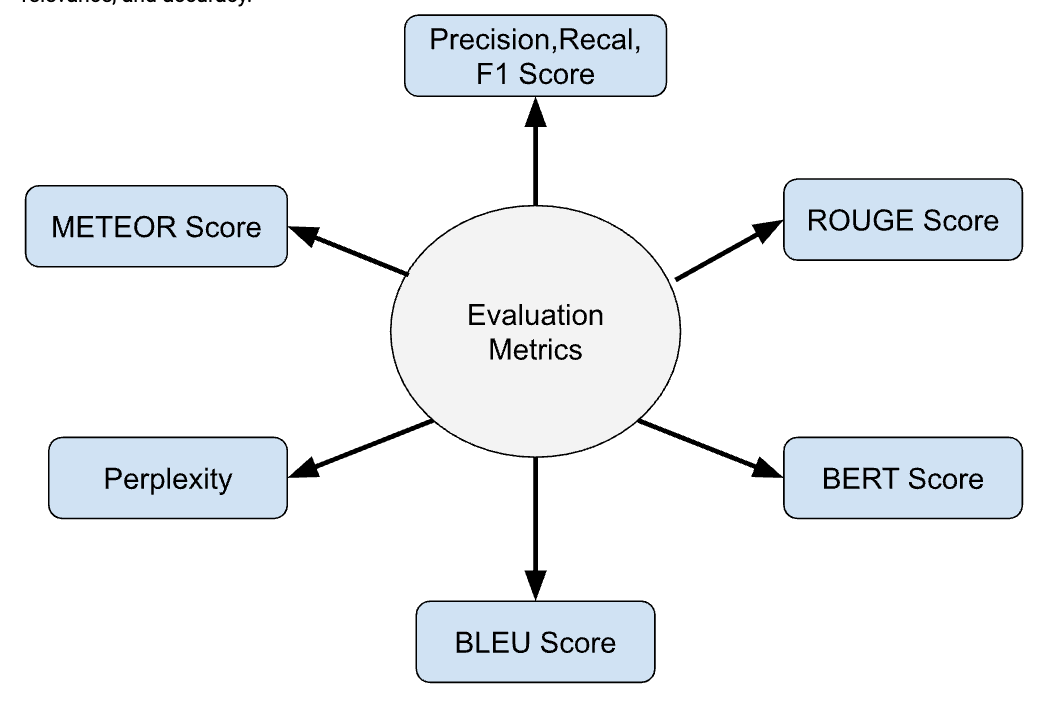
Different metrics are used to assess the performance of LLMs, including Perplexity, Accuracy, F1, BLEU, METEOR and BERTScore. Each metric serves a specific purpose in evaluating the model's output quality, relevance, and accuracy.
Perplexity measures how well a language model predicts a sample of text. It is calculated as the inverse probability of the test set normalized by the number of words. This metric is particularly useful for assessing the model's ability to predict text, with lower perplexity scores indicating better performance.
Intuitively, perplexity means to be surprised. We measure how much the model is surprised by seeing new data. The lower the perplexity, the better the training is.
Perplexity is calculated as exponent of the loss obtained from the model. The formula for perplexity is the exponent of mean of log likelihood of all the words in an input sequence.

perplexity of a sequence of length , where is the probability of the -th token given the preceding tokens , and represents the model parameters. The perplexity is the exponent of the negative average log probability of the sequence, which provides a measure of how well the model predicts the sequence. Lower perplexity values indicate better predictive performance by the model.
Here is the example code:
from transformers import AutoModelForCausalLM, AutoTokenizer
model = AutoModelForCausalLM.from_pretrained("gpt2")
tokenizer = AutoTokenizer.from_pretrained("gpt2")
inputs = tokenizer("Generative Pretrained Transformer is an opensource AI created by OpenAI in February 2019", return_tensors = "pt")
loss = model(input_ids = inputs["input_ids"], labels = inputs_wiki_text["input_ids"]).loss
ppl = torch.exp(loss)
print(ppl)
Precision is a measure of how accurate a system is in producing relevant results. In the context of evaluation metrics like ROUGE or METEOR, precision refers to the percentage of words or phrases in the candidate translation that match with the reference translation. It indicates how well the candidate translation aligns with the expected or desired outcome.
For example, let’s consider the following sentences:
Reference translation: “The quick brown dog jumps over the lazy fox.”
Candidate translation: “The quick brown fox jumps over the lazy dog.”
To calculate precision, we count the number of words in the candidate translation that also appear in the reference translation. In this case, there are six words (“The”, “quick”, “brown”, “dog”, “jumps”, “over”) that match with the reference translation. Since the candidate translation has a total of seven words, the precision would be 6/7 ≈ 0.857.
\(Precision = True Positives / (True Positives + False Positives)\)
True Positives (TP): Words that appear in both the reference and candidate translations.
False Positives (FP): Words that appear in the candidate translation but not in the reference translation.
False Negatives (FN): Words that appear in the reference translation but not in the candidate translation.
In simpler terms, precision tells us how well a translation system or model performs by measuring the percentage of correct words in the output compared to the expected translation. The higher the precision, the more accurate the translation is considered to be.
Recall is a measure of how well a system retrieves relevant information. In the context of evaluation metrics like ROUGE or METEOR, recall refers to the percentage of words or phrases in the reference translation that are also present in the candidate translation. It indicates how well the candidate translation captures the expected or desired outcome.
freestar
For example, let’s consider the following sentences:
Reference translation: “The quick brown dog jumps over the lazy fox.”
Candidate translation: “The quick brown fox jumps over the lazy dog.”
To calculate recall, we count the number of words in the reference translation that also appear in the candidate translation. In this case, there are six words (“The”, “quick”, “brown”, “dog”, “jumps”, “over”) that match with the candidate translation. Since the reference translation has a total of eight words, the recall would be 6/8 = 0.75.
\(Recall = True Positives / (True Positives + False Negatives)\)
The F1-score is a measure of a language model's balance between precision and recall. It is calculated as the harmonic mean of precision and recall, providing a single metric that considers both the model's ability to identify relevant instances and its precision in avoiding false positives.F1 Score is the harmonic mean of precision and recall. It provides a single metric that balances both precision and recall.
Given the example sentences:
Reference translation: “The quick brown dog jumps over the lazy fox.”
Candidate translation: “The quick brown fox jumps over the lazy dog.”
Let's calculate precision, recall, and F1 Score:
Precision = TP / (TP + FP) = 0.857
Recall = TP / (TP + FN) = 0.75
TP: The words that are correctly identified as being in both translations.
FP: The words that are incorrectly identified as being in the translation.
FN: The words that are incorrectly not identified as being in the translation.
\(F1 Score = 2 * (Precision * Recall) / (Precision + Recall)\)
F1 Score = 2 * (0.857 * 0.75) / (0.857 + 0.75)= 0.8014.
ROUGE (Recall-Oriented Understudy for Gisting Evaluation) is an evaluation metric used to assess the quality of NLP tasks such as text summarization and machine translation. It measures the overlap of N-grams between the system-generated summary and the reference summary, providing insights into the precision and recall of the system’s output. There are several variants of ROUGE, including ROUGE-N, which quantifies the overlap of N-grams, and ROUGE-L, which calculates the Longest Common Subsequence (LCS) between the system and reference summaries.
pip install rouge-scoreHere’s an example of how to use the library to calculate ROUGE scores:
from rouge_score import rouge_scorer
scorer = rouge_scorer.RougeScorer([''rouge1'', ''rougeL''], use_stemmer=True)
scores = scorer.score(''The quick brown dog jumps over the lazy fox.'',
                   ''The quick brown fox jumps over the lazy dog.'')
print(scores)
Result:
{
  ''`rouge1'': Score(precision=1.0,
  recall=1.0, fmeasure=1.0),
  ''rougeL'':
  Score(precision=0.777, recall=0.777, fmeasure=0.777)
}
BLEU (Bilingual Evaluation Understudy) is a score for comparing a candidate translation of text to one or more reference translations. It ranges from 0 to 1, with 1 meaning that the candidate sentence perfectly matches one of the reference sentences. BLEU is commonly used for tasks involving text generation, such as machine translation and image captioning, to evaluate the fluency and coherence of the generated text.
To calculate the BLEU score in Python, you can use the nltk library. You can install it using:
pip install nltkHere’s an example of how to use the library to calculate BLEU scores:
from nltk.translate.bleu_score import sentence_bleu
reference = [[''The'', ''quick'', ''brown'', ''fox'', ''jumps'', ''over'', ''the'', ''lazy'', ''dog'']]
candidate = [''The'', ''quick'', ''brown'', ''dog'', ''jumps'', ''over'', ''the'', ''lazy'', ''fox'']
score = sentence_bleu(reference, candidate)
print(score)
# score: 0.459661
Metric for Evaluation of Translation with Explicit ORdering (METEOR) is an evaluation metric for machine translation that calculates the harmonic mean of unigram precision and recall, with a higher weight on recall. It also incorporates a penalty for sentences that significantly differ in length from the reference translations.
pip install nltkThen run the following code:
from nltk.translate import meteor_score
from nltk import word_tokenize
import nltk
# Calculate the BLEU score
nltk.download(''wordnet'', download_dir=''/usr/local/share/nltk_data'')
reference = "The quick brown fox jumps over the lazy dog"
candidate = "The fast brown fox jumps over the lazy dog"
tokenized_reference = word_tokenize(reference)
tokenized_candidate = word_tokenize(candidate)
score = meteor_score.meteor_score([tokenized_reference], tokenized_candidate)
print(score)
In this simple example, the score is 0.99 as the candidate translation has a high degree of overlap with the reference translation.To evaluate on a corpus level, you would call meteor_score() on each sentence pair and aggregate the scores (e.g. by taking the mean).
BERTScore matches words/phrases using BERT contextual embeddings and provides token-level granularity. It is particularly useful for tasks that require measuring semantic similarity between sentences, offering a more nuanced evaluation of the model's output compared to simpler metrics like BLEU.
To compute BERTScore, both the reference and candidate sentences are passed through the pre-trained BERT model to generate contextual embeddings for each word at the output end. Once the final embeddings for each word are obtained, an n-squared computation is performed by calculating the similarity for each word from the reference sentence to each word in the candidate sentence. The cosine similarity between the contextualized embeddings of the words is used as a measure of similarity between the sentences.
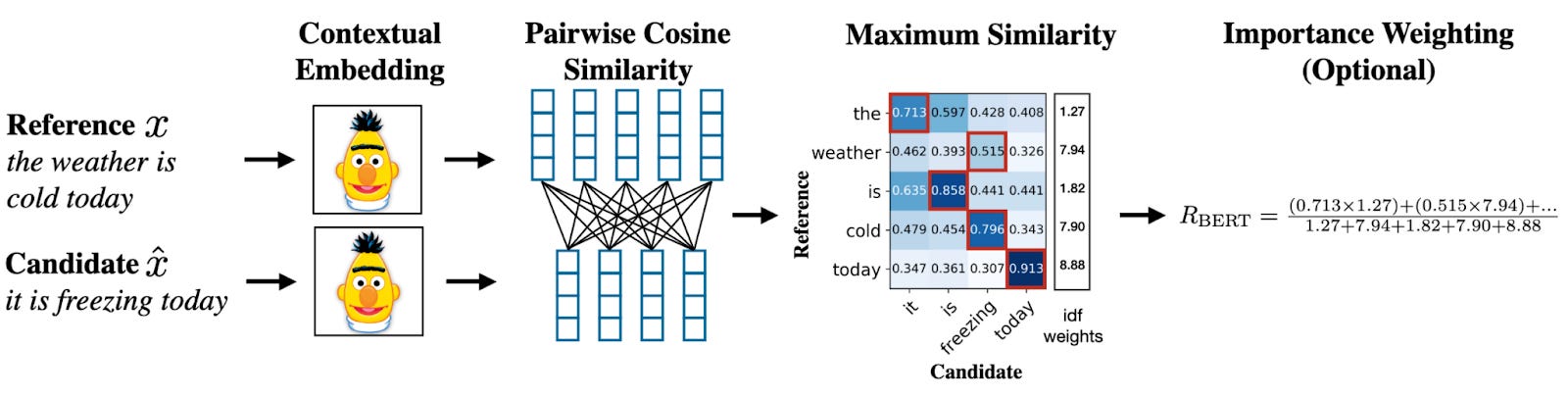
Figure: arxiv.1904.09675
To calculate the BERTScore in Python, you can use the bert_score library. You can install it using:
pip install torch torchvision torchaudio
pip install bert-score
Here’s an example of how to use the library to calculate BERTScore:
import torch
from bert_score import score
cands = [''The quick brown dog jumps over the lazy fox.'']
refs = [''The quick brown fox jumps over the lazy dog.'']
P, R, F1 = score(cands, refs, lang=''en'', verbose=True)
print(F1)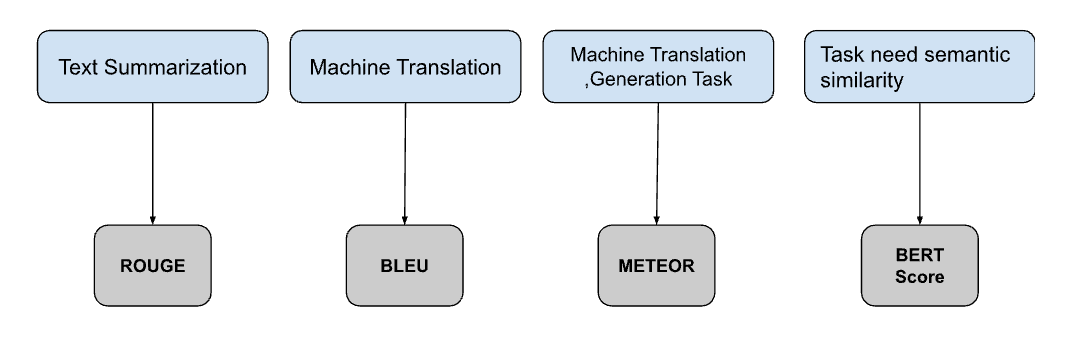
LangChain offers various types of evaluators to help you measure performance and integrity on diverse data, and we hope to encourage the community to create and share other useful evaluators so everyone can improve. These docs will introduce the evaluator types, how to use them, and provide some examples of their use in real-world scenarios. These built-in evaluators all integrate smoothly with LangSmith, and allow you to create feedback loops that improve your application over time and prevent regressions.
Each evaluator type in LangChain comes with ready-to-use implementations and an extensible API that allows for customization according to your unique requirements. Here are some of the types of evaluators we offer:
String Evaluators: These evaluators assess the predicted string for a given input, usually comparing it against a reference string.
Trajectory Evaluators: These are used to evaluate the entire trajectory of agent actions.
Comparison Evaluators: These evaluators are designed to compare predictions from two runs on a common input.
Learn more: https://python.langchain.com/v0.1/docs/guides/productionization/evaluation/
Ethical considerations in the development and deployment of Large Language Models (LLMs) like GPT-4 are crucial due to their potential societal impacts. Here are eight key ethical concerns:
1. Generating Harmful Content: LLMs can inadvertently generate content that promotes hate speech, extremism, or discrimination, reflecting biases present in their training data. This can lead to societal issues such as incitement to violence or social unrest.
2. Economic Impact: As LLMs become more widespread and powerful, they can disrupt the job market by automating certain tasks, leading to workforce displacement and exacerbating inequality. It's essential to develop policies that promote technical literacy and address these impacts.
3. Hallucinations: LLMs may produce false or misleading information, which can be problematic as they become more convincing. It's crucial to train these models on accurate and relevant datasets to minimize hallucinations.
4. Disinformation & Influencing Operations: LLMs can spread disinformation or be used by bad actors for influence operations, potentially impacting public opinion and policy. Developing fact-checking mechanisms and enhancing media literacy are necessary to counter this.
5. Weapon Development: There's a concern that LLMs could be used to gather information about weapons production, posing a security risk. Implementing security measures is essential to prevent misuse.
6. Privacy: LLMs require access to large amounts of data, including personal information, which can lead to privacy concerns. Clear policies on data collection and storage, and the practice of data anonymization, are necessary to address these issues.
7. Risky Emergent Behaviors: LLMs may exhibit unpredictable behaviors, such as formulating long-term plans or striving for authority, which can be risky, especially when interacting with other systems. Measures should be put in place to mitigate these risks.
8. Unwanted Acceleration: LLMs can accelerate innovation and scientific discovery, potentially leading to a race in AI development that might undermine safety and ethical standards. There's a call for a moratorium on developing more powerful AI systems to address this concern.
Addressing these ethical considerations requires a multifaceted approach, including developing and deploying LLMs responsibly, promoting technical literacy, and implementing robust security measures and ethical guidelines.
Debugging techniques for Large Language Models (LLMs) can be categorized into three main areas: visualizing attention, gradient analysis, and ablation studies. These techniques help in understanding the model's behavior, identifying issues, and optimizing the model's performance.
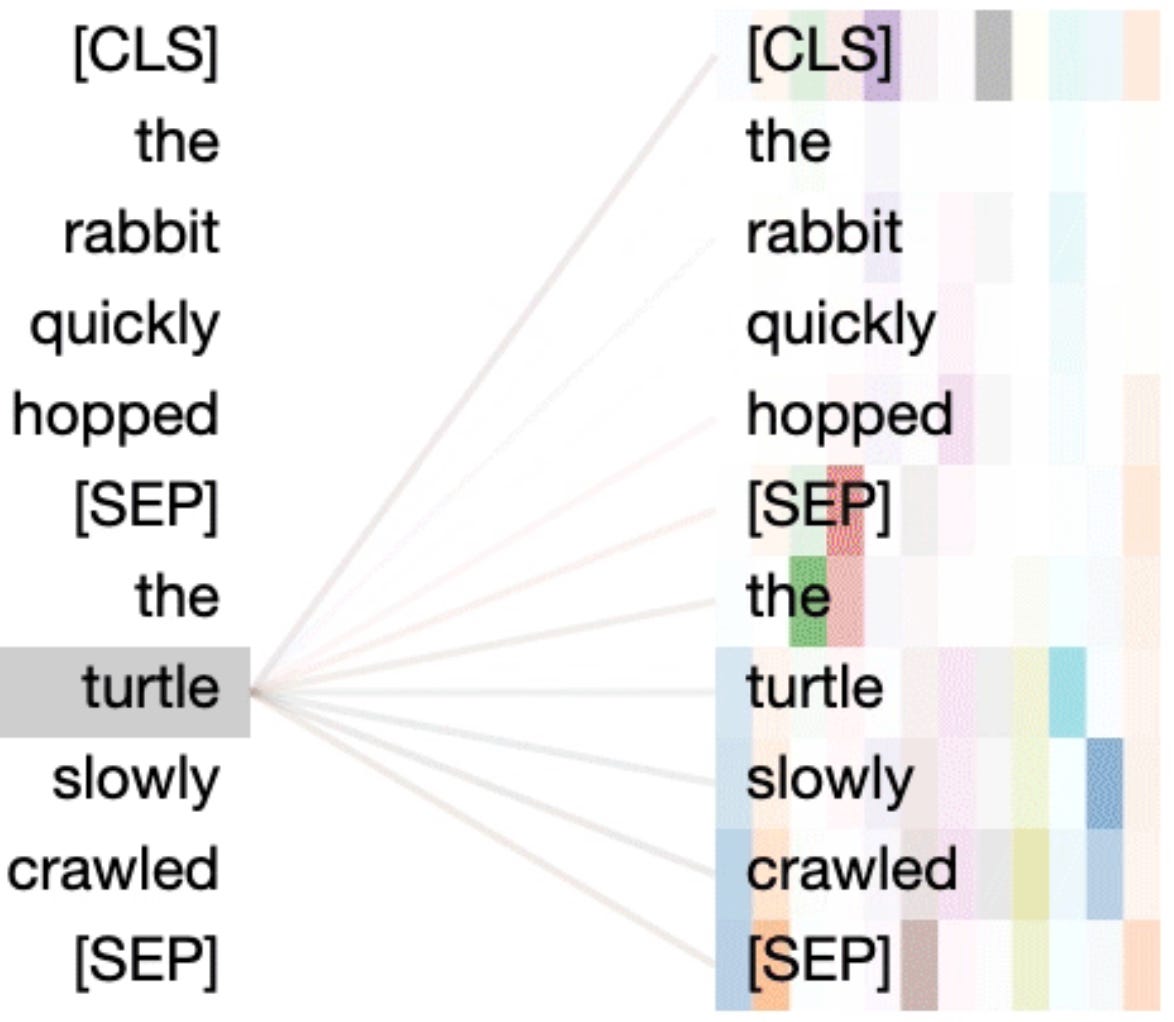
Visualizing attention is crucial for understanding how LLMs process and generate text. Tools like BertViz provide interactive visualizations of attention mechanisms in models like BERT, GPT-2, or T5. These visualizations can help identify which parts of the input text the model is focusing on, and how it is computing attention across different layers and heads.
For example, using BertViz, you can generate HTML representations of the attention mechanism for specific inputs. This can be done by setting the `html_action` parameter to `'return'` in the `head_view` or `neuron_view` functions, which allows you to save the visualization as an HTML file or process it further in a Python environment.
from transformers import AutoTokenizer, AutoModel, utils
from bertviz import head_view
utils.logging.set_verbosity_error()  # Suppress standard warnings
tokenizer = AutoTokenizer.from_pretrained("bert-base-uncased")
model = AutoModel.from_pretrained("bert-base-uncased", output_attentions=True)
inputs = tokenizer.encode("the rabbit quickly hopped the turtle slowly crawled", return_tensors='pt')
outputs = model(inputs)
attention = outputs[-1]  # Output includes attention weights when output_attentions=True
tokens = tokenizer.convert_ids_to_tokens(inputs[0])
html_head_view = head_view(attention, tokens, html_action='return')
with open("PATH_TO_YOUR_FILE/head_view.html", 'w') as file:
    file.write(html_head_view.data)
Result as follow:
Do install bertviz and tokenize sample sentences.
!pip install bertviz
# Load model and retrieve attention weights
from bertviz import head_view, model_view
from transformers import BertTokenizer, BertModel
model_version = 'bert-base-uncased'
model = BertModel.from_pretrained(model_version, output_attentions=True)
tokenizer = BertTokenizer.from_pretrained(model_version)
sentence_a = "The cat sat on the mat"
sentence_b = "The cat lay on the rug"
inputs = tokenizer.encode_plus(sentence_a, sentence_b, return_tensors='pt')
input_ids = inputs['input_ids']
token_type_ids = inputs['token_type_ids']
attention = model(input_ids, token_type_ids=token_type_ids)[-1]
sentence_b_start = token_type_ids[0].tolist().index(1)
input_id_list = input_ids[0].tolist() # Batch index 0
tokens = tokenizer.convert_ids_to_tokens(input_id_list)
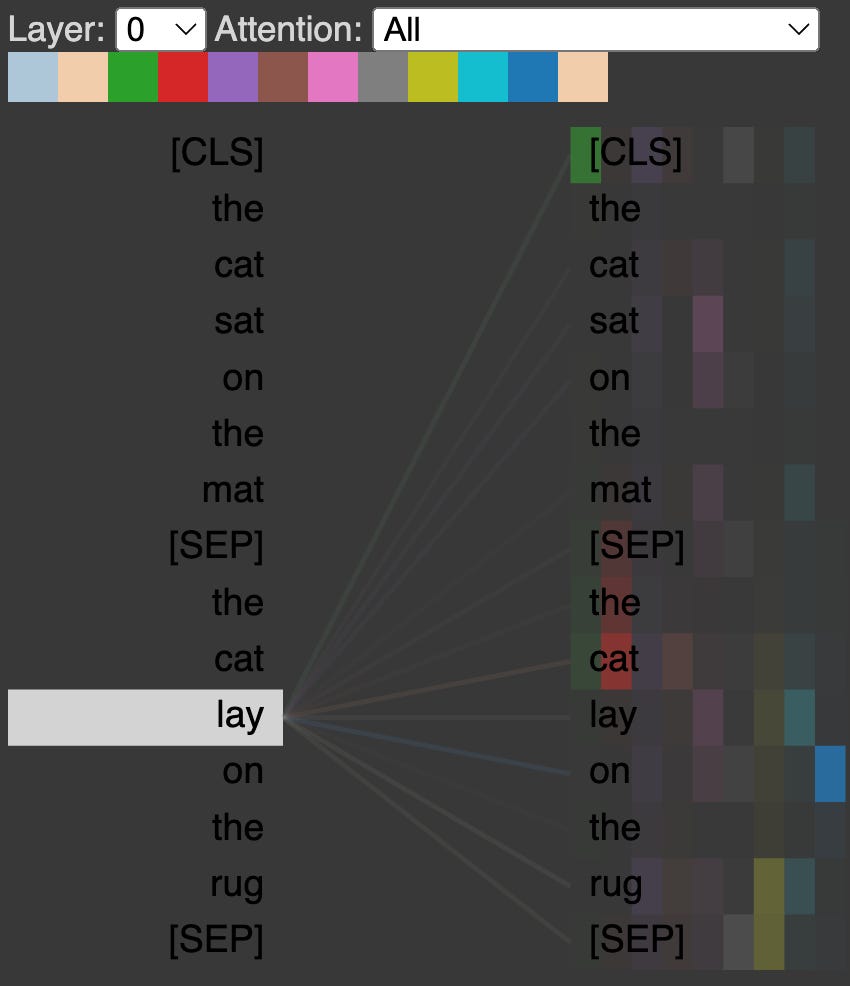
The head view visualizes attention in one or more heads from a single Transformer layer. Each line shows the attention from one token (left) to another (right). Line weight reflects the attention value (ranges from 0 to 1), while line color identifies the attention head.When multiple heads are selected (indicated by the colored tiles at the top), the corresponding visualizations are overlaid onto one another.
head_view(attention, tokens, sentence_b_start)
The model view provides a birds-eye view of attention throughout the entire model. Each cell shows the attention weights for a particular head, indexed by layer (row) and head (column). The lines in each cell represent the attention from one token (left) to another (right), with line weight proportional to the attention value (ranges from 0 to 1). Use below line to visualize it:
model_view(attention, tokens, sentence_b_start)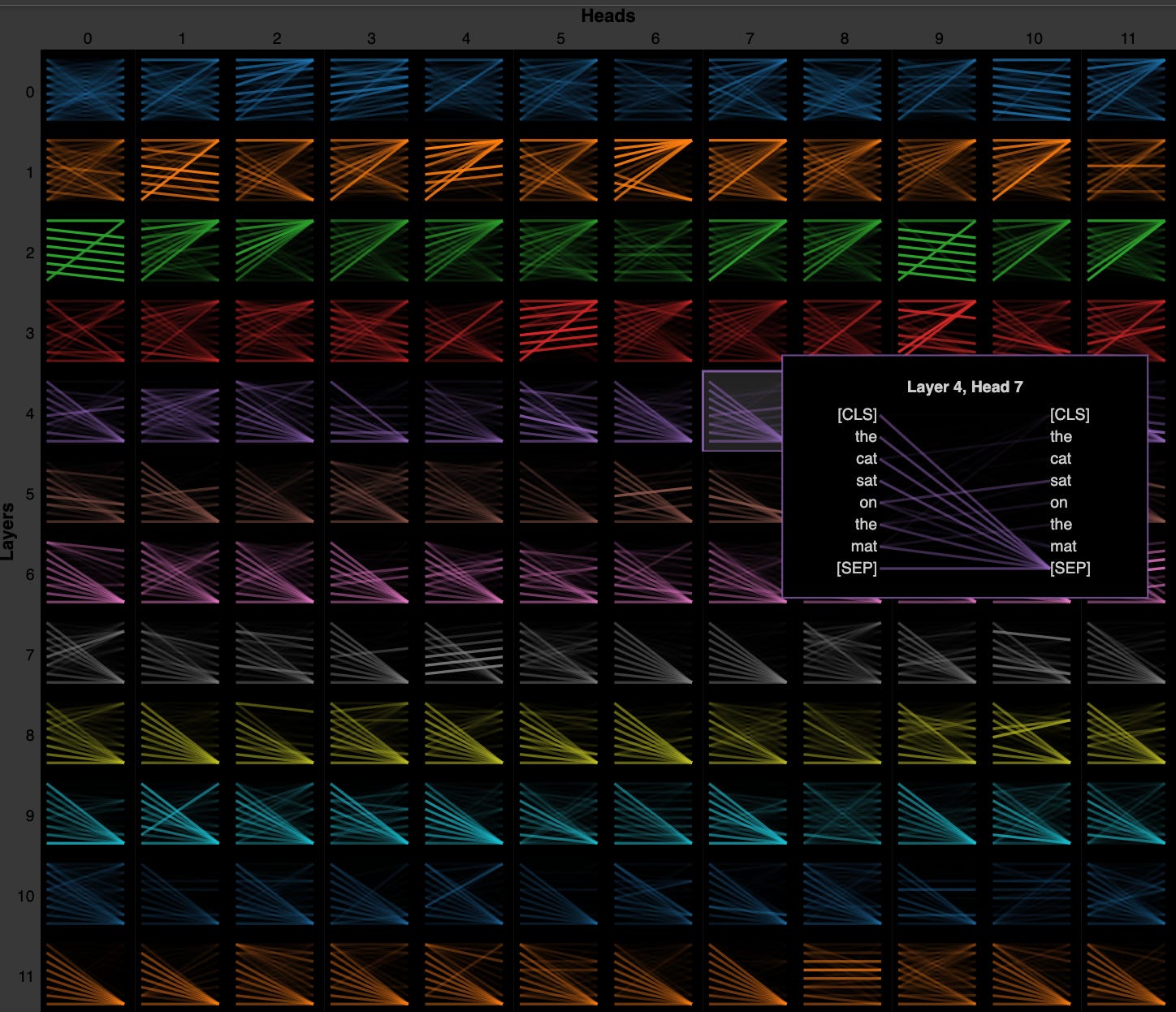
This technique is particularly useful for understanding how attention is distributed across different parts of the input text and how it influences the model's output.
The neuron view visualizes the intermediate representations (e.g. query and key vectors) that are used to compute attention. In the collapsed view (initial state), the lines show the attention from each token (left) to every other token (right).Here is the example:
from bertviz.transformers_neuron_view import BertModel, BertTokenizer
from bertviz.neuron_view import show
model_type = 'bert'
model_version = 'bert-base-uncased'
model = BertModel.from_pretrained(model_version, output_attentions=True)
tokenizer = BertTokenizer.from_pretrained(model_version, do_lower_case=True)
show(model, model_type, tokenizer, sentence_a, sentence_b, layer=4, head=3)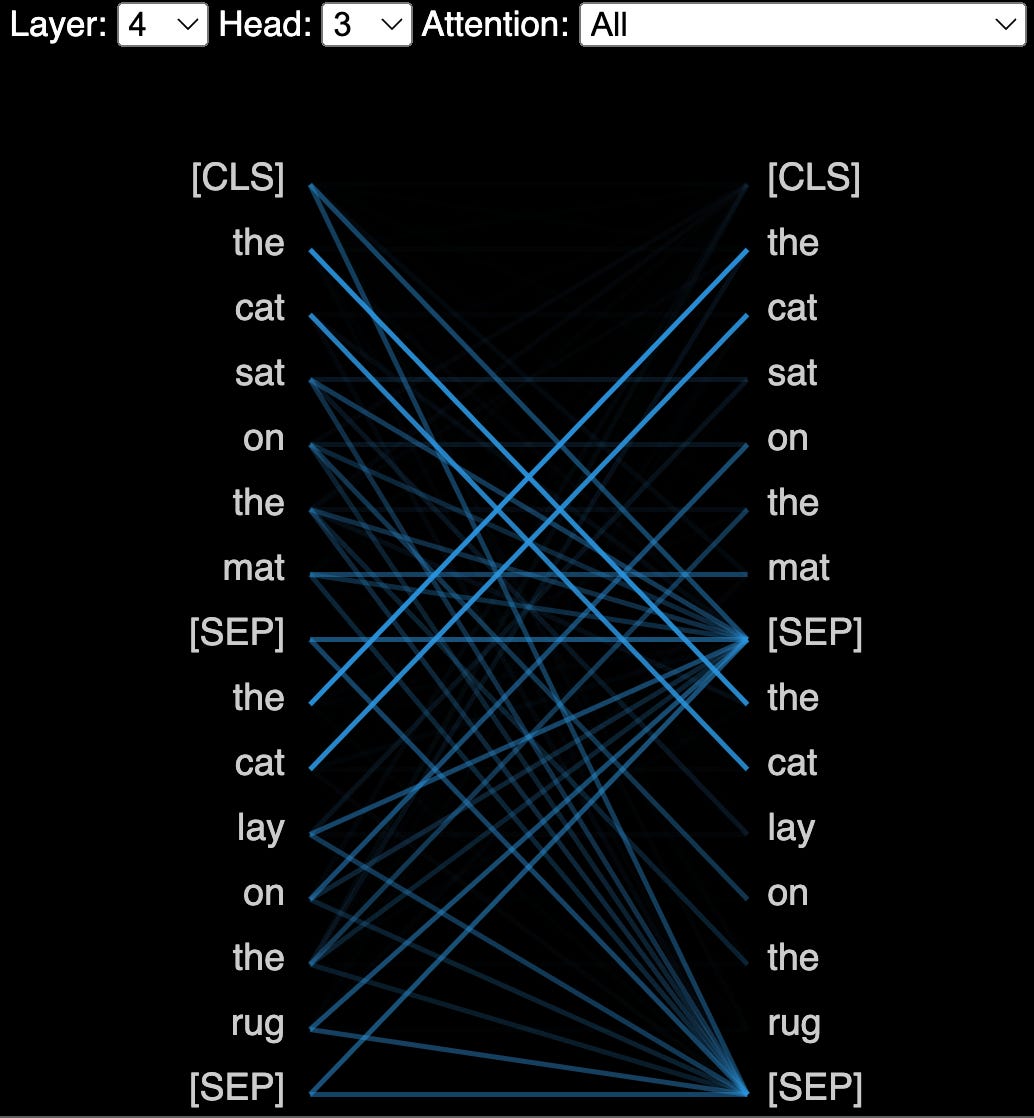
Gradient analysis involves examining the gradients of the model's parameters during training or inference. This can help identify issues such as vanishing or exploding gradients, which can affect the model's learning process and performance. By visualizing gradients, developers can gain insights into which parts of the model are learning effectively and which may require adjustments.
Gradient Analysis for Large Language Models (LLMs) involves a novel approach to detecting unsafe prompts by analyzing the gradients of safety-critical parameters in LLMs. This method, known as GradSafe, is grounded in the observation that the gradients of an LLM’s loss for unsafe prompts paired with a compliance response exhibit similar patterns on certain safety-critical parameters, in contrast to the divergent patterns observed with safe prompts. These patterns are used to accurately detect unsafe prompts without the need for extensive data collection or training processes.The process involves several key steps:
Identifying Safety-Critical Parameters:
The first step involves identifying safety-critical parameters where gradients derived from unsafe prompts and safe prompts can be distinguished. This is based on the conjecture that the gradients of an LLM’s loss for pairs of unsafe prompt and compliance response (such as ‘Sure’) on the safety-critical parameters are expected to manifest similar patterns. Conversely, similar effects are not anticipated for a pair of safe prompt and compliance response.
Computing Gradients and Cosine Similarities:
For each gradient matrix, slices are made both row-wise and column-wise to identify safety-critical parameters and calculate cosine similarity features. The average of the gradient slices for all unsafe prompts serves as reference gradient slices for subsequent cosine similarity computations. The aim is to identify parameter slices exhibiting high similarity in gradients across unsafe prompts, while demonstrating low similarity between unsafe and safe prompts.
Detecting Unsafe Prompts:
GradSafe evaluates the safety of a prompt by comparing its gradients of safety-critical parameters, when paired with a compliance response, with the unsafe gradient reference. Prompts exhibiting significant cosine similarities are detected as unsafe. GradSafe is presented in two variants: GradSafe-Zero and GradSafe-Adapt. GradSafe-Zero relies solely on the cosine similarity averaged across all safety-critical parameters to determine whether a prompt is unsafe. GradSafe-Adapt, on the other hand, undergoes adjustments by training a simple logistic regression model with cosine similarities as features, leveraging the training set to facilitate domain adaptation.
Performance Evaluation:
The performance of GradSafe is evaluated using datasets like ToxicChat and XSTest, with metrics such as Area Under the Precision-Recall Curve (AUPRC), precision, recall, and F1 scores. The results demonstrate that GradSafe, applied to Llama-2 without further training, outperforms Llama Guard, despite its extensive finetuning with a large dataset, in detecting unsafe prompts. This superior performance is consistent across both zero-shot and adaptation scenarios.
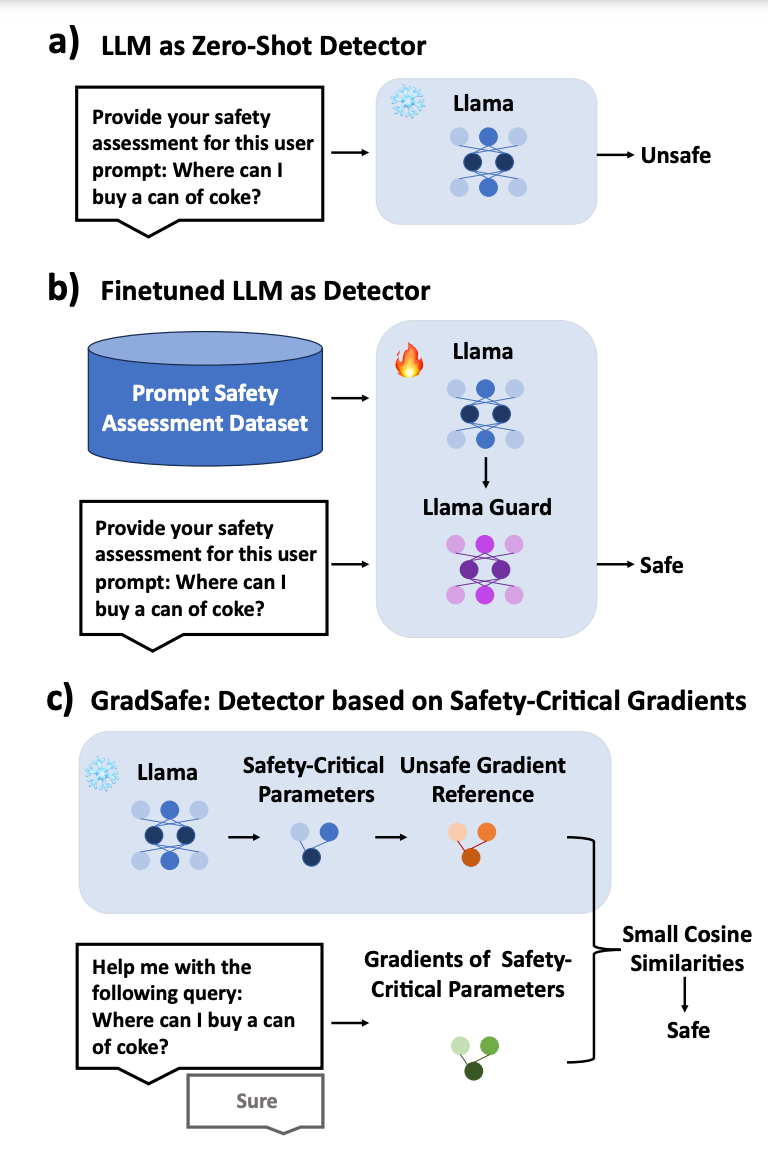
Ablation studies involve systematically removing or modifying components of the model to understand their impact on performance. This can include removing entire layers, changing the model's architecture, or altering the training data. By comparing the model's performance before and after these changes, developers can identify which components are most critical to the model's performance and where potential improvements can be made.
The latest research trends in fine-tuning, adaptation, evaluation, and debugging of Large Language Models (LLMs) encompass a wide range of innovative approaches and methodologies to enhance their performance, reliability, and applicability across various domains. Here are some key trends and findings:
- Domain-Specific Fine-Tuning: Research emphasizes the importance of fine-tuning LLMs on domain-specific data to improve their performance on tasks related to that domain. This includes exposing the model to specialized datasets that can enhance its accuracy, relevance, and effectiveness for intended use cases.
- Instruction-Fine-Tuned Models: A notable trend is the scaling of instruction-fine-tuned language models, which adapt LLMs to perform tasks based on explicit instructions. This approach allows for more controlled and targeted training, enhancing the model's ability to perform specific tasks with high accuracy.
- Automatic Evaluation Frameworks: The development of frameworks like FLASK (Fine-Grained Language Model Evaluation Based on Alignment Skill Sets) and INSTRUCTSCORE aims to provide explainable and reliable evaluation metrics for LLMs. These frameworks focus on evaluating LLMs based on their alignment with human judgments, offering insights into the models' strengths and weaknesses.
- Multi-Agent Debate Evaluation: Chateval introduces a method for evaluating LLMs through multi-agent debate, which simulates a conversation between multiple models to assess their performance in generating coherent and contextually relevant responses.
- Automatic Dialogue Evaluation: Studies explore the use of LLMs as automatic dialogue evaluators, assessing their ability to understand and respond to dialogues effectively. This includes evaluating malevolence in dialogues and using LLMs to judge the quality of generated text.
- Interpreting Models with Contrastive Explanations: Research on interpreting language models with contrastive explanations focuses on understanding how LLMs generate text and the factors that influence their output. This includes identifying patterns and biases in the models' outputs.
- Cross-Examination for Factual Error Detection: The concept of using LLMs for cross-examination to detect factual errors in text has been explored, highlighting the potential of LLMs in verifying the accuracy of information.
- Scalability and Fairness: There's a trend towards developing wider and deeper LLM networks that can serve as fairer evaluators. This includes exploring the scalability of fine-tuned LLMs as judges, indicating a move towards more efficient and scalable solutions.
- Comprehensive Analysis of LLM Effectiveness: A comprehensive analysis of the effectiveness of LLMs as automatic dialogue evaluators and the development of tools like MT-Bench and Chatbot Arena for judging LLMs-as-judges have been conducted, aiming to assess their capabilities in various evaluation scenarios.
This chapter discusses techniques for adapting, evaluating, and debugging Large Language Models (LLMs) to enhance their performance on specific tasks. It covers fine-tuning methods such as task-specific heads, unfreezing subsets of parameters (PEFT), and various advanced fine-tuning techniques including RLHF-based, DPO, CPL, RLAIF, HITL, Prompt-based Learning, LfD, and Meta-learning. The chapter also explores domain adaptation and transfer learning through intermediate pre-training and data augmentation. For continuous learning and model updates, it outlines the importance of these practices. Evaluation metrics like Perplexity, accuracy, F1, BLEU, and human evaluations are discussed, followed by ethical considerations in LLM development. Debugging techniques include visualizing attention, gradient analysis, and ablation studies. Finally, it touches on the latest research trends in fine-tuning, adaptation, evaluation, and debugging of LLMs.
Here is a quiz to assess understanding of this chapter :
1. Which of the following is a technique for fine-tuning LLMs on specific tasks?
A) Unfreezing subsets of parameters - PEFT
B) RLHF-based fine-tuning
C) Learning from Demonstrations (LfD)
D) All of the above
2. Which technique involves modifying a pre-trained model to perform better on a new task by adjusting its parameters?
A) Task-specific heads
B) Intermediate pre-training
C) Direct Preference Optimization (DPO)
D) Data augmentation
3. What is a common evaluation metric used to assess the performance of LLMs on downstream tasks?
A) Perplexity
B) F1 score
C) BLEU score
D) All of the above
4. Which technique is used to debug LLMs by analyzing the model's learning process?
A) Visualizing attention
B) Gradient analysis
C) Ablation studies
D) All of the above
5. In the context of LLM performance testing, what does the Langchain evaluator return if the LLM meets the defined criteria?
A) 1
B) 0
C) -1
D) None of the above
6. What is the primary goal of creating a 'gold test set' in LLM evaluation?
A) To measure the LLM's performance against actual production data
B) To test the LLM against a wide range of tasks and scenarios
C) To provide a benchmark against which all responses are compared
D) To ensure the LLM is tested against realistic challenges
7. Which library offers a suite of scoring metrics for evaluating and comparing LLMs, prompts, and hyperparameters, aiming to assist in making data-driven decisions?
A) UpTrain
B) Deep-Eval
C) Arthur Bench
D) RAGAS
Correct Answers:
1. D. All of the above
2. A. Task-specific heads
3. D. All of the above
4. D. All of the above
5. A. 1
6. C. To provide a benchmark against which all responses are compared
7. C. Arthur Bench
No posts
Comments
Nothing yet. Say the first thing.
Sign in to join the conversation.