
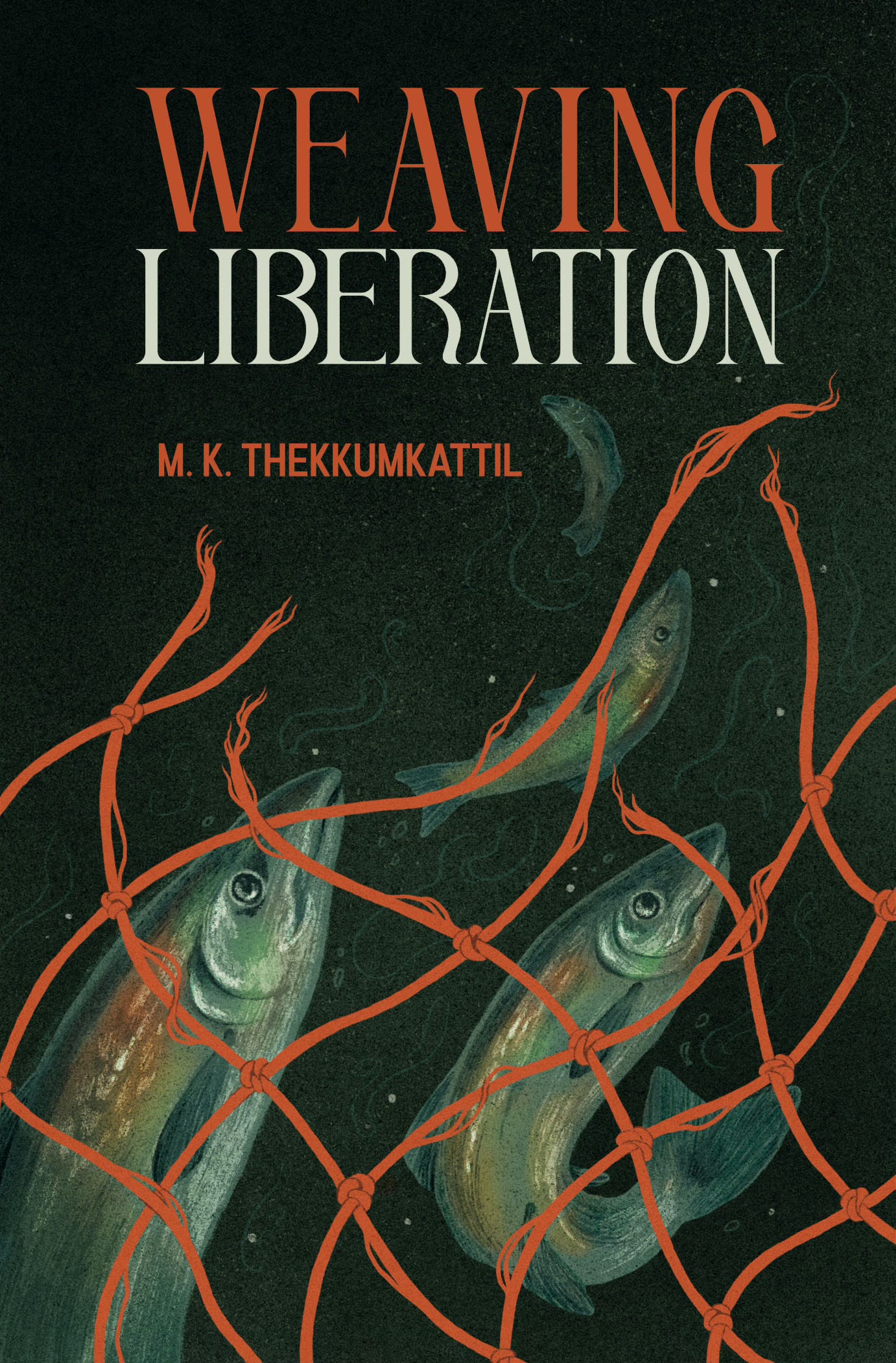
It’s been nine incredible months since we published the necessary work that is Weaving Liberation by M. K. Thekkumkattil. After a successful 100 book print run, we ordered an additional 40 copies which are quickly selling! To celebrate this collection, Abode Senior Hybrid Acquisitions, Michael Zendejas conducted an interview with Thekkumkattil on their work, inspirations, and thoughts about their chapbook. Keep reading to learn more!
Book Description: Weaving Liberation: An Archival Chapbook is a hybrid chapbook that documents one year of refusing genocide against Palestinians. Drawing connections between Palestinian liberation, relationship with land, nursing during the early years of the COVID-19 pandemic, transness, diaspora, and fishing, this collection offers an archive and genuflection to the communities that have come together for Palestinian liberation. Situated in the specificity of Dena'ina Land, the chapbook's ephemera includes ceremonial scripts from actions, letters to an assembly member, and essays written in grief, rage, and desperation.
Mike: Weaving Liberation: An Archival Chapbook moves between many genres without clearly separating them. When considering the structure of this book, what led you to choose that braided framework instead of a more traditional narrative form?
M. K.: Weaving Liberation: An Archival Chapbook came together as the year-mark of the escalation of genocide against Palestinians approached. Collecting these essays, protest writing, and letters, and taking time to honor the work we were, and are, doing to resist genocide, to free Palestine, the land, and each other, felt like an urgent act of hope. The genocide continues, and my friend Mayar continues to witness explosions and killings perpetrated by the zionist entity. She recently tried to visit her aunt, who had heart surgery, and saw the Zionist entity’s army advancing. As the genocide continues, it might seem strange to look at the past and talk about writing towards hope, about the ways we cultivate hope, or about archiving as centrally an act of hope, but, even as I write this, my relationship with Mayar is one rooted in hope.
I can’t talk about Weaving Liberation without doing some weaving in these interview questions as well, but to tighten these strands against each other, so maybe they take shape: I’m someone who has long turned to the archives to root myself in the struggles, resilience, strategies, and practices of those who came before me. Lineage is incredibly important to me: nothing I write or say has been done in isolation. Everything I am is a collaboration with my ancestors, with the land, with the brilliant and complicated people I’m surrounded by. As my community organized against genocide, built relationships, and supported each other through the normalization, gaslighting, and repression that fighting for Palestine was, and is, met with, I wanted to collect the ephemera of our efforts. Because this organizing took place on Dena’ina land, there’s the very real chance that the record of our resistance could have been erased. As a guest on this land, I consider the chapbook to be a genuflection: an act of devotion, bending my knee to my community and the lineages of Indigenous resistance that connects these lands to Palestine. The erasure of resistance serves the oppressor: our fight needed to be known, even if just for each other, so we can remember the liberatory possibilities created when we work toward a world worth fighting for.
The structure of the book, then, is a chronological journey through organizing from October 2023 to October 2024. It contains both the archived documents, like the scripts and letters, and essays I wrote in trusting, liberatory relationships. It took the shape it was meant to be—I really ceded control over what this archive wanted to be.
Mike: You speak extensively about care Weaving Liberation. What connections do you see between caregiving and political resistance?
M. K: Such a complicated question, one that I could answer in many ways! First, when I think about periods of my life that I’ve been most actively involved in organizing, I think about moments of intimate care: learning each other’s food restrictions and feeding each other; curating the action to meet the access needs of neurodivergent and disabled beloveds; holding each other after confronting state violence; regulating with each other. In my life and in the lives of my beloveds, care has made resistance possible.
When I think about the times I was unable to stay involved in organizing, I remember burnout, drinking, compassion fatigue, and self-abandonment. My care needs weren’t being met in both big and small ways. I dealt with that through self-destruction. I did not have the structure of support to allow me to live differently. When I eventually received that support, I became more able to imagine, and fight for, a different future for myself and others. This is a super simplified answer, but there’s definitely more on this in my upcoming essay collection, The Sexuality of Care: On Nursing, Kink, and a Future Without Hospitals.
As I came back into organizing these last few years, it felt vital for me to organize from my positionality as a nurse. Healthcare workers in Palestine have been intentionally targeted by the zionist entity, and these are my colleagues: they are the people who have the same kind of training as I do, who respond in crisis in similar ways, who have dedicated their lives to the care of others. Whether I like it or not, nurses are my people: we share a language and an ethic; we often have similar trauma and coping mechanisms; we chose a profession that requires we put others’ needs above our own. We carry extremely specialized skills required for resistance: to see a person in need and act, to assess quickly, to triage, and to use our hands in service of others, even when it does not serve us at all.
All that to say, I’m always thinking about bodies, our needs, how we can care for each other, how we can create networks of care so abundant that people can stretch outside their comfort zones and show up in ways they never have before. We’re building worlds with every act of resistance, and care is required to make that possible.
Mike: Recurring metaphors that stood out to me while reading include water, fishing nets, and, of course, weaving. What drew you to those images as a way of thinking about liberation and relationships?
M. K.: I’m really tempted to give multiple answers to every question—a greedy bisexual who does not want to choose! So, my first answer is that fish and fishing practices are extremely important to the culture and ways of life of both my homeland and where I live now. I wrote the title essay while visiting my homeland, staring at fishing nets strewn about beach shelters, and wondering how I could be one knot in a net strong enough, resilient enough, to cultivate safety, belonging, and liberation.
What’s not as explicit in Weaving Liberation, but is more explicit in The Sexuality of Care, is that I’m a kinky freak, and I love to play with rope. When using rope to bind a lover, I extend my grasp, create feeling beyond my hands, and curate feeling. Once rope is on someone, they feel everything I’m doing to the rope, even if I’m not touching them. I think about this as one metaphor related to weaving: moving these fibers alongside, onto, and against a body physicalizes unseen connections. Liberation requires cultivating unseen connections, surrendering to relationships we can’t predict.
Mike: The book repeatedly returns to the idea that community is central to survival. How has writing this book changed the way you think about community and liberation?
M. K.: As an ICU nurse, I became extremely isolated during the first few years of the pandemic. The writing within Weaving Liberation required I trust my community, be known and vulnerable, and leave my own comfort zones. Prior to the escalation of genocide, I deferred to other people, and saw care work as the primary way I contributed to liberatory worlds. That is still a primary way I use my body, but writing the pieces within the chapbook really challenged me to see the skill of writing as one that could be harnessed for liberation. The writing connected my body to both the Indigenous people of the land I’m on and to Palestinians fighting for liberation.
The chapbook’s writing was all created through relationship: no one protests, or writes, alone. I had the great fortune of organizing with beloveds and new friends, of being challenged and encouraged, of receiving loving feedback and integrating the wisdom of people who look at the world differently, of organizing around the multiplicity of needs within my community of neurodivergent and disabled queer and trans beloveds.
Mike: You write about transness as something borderless rather than fixed or individual. How did your experiences with community shape that understanding of gender?
M. K.: I’ll simply quote my friend Nikita here, who once said, “Loving trans people makes you more trans.” It’s true! I love trans people and we make each other, and those we love, more trans. An infinite loop that has no borders.
Mike: And lastly, where do you envision your work going in the future and how might Weaving Liberation impact that trajectory?
M. K.: I recently finished a manuscript for a poetry collection, which I’m submitting to publishers. In some ways, it’s related to Weaving Liberation, in that some of these poems archive the relationship between myself and my friend Mayar as she survives the immense cruelties perpetrated by the zionist entity. It also explores complicity in cruelty, in my work as an ICU nurse, and themes of death, care, and worldbuilding.
I have two fledgling projects in the work, too, which I won’t say too much about here. One is directly related to the essay collection coming out this summer, The Sexuality of Care: On Nursing, Kink, and a Future Without Hospitals, and the other is pure kink. Still very unclear which one will take priority—a book project takes years!
For the time being, I’m excited for The Sexuality of Care to get in the hands of readers, and to have more nuanced conversations about care, violence, liberation, and building a world worth fighting for.
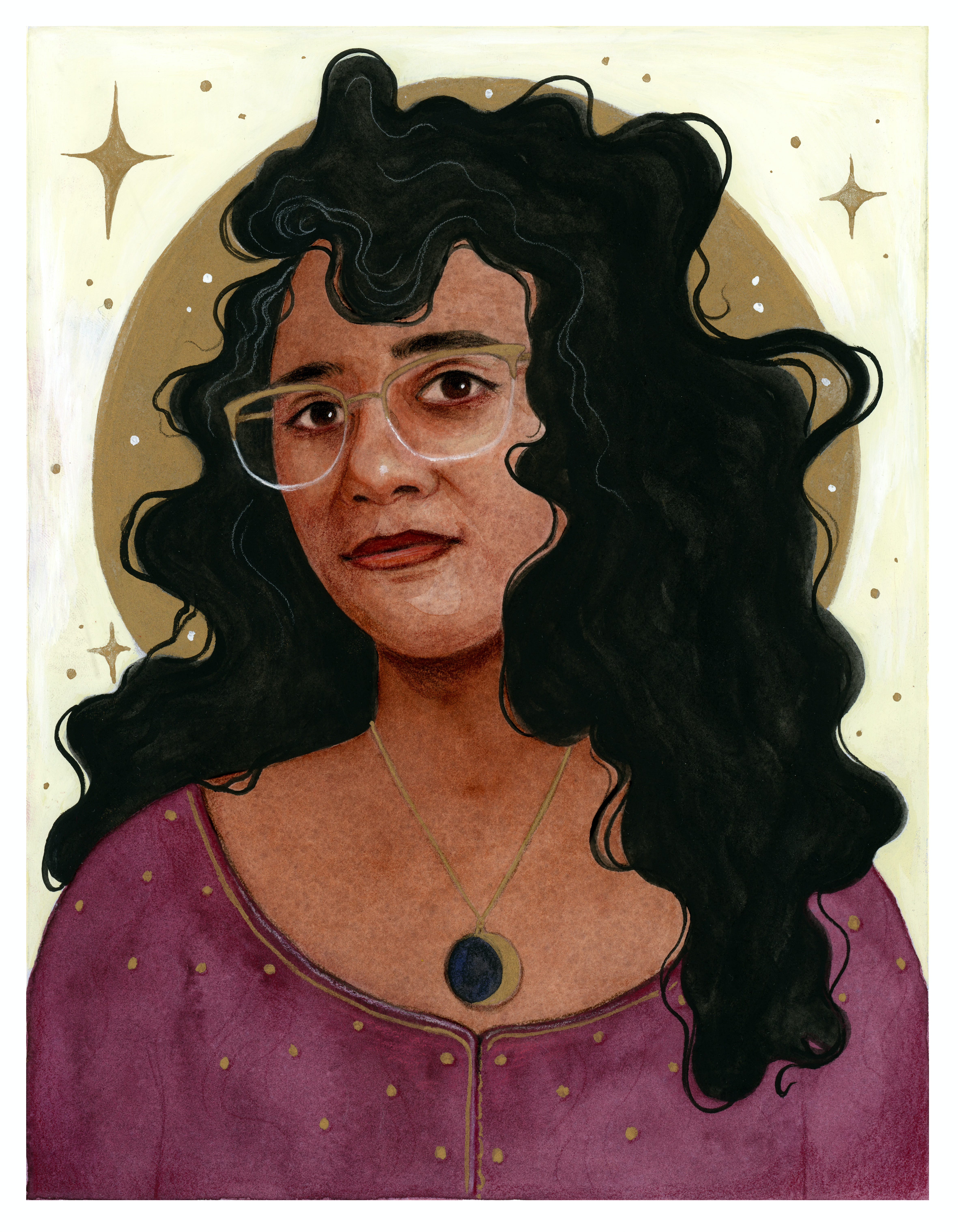
M. K. Thekkumkattil is a trans, disabled, kinky writer and nurse whose liberation is bound up with Palestinian liberation. They have received support from SmokeLong Quarterly, Tin House, Queer Art Mentorship, Lambda Literary, VONA, and Writing by Writers. They are the author of the essay collection "The Sexuality of Care: On Nursing, Kink, and a Future Without Hospitals," and the chapbook "Weaving Liberation: An Archival Chapbook." Their work can also be found in Black Warrior Review, smoke and mold, ___figuration, Year Round Queer, and In the Future There Are No Hospitals.
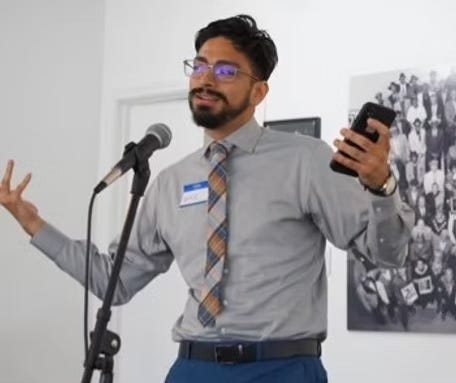
Michael Zendejas (he/him) received a Fiction MFA at UMass Amherst. He runs the film blog, The Chicano Film Shelf, and was an inaugural recipient of the Rose Fellowship, a Juniper Fellow, a 2022 winner of the James W. Foley Memorial Prize and was in the inaugural cohort of the Emerging Writers Fellowship. He consults and teaches classes on Fiction, Poetry and Screenwriting via GrubStreet. His work is featured or forthcoming in: Stanchion, North American Review, Unstamatic, Five2One Magazine and elsewhere. He's currently working on a novel!
Grab your copy here!
Comments
Nothing yet. Say the first thing.
Sign in to join the conversation.