
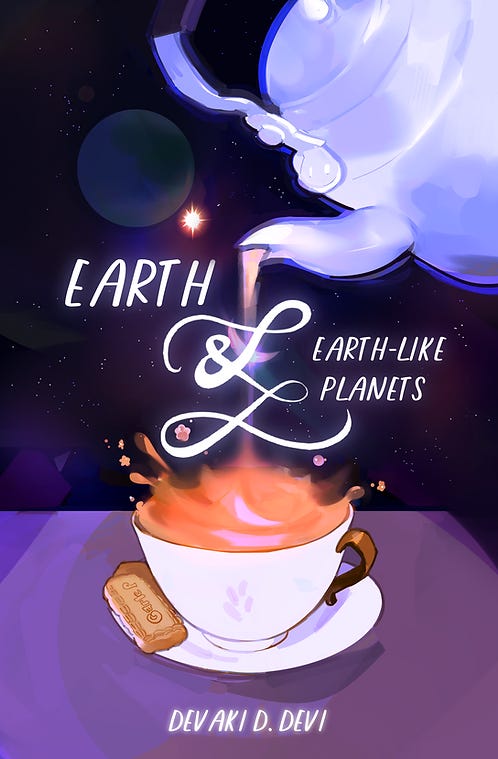
Earth & Earth-like Planets by Devaki D. Devi is a collection of imaginative short stories following Indian American children, teens, and young adults as they come of age in a country that often alienates them. This genre-bending chapbook hums with the steady pulse of Indian culture as diasporic youth create new worlds amid the weight of family expectations, shifting social norms, gender roles, and economic pressure. Rooted in heritage, Devi’s speculative prose transports readers to new planets, ones that remind us dreaming isn’t just survival, but rather, a radical act of envisioning the futures we all deserve. It was published by Abode Press last October and can be ordered here!
In this newsletter feature, Devi spends time reflecting on their chapbook, their process behind writing Earth and Earth-like Planets, and more! Keep reading to hear from the author themself!
Devaki D. Devi is a queer Indian American author and journalist currently surviving severe myalgic encephalomyelitis. Their writing often showcases the emotional landscape of childhood; observations sharpened by their years of experience teaching. Devaki is a Tin House writer’s workshop participant with a BA in Rhetoric from UC Berkeley. They are a Pushcart prize nominee, and more of their work can be found in The Dawn Review, Barren Magazine, and The Roadrunner Review.

From Devaki D. Devi on Earth and Earth-like Planets
When my parents came to America, we shifted rapidly between states – Indiana, Colorado, Missouri, till we finally ended up in the Bay Area when I was about three years old. I grew up, therefore, in some degree of cultural and racial privilege, because I was never technically lonely. Every single one of my neighbors was Indian. I had many Indian classmates who I saw as a second family when home was unsafe or scary. There was an Indian grocery store right across my street, where on weekends you could even line up for sugarcane juice. All around me, there was always familiarity to grasp. I never considered my apartment the bounds of my home. It flowered easily outside of it as long as I’d ever known myself.
That being said, I often felt lonely within it anyway. I see people in the diaspora talking about it a lot – the difficulty of being Indian and an artist, of being Indian and being queer, of being Indian and being neurodivergent, disabled – of being Indian and anything “outside the norm.” These were vague feelings that followed me too, before I could ever put them to words. The crushing paradox between my need for bonding with the most fundamental and intimate part of myself, and this inexplicable wall which separated me from it. After all, why did these differences make me feel at odds with my home, and my identity? It wasn’t as though they were opposites.
As I grew to love literature and sociology in college, this particular question was the one I kept circling back to. Why this block?
I read countless papers about queer and trans Indian identity before colonialism. Numerous times I was presented with the old story of the gender non-conforming characters which were censored from religious texts. The Making of Asian America by Erika Lee went on to describe how the model minority stereotype was meant to glamorize America during the cold war. After the double onslaught of British colonialism with its long, violent censorship and American imperialism’s economic exploitation and manufactured cultural flattening, a fenced-off story arose about Indian Americans. Due in part to its “flattering” nature, it ended up being absorbed as if it were our own, leaving Indians outside of the normative productive sphere alienated from their culture’s own mythos. But it never was ours to begin with.
Indian fiction which prods at the western world’s cultural perceptions does exist already, which I know since it was something I desperately searched for. The Truth About Me by A. Revati and The Ministry of Utmost Happiness by Arundhuti Roy presented to me both biographical and realistic fiction surrounding being an Indian trans woman, the hijra identity. The Sea Elephants by Shastri Akella, Don’t Let Him Know by Sandip Roy and Quarantine by Rahul Mehta all looked at the experience of Indian gay men, both in mainland and diaspora. All This Could Be Different by Sarah Thankam Matthews followed a diaspora Indian’s lesbian identity. The work was there, and I’ve leaned on it through my young adult life. But the weight in my chest remained where it was until I began writing my own stories, and joining the fence-breakers.
So what is my story? As I’ve said, I grew up in the Bay Area surrounded by other Indians. I’ve felt both moments of community and moments of alienation within it. I’m queer, I’m severely chronically ill, bedbound and unable to work. My parents are divorced, and I grew up with a lower income than many of my peers, never owning a house and living the majority of childhood without a working car. But in many ways there was that privileged integration for me as well – a higher caste family, both my parents holding a higher education degree, the expectations around my future, and of course, growing up somewhere like the bay. In this sense I would both bond and split from the Indian Americans I was around, relating and not-relating hundreds of times within one conversation.
I decided I didn’t necessarily want to write about identity in the sense of contrast and clash. I didn’t want to argue – I wanted to widen. In Benedict Anderson’s Imagined Communities, he writes about how novels themselves played a critical part in building the concept of nationhood, which was really just a set of imagined community members joined by certain histories, geography and traditions. From the seed of this concept, I thought about writing my own sense of community, thus widening the concept of diasporic Indian nationhood to all that it meant to me and my friends who currently didn’t feel we were imagined with it.
This, to me, meant infusing my pieces with all the memories of places where I’ve felt whole and seen – bonding with other Indians who have felt left out, different, others who’ve struggled with being accepted. Late night conversations in school when I was a kid. Open mics I went to as an adult. An organization called Parivar, named after the hijra tradition of making one’s own family, where queer desis came together to celebrate events. I wanted this to be the central pulse, the heart of which I would describe as a kind of “freedom dreaming,” a concept theorized by D.G. Kelley. Freedom dreaming is essentially the process of looking at our lives and deciding both what we want to change, but also what we want to keep. The moments of clarity, wholeness, and home I’ve felt in being Indian nearly always included an incidence of that dreaming – a celebration of culture as it is now, but also an embrace of queerness. A love for our parents, but also a defiance towards their restrictive expectations. An understanding of sacrifice and privilege, but also a resistance to capitalism and soulless wealth accumulation. As a whole, Earth & Earth-like Planets was borne out of these glimmering moments of clarity within such tensions. While it was being written, the collection was an attempt at describing my home while simultaneously creating it.
One central question I had as I wrote through these stories was how I was going to represent the Indian American experience on a basic level as I worked through these storylines of defiance. At a certain writer’s meetup, I once had a white author ask me “what makes your characters or stories Indian?” At the time I simply answered “their names,” because the answer felt too complicated to outline conversationally.
The reality is the Indian identity is astoundingly diverse, the Indian American identity perhaps even more so. My bond towards other desis has always been through recognizing each other’s faces across a room, or seeing each other’s names on a roster. Beyond that, so much is different. There are so many different languages – Tamil, Telugu, Kannada, Malayalam, Gujarati (my own), Hindi, Marathi, the list goes on. There are many different religions too, between Hinduism, Christianity, Islam, Buddhism, and within those too there are branches. I’m reminded here of A.K. Ramanujan’s essay, Is There an Indian Way Of Thinking? The answer essentially being that India, being so unfathomably diverse, does have an Indian way of thinking, which is specificity – the rejection of universality due to the sheer impossibility for such a concept to reside there.
But I would go on to argue here that in America this reality changes a little. There is a bond we experience in the similar way we are othered and the similar ways we push back. Even when I talk to Indians with an entirely different background to mine, I notice that essence is there. Counterintuitively the imposed hegemony brings us together. Anne Anling Cheng writes about how racial identity can sometimes become the grounds for “both progress and discrimination,” in The Melancholy of Race. It became very easy to stress about how I was representing being Indian American, which was why I decided to go about it in the most honest, archival way I could – one that didn’t flatten or universalize, exoticize or over-integrate, because it was simply true.
If I were to describe how Indian culture appeared in my life, I would describe it as an atmosphere: something which follows and breathes life into me, but isn’t always visible. Let me describe it this way: I don’t know Gujarati per se. I’ve long forgotten it. But last year, when I had a medical event and fell into a semi-coma, I experienced a sudden loss of English, where I could only recall Gujarati words. Everything I experience goes through the filter of my home, my family, how I was raised, and what I’ve chosen to retain from that way. Subtle things, like the cadence of my internal monologue, the balance of spirituality with rationality, or the things I like to eat. Larger things, like to treat my friends as family. An atmosphere is an undetectable thing day to day, but it’s also what keeps us alive. Its composition determines what a planet will harbor, and also determines how it’ll be perceived by an external observer. An atmosphere can be all this while all the proof we have of it up front is the blue of the sky, like all the proof I have up front is a name and a face. But there’s so much more than that.
In my stories, I represented the Indian American identity carefully, in a couple ways. I incorporated traditions which me and my own friends have joked about, and been very familiar with: superstitions about when to wash our hair, cut our nails, go outside. I mentioned homemade food, tea, biscuits, but not with any particular centrality. I thought about the expectations me and my community have grieved over – patriarchal ones, academic ones, unspoken ones, capitalist ones. I thought about subtle things, like long hair and braids, like easily forgotten house decorations like torans. I thought about cadence and the prominence of fables in our childhood, and weaved in many animals and a rhythm which followed the sound of Indian stories I read as a kid. I used certain expressions which came from specific tendencies of translation, because it came to me more naturally than a fully Americanized English. I used a diversity of names and gave my characters a diversity of faiths, because my friends and community have never been a monolith. And all of this is still only to the side, only the soft, corner-of-my-eye experience of identity. What is actually central is the character’s struggles against what the book itself is struggling against.
These stories where Indian girls in America drop out of college because they’d rather pursue art, kids in wheelchairs who lament the oppressive work week, neurodivergent kids who struggle to get along with others, who make worlds in their heads and play with bugs, queer teens with relationships that aren’t working out, with names and identities that aren’t working out, young men who love their families but can’t quite reach them, young women who avoid their families and can’t seem to heal from them. A lot of my own pain flows through these stories. But it isn’t just my own.
When I think of home, of identity and culture, I think of youth. After all, it is the ultimate youth – the most primary iteration of who you are. I wanted to use words and images that evoked the sensation of the past, especially Indian American childhood in the bay, with things like calling cards and silly bands and swimming pools and egg drops and malls. With that sort of whimsical, reminiscent state, combined with the magical realism inspired heavily by K-Ming Chang and Andrew Lam, I wanted to infuse in the narrative the inherent magic of freedom dreaming. I wanted to soften and open up the heart so it may stretch to include new air, new stories, new imaginations. A new atmosphere. And slowly, under this new air, a new planet, with more life.
A question often posed of Desi diasporic literature is simply: why? Why write it? This question also nags me, always at the back of my mind. What exactly am I offering, if not culture in its “purest” form, which would be better reserved for the mainland? Is this profiting from my identity? What is the alternative…that I write only white characters, or characters who are Indian, but only act white, though this isn’t true to life? That I don’t write at all? The answer comes to me most clearly in Orphan Bachelors by Fae Myenne Ng. In the end, I want an honest archive. I don’t want to have looked on soundlessly while people turn back and say, “Indian Americans were like this,” when it isn’t true. I want to have said, at least once, who my friends and I are and were.
Come, meet us. There’s more to us than you think.
Earth & Earth-like Planets is now available for purchase. Grab your copy here!
Comments
Nothing yet. Say the first thing.
Sign in to join the conversation.