
The image of Peter walking to Jesus falteringly on water has become so much a part of this story of Jesus, the disciples, and a storm, that it is hard to imagine it otherwise. What could be the oldest surviving images of Jesus depict this very moment (see below). Yet the older version in Mark (6:45-52) had not included Peter’s uncertain aquatic journey. We are invited, then, to grasp Matthew’s specific intention when reading this text and Peter’s role.
Last week with the miraculous feeding and now again here, the narrative of Matthew offers stories of Jesus’ power which are intended to teach, more than just to astound. Where modern scepticism holds sway however (even though sometimes people do seem willing to believe anything…), the mere fact of multiplying loaves or walking on water may seem too startling—or entertaining— for us to get past the surprise, to the heart of the matter.
In Jesus’ time the idea of walking on water represented divine power, but the desire of human rulers to do so was a symbol of arrogance, and of tyranny. The Second Book of the Maccabees, written very not long before Jesus’ time, refers to the tyrant Antiochus IV Epiphanes, defiler of the Jerusalem Temple, who thought “in his arrogance that he could sail on the land and walk on the sea” (2 Macc 5:21). A bit later, between the time of Jesus’ ministry and Matthew’s composition, the notorious Caligula had a temporary bridge built across the Bay of Naples, 50 km long, to enable him to cross on foot— since it was more appropriate for a god to walk over water rather than to wallow in a boat.
So the scene where Jesus walks on water would have reminded ancient readers both of the prerogatives of divine power, and of human presumption. As to the first, divinity is also invoked by Jesus’ response to the fearful disciples, “It is I.” While this phrase could be straightforward self-identification, it is the same as the “I am” that appears in the Hebrew scriptures as divine speech, and more clearly in John’s Gospel as a divine self-announcement. If Matthew’s version is more ambiguous than John, when the disciples acclaim Jesus (v. 33) as “Son of God,” this doesn’t come from nowhere.
The Jesus who walks on water is not only a “Son of God,” but a more legitimate ruler than Antiochus or Caligula. This is clearer in Matthew than in our lectionary excerpts; we have jumped over another story of tyranny, of Herod Antipas (son of that other Herod from Matthew’s nativity) and the death of John the Baptist (14:1-11), which set up a contrast that Jesus fulfilled in the miraculous feeding story, a compassionate leader juxtaposed with a rapacious one. So when Jesus, immediately after that story of violence, multiplies the loaves and now walks on water, Matthew shows him to be as a legitimate, effective, and compassionate ruler for Israel, in contrast to the oppressive conduct of the Herods and to the pretensions of Antiochus or Caligula.
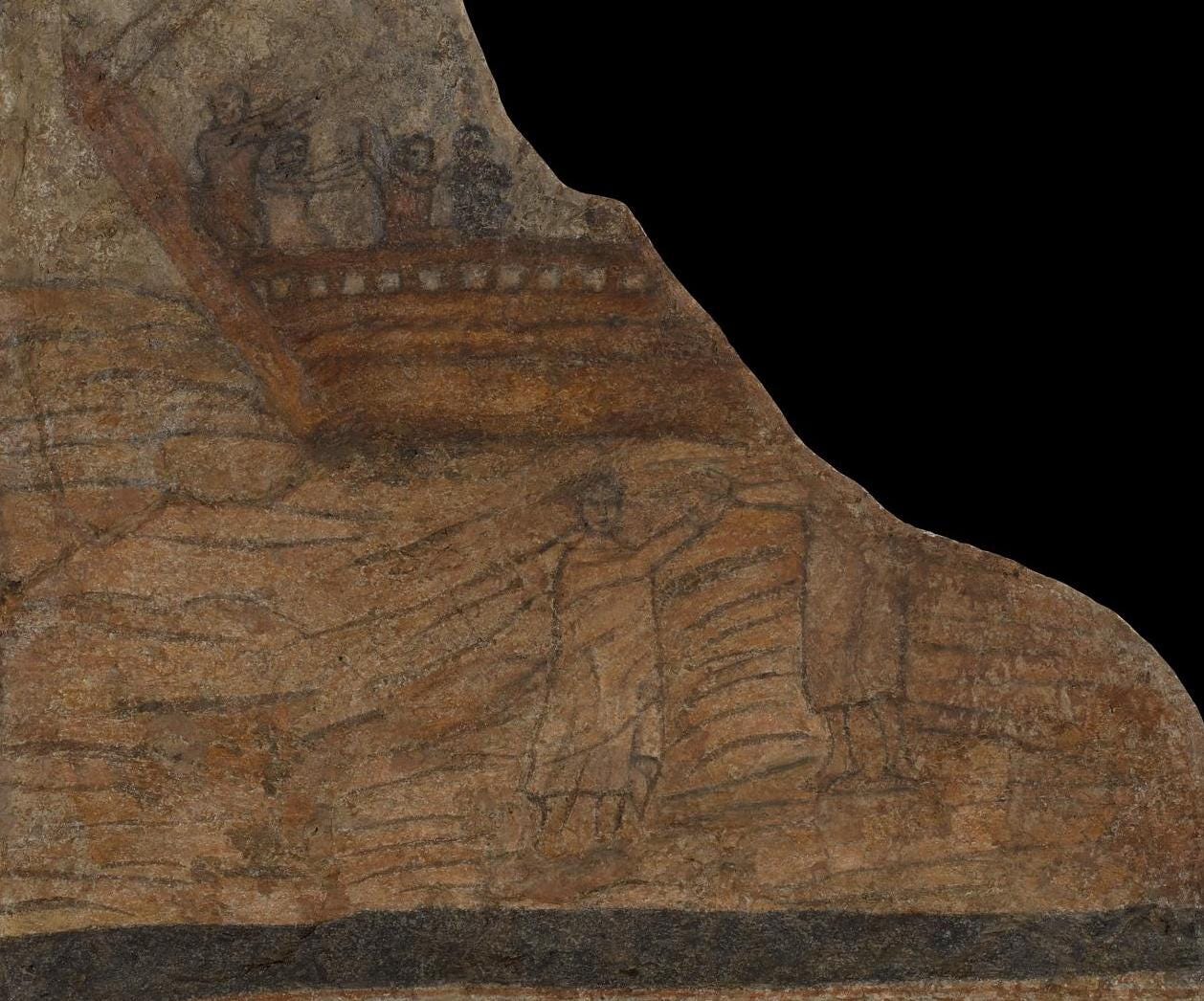
The walking on water story is not just a demonstration of power over nature then, although it is that; Jesus is undertaking the royal procession of true Messiah, whose rule promises plenty and freedom in place of the familiar exploitation and war. The stilling of the waves represents power over nature, but also the promise of care for God’s people.
Matthew may be giving some special attention to Peter, given the apostle’s subsequent role in the earliest Christian movement. It is important to place this within Matthew’s presentation of the disciples generally, too. We have seen how the group are presented as growing in faith and understanding. The growth is non-linear—there is no “arc” tending clearly and inexorably to wisdom or strength, and crises a-plenty still to come— but they progress in being called to follow, trust, and participate in what Jesus is doing. The disciples function within the narrative itself as the key audience to the Gospel, modeling how readers might respond to the message of the reign of heaven in Jesus as they did. Despite the most monumental failure still to come (26:56), they will ultimately receive the task of Jesus’ mission (28:19-20).
This story is the first time Peter becomes a sort of representative disciple, providing what is needed when the reader might be asking “what do I do?” Something similar—again not idealizing him at all—will recur in the Transfiguration story and in the prediction of the Passion. Peter is emerging as personal embodiment of what the disciples have been learning across these events, parables, etc., inexpert as he may be. His suitably inexpert walk on the water shows that Christian discipleship, like the disciples’ participation in the feeding story (14:19), means imitating Jesus in his own self-giving love.
At the end the disciples “worshipped him” (14: 33). This term is surprisingly difficult to grasp, because our own uses of the terminology of “worship” are, frankly, often insipid and misleading. Mainline Christians have used “worship” for their traditional liturgies, which is fine so long as we understand that “worship” doesn’t actually mean liturgy, it means devotion or obedience. The problem is at least as deep when, in some less liturgical forms of Christian gathering, certain musical genres and performances are called “worship.”
Sacramental worship, the Eucharist, has a particular claim to being “worship” because we do this in obedience to him. Otherwise, liturgy (including less formal gatherings) is at best the symbolic and communal center of worship, properly speaking, not the extent of it. Economics and ethics and relationships are all as much “worship,” when oriented to God, as is liturgy.
In the boat however, the disciples are not curating, nor performing, nor undertaking ritual; the word prosekunēsan translated here as “worship” means they are prostrating themselves. Flat on their faces, they embody their own dim but growing understanding of this mysterious one who controls even weather, and whose service is not ecstasy or ritual but justice. Their joy as well as their apprehension anticipates their future as actual “worship leaders,” that is, people who will serve him in building community, proclaiming the reign of heaven, and giving themselves for his sake and for the sake of the world he came to rule and save. Sometimes they too may even walk on water.
Comments
Nothing yet. Say the first thing.
Sign in to join the conversation.