
[For comment on the Epistle, see my 2023 comments here]
Jesus tells a parable involving fields, sowing, wheat, weeds and harvest, and later explains it to his disciples. If you have a sense of déjà vu, that’s understandable. Not only does this parable involve a scenario at least somewhat like that of the Sower which was read last week, but once again both the Matthean text and, in a quite different way, the RCL gospel lection have been arranged to present the telling of the story and then its separate explanation to the disciples as though continuous, which they are not.
I will not spend too much time adding to your sense of repetition by complaining about the RCL editing, but again we do skip over material that addresses the significance of parables per se (vv. 34-5), although here the explanation to the disciples is at least flagged in what we read, and so we have an explicit transition of audience and setting between the two parts, and hence also an acknowledgement that the meaning of the story may not be straightforward.
Once we are past these issues, there is more contrast here than similarity with the parable of the Sower. Matthew includes this parable—traditionally named “The Wheat and theTares”—at the place in the narrative where Mark had the simpler parable of the seed that “grows by itself” (Mk 4:26-29). There are parallels here—sowing, sleeping, growth, mystery, harvest—enough perhaps to think of Mark’s parable as a source, expanded into this more complex one. The result is unique in the Gospel parables, in that half of it is just the dialogue between slaves and landowner after the discovery, and the conclusion is a speech within a speech, where the landowner foreshadows his instructions to reapers, who appear only in the voice or intention of the landowner about a mysterious future.
While the scenario once again involves the hard labor of peasants in fields, this time the central figure is not one of those workers doing that sowing, but the property owner who oversees it. Any thought that this farmer actually does the work is erased by the appearance in the narrative of his slaves. So, even more than last week, we should not be romanticizing agricultural production itself. And just as otherwise, Jesus’ use in a parable of a particular institution or power relationship from his own setting does not entail an endorsement.
In this case, the landowner’s contribution was providing seed and ensuring that it was good. By “good” we should imagine not absolutely pure wheat, but that there was a low proportion of weed seeds. Whether this matters to the interpretation is not clear, but in any case the landowner’s plans for a quality crop have been compromised by the action of an enemy. The extraneous material that has been planted is translated in NRSVue as “weeds” but was meant to be something a bit more specific. The plant here, rendered in older texts as “tares,” has the exotic sounding name zizania, and is generally thought to be the wild grass Lolium tementulum, otherwise translated as darnel (or ryegrass). Zizania seems to derive from an old Sumerian word for wheat,1 and the resemblance to wheat was physical as well as verbal. Darnel had evolved to look like wheat in order to propagate itself, so farmers had difficulty distinguishing the real and “false wheat,” as it was also sometimes known.2
So the farmer—landowner—may just be exercising common sense here; the stalks could probably be told apart (hence the slaves’ suggestion) but the process of sorting and pulling darnel might be unreliable, not least when undertaken on a large scale by an unenthusiastic enslaved work force. Sometimes such real-world details help understand how parables work, but not always; the reign of God can be illustrated both in harmony with our expectations or common sense, or in opposition to it, as the particular case may warrant. In any event, here the landowner determines that the two crops will grow together for the meantime, and this decision becomes the basis of the lesson to be drawn.
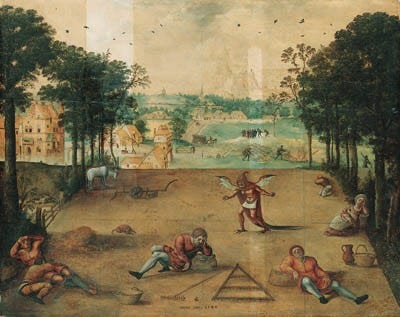
In the second part of the reading (edited to skip past material that will come up next week) where Jesus interprets the parable, note the shift of audience: the parable itself was spoken to a crowd, a mixed group, but the explanation happens privately with the chosen band of disciples, and “in the house” (v. 36). This was the same sort of procedure as for interpreting the Sower, but here form and content are aligned more directly, and interpret each other. The parable as interpreted refers to how people turn out to be a mixed bunch like the hearers, some not really fulfilling the hopes that might have been placed in them. This reality however is being explained to a smaller group who are the chosen, although bear in mind that Judas Iscariot was one of them. So the social reality of Jesus’ disciples was (and is) in some respects at least depicted in the parable, and reflected in the interpretation.
The explanation Jesus gives is clear, and bracing: it turns out this was an eschatological picture, and the harvest here is not (as in the Sower) the hopeful growth of the reign of God, but the devastating and revealing end, when all things will be shown as they really are, and all things put to rights. The core of this interpretation is given in three verses (37-9) that identify characters or elements allegorically; after that the judgement itself is expanded on, Jesus as retells the angelic harvest in more detail of wrath and glory.
The presenting issue overall is the experience of reader or hearer of how the world—and also of the community of believers—is like that “mixed bag” of the confused crop. Why are people such a collection of good and bad, and why is it often hard to tell them apart? In the world of the parable and its explanation, the population being sorted seems initially to be that of the whole world, but context allows a somewhat more specific application. Perhaps the reference was originally to Israel itself (why do some receive Jesus and others not?), but includes the emergent Christian movement (why are some adherents not sincere or resilient [a point also made in the Sower]?).
The parable has a double message of reassurance. The first form of reassurance is the affirmation that God does and has in fact acted justly. The seed was good, despite the slaves’ doubts. The fact things in the world or the Church (or wherever) are a mess, and that people often disappoint and hurt, is not evidence that God has planted something other than good seed. Of course the scope given to “the evil one” to plant other seed is a theological problem bigger than we can solve here; however the acknowledgement that God is the author of good is the starting point, because it also allows for the hope of renewal and restoration of an original divine purpose.
The second form of assurance is the more obvious one in the Matthean interpretation, the eschatological part. Although there are weeds in the field, they will not last for ever, and the very end of all things will reveal their reality. Judgment and the vindication of God’s elect will take place.
The intervening detail though—the landowner’s instruction not to attempt a preemptive sorting or weeding exercise— becomes the moral of the story. While there are people, and communities, and institutions, that are good and others that are not, the temptation to claim discernment or even to act as judges is as erroneous as it is tempting. A world of the pure and good alone is a fantasy (historically speaking); a Church of the pure is not even a Church. Despite our conceits of insight into others, we do not really know who will turn out to be good and true or not, in the end; and while that does not prevent us from seeking to act in righteousness, judging others is not included. We cannot determine what is known only to God and waits to be revealed. Meanwhile, we watch, and wait, and work. God has done well at the beginning of all things, and will again at the end.
Further reading: J. R. C. Cousland, “Toxic Tares: The Poisonous Weeds (Ζιζάνια) in Matthew’s Parable of the Tares (Matthew 13.24–30, 36–43).” New Testament Studies 61, no. 3 (2015): 395–410.
LSJ Greek-English Lexicon, sv. ζιζάνιον; “zizân” was a Sumerian word for wheat.
You may have had enough words now, but this process of imitative evolution is known as “Vavilovism.”
No posts
Comments
Nothing yet. Say the first thing.
Sign in to join the conversation.