
Last week we read the famous confession of Peter in answer to Jesus’ question, “who do you say I am?” Found in all the Synoptic Gospels, Matthew’s version is the longest, including the acknowledgement that Peter will be a rock on which the Church is built, as well as the “bestowal of the keys” (vv.18-19). All three versions of the episode however continue with some version of a twist in the subsequent episode we read this week.
Jesus goes straight on from having been acclaimed as Christ and praising Peter to predicting his demise. And of course then Peter, spurred on by his success in the last part of the conversation, decides to correct Jesus, but earns the harshest of rebukes in turn: “Get behind me, Satan!” Jesus then explains his own fate along with the difficult call to discipleship, and the need not just for him but for them (and by implication us) to take up the cross.
It is awkward to have all this spread over two weeks. When we read the equivalent story in Mark next year, we get the four parts of this story (confession, prediction, denial/rebuke, teaching about following) together in one reading, which makes best sense of the Gospel narrative. Today then may have to constitute a corrective or at least a nuance about confessing Jesus as Christ, or about apostolic ministry, or both: the glory of Jesus and of his apostles is the glory of taking up the cross. Yet if last week the challenge was how to avoid collapsing the confession of Jesus as Christ into triumphalism, this week it might be missing or misconstruing the connection between suffering and following Jesus the Christ.
Jesus alludes here to the process he would undergo, as did so many under Roman rule, of being paraded between prison and gallows, carrying the instrument of torture and death. Crucifixion was associated with slaves and rebels; the shameful and prolonged nature of the process, including this macabre parade, was deemed appropriate only for people of low status and not least slaves and captives. Our mental pictures of it are typically inaccurate, though; the condemned did not carry a “cross” in the sense of the whole + shaped apparatus, but the cross-bar or patibulum —like a railway sleeper—to which they would later be attached, by rope or nails, before being hanged on the existing upright or scaffold.
The image of “taking up the cross” refers to that journey of shame, not directly to the crucifixion itself. While we of course think ahead to Jesus’ particular way of the cross, the first readers of Matthew’s Gospel saw such walks still, as condemned prisoners dragged their own cross-bars through the streets, providing a kind of spectacle and a warning. For the disciples to be told their own life was like this did not evoke noble suffering, but shame and vulnerability, or ridicule.
Ancient prisoners (like many fairly recent ones) served as a sort of moralizing entertainment, before execution as well as in death. Our own treatment of those in the judicial and penal systems now lacks some of the color, but remains a form of distraction. The implication of carrying the cross isn’t just suffering, but shame, labeling, and misunderstanding.
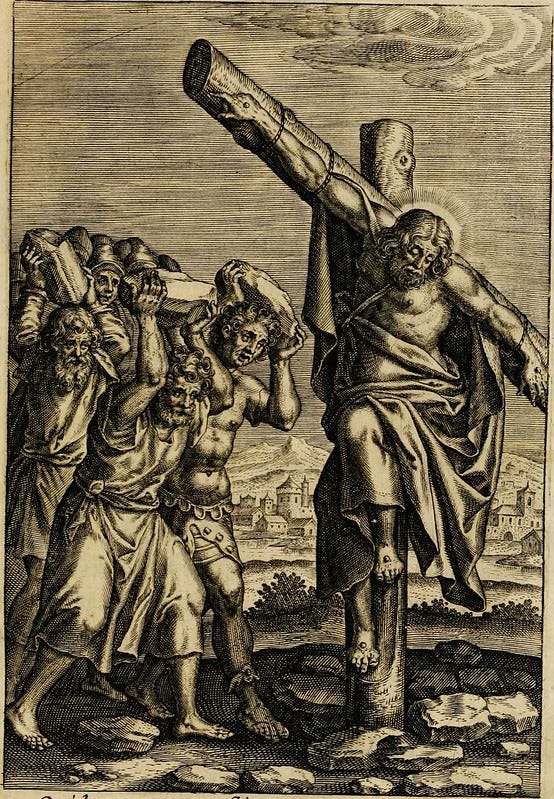
At least by tradition, Peter himself was to end his life similarly, and in early centuries many others were imprisoned, tortured, and killed whether or not with crosses involved. As the possibility of persecution faded however, in at least some places and times, and after some centuries, the context was forgotten and the more generic idea of “having a cross to bear” overshadowed the original and more confronting sense of the implications of the Gospel.
Taking up the cross refers, then, to what disciples face specifically because of following Jesus, not to human suffering generally. The comparison of discipleship to carrying a cross is not an invitation to think of our varied personal struggles as a sort of spiritual gift. If that is ever so, in some way at some times, it this is not the point here. This easy mistake has often led us to accept or hallow forms of suffering that we should not, but also to miss the distinctive and difficult fact of the call to be walking differently from many of those around us.
Although some Christian-related groups (I use the term loosely but unavoidably) complain about the loss of influence and privilege once taken for granted in the West, in fact even very outspoken Christians are not really persecuted in most places this post will be read. Religiosity is less common, and faith may be misunderstood or even joked about, but you are very unlikely be asked to bear anything much like a cross simply for identifying as a Christian. The significance of this Gospel call could thus remain a bit obscure, or may seem not to apply. Paul in Romans may help us out here.
There is a sort of parallel, real if not obvious, between the Epistle and Matthew’s account of Peter and Jesus’ conversation. Both have to do with what following Jesus entails. In the Gospel, Jesus is shown (or foreshadowed at least) indeed to be the Christ, not gloriously—or rather not gloriously in the way Peter imagined—but in shame and ridicule, for the sake of showing the deepest love for his own. Contrary to all common sense, and certainly to the discourse of power and glory, he must suffer many things before rising again. Peter likewise will be the rock and given the keys, having his part in all this, but must take up the cross and follow Jesus in order to grasp whatever this authority will be.
In the Epistle, Paul expands on his call last week to be “living sacrifices” (12:1), describing the new life into which believers have been raised after dying with Christ. At first, the sketch of that life is much less confronting than “take up your cross” talk; it could seem just a sort of “do unto others” list. Paul however contrasts the typical view of what success and happiness are with a quite different truth that may lead to misunderstanding. He contrasts a set of common-sensical responses to everyday challenges, not necessarily grand dilemmas, with paradoxical alternatives: generosity for its own sake, not for hope of return; giving honor rather than seeking it. At one point at least, he acknowledges directly the possibility of persecution (12:14). These principles, taken seriously, might cause ridicule in the eyes of the world. A call for mercy may be deemed “nasty” by those wielding power for self-aggrandizement.1
Whether or not we find the path of discipleship leading to present suffering and shame, the way of following Jesus is utterly counter to the wisdom of the world. Our call to take up the cross is a call to love, not to suffering, but that may have consequences. Dominican theologian Herbert McCabe put it acutely: “If you don’t love, you’re dead, and if you do, they’ll kill you.”2 So the cross may yet await; Paul has reminded us, however, that those who have already died to sin and are alive in Christ need not fear the power of death.
https://www.pbs.org/newshour/politics/trump-demands-apology-after-bishop-asked-him-to-have-mercy-on-lgbtq-people-and-migrants
Widely cited and doubtless authentic, but not found (by me at least) in any of his own published writings. One of my favorite citations is here: https://www.lrb.co.uk/the-paper/v28/n20/terry-eagleton/lunging-flailing-mispunching
No posts
Comments
Nothing yet. Say the first thing.
Sign in to join the conversation.