
This Gospel opens with Jesus lamenting the perversity of his generation, using an otherwise unknown children’s game or song; people just can’t be pleased, sneering first at John the Baptist’s asceticism and then at Jesus’ conviviality. Jesus’ summation of their intransigent refusal of God’s invitation is the curious saying that “Wisdom is justified by her deeds.”
In Luke’s version (7:35) Wisdom is justified by her “children”; whatever their common source said, Matthew’s version more clearly links the vindication of Wisdom to Jesus’ criticized actions, rather than just to John and Jesus personally, in Luke. Opinions themselves are not the point. Wisdom nevertheless is. We then skip some verses (20-24) which instantiate the foolishness of ignoring deeds; Chorazin, Bethsaida and Capernaum have behaved like those petulant children, and ignored Jesus’ “mighty works”—that is, his deeds.
The theme of Wisdom is still present when we return to the text with an extraordinary statement from Jesus (again shared with Luke) which out of context could sound more like something from John’s Gospel (25-27). At first it may seem however that wisdom is now relativized, rather than exalted, when Jesus praises the Father because “you have hidden these things from the wise and the intelligent and have revealed them to infants” (v. 25).
A certain kind of wisdom, perhaps book-learning, is rejected here though as a basis for claiming true knowledge of God. Yet knowing remains important; the “infants” are those to whom the Son has given true knowledge of the Father. Perhaps these faithful little ones are being contrasted with how the influencers of the day had been behaving like unruly kids in the marketplace.
What has been revealed to these other “little ones”? First, bearing in mind the previous section, it is this reality of Wisdom’s deeds and their recognition, which amounts to knowledge of Jesus and the Father. This “knowledge” does not mean we are quite in the realm of mysticism (special claims to insight would belong with the rejected “wise” here, not with the infants), nor are we just dealing with correct doctrine (yes, this intimate prayer may be close to trinitarian, but again that is not quite the point). Those to whom the Son has revealed the Father are those who have seen Jesus’ actions and have accepted him; to do this turns out to be true knowledge, not only of the Son, but even of the Father. Recall the recent promise to the twelve (10:40), that whoever received them as a host received not only Jesus himself, and the one who sent him. Actions, not erudition or opinion, amount to knowledge of God.
This is what true Wisdom constitutes, because true Wisdom is not an “it,” not a body of knowledge to be acquired and manipulated, but a person, whose nature is revealed by his practice, and hence our relationship with that person and our following him—or her. This divine Wisdom with which Jesus here identifies himself was an ancient Israelite way of speaking of God’s reality and its accessibility to humankind. Not only was Wisdom personified (see Proverbs 8), but in both Hebrew and Greek was feminine in gender. This becomes the basis, both in scripture and tradition, of imagining Her (e.g.) as a generous host:
Wisdom has built her house,
she has hewn her seven pillars.
She has slaughtered her animals, she has mixed her wine,
she has also set her table.
…
‘Come, eat of my bread
and drink of the wine I have mixed.
Lay aside immaturity, and live,
and walk in the way of insight.’ (Prov 9:1-6), part
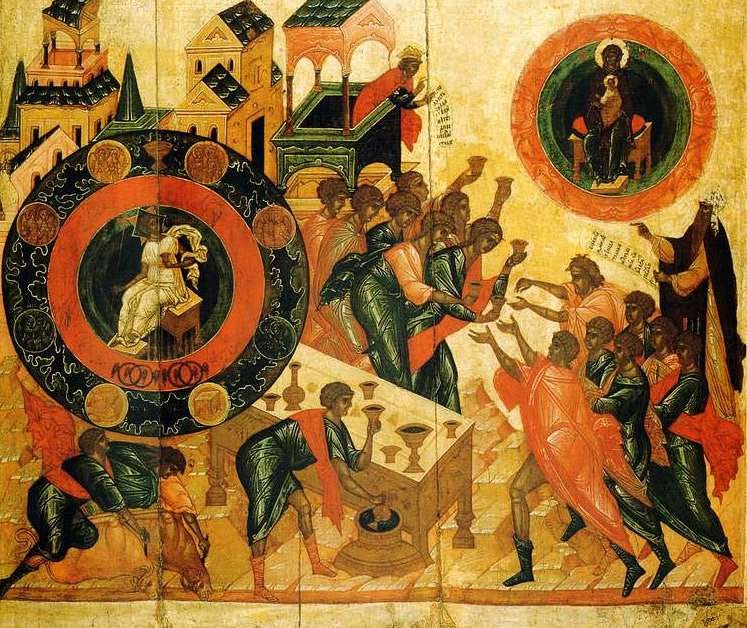
This image of Lady Wisdom also underlies the famous words that now follow and which are unique to Matthew, “come to me, all you who are weary” (10:28). This statement combines the familiar invitation from Wisdom just cited from Proverbs with another text in the “wisdom literature,” from Ecclesiasticus (also known as Ben Sirach), which is somewhat later in date than Proverbs. Ben Sirach had taken up the familiar image of Wisdom’s feast to provide an even closer parallel to Jesus’ words, making the link between hospitality and transformation (via a “yoke”) more explicit:
Draw near to me, you who are uneducated,
and lodge in the house of instruction.
Why do you say you are lacking in these things,
and why do you endure such great thirst?
…Put your neck under her yoke, and let your souls receive instruction; it is to be found close by. (Ecclus 51:23-26, part)
While the invitation to rest, refreshment, and true learning are offered to all, consider the context of Jesus’ words (as well as Ben Sirach’s) and how the message of comfort amid hard labor would sound to those whose lives were and are literally burdened with hard labor. This was an agrarian society requiring considerable toil, and with yokes both literal and figurative. Jesus’ ministry was conducted under the yoke of occupation, and the poor who followed him included day laborers, dispossessed peasants, and others experiencing economic stress and political oppression.
Jesus’ acts and Wisdom’s call have offered a vision of life where each is valued, and where all needs are met. This does not happen without costly change, including for the privileged. The banquet of Wisdom is not a tasting menu for the jaded spiritual appetite, but a soup kitchen or a rowdy pot luck of the unlikely redeemed. Those who respond to Wisdom’s call with the actions of a life well led will find themselves both feeding and fed.
Wisdom offers plenty, but she offers herself above all. “Herself” is this same Jesus, who is also Lady Wisdom. With that relationship, that invitation, come the demands of another yoke, as s/he says. Jesus invites to relationship, but not as an abstraction; some Christian piety makes him an imaginary friend or an air-brushed (or AI) image, that ignores his character and his demands. He offers he transformative possibility of life in him and “deeds” like his own, which is a “yoke” unlike that of the Romans.
Matthew consistently presents a Jesus who is Wisdom and grace, but who makes demands, and whose easy yoke can even take the form of a cross-beam. The “ease” he offers, the comfort and hospitality, is the genuine and deeper ease of knowing and doing the truth. By most measures this is actually hard, not easy. How can it be hard and easy at the same time? Augustine of Hippo comments on this passage: “Whatever is hard among the commandments, love makes easy” (Sermon 96). Wisdom offers the truth at her hospitable table, where the little ones outrank the wise, and those who have heavy burdens are honored guests. To be truly wise, we must join this feast.
Comments
Nothing yet. Say the first thing.
Sign in to join the conversation.