
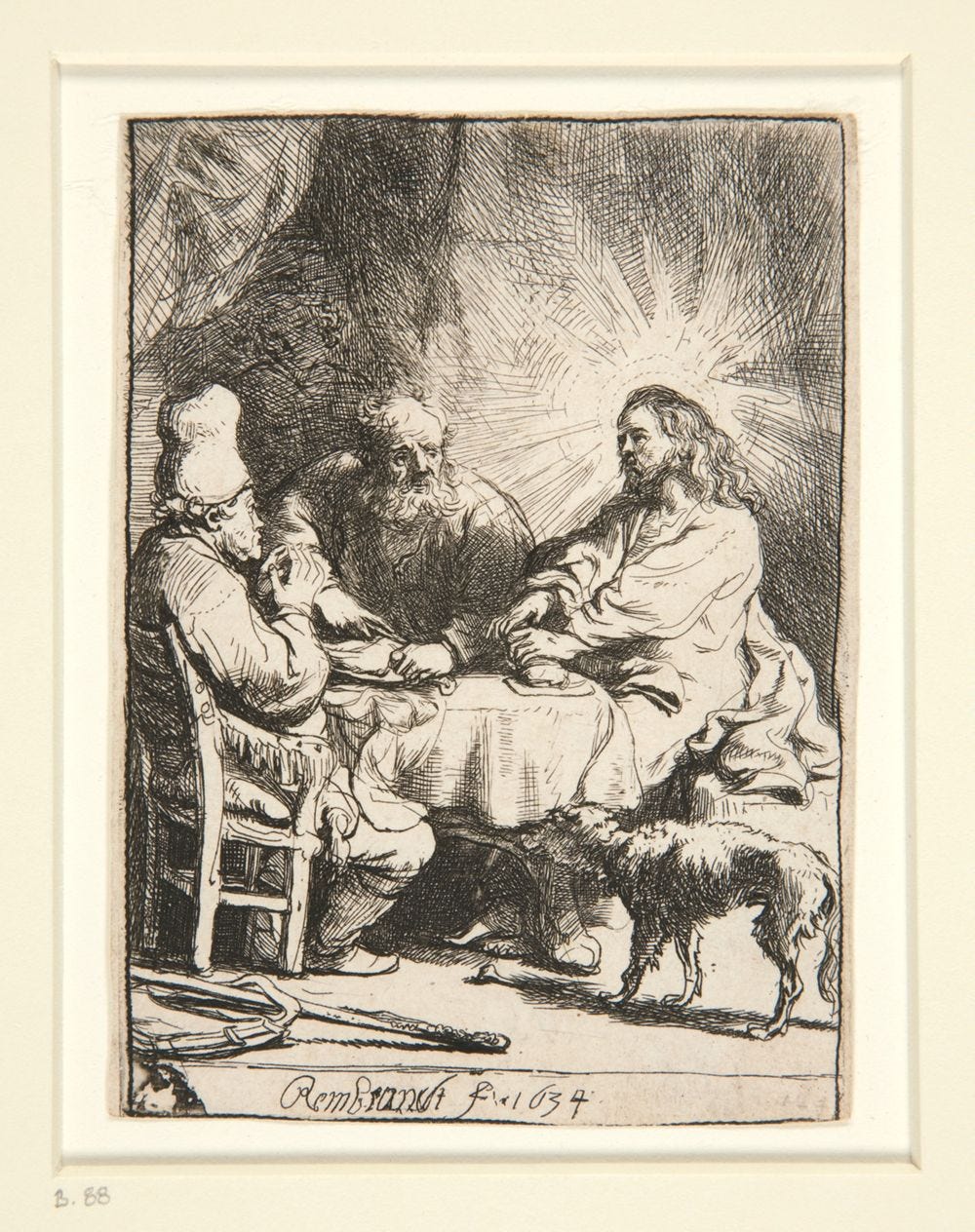
When the two disciples meet Jesus on the road to Emmaus, they are given a long itinerant bible study by the mysterious risen one, but neither their extended time in close proximity nor his careful teaching leads to recognition of their companion. When he accepts their invitation to dine however, and then takes the role of host at table: “…he took bread, blessed and broke it, and gave it to them. Then their eyes were opened, and they recognized him; and he vanished from their sight” (Luke 24: 30-31).
The Emmaus episode is by far the longest single resurrection story in the Synoptic Gospels.1 The scene is, as Luke Johnson suggests, almost a “pastoral” one which carries the reader into the quiet landscape, the lengthening day, and the extended exchange between three travelers who are more closely connected than two of them realize. This gentler story bridges the stark and shocking reality of the empty tomb and the striking fulfillment of the promise that the apostles would all see Jesus again.
Jesus’ actions at table, which form a climax of the story, clearly evoke episodes from earlier in this Gospel (and in others), such as the miraculous feedings: “And taking the five loaves and the two fish, he looked up to heaven, and blessed and broke them, and gave them to the disciples… (Luke 9:16). Most tellingly, they echo the Last Supper: “Then he took a loaf of bread, and when he had given thanks, he broke it and gave it to them…” (Luke 22:19). Each of these involves the sequence take, bless, break, give or close equivalents. Yet “breaking” stands out in this story, since when they return to tell the others what they had experienced they report that he was “made known to them in the breaking of the bread” (24:35).
While to “break bread” is a familiar expression to us, there is nothing in ancient Greek or Hebrew to suggest that “breaking bread” meant “sharing a meal.”2 Our knowledge and use of the phrase in English seems to come from the Gospel of Luke and its sequel the Acts of the Apostles. If not previously a proverbial expression, breaking bread was nevertheless a common action; since bread was central to any ancient Mediterranean meal, the flattish loaves were often scored to be divided into wedges by hand, rather than with knives—no, there was no sliced bread in this world—and had to be broken thus to be shared and eaten.
So while it suggests sharing and eating generally, “breaking bread” is a specific allusion to the actions of Jesus in those stories, and also a distinctive way of speaking about Christian meals that emerged soon after. In the Acts of the Apostles, we find “the breaking of the bread” used as a technical term when the life of the early community is described (2:42, 46; cf. 20:7) as centered on this act, harking back to all those other stories, but especially to this report of the two disciples eating with the risen Jesus and telling the story.
What does it mean though? “Breaking bread” as a phrase amounts to a thread woven through the life of Jesus and through the story of the early Christians connecting the miraculous feedings, the fateful last meal, and now this episode, as well as our own eucharistic meals. The Emmaus story interprets both the resurrection of Jesus and the community life, including meals, known to the early readers of Luke-Acts.
The Emmaus story bridges, as we noted, the empty tomb and the meeting between Jesus and the disciples at some considerable length. Brendan Byrne calls Emmaus “Luke’s masterpiece” because of how it combines its own simple story with so many others;3 ; the parts occur and recur like Russian matryoshka dolls, one story nesting inside another in a repetitive yet varied pattern.
So in the narrative of the walk together with Jesus, much of what goes on is story-telling: the two disciples are telling their mysterious companion another narrative, the story of Jesus’s fate, including the aftermath, through to the experience of the women at the tomb—to which this episode itself, we readers know, is now in fact another addition—and the women’s recounting of that story. Jesus however tells them—and places them all in— still another and more capacious story, that of the whole biblical narrative “beginning with Moses and all the prophets” (24:27).
The meal and the breaking of the bread amount to a turning point both in the story and in the two disciples’ place in it. When they recognize him, the story has become clear; that is, their recognition at table was not just of his identity, but of the meaning of everything both he and they had been narrating and their own place in it.
That revelatory moment then leads to another set of story-telling events: the two begin repeating the bread-breaking story to one another, then they return to Jerusalem where they retell the whole thing—the story about these stories—at least, that is, once they have been told themselves that the eleven and Peter now have a story of their own, too. As Johnson puts it, “Luke intertwines experience and narration by several characters, moving progressively and dramatically toward the creation of a community narrative that is the basis for discernment”;4 that is how these accounts come to belong to the whole group, and not just to the original witness or participant.
The connection with the breaking of the bread is not incidental. Just as the two travelers discerned Jesus and the meaning of the whole story at that point, the community we imagine reading Luke in ancient times—and our own—likewise breaks bread together and understands their own story to be part of this same one when they do so. Breaking bread, they, and we, are one with the hungry crowd on the Galilean hillside, with the uncomprehending disciples at the Last Supper, and with the two at Emmaus glimpsing him and seeing themselves differently in relation to him.
Emmaus can thus certainly be read as “eucharistic,” insofar as it presents the breaking of the bread as affirming and celebrating Jesus’ presence when the community gathers and remember him. Yet it also suggests that eucharistic celebration is not just a moment of finding or recognizing him in bread and wine, but of realizing that we ourselves are in the same story as he is, and then acting on it.
Thanks to Misty Krasawski for research and Felicity Harley McGowan for proofreading.
Further reading:
Luke Johnson, Gospel of Luke (Sacra Pagina).
Brendan Byrne, The Hospitality of God.
The appendix to John (chapter 21) is slightly longer if we count the Galilean fishing story and the dialogue with Peter as a single whole.
See Barry Craig, Fractio Panis (Rome, 2011), 74-5.
The Hospitality of God, 186.
In fact he uses this descripion of how the Cornelius story in Acts is retold but compares it will Emmaus; Gospel of Luke, 398-99.
Comments
Nothing yet. Say the first thing.
Sign in to join the conversation.