
Able Zine Issue 2 - Environment
Hi Family and Friends,
Preparations for Issue 2 are well and truly underway and we have been blown away by your responses to our prompts and call-outs. Many of these we wanted to highlight and share with the community via our irregular yet accessible newsletters!
Following our theme 'Environment', we prompted our contributors to think about the environments they inhabit and their specific experiences of these spaces as disabled/chronically ill and neurodivergent people.
Their responses encompassed everything - from the bedroom, workspace, nature, stages, and laboratories to name a few. We can't wait to share this upcoming print issue with you soon. But in the meantime, we hope this newsletter series allows you an opportunity to reflect on the spaces you exist in, and which environments allow us access to all our disabled potential.
We hope you enjoy,
Team Able Zine
For enquiries and submissions for future newsletters please contact sub-editor
Noni Benus noni@ablezine.com
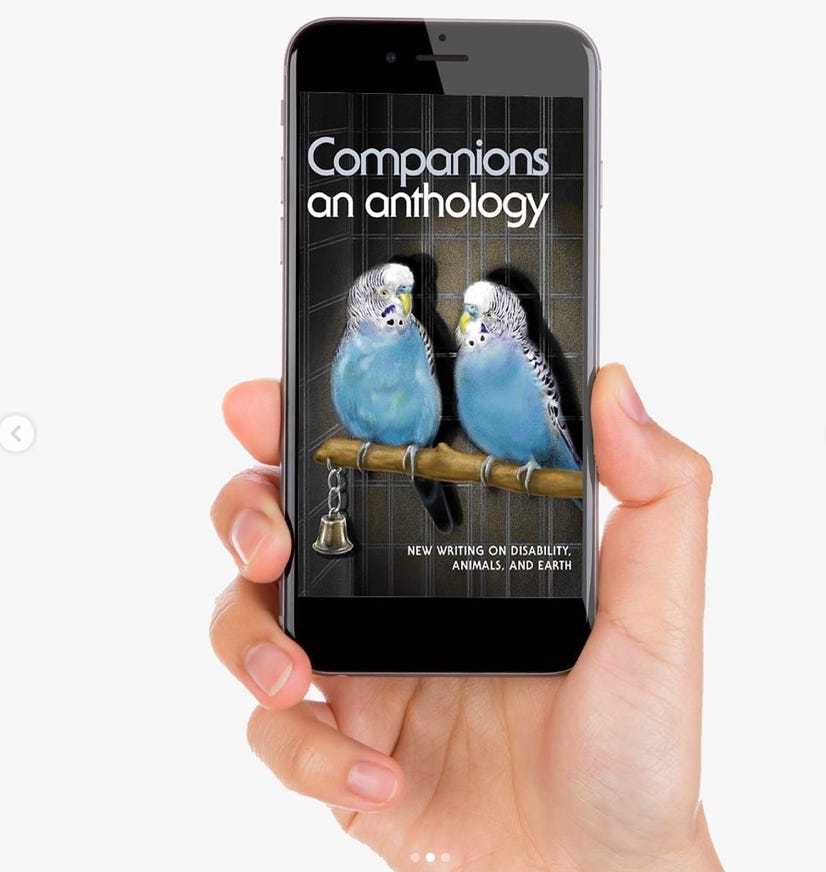
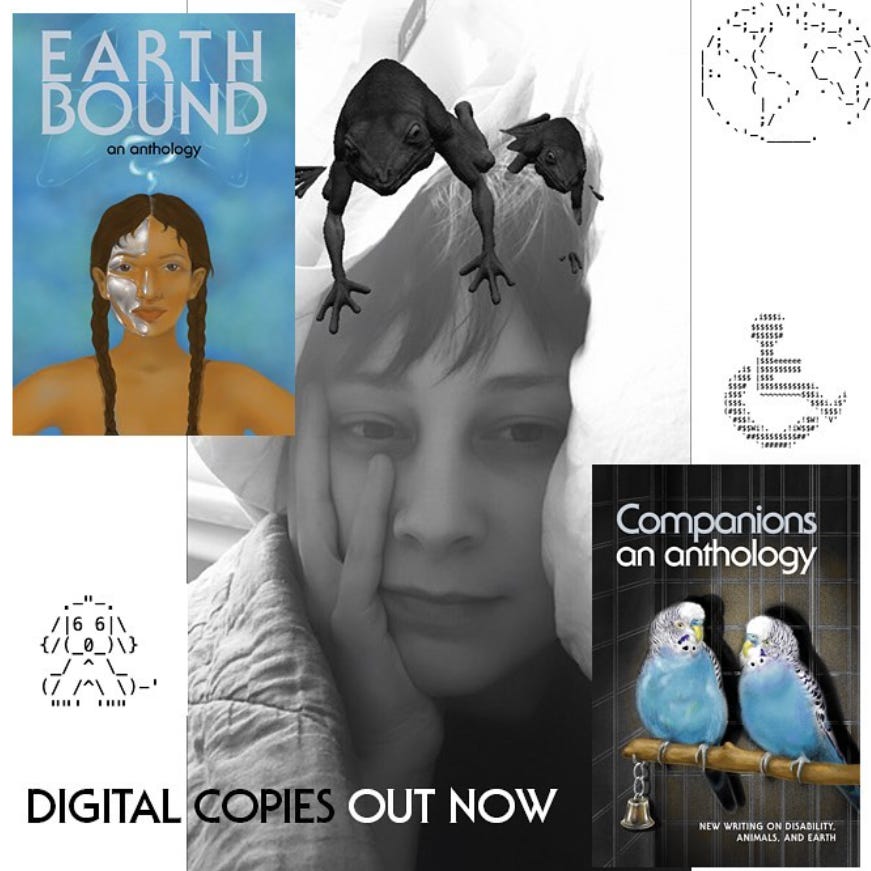
Below, in our first installment, we invite you to meet Olivia Dreisinger and learn about her newly published project, Companions & Earthbound.
This 2-in-1 anthology collects writing by nine authors about disability, animals, and the environment. A werewolf with PTSD and an environmentally ill AI are featured alongside human characters living with brain injury, chronic pain, neurodivergence, and more.
Contributors: Alexandra Box, Olivia Dreisinger, Sophie Helf, Bára Hladík, Cypress Marrs, Koyote Moone, seeley quest, Vanessa Santos, and George Wu Teng.
In the sections below, Olivia has shared with us both the introduction to the anthology and an excerpt for you to read. Scroll to the bottom to buy your copy and get 10% off using our code 'ABLE10'.
Olivia's Instagram
Olivia's Website
Back in the summer of 2018, I was in the middle of a rather insidious breakdown. My relationship had unravelled and my chronic illnesses were the worst they had ever been. Somehow, after some extensive googling, I came across horse-assisted therapy. Counseling in the past had often re-traumatized me and I wanted to be around animals as a way to mediate my distrust of other people. So, on a hot and sunny afternoon, I found myself in a field with a new counselor and Haven, a dark brown mare.
I didn’t have much experience with horses, but had heard that horses possessed a kind of healing power. Sitting across from the counselor, Haven off to the side between us, I tried to give myself over to the equine healing process, but something didn’t feel right. To be honest, I was afraid of the horse. I knew nothing of horse body language, and Haven knew nothing of me. My hand sat tensed against her neck for the next hour, the powerful muscles in her neck both relaxing and terrifying me.
At the end of the session, I pulled out two apples I had brought for Haven. I didn’t consider this to be a fair exchange—apples for emotional turmoil—but my hand came back empty all the same. She walked off to her barn, our exchange over, and I went home.
Meeting Haven taught me two things: my illness did not automatically make me feel closer to animals, and that animals were not interested in unearned connections either. I’d like to say this anthology grew out of that meeting, but it took other animals in my life for that initial lesson to really stick.
•••
Something I thought about while writing this introduction was what disabled people and animals had in common. I compiled a rather depressing list, highlighting our parallel histories of oppression and marginalization—one where we’ve been locked away and studied; poked, prodded, and devalued for our bodyminds. But these are not the only stories we can—or should—tell.
The goals of this anthology, then, are relatively simple: to explore how disability, animals, and the environment intersect. While compiling this anthology, I wanted stories that depicted nonhuman animals as vital, important, and complex, pulled by their own desires and preferences and right to exist. At the same time, I wanted stories that showed disabled lives as worth living. Lastly, I wanted stories that somehow connected these things to the environment.
When I first shared the call-out for stories, I worried that my criteria was too narrow and that people might only write about their dogs. While there are quite a few dogs that appear as either major or minor characters throughout the anthology, the stories that follow are incredibly diverse. You will find disabled, sick, mad, and neurodivergent characters, both human and non-human, throughout the following pages. There is a werewolf with PTSD and an environmentally ill A.I. There are also horses, birds, a whale (somehow, there is only one cat.)
The following nine stories are split into two sections: Companions and Earthbound. Inspired by the mass-market science fiction paperbacks I read as a teen, the anthology is designed as a 2-in-1 volume. The first side of the anthology, Companions, features six non/fiction fiction stories and essays. Flipping the book over, you will find Earthbound, featuring three speculative fiction stories I hope you will enjoy. May these stories matter.
Olivia Dreisinger
2021
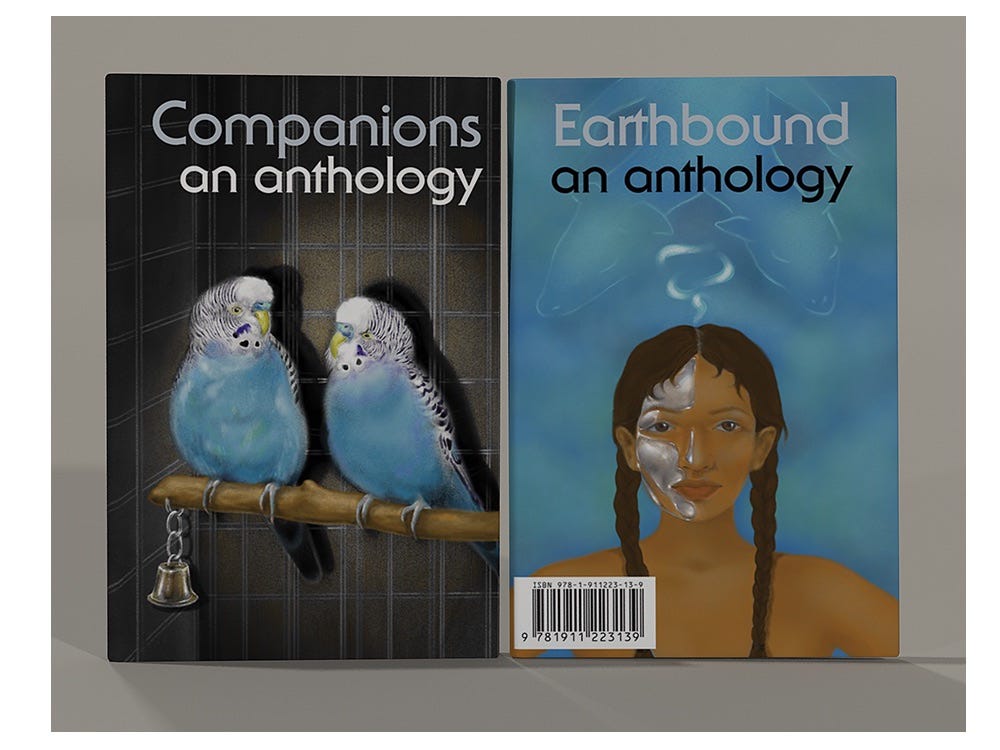
Cover concept by Sasha Zamani and artwork by Audrey Leshay
In the next hour, George met the staff, who gradually filtered in and routinely came in the back to place dishes, or throw lids and other Gastronorm containers in the to-wash bin. There was Courtney, first to arrive, the woman who had brought George water the day before, whose miniature stature belied a projecting, full-bodied, and, unrelatedly, seemingly endlessly optimistic-sounding voice; Miriam, light-brown-haired, or dark-blonde, from Montreal, spoke a “hello” in what almost seemed a whisper—though George would soon realise she just naturally possessed a quiet, almost constantly-singing vocal quality; Jeanne, tall, with limbs that moved as if through a material slightly, but not significantly denser than air, was a manager, and introduced herself with a soft smile, telling George to “let me know if you need anything.”; Victoria, he learned, was born in Montreal, and piloted pole position at the grill.
As he focused on placing dishes most efficiently in the rack, he ran through these new names and faces continually, attempting to commit them to memory, anxiously awaiting the end of the shift, when he could go home and add them to the spreadsheet. While in Boston, as a young teenager, he had two parakeets, one male and one female, both the same light-blue colour, both of whom he had initially refrained from naming. He would interact with the birds for long periods each day, sometimes giving them different seeds to try out, other times bringing them out to hop around on his desk. After a few weeks, he noted significant personality differences between the two. Though they almost definitively liked each other (they would often sit and cuddle together on the same branch in their cage, or nuzzle each other’s face, and would always, unfalliably, sleep side-by-side, leaning against one-another, with softly shut eyes), one was clearly more energetic, chirping more often and fluttering impatiently around the cage when kept inside for too long. The other seemed more pensive, and cautious: when greeted with new bell toys, or a different water dish, they took the time to examine the object, assessing it of any risks, before then fiddling with it. He enjoyed when they had arguments—infrequently, one of them would chirp aggressively and forcefully, while flapping around the cage, the other remaining on a branch replying every once in a while, trying to get a word in. Eventually, they would reconcile and return to their sleeping branch, where they would nap, or, sometimes, prune each other. He then decided to name the former “Active One” and the latter “Less Active One.”
No posts
Comments
Nothing yet. Say the first thing.
Sign in to join the conversation.