
This all started with the 1987 movie My Best Friend Is a Vampire.
Starring Robert Sean Leonard (probably best known for his roles in House and Dead Poets Society), this goofy, heartwarming ’80s teen film is all about learning to accept yourself for who you are — vampire and all.
One of my favorite things about watching creature features is seeing how they’ll interpret their subject’s mythical traits, and My Best Friend Is a Vampire is no exception. One amusing scene depicts a confused Jeremy making a truly horrific smoothie in the process of trying to figure out his new appetites (which his dad ends up drinking instead). A classic mixup of the genre — is it just puberty, or is it a supernatural evolution?
Admittedly I’ve always kinda preferred werewolf movies to vampire flicks, and went on a big werewolf-watching kick during the pandemic — but it’s hard not to love a film in which Robert Sean Leonard exclaims “The mirror’s not working!” while searching for his absent reflection. It’s a fitting watch for spooky season that feels like a big hug.
A week after my rewatch, I was browsing vendor booths at a convention when I came across a mysterious book I’d never heard of before. At first glance it appeared to look like an old withdrawn library book, bearing stamps written in other languages on its marbled cover. The title was Thousand Year Old Vampire.
I picked it up and flipped through the pages, where I found scanned-in ephemera such as odd newspaper clippings, antique photographs, and medieval drawings, as well as a series of numbered prompts.
It’s very rare these days for me to buy a book without knowing anything about it — but there was just something about this one. It’s funny how those chance discoveries so often end up delivering the most profound impacts.
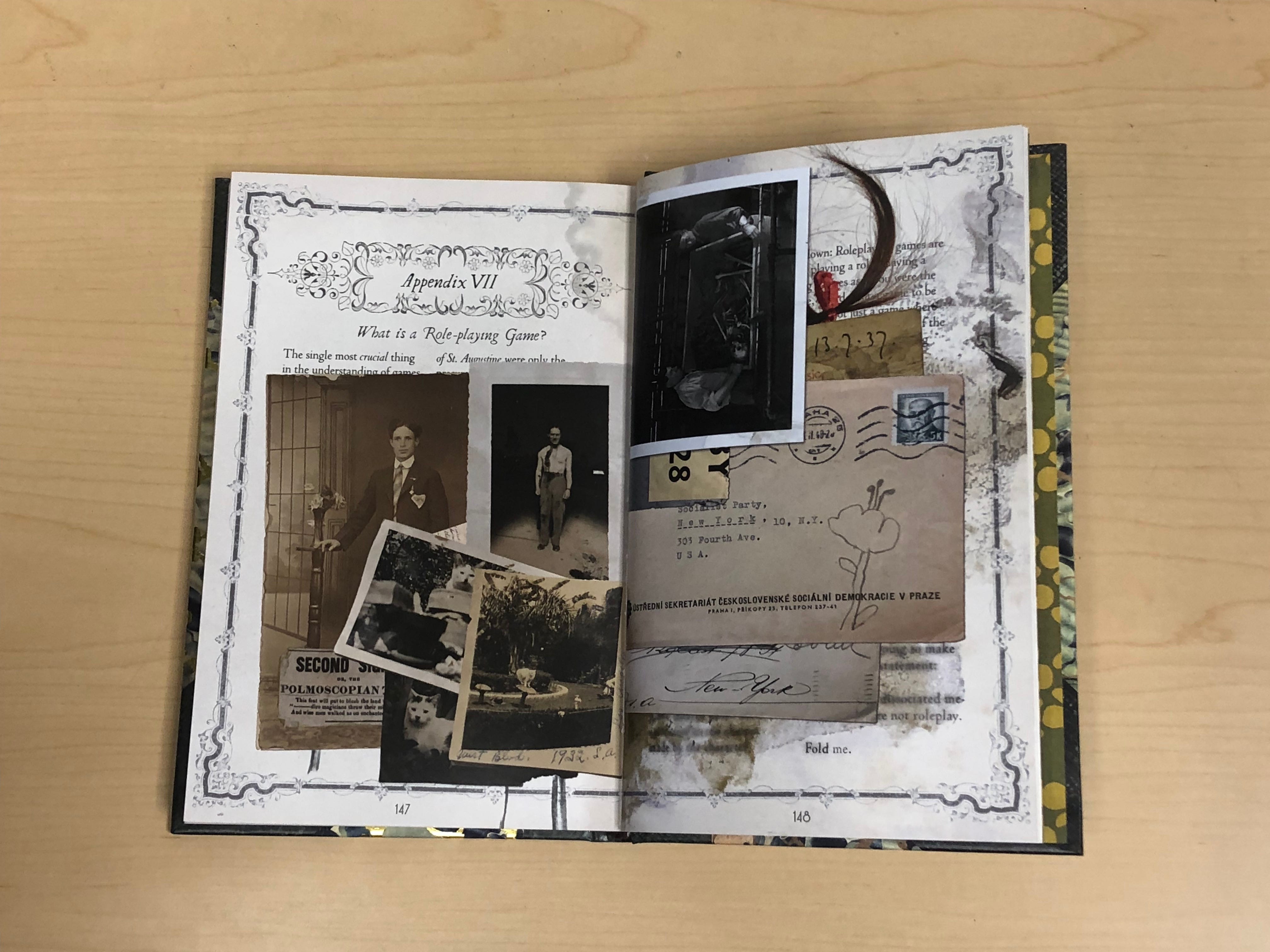
What would it be like, in practice, to live for a thousand years? Tim Hutchings’ Thousand Year Old Vampire attempts to answer this question through an interactive act of storytelling also known as a solo roleplaying game.
You begin by crafting the character whose story you’ll be exploring, answering questions like Who are you? Where were you born? Who were the people you were closest to in life? Who made you a vampire? To learn more about their story, you roll dice to move through a series of prompts, and then discover through your own writing how each event resolves. The prompts do away with the intimidation of the blank page, meaning that you never get stuck wondering what happens next. You can write as much or as little as you want, and you could play over and over again, as the dice rolls ensure that your story moves through a unique narrative sequence every time.
TYOV is part game, part writing prompt, and part adventure. It’s one of the best resources I’ve come across for anyone who enjoys writing but feels a little burnt out or disconnected from what they used to love about the process. At the same time, it’s also a phenomenal exercise for someone who’s never written anything before and just wants a little guidance in getting started.
An example prompt might look something like this:
You are exposed and flee to a neighboring region. Lose any stationary Resources. Check a Skill. A mortal flees with you. What new name do you adopt among these strangers?
All of this on its own gives you plenty to work with, but the game mechanic that most fascinates me is that you can only hold onto five core memories at a time. Kinda makes sense, doesn’t it? If you were a vampire who lived for a thousand years, you might begin to process the passage of time differently from those who only experience an average human lifespan. Perhaps even the people and experiences you thought you’d remember forever would start to fall away as the centuries progress.
In practice, it works like this: With almost every new event, you make an addition to your memory bank — but given that you can only have room for so many memories, you must eventually start crossing some out to make room for new experiences. There are things you can do to try to fight the inevitability of this loss — for example, you can choose to create a Diary, which holds four additional memories. But some prompts may lead to the destruction or loss of that Diary, which means it’s still a risk.
And so you start to realize firsthand that it’s pretty darn difficult to hold on to things when you live a thousand years. As the game progresses this might result in eventual acceptance, or alternatively a ferocious attempt to protect a certain memory. (My character clung to the recollection of her human family.)
Not only did TYOV provide a new way for me to explore some of my favorite narrative themes, it also gave me a chance to take a step back from the immediacy of our current moment and try to think about history with a bit more distance — how it often moves in cycles.
It’s all a little bit Memento, a little bit Interview with the Vampire.
This month, for the first time, I visited a classroom to speak about my writing. Fittingly enough, the questions I was asked led me to reflect on the joy I’ve always found in discovery — the delight in not knowing where a piece of writing is going, like a mystery that only I can solve. Over time I think some of us lose the joy of the process, so it’s worth remembering: Writing is something we get to do. We get to find out where our story or essay or poem goes. And the unique power of human imagination means your version will be entirely different from anybody else’s. Only you can write it.
By its nature, TYOV encourages that exact quality of creativity. Moving through the prompts actively prevents any attempts to plan ahead or outline how your vampire’s life might play out. (Oh, you’re gonna try to be one of those vegetarian vampires? Oof, good luck with that, buddy. And did you think you were gonna hang out in this quaint lil French town for the next hundred years? Oop, they just found out your secret — gotta go!) Instead, your vampire must adapt to every new obstacle that crosses their path in real time; as a writer, you must find a way to link all of these events by learning how to incorporate the unexpected.
In a funny way, I guess it all kinda mirrors life. Carving a path forward by creating your own meaning out of all the many surprises the world will throw your way.
Bonus Rabbit Holes!
TYOV comes with a few different purchase options! The lovely book I stumbled across, a downloadable pdf, or even a free community copy if funds are tight.
If you love rabbit holes, this game is made for you. I heartily second playtester Marshall Bradshaw’s suggestion: “If you like to learn, plop a vampire down in a place & time that you’re curious about.” You’ll have the option of using them as a lens for your own interests as you fulfill the prompt’s directions. (As an example, some of my TYOV Wikipedia bookmarks included the history of Venice, edelweiss flowers, and people of medieval France!)
Poke around online and you’ll find a ton of different ways in which TYOV fans engage with the prompts (digitally in a word processor, longhand in a journal, with a pen pal in actual letter form…). Maybe you’d like to try making your own little notebook to write in, like I did!
I asked a librarian for vampire movie recs and she turned out to be an expert in creature features. Recent watches include Dracula 2000 (Gerard Butler, lots of nu metal), Daybreakers (Ethan Hawke, vampirism as virus), and 30 Days of Night (Josh Hartnett defends an Alaskan town from bloodthirsty invaders during a month without sunlight). Tell me about your favorite!
I’ve also been rewatching one of my favorite BBC shows, Being Human, this month: a werewolf, vampire, and ghost live together as roommates. (Important! Not the American remake, but the BBC series. If you spot Aidan Turner wearing fingerless gloves — as seen in the above clip — you’ll know you’re in the right place.)
This isn’t the first time I’ve embraced a spooky theme for October — back in 2023, I attempted to ascertain the all-time scariest horror movie. You can read my findings here!
A few opportunities and some thank-yous to share this month:
Connecticut folks! I’m hosting a Write-in series every Monday in November at Wesleyan RJ Julia Bookstore. Drop in for quiet and companionable coworking with other writers in your community!
Readers! The Scholastic Writing Awards are currently looking for volunteer judges of young writer submissions. I’ve been judging annually myself since 2018 and find the experience so rewarding. Super recommend if you’ll have a little downtime this holiday season and want to support a future generation of writers — just fill out their judging interest form before December 1st.
Thank you, Nikki, for inviting me to speak with your students! Her classes read two of my stories: the one about the girl who finds her doppelganger on the internet, and the one about the fax machine that might communicate with the dead. Both pretty fitting for spooky season, now that I think about it.
Thank you to everyone who reshared Marginalia Quest this month! I hope October’s Microfascination offered some inspiration for your own secondhand bookstore adventures.
I’ll be back in your inboxes next month with another one of my zine roundups; have a good November, y’all!
Comments
Nothing yet. Say the first thing.
Sign in to join the conversation.