
Note: I meant to publish this piece on the winter solstice (Dec. 21), the darkest day of the year. But I underestimated the time spent teasing it out and making sure I’d said what I wanted to say as clearly as possible and that it actually was what I wanted to say and that I’d written it with enough nuance that it could not be wildly misconstrued . . . all the familiar worries. So here it is, 10 days after the solstice, as the sun bleeds a little more light into each day. I tell myself regularly, stubbornly: I will make it through this winter. I am looking for the sunrise when I wake, and in a few months, it will streak across the sky before I even stir from sleep.
In case you need to hear it: You will make it through this winter, too.
In recent weeks, I came across a beautifully filmed and directed New York Times documentary. The video follows Dr. Nadia Tremonti, a palliative care doctor for children (which means, in lay terms, that she cares for dying children).
Near the end of the video, Dr. Tremonti says this: “I get asked often, ‘How would you want to die?’ If I’m really magical about it, I would say, that I want to live until I’m 100 with everybody I love healthy, and then I’d like to magically turn into a baby and die in my mom’s arms. Because I think there’s not a place in the world of more peace and unconditional love.”
As she speaks these words, the camera holds focus on a mother gently cradling a tiny baby. This baby was born with multiple birth defects and health problems, and his mother has brought him home to care for him as he dies.
The image of moving into death so peacefully, cradled in another’s arms, sticks with me. Over the last few months, death has been on my mind. Perhaps it’s because of the shift in seasons, when all the green things withdraw their life into the ground and die some kind of death for the frozen winter. Perhaps it’s because of the too many people I know who are having to consider and reckon with death in terrible ways.
Just a few weeks ago, a woman in our church community took her last breath. She is, and will continue to be, mourned and missed. The night before we attended her viewing, my sleep was troubled. I had a dream that we were at the funeral and people were filing in, and I kept looking at the door, wondering why she wasn’t coming in, too. How had she been with us just a short while ago, and now, she could not be? How could death’s door be shut so definitively, that no matter how hard you knocked and how disorienting it felt, that person’s life was absolutely gone?
Back when the trees were following the sun’s arc from summer, all the leaves lit up in flames of marigold, amber, and scarlet. When I walked around the neighborhood, I would gaze up into those bright bunches of leaves, and think: “If I could choose where and when to die, I would die under a tree in autumn. I would gaze up into the leaves and into the blue, blue sky above—and then I would close my eyes.”
I think I crave death as a peaceful process because I have so often been terrified of it, and am slowly growing away from my fear. This is a fear lingering on from childhood, when I desperately prayed the sinner’s prayer again and again, uncertain that I was actually going to be rescued from the flames of hell whenever death came for me. I know the truth of the words in Hebrews 2, that the fear of death can be a “lifelong slavery” (vs. 15). Now, I am trying to live in the truth of the other words there, that Jesus took on flesh so that he might experience death, and through death “destroy the one who has the power of death,” and “deliver all those” who live in fear of death.
As much as my perception of death has changed over the years, the deep terror of childhood is difficult to shake off. The fear of missing your chance at life everlasting is a rampant one in Amish and Mennonite circles, and one that I heard reinforced often. My fear fanned brighter with my father’s sermons—calls toward radical ministry, stripped of nuance—and his reminders of the goats and the sheep.1 The goats are barred from the presence of Jesus, with seemingly no inkling beforehand. I lived with a vague fear that I was living my life as a goat, oblivious to the fact that I was going to be told to depart from Jesus at the end. (How could I be oblivious to it when I pondered it so often? That, I failed to consider.)
Guilt met me at every turn, and it wouldn’t leave. After all, would a sheep think that the hitchhiker her dad picked up on the side of the road was stinky and creepy? Would she resent his presence in the family routines, or the assiduous attention her father gave to him? Would a sheep miss her quiet time too many days in a row? What was too many days?
This old, familiar anxiety I still hear reinforced, often in situations where various nonheretical biblical interpretations or ways of practicing faith are being discussed. Suddenly there is no room for uncertainty, questions, or differences in understanding Scripture and living it out; suddenly there is only life or death—and the terror of getting it wrong. (Coincidentally, that terror is an excellent method of controlling people).
Certainly there is the truth of Matthew 7:21: “Not everyone who says to me, Lord, Lord, will enter the kingdom of heaven; but he who does the will of my Father in heaven.” An evaluation of our behaviors has a place, especially for those in religious power, for whom Jesus reserved his harshest criticism.2 But focusing on our behavior and what it proves about us can swing toward spiritual fragility and a forgetfulness of another verse in the Gospel of John: “For this is the will of my Father, that everyone who looks to the Son and believes in Him shall have eternal life, and I will raise him up on the last day” (John 6:40).
We forget that Christ is our righteousness (2 Cor. 5:21). We forget that we are called to abide in the Vine, and He will bring forth fruit through even such a state of seeming passivity (John 15:4-8). We forget Paul’s impassioned declaration that God is our justifier, Christ is interceding for us, and nothing can separate us from the love of God in Christ (Rom. 8:31-39). We eclipse God’s work with our own attempts at perfection.
“Everyone who looks to the Son and believes in Him”. . . . Yes, I believe. I believe, partly because of my deep fear of being damned and tortured forever (my love of God is still being made perfect, the apostle John might say).3 But I also believe because there is a beauty in the Christ of Scripture that I cannot deny. At seventeen years old, when all the assumptions I had built my life on were falling to the ground, I considered this Christ and the story of his humble birth, his entrance into the world through a young woman’s body. For a few seconds, time warped, and the story became more than a story. The characters—Mary, delighting in the downfall of the mighty; Jesus, a slick mewling newborn; the shepherds, in awe; and all the others—seemed like they were about to appear around the corner and greet me. The eyes of my mind widened, opened.
I thought: “If this is true, it changes everything.”
The glimpse I had of the reality of God taking on flesh is sometimes near, sometimes felt more far away. But I determined that I would act on that story even when it felt unreal, and in the years since then, it truly has changed me. (And ironically, it has changed me more in the direction of Jesus’s call to care for the hard-off people in society than the obsessive, fearful evaluations of my behavior/thoughts/beliefs ever did).
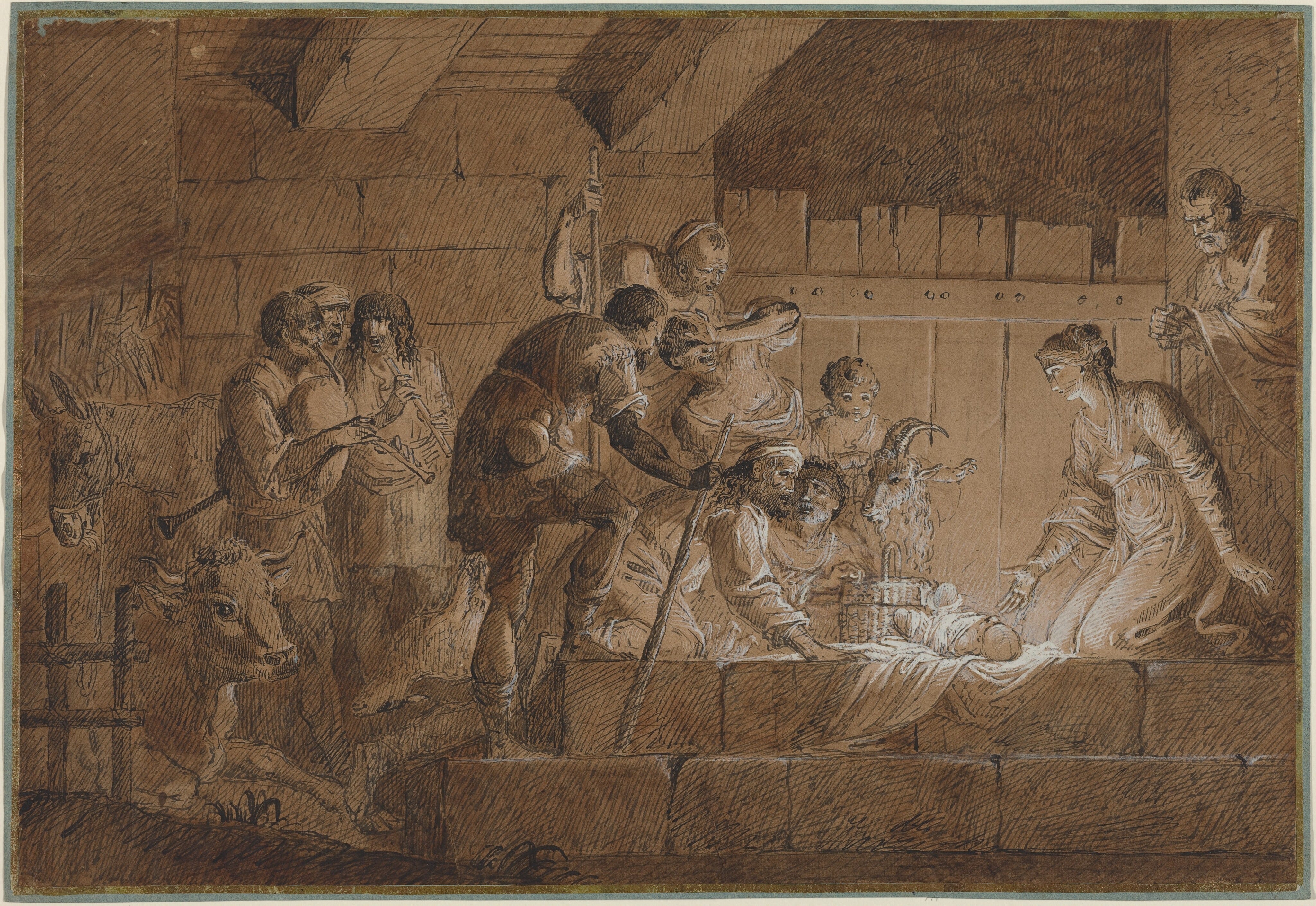
I am compelled by the Christ who embraces flesh and blood, who embraces suffering and poverty and persecution, and who even embraces death, that most fearful and unknown of human processes. Like birth, we do not what it feels like, even though we have all been born. We cannot ask each other, “How does it feel to be born?” Likewise, we cannot ask each other, “How does it feel to die?”
Whatever death feels like in the moment of shuttering our eyes and soul to this world, and whatever way we hope to experience that, the moments leading to death are often ugly. At its worst, life on earth is agonizingly painful, bloody, exhausting, heartrending. We don’t get to choose whether we experience that kind of pain. We don’t get to choose our last moments. That is a truth and a fear all to itself.
But the God of the universe chose to experience death’s worst; He chose to experience torture and beatings and a horrendous breakdown of his body. He chose what runs against the grain of human instinct to choose—in order that He might be the first fruits of “those who have fallen asleep,” and powerfully proclaim: “O death, where is your victory? O grave, where is your sting?” (1 Corinthians 15:20, 55).
My instinct for a long time has been to push aside my thoughts of death, to push aside my unspoken fears, to push aside even the rituals of death. At my grandfather’s funeral a decade ago, I resented his open casket. I hated looking at his face in death, white and drawn after leukemia sucked all the life from him. I disliked that body, how it reminded me of him, but it was not him. When the time came for the last viewing by the family, I didn’t want to go and look again.
I understand why I felt as I did then. Death is hateful in the sense that it separates us from those we love. But now, I look at death. Now, I talk about death. I acknowledge its ever present possibility and its inevitable reality. I agree with Dr. Tremonti as she notes: “I think we should all explore a little bit more this death and dying thing.”
As much as we want to survive, we want to not suffer, we want to live, death comes for us all. The astounding thing is that Jesus offers His followers something beyond death and its harshest realities: an entryway into another world and existence, just as in birth, when we are babies, we are forced from one reality into another. And in this reality, as the poet John Donne puts it, “Death shall be no more; Death, thou shalt die.”
The only hope we have of accepting death, of welcoming it with peace, is an otherworldly hope and the power of God’s Spirit working in us. I saw this peace in my grandfather as he lived out his last weeks seeking to comfort his family and remind us that he was ready to die. When my time comes to face death, I hope to have such a perspective. I hope to remember that whether I live or die, I belong to God (Rom. 14:8).
I will welcome His arms inviting me in, suddenly more real than I can deny. May I rest in them like a baby with her mother. Softly. At peace. As the breath leaves my body, and I am present, finally, with the One who conquered death.
Thanks for reading In Plain Sight! This post is public so feel free to share it.
No posts
Comments
Nothing yet. Say the first thing.
Sign in to join the conversation.