
If you’re writing a book, eventually the goal is either self-publishing or seeking traditional publishing. And the only reliable way to break into traditional publishing? Get an agent. That means you need to enter the dreaded… query trenches (cue the scary lightning bolt over a haunted, dilapidated castle). Just kidding, it’s not as scary as it seems. Especially if you go in feeling prepared.
So what do you actually need? I thought I knew: a completed manuscript, a query letter template, and a synopsis.
Oh boy… I got a rude awakening pretty much immediately. Here’s a list of all of the documents I’ve actually created in the last several weeks that has actually meant I’m ready. See each header below for additional details on each item:
A completed manuscript
A query letter template
Synopsis (of varying lengths)
Author bio (a formal version and a more fun version)
Target audience description
Extended comparable titles
One sentence pitch
Manuscript sample options (of many varying lengths)
There’s a lot here. I know that. But inevitably, these are all items that will be asked of you. I don’t meant to scare or intimidate anyone as much as prepare and set expectations.
This is the reason we’re here! You finished your book! And now you’re ready to do something with it. But take a second to ask yourself… is it actually ready ready?
Ask yourself the following things to determine whether your manuscript is actually complete and primed for agent eyes:
Is this your first draft? If so, you’ll want to go back and do a second pass.
Is this your second draft? If so, I would bet money that you’ll want to go back and do a third pass.
Have you looked at the big picture of the story? Does it make sense and accomplish your original goal?
Have you done a copy and line review? While this may not be the most important step, removing egregious grammar errors and misspellings is important for the overall professionalism of your submission. It makes you look legit if your manuscript is clean.
Has someone other than your best friend, partner, or mom read it? Beta readers and critique partners are essential. Hearing and addressing feedback from people other than your loved ones will make you more confident going into the querying process.
After reviewing these questions and feeling confident, then you are in good shape.
I could (and probably should) write a whole post just on query letter writing and my specific process to writing one. But for the sake of brevity, we’ll focus on the major needs within each query letter. Here are the major components to include:
Opening hook: What’s a juicy one-liner that might get an agent immediately intrigued?
Your blurb: This is what would theoretically appear on the inside dust cover or back of your book if it was on a shelf. It should mention main characters, enticing world building concepts, and the central conflict without getting too in the weeds or complicated.
Your one sentence pitch: There’s a section on this later in this post, but this is a shorter, hook-y version of your blurb; it should pack a punch and also set the stakes of your story.
The book’s “stats”: This is a paragraph walking through the word count, genre, target audience, and comparable titles. This is also an opportunity to inject any unique selling points for your book like diverse representation, unique storytelling elements that you couldn’t fit into the blurb, etc. You’re not talking to a reader but to an agent in this section.
Author bio: If you’re a debut author like me with a modest social following and somewhat thin credentials, this shouldn’t be very long. Include a few major things about yourself that feels relevant (degrees earned, location, hobbies)
Spaces for customization: This is a very important section. Make sure your word count isn’t so long that you can’t include a section dedicated to speaking directly to the specific agent you’re querying. It’s intentional and kind and shows you went the extra mile to look at their list of clients, their wishlist, and reading interests.
You’ll notice that I’ve labeled this section as a “query letter template” and not just a “query letter”. This is because your query letter should look different based on the specific person you’re querying. This does not mean you’re changing your book or the major selling points; those should be the same. Don’t lie about the contents of your book just to get an agent to read it. That’s rude and not going to earn you anything other than a form reject.
What you should customize is slight tweaks that speak directly to what the agent mentions. For example, here are some customizations I’ve made in my query lettes:
Agent A mentioned they really love a found family story. I made sure to spend time in this customization section to speak directly to the agent about that.
Agent B mentioned prioritizing LGBTQ+ representation. I speak to that in this section instead of the found family aspect for this specific agent.
Agent C included one of my comp titles directly in their wishlist, so I called that out specifically and explained a bit why I believe my book is comparable to that title in a little more detail.
Agent D represents one of my favorite authors. I mention that, explain why I feel my writing style/book is similar to that authors but also emphasizing the areas of differentiation (respectfully) about myself that would round out their client list with continued diverse folk to represent.
Not every agent will ask for it, but when it is requested, you want it ready. Not every agent will read it either, but it can be used by agents as a deciding factor between asking for a manuscript and passing.
The synopsis should:
Establish all the major characters and their motivations/arcs
Talk through all the major plot beats in specificity
Spoils the ending
Pull back the curtain, show the agent your vision in its completed form.
I have various versions of this as different agents seem to want different lengths. The lengths I have written are:
Short: 500 words
Medium: 1,000 words
Long: 2,000 words
But I would start with a short one (500 words) and work the word count up as needed.
You should have one in your query letter. But you’re going to be asked occasionally for a longer version. It doesn’t have to be a memoir, but it should be longer than a paragraph. Most agents I’ve seen have a 500 word max on your author bio.
I also have two versions of my author bio:
A more formal version that speaks to my credentials, marketability, transferrable skills from my day job, while still including some basic facts about myself (location, family, etc.)
A more fun version that still speaks to my credentials but also shows a bit more personality. In this version, I’m relating to the agent a bit more and just being a bit more… myself.
I use either the formal or fun version based on the agent and what it seems they’re asking for.
When it comes to describing your target audience, similar to your author bio, I’ve seen around a ~500 word count version, but I have a longer one that I pick and choose from based on the agent I’m submitting to. This has served me well in customizing for specific agent interests while still remaining true to the book’s essence and unique sell-ability.
Some phrases/things you can consider when writing your target audience:
Target age groups
Readers of Percy Jackson will enjoy…
Readers that love slow-burn…
Readers interested in LGBTQ, diverse representation, etc
There’s lots of good examples of these online. Look one up and plug and play!
You should be including your comparable titles in your query letter, but often (especially on QueryTracker forms), agents ask for comparable titles in a separate field. This means you have more space for more than just the ~2 titles you can include in your letter.
I take this opportunity to include more titles that I consider comparable than what were in the query letter. I also add examples of why they’re considered a comp title. Some examples of this:
The epic scope of [TITLE]
The strong, female protagonist similar to [TITLE]
An inventive magic system akin to [TITLE]
Some agents have you include this separately from your query letter. This should already be in your letter, but having it ready to copy and paste into a separate field is helpful.
A format for a one-sentence pitch might look something like:
[TITLE] follows [character], the [adjective] [noun], as they [verb] to [stakes].
Here’s my one-sentence pitch as an example:
THE HEIR AND THE ANSWER follows Danya, the last surviving royal, on her journey for redemption and revenge in a world where truth means death.
This isn’t the “end all, be all” format, so play around with different styles and flows until something feels right.
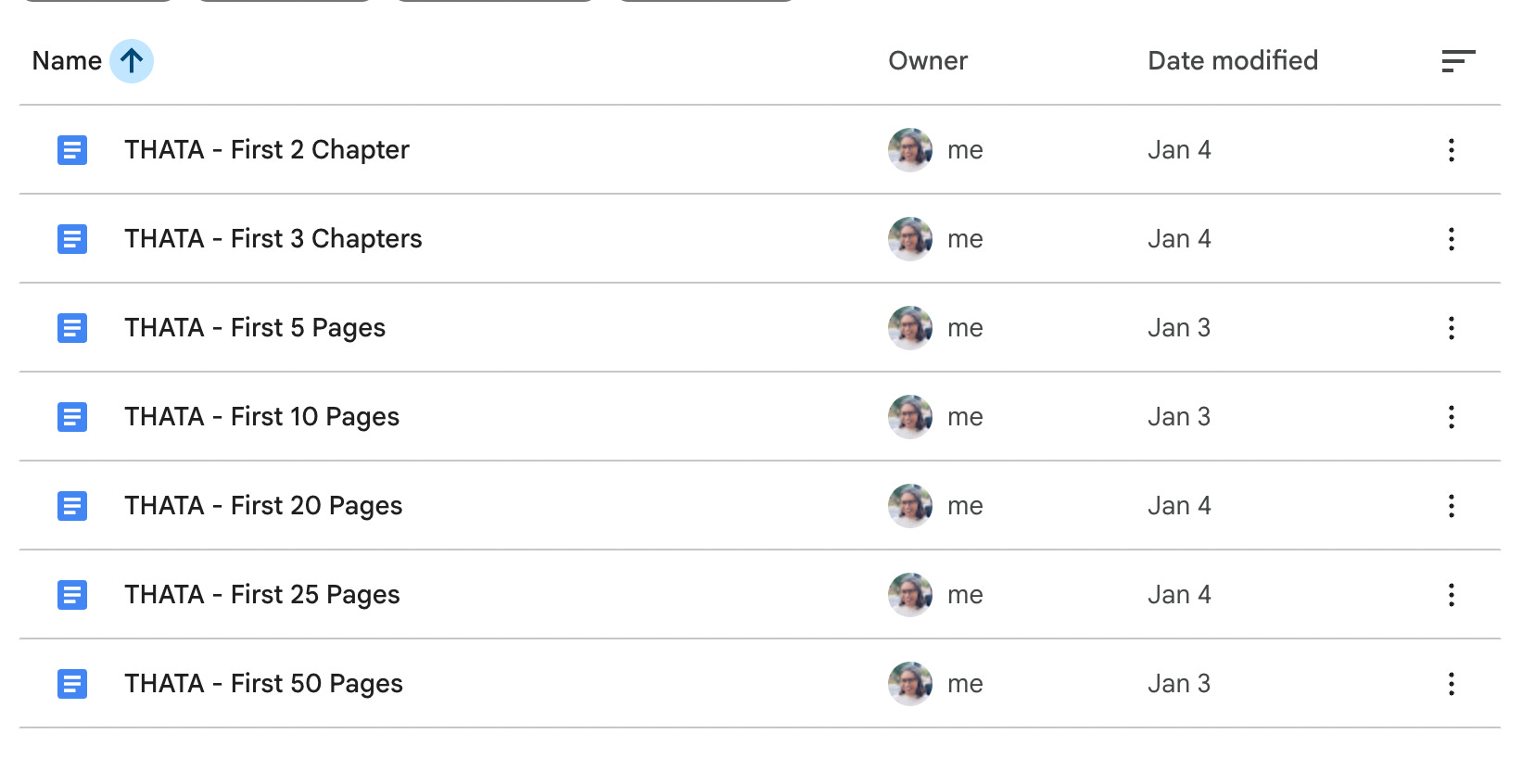
This one snuck up on me. I thought having a prepped manuscript was all I needed to be ready to go, but in reality, agents want varying lengths of manuscript samples. While it’s still just pieces from your manuscript (that should be done and you’re not poking at anymore), it is still a time commitment to pull the varying lengths that different agents want.
Here are all the varying lengths I’ve seen so far in querying (and I just started a few weeks ago):
The first 5 pages
The first 10 pages
The first 20 pages
The first 25 pages
The first 35 pages
The first 50 pages
The first 2 chapters
The first 3 chapters
That’s a lot of variations of the same thing that you don’t want to risk messing up. For this reason, I created separate documents for each of these. See screenshot of my Google Drive for proof.
There are other things you can do too that might increase your odds of getting noticed (and that are sometimes requested as optional materials in queries). These include:
Author website
Social profiles
Blog site (like Substack! Yay!)
These are optional but if you have the time, it might be worth it to you if it means it gives you that final extra boost.
Being prepared with all of these elements will make you more confident going into querying. I promise you. It’ll feel easier to copy and paste and do your query letter customizations intentionally if you already have all of the most “busy work” stuff done. By checking the extra stuff off the list, you’ll be able to spend more time actually connecting with an agent and writing them as people.
Stick with it, y’all, and happy querying!
Thanks for reading Publishing Potential with Abigail BW! Subscribe for free to receive new posts about the publishing process, my specific journey, and to support my work.
No posts
Comments
Nothing yet. Say the first thing.
Sign in to join the conversation.