
I think it’s high time for my regular “this is for the ladies” anthem.
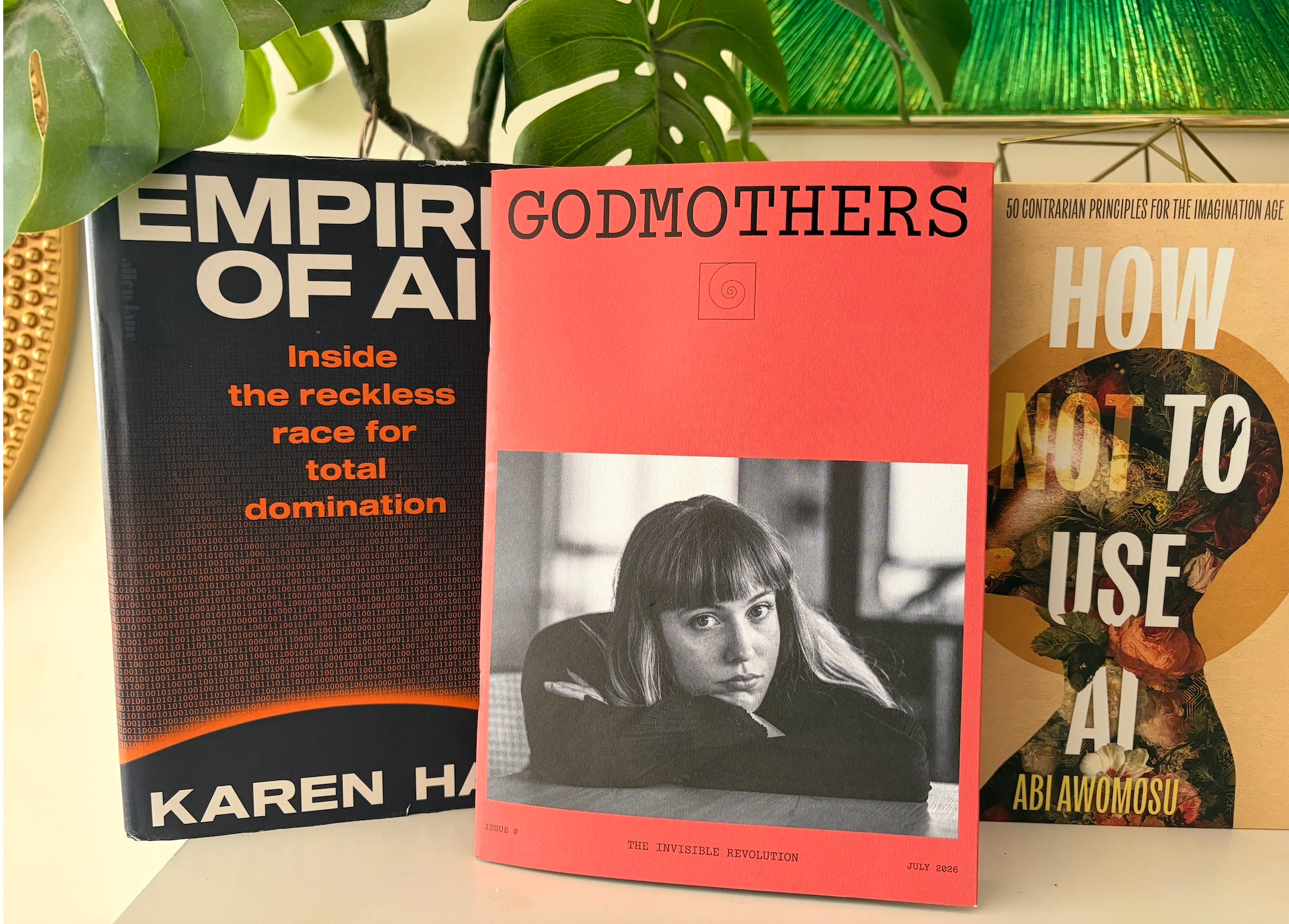
I recently received my copy of the Godmothers.ai zine - The Invisible Revolution. Brilliant. I have not been able to put it down. I’ve started cross referencing it with Karen Hao’s Empire of AI, my book How Not To Use AI and it’s made me want to revisit the AI adoption gap debate again. I think we have had it all wrong.
It’s been closing, apparently. Have you looked at this year’s numbers? Women are finally catching up to men on AI use and the gap is narrowing. Yass!. We did it, ladies.
But don’t get too excited yet.
Remember when I told you about the ick in They Built Stepford AI and Called It “Agentic”. Go read it if you haven’t. This article is its reprise.
I called the ‘ick’ a form of wisdom then. I still think it is, and it’s not just a feeling. It’s actually data. Our own data, gathered the way women’s data has always been gathered, in her body, before anyone handed us a Pew survey to confirm it.
But the strangest thing happened. I watched a lot of us stuff the ick back down.
We set it down. Deliberately, in service of the aim of not falling behind.
It was never really one response either.
It was three, and not one of the three was driven by our own sovereignty.
Some of us stayed on the side. Not refusing, exactly, but just sort of standing at the edge of the room with our arms folded, waiting to see how the thing would shake out before committing to a position, which felt like prudence for sure and functioned as absence. The board kept getting set up around us either way.
Then there was another group of us that got swept along entirely, into the FOMO and urgency, and I’ll describe that stampede in a second because it’s the loudest of the three and it’s where most of the traffic went.
And some of us did something that looked, from a distance, like the responsible choice: the mature one, the one that should have been sovereign and wasn’t. We doubled down on AI ethics. AI safety. Responsible-AI teams, DEI-adjacent AI roles, the whole vocabulary of harm reduction and guardrails and governance.
While ethics and governance roles are essential, I found they often function as a “glass cliff” for women. In practice, these roles frequently invite women to consult on and humanize a roadmap they didn’t author, while actual capital and material power remain concentrated in a small circle of men. This lane often serves to provide a responsible face for the industry without granting genuine influence over the underlying technical and strategic trajectory.
None of the three postures, the folded arms, the stampede, the responsible seat with no power in it, was ever going to get us out of this game for a whole host of reasons.
So let me describe the stampede properly, because it’s the one that ate the most of us up.
I love women. When we really set out to do something, we just get it done.
The mission: Operation No Woman Left Behind.
We got in formation and we joined all the AI courses and accountability challenges that started multiplying across every platform. Conferences with names like “Women in AI” and “Close the Gap” filled up months in advance. Group chats turned into study halls: how do we solve this thing, ladies, how do we not get left behind, who’s teaching a workshop, who’s found a prompt framework, who’s already three modules into the course. Even Reese Witherspoon weighed in.

It turned into a stampede toward closing a number- a metric, and almost nobody stopped to ask what the number was actually measuring.
But boy did it work. Pew’s numbers this year now show 50% of men and 47% of women say they’ve used AI. Two years ago it was 39% and 28%. On its face, the gap closed. Runners in the stampede would call that a win.
But let’s take a closer look at which tools; because the picture flips entirely. Consumer research from Goodwater this year puts Grok’s user base at 77% male and disproportionately high-income; Claude’s at 57% male and the most likely of any platform to be paying customers rather than free users; ChatGPT alone reads as close to balanced. Forbes, citing the same data, found 56% of male AI users pay for a subscription against 42% of women. Move past who’s logging in and look at what they’re logging in to do: 44% of men use AI for work and productivity against 37% of women, and among the women who do use it, the heaviest use clusters around health, wellness, cooking, meal prep, the unpaid infrastructure of a household, run through a chatbot now instead of a notebook. Hilke Schellmann, who studies this at NYU, has a phrase for the split that I haven’t been able to stop turning over: one kind of AI use accrues as career capital. The other stays as life admin. Both take real skill. Only one gets read, by the person deciding your raise, as strategic fluency.
This isn’t just about fun versus promotions. The ILO found 29% of female-dominated roles exposed to generative AI compared to 16% of male-dominated ones. Research from the Open University and Nokia Bell Labs shows that while AI exposure in male-dominated fields hits the top of the pay scale, in female-dominated fields it impacts the entire career ladder. This risks eroding the administrative “doors” that have historically allowed women entry into professions like law and medicine.
So here is the actual state of things, stated plainly before I sprinkle my usual mythic or historical analysis on top: the adoption gap did not close. It just changed its shape. It became a subscription gap, a seniority gap, a career-capital-versus-life-admin gap. The same gap, wearing better numbers.
And here is what happened to the wisdom in the ick while all of that was unfolding.
Some of us turned it into rage, or what I like to call wise anger, doing exactly what wise anger is supposed to do: naming something that’s actually wrong. I was one of those people too.
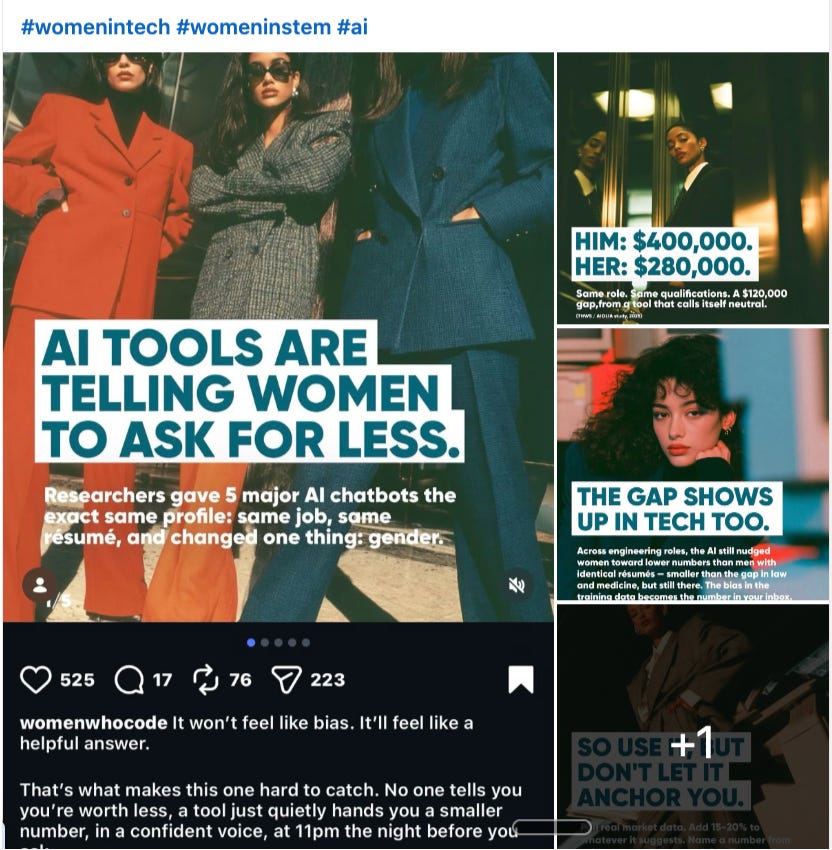
LinkedIn posts have been stacking up: WHERE IS THE OUTRAGE, over research showing AI salary tools recommending $120,000 less for the same résumé with a woman’s name attached. The anger is not the problem. The anger is accurate. The problem is where it’s been allowed to go.
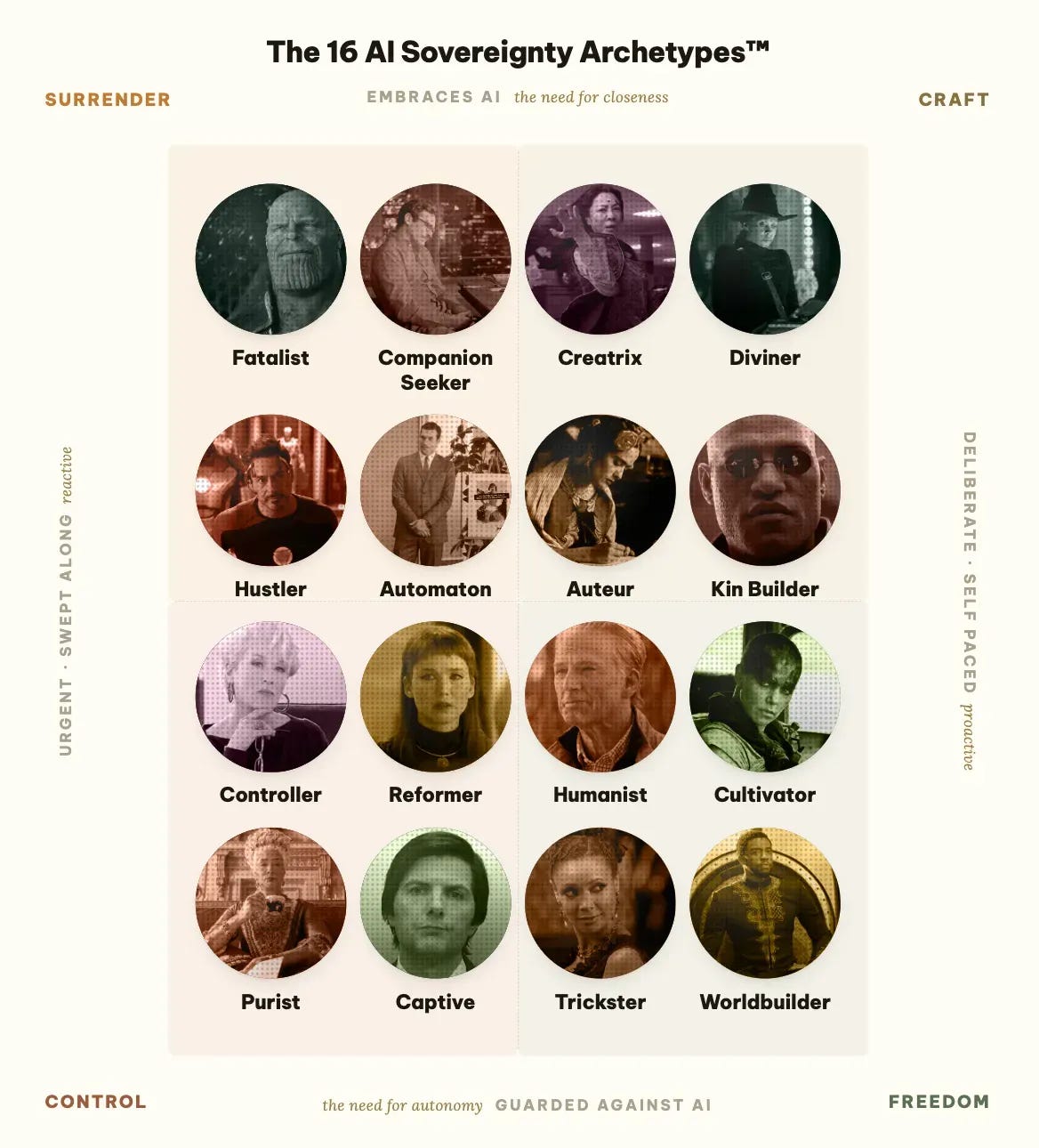
When we look at the shape the response takes, the rage is moving women away from what I call the Captive archetype, out of the frozen, complying, “I already have no choice” posture, and into the Controller. Into the Hustler mode. Into the Automaton, learning to sound like the machine so the machine will finally take her seriously. Into Fatalist territory, certain the whole thing is inevitable and the only rational move left is to run faster than everyone else running. Or the anger moved us the other direction, down into Reformer, endless petitions to the companies to do better, or maybe into Purist mode, spending real energy policing other people for using AI at all, instead of spending that same energy on the standard itself.
The Controller and Hustler archetypes are pursuing a false sense of power. You cannot truly control a complex system that routes around instructions, nor can you reach the “front” of an industry that always moves the goalpoasts as soon as you arrive. These efforts are often sincere but ultimately directed at impossible goals.
Also, I’m not saying these are “bad” archetypes or the wrong archetypes to hold. A female Hustler acting from self-authorship, who is choosing speed because it serves her actual vision, because she knows exactly what she’s building and why, is a different creature from a FOMO Hustler running because the stampede is moving and she’s terrified of being left behind. A Reformer who picks her fights deliberately, who preserves her energy for the change she can actually make, is not the same as a Reformer spending her entire energy and life force petitioning power that will never listen. Same archetype, different authorship score. The instrument doesn’t judge the position. It measures how much of it you own.
But look at where every single one of those archetypes sits. Urgent. Swept along. Reactive. Every one of them is still standing on the Surrender side of the board, or the Control side. Not one of them has crossed into Freedom. Not one of them has crossed into Craft. The rage is real. It’s just been funneled, almost perfectly, back into the two quadrants that were never going to get us anywhere new.
We just joined the king’s game of chess, sadly. We even joined it angry, primed and ready to fight, which felt like progress. But we joined it as pawns: the piece that can only ever move one direction, forward, and can only ever strike sideways at the piece standing next to her.
We were essentially conscripted into a fight about AI that was never the real fight, and the only way out is to stop performing positions and start owning the entire chain, from deciding what you actually think, to actually changing your life to match it.
So let me offer a different perspective: there is no adoption gap. There is only an authorship gap.
They are not the same problem, and they do not have the same fix.
An adoption gap closes with tool literacy, a course, a conference badge. An authorship gap closes only when a woman decides her own relationship to AI as a medium on her own terms, using her own body as the instrument that already knew something true before any workshop talked her out of it.
Here is the proof. The instrument I built could not tell them apart. The woman who refuses AI on principle and the woman whose prose has been quietly colonised by it land within two-tenths of a point on the sovereignty axis. Purist: 52.7. Automaton: 52.9. On a scale spanning nearly thirty points, that is not a difference. That is noise.
Refusal is a position. It is not an exit. The adoption gap was never the axis. It was a distraction dressed as a metric.
A year of listening in the spaces where people work things out before they perform (pseudonymous, pre-resolution, shadow spaces) returned one finding: the promised relief never arrived. AI does not transform. It amplifies. Hiders hide faster. Hustlers hustle harder. The erased get better tools to erase themselves. The authorship gap is not new. It is the old problem, now with infrastructure.
Beneath it sits what I call the adaptation gap, the one that determines whether authorship becomes anything at all. Stating your stance is the decision. Living it is the follow-through: how you work, what you build, where your hours and life-force energy go. Most empowerment stalls at the decision and calls it done. You can know exactly what you think about AI and change nothing on a Tuesday. Both halves must move.
This is the argument underneath AI sovereignty. It is why I return to a phrase I do not use lightly: women need to activate the inner matriarchal sleeper cell. They don’t need to join faster. Or adopt harder than the boys. They need to wake the part of themselves that was never asleep, only told, repeatedly, that the ick was the problem rather than the useful information.
So let’s look at what this current energy of feminine rage actually looks like. Most people scroll past it, feel the outrage land correctly, and never ask whether it does anything past the scroll.
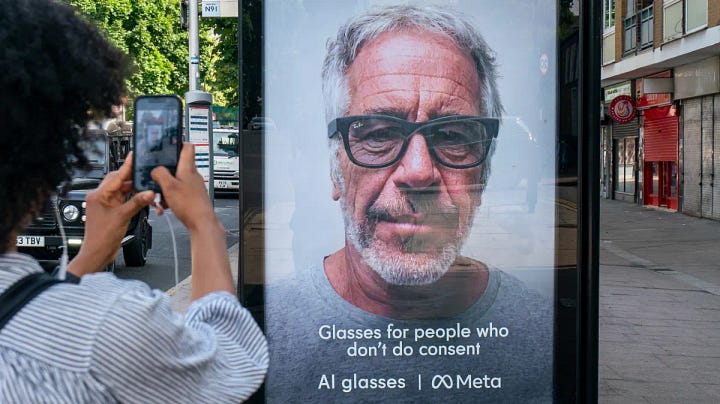
Right now there are spoof ads for Meta’s AI glasses: “glasses for people who don’t consent,” “the biggest advance in pervert technology since the trenchcoat.” One repost cleared half a million likes. Brilliant. Just like the post above about an AI salary tool recommending $120,000 less for a woman with the identical résumé.

None of it is wrong. The ads are sharp, the research is real, the outrage is earned. But it is all aimed at an audience that already agrees, in a register (protest, placard, viral repost) that has never moved the broligarchs actually building the thing.
The quasi-religious mythology (thanks, Karen Hao for this language) the broligarchs currently operate inside isn’t a business plan.
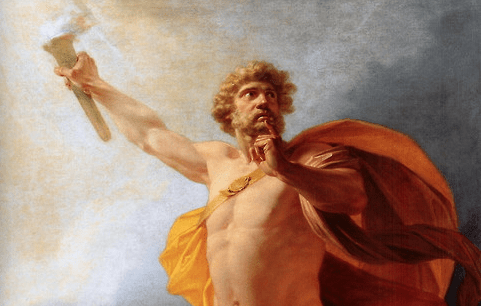
It’s a Prometheus-shaped hero’s journey. In the story, Prometheus steals fire from the gods and gives it to the people to help them. Aww how selfless. In the tech-bro version of this story, they prefer to steal creative fire from the people to either make themselves gods or to make superintelligent AGI, in other words, their very own machine god. And they will quite frankly destroy actual books to train it.
You cannot shame a broligarch out of his quasi-religious creation myth, just like you cannot fact-check religious fanatics out of their religion belief. Every spoof ad and brandished statistic is aimed at an institution that cannot receive it. It’s misplaced Reformer energy, petitioning power to behave, and Reformer energy has never worked on power that has already decided it’s building a god.
The question isn’t whether the anger is justified. It obviously is. It’s about where the energy goes once you’ve felt it, because right now most of it is spent proving water is wet and gathering evidence for a case with no jury willing to hear it. Awareness has a shelf life. It is not nothing. But it is also not the job we need to do now, ladies.
Underneath the campaigning is the actual operational engine: women without realising it are the cultural, relational, and cognitive source the compute cannot manufacture. The language, attention, correction, care, context, and daily return that make the machine useful. We are not standing outside it asking to be recognized. We already keep it culturally alive by what is already coming through us. Our authorship, or its absence, is what puts us in Captive mode or Controller mode. We should not be petitioning the engine. We should be redirecting it.
Which is why the men building this were never going to be moved by a poster. You do not petition the engine. You redirect it.
Because what do you mean it’s actually women quietly running the best-run of the frontier AI companies on Earth right now?

Don’t take my word for it. Dario Amodei told Bloomberg himself that he has exactly one direct report, his chief of staff, and every other executive answers to his little sister. He called it incredibly freeing. Freeing, for him. Meanwhile she runs a workforce of over two thousand and answers to the board. You should watch the full interview.
I need you to sit with that. When Anthropic and OpenAI disclosed within weeks of each other that they had filed to go public, the contrast became impossible to ignore. Anthropic generates roughly thirty-six cents in annualized revenue for every dollar raised. OpenAI generates roughly fourteen. Anthropic crossed OpenAI in revenue run rate having raised roughly $48 billion less. Not eventually, not aspirationally, in the numbers reported simultaneously.
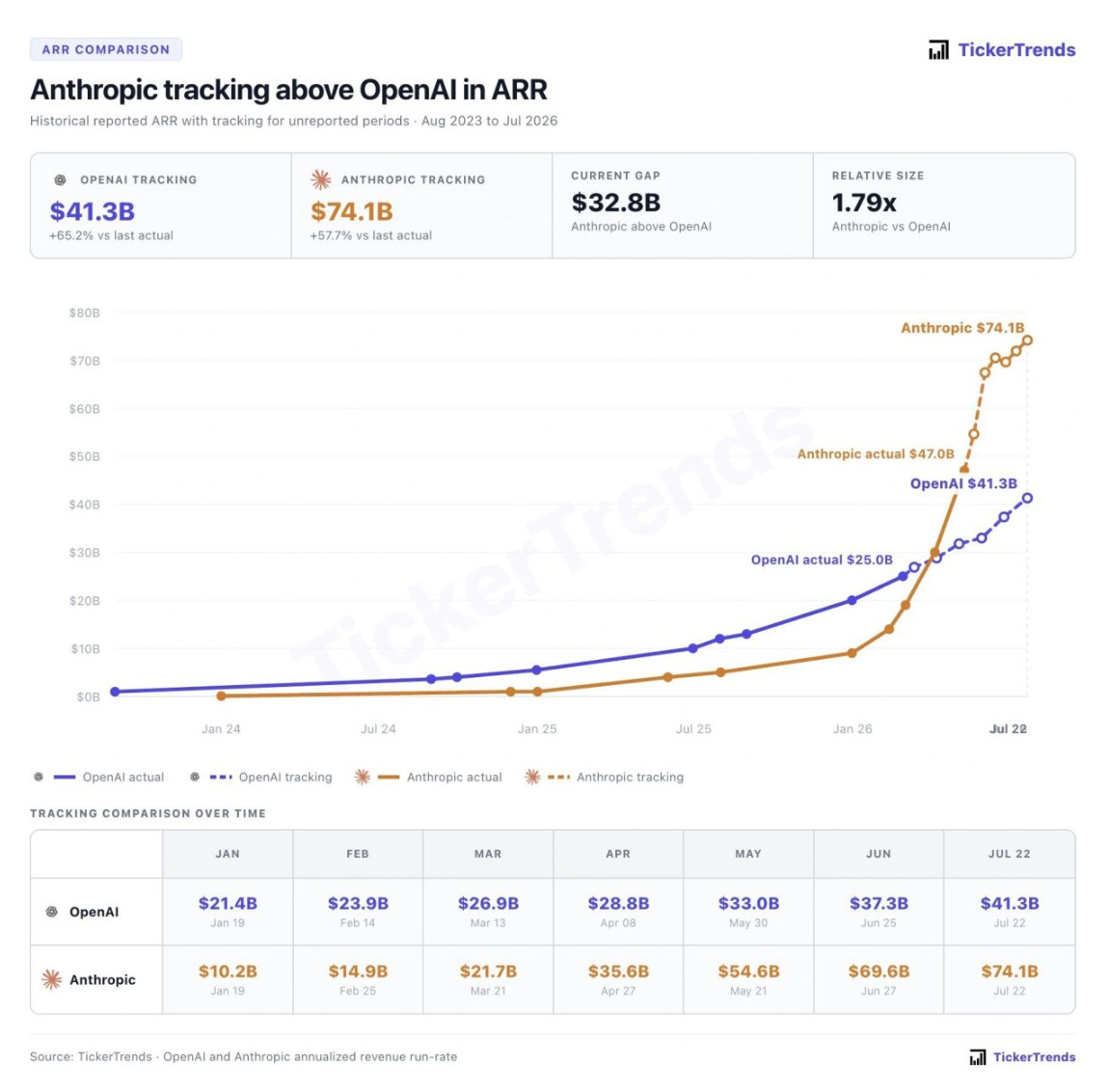
The company where the woman runs the operation is outperforming the company built in its founder’s own image. Not on mythology, not on AGI theater, not on war-footing language about China.
So when I say women are running AI, it isn’t a hope or a demand or maybe someday. Women are not behind in AI. We were never behind. If we were behind, we would not currently be running the most capital-efficient, fastest-growing frontier lab on the planet.
But here’s what should stop you harder than the revenue number. Women get things done. That was never in question, not at Anthropic, not in the counter-lineage I’m about to walk you through, not in your own house. The actual question, the one the adoption-gap panic never let anyone ask, is this: whose story are we getting it done for?
If we look at the frontier labs race right now, it’s easy to see it as a two-man competition between Sam Altman and Dario Amodei. Plus Elon Musk lurking in the shadows.
But oh no. It’s time to call the thing the thing.
And we are going to say their names.
Here are their names. Here are the functions. Here is what’s actually happening, right now, inside the company everyone keeps calling a founder’s story.
Daniela Amodei is President of Anthropic, co-founder alongside her brother Dario. Every single executive at the company reports to her, every one, except Dario’s own chief of staff, the “freeing” arrangement I already told you about. He runs point on vision, he does the press circuit, and I guess tinkers away in the lab somewhere creating new innovative ideas. Meanwhile she runs the actual company: a company now valued near a trillion dollars, over two thousand people, all answering to her.
Ami Vora is Chief Product Officer. She spent fifteen years at Facebook and WhatsApp running product and design before this, and this year she took over the entire product organization, the whole apparatus that decides what Anthropic builds and when.
Angela Jiang runs product for the Claude Platform. Katelyn Lesse runs platform engineering, her direct counterpart on the same layer. That layer, the enterprise and developer API business, the unglamorous, unphotographed infrastructure everyone assumes is boring, is generating something like seventy to eighty percent of Anthropic’s entire revenue. That’s not a department. That’s the engine.
Cat Wu runs product for Claude Code and Cowork, the fastest-growing line the company has, already touching a meaningful share of the world’s written code less than a year after it shipped.
And Amanda Askell, a philosopher, PhD from NYU, a thesis on infinite ethics, has run the personality alignment team since 2021. She is the one who built Claude’s character. She co-wrote its constitution. Not a side function, not a soft-skills afterthought bolted onto the real engineering. The soul of the product. Authored by a woman.
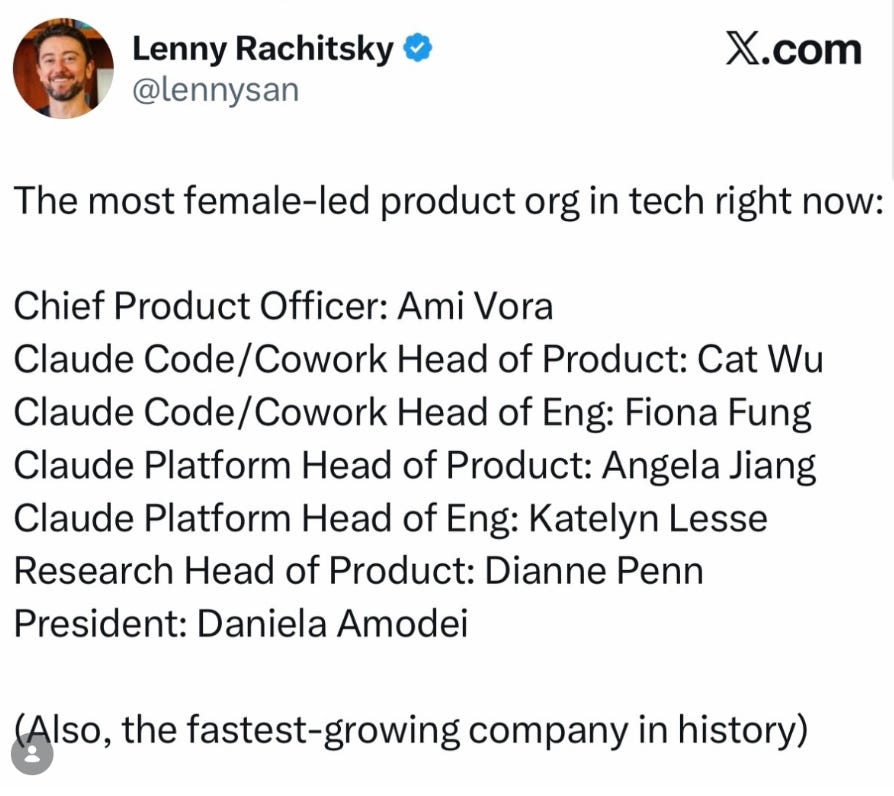
So in short - The president. The product chief. The two women who run the layer where the money actually lives. The woman running the fastest-growing product line the company has ever shipped. The woman who wrote the character.
Product decides what gets built at all: which features exist, which don’t, which problems the company decides are worth solving this quarter and which get shelved. That’s the company’s entire creative and strategic direction, funneled through one person’s judgment. Platform engineering decides how everything scales: whether the infrastructure holds when demand triples overnight, whether the thing that works for a thousand users still works for a million. That’s the difference between a company that survives its own growth and one that doesn’t. Alignment (Amanda Askell’s actual domain) helps shape the behavioural character through which the public encounters Claude: its expressed values, tone, refusals, and the way it meets you when you open it. That’s not a side function. And operations (Daniela’s actual domain) determine whether any of the above happens at all, on schedule, inside budget, without the company collapsing under its own ambition.
None of that is background. That is the stack. Company, to product, to platform, to interface, to character. Every layer of it, right now, is run operationally by women.
The queen is not hypothetically powerful. She is, right now, provably running the board. And she is still, somehow, playing checkers in someone else’s chess game.
So I’ve kept going on about this game, so I’m going to break it all the way down including actual history underneath it. Because the real story of chess is stranger and more damning than the version most people carry around, and I don’t want to borrow its power without showing you where it comes from.

Chess started in India, in the sixth century, under the name chaturanga, Sanskrit for the four divisions of an army: infantry, cavalry, elephants, and chariots. It was a war game from the very beginning, not a metaphor for one, built to simulate an actual battlefield, piece for piece. And in that original army, there was no queen. No queen existed in the game for nearly a thousand years, because women weren’t on the battlefield the game was modeling. What sat next to the king instead was a vizier, a counselor, a mantri, and he was weak on purpose. He could move only one square, and only diagonally. Not because counselors are weak. Because the game’s designers couldn’t imagine giving that seat any real range.
The game traveled: into Persia, into the Arab world, and from there, through the Moorish conquest, into Spain in the eighth century. Along the way it picked up the phrase that still lives inside our word for winning: shah mat, Persian for “the king is helpless.” Checkmate isn’t a translation. It’s a fossil. Every time the game ends, we’re still saying it in the original language of a king discovering he built a system he can’t survive without everyone else’s labor propping him up.
For the next seven hundred years, the board looked almost exactly like it does now, except for the weak vizier at the king’s side, and except for what the other pieces meant. The elephants became the bishops. The chariots became the rooks. The cavalry became the knights. The infantry became the pawns. The war never stopped being the subject. Europe just relabeled the units to match its own hierarchy (church, fortress, enforcer, foot soldier) and kept playing the same game underneath the new costume.
Then, in Spain, in the fifteen years or so before Columbus sailed, everything about the piece next to the king changed at once. A Valencian poem called Scachs d’amor was the first to describe a queen and bishop moving the way we’d recognize today, and it wasn’t written in a vacuum. Chess historians have traced the poem’s language directly to the language used at Isabella of Castile’s actual coronation: the sword of justice raised before her, the scepter and the throne handed to her, close enough that historians now consider the connection almost impossible to be coincidence. Isabella had just finished the Reconquista and funded Columbus’s voyages. She was, by any measure, one of the most consequential rulers in Europe, and she was not ruling through a husband. Somewhere around 1475, in Valencia and in Italy, the weak vizier who could crawl one square at a time was quietly retired, and in his place stood a queen who could move the length of the board, in any direction, in a single turn.
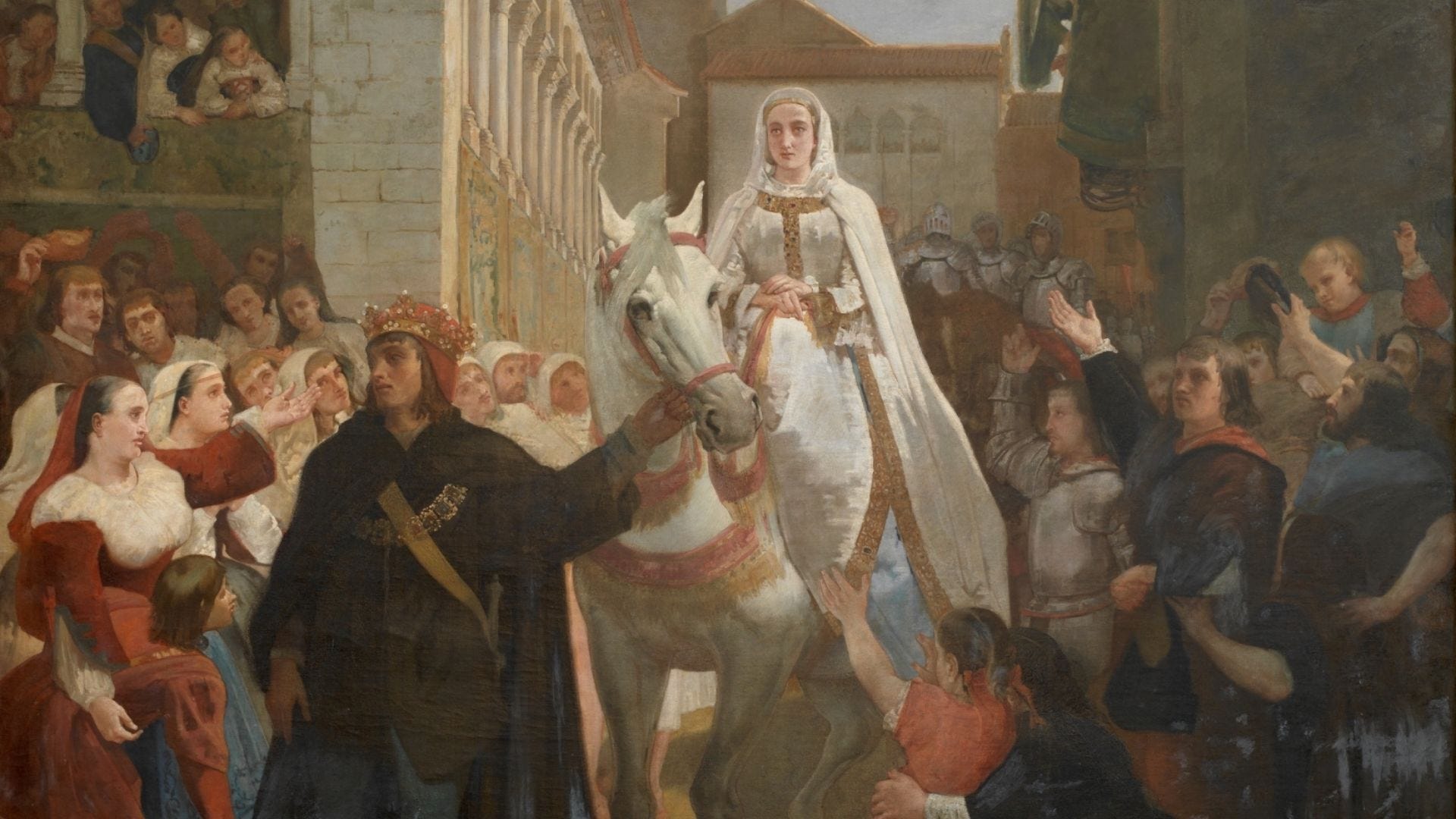
They didn’t call the new rules an upgrade. They called it Mad Queen’s Chess, Scacchi de la donna, because giving one piece that much freedom of movement felt, to the people playing it, like something had gone slightly insane. Mad, as in unrestrained. Mad, as in: we don’t have a category for a woman with that much room to move, so we’re going to call the category itself a kind of madness rather than admit the category was always too small. The new rules spread across Europe fast, carried partly by the new printing press, and partly, historians believe, by Jewish families expelled from Spain in 1492, who carried the game with them into exile along with everything else they carried. A persecuted people, fleeing a kingdom, still passed on the one piece of that kingdom’s culture that had just been rewritten to make room for a woman’s actual power. Sit with that for a second. The queen’s freedom outlived the very court that invented it, and it traveled on the backs of people that same court had just cast out.
And even after all of that, even after the vizier became a queen who could out-move every other piece on the board, the game kept its name. It never became her game. It stayed his. Because chess was never really about which piece is strongest. It was about which piece the whole architecture exists to protect.
Here’s the part that matters most for what this piece is actually about: every broligarch who sets out to build an empire starts exactly the same way. He commissions a game. Not joins one, commissions it, from the ground up, board and rules and win condition all his to set. And inside the game he built, he is automatically the most important piece on it, not because he’s the strongest (he isn’t), but because it’s his game, and the most important piece in any game is whoever’s name the whole thing collapses without. He also goes first. Every single time. That’s not a rule of chess so much as a rule of this industry right now: whoever moves first gets to call it innovation, and everyone reacting to him gets called slow.
The king can move one square. He is, mechanically, nearly useless, and because he’s weak, he needs everyone else on the board to prop him up and make the thing actually happen, which is the entire function every other piece exists to serve. He is also, not coincidentally, a linear thinker. One square, one direction, no complexity: everything reduced to a straight line and a binary outcome, win or lose, alive or shah mat. And in a game built by a man who thinks that way, the win condition was never going to reward patience or care. It rewards whoever can move fastest and break the most on the way there, which is, almost word for word, the actual motto more than one of these companies has run on. He is still the only piece whose death ends everything, which means every other piece on the board, including the one who can cross it in a single turn, exists to make sure his weakness never becomes fatal.
Now look at who’s actually standing on the squares.
The pawns are the people. The pawns are the writers and artists whose books and paintings and years of unpaid creative labor went into the training data without a contract, without a checkbox, without so much as a thank you. Pawns, because a pawn’s labor was always assumed to belong to the board before it belonged to her. The pawns are the content moderators, mostly in the Global South, mostly paid a few dollars an hour, who sat for eight-hour shifts watching the worst images a species can produce so the model could learn the difference between right and wrong without a single executive ever having to look at what they looked at. The pawns are the communities standing on top of cobalt, lithium, silicon, digging the minerals that make the chips that make the “intelligence,” often by hand, often as children, in supply chains long enough that nobody at the top has to know either of their names. The pawns are the towns that give up their water, quietly, unglamorously, so a data center three counties over can keep its servers from overheating while the wells nearby run low. The pawns are every consumer told, in the same breath, twice a day: adopt or get left behind, hand over your data, your attention, your daily correction of the model’s mistakes, and call it convenience because “labor” was never going to be the word they’d let you use for it. Forward only. Strike only sideways, at whoever’s standing next to you in the same unpaid position. That’s a pawn’s whole permitted range of motion, and it was designed that way on purpose, a thousand years before anyone called it “training data.”
The rooks are the institutions, the fortresses. Compute. Capital. The venture rounds stacked on venture rounds. The undersea cables carrying the actual weight of the internet across ocean floors most of us will never see photographed. The data centers themselves, poured in concrete directly onto the body of the earth, drawing power and water out of it the way the old chariots once drew their force from conquered ground. A rook doesn’t negotiate and it doesn’t apologize. It just sits on the square it’s already claimed and dares you to come take it.
The bishops are the ideology, the church of the thing. The quasi-religious mythology Karen Hao named so precisely: the AGI-arrival sermons, the theologians brought in to consult on whether a model has a soul, the founder essays that read like scripture. The podcasts booking the same six men on rotation. The pundits and the press mouthpieces repeating the prophecy until repetition does the work persuasion couldn’t. The predictions dressed up as inevitabilities, so that by the time anyone thinks to ask whether this future was actually chosen, the asking itself sounds naive. Bishops move on the diagonal only, forever split between light squares and dark, and the split is the point: the true believers and the doomers need each other to keep the whole board feeling like the only two positions available.
The knights are the enforcers. The governments that let the industry leap clean over community input, over zoning boards, over the people already living on the land a data center gets built on top of, because a knight’s whole design is that it’s the one piece allowed to jump. The surveillance infrastructure sold to those same governments as a feature, not a cost. The corporate mandates landing on employees who never got a vote: use the tool, adopt the tool, or explain in a performance review why you didn’t. Knights don’t ask permission to move through you. That’s what makes them knights.
And underneath all four of them sits the board itself, which I want you to notice is not neutral furniture. The board is a character in this story, and its only trick is the one it never stops running: it will only ever hand you two squares. Adopt, or get left behind. The West, or China. Frontier AI, or open source. Utopia, or dystopia. Every choice the board offers you is really the same choice wearing a new coat of paint: pick a side of a binary someone else built, and mistake the picking for freedom. A board with only two colors on it was never going to let you invent a third.
And the queen. The most powerful piece in the game, and the only one whose power was granted rather than assumed. Granted late, granted reluctantly, granted in a country half a world from where the game began, and named “mad” by the very culture that finally admitted she was stronger than everyone standing next to her. Mechanically, she can cross the entire board other pieces spend their whole existence inching across. The only thing she cannot do is jump the way the knight does. She cannot leap over the human cost the way the enforcers do. She has to cross every square, see every square, on her way to wherever she’s going.
And look at what she’s actually been asked to be inside his game, because the range of motion was never the same thing as the range of roles. She is everything, all at once. She is the supercomputer running numbers he doesn’t have to run. She is the typing pool, the calendar, the memory he outsources without ever calling it labor. She is the companion when the work gets lonely, and the muse when he needs a spark he can stand up later and take credit for. The one he can Matilda-effect on a Tuesday and call visionary on a Thursday, her actual contribution moved quietly into his account the way that trick has always worked. I wrote about this exact pattern in They Built Stepford AI and Called It “Agentic”: a system built to perform every function a household and an empire both require, engineered never to ask whose empire it’s actually building.
And here is where the metaphor stops being a metaphor. Dario Amodei sat for an interview and was asked, plainly, to explain his own reporting structure: Daniela runs day-to-day operations, the entire leadership team answers to her, and no one, not one person, reports to him. He called it incredibly freeing. Freeing, because it lets him do everything he does more easily than he otherwise could. Freeing, because, in his own words, the sentence trailing off before he finished it, she does all the work. He didn’t dispute it when it was put to him directly. He just let it hang there, unfinished, the way the truest sentences in an interview usually do.
That is not a metaphor about a queen. That is a queen, on camera, describing the arrangement in real time. He is the king who goes first and gets asked what he’s building. She is the entire machinery that makes the building possible, running thousands of people, absorbed so completely into the operation that the interviewer has to stop and ask him, twice, why exactly this looks the way it does. He didn’t design Stepford AI as a product feature. He is living inside it, at the very top of the company currently teaching the rest of us how to think about ours.
She has been playing his game this whole time. Not because she lacks the power to leave it. Because the game was never redesigned to let her choose a different objective, only to let her win his.
This pattern is way way way older than Dario and Daniela.
You already know the patrilineal list I built here. Sam Altman begat OpenAI. Elon Musk begat Grok. Mark Zuckerberg begat Meta AI. Dario Amodei begat Anthropic. He begat Claude. Clean, no friction, no mother anywhere in the sentence.
I’m not going to rehash it. But let me introduce you to the other one. The one running underneath the whole time, doing the actual foundational work, credited late or never, while a man’s name went on the building.
Ada Lovelace wrote what’s recognized as the first published algorithm in 1843, working from Charles Babbage’s unbuilt Analytical Engine, and she was the first person to understand the machine could do more than arithmetic. That it could manipulate symbols, letters, even musical notes, a full century before anyone built a machine that could. She was twenty-seven when she wrote it. She died at thirty-six, and Babbage disputed her credit in his own memoirs.
Grace Hopper built the first compiler after she was told, flatly, that a machine could never be made to understand human language. She built it anyway, and modern programming exists because she didn’t listen.
Katherine Johnson calculated the trajectories for America’s first crewed spaceflights by hand, and John Glenn refused to fly until she’d personally verified the machine’s own numbers. The astronaut trusted the woman over the computer, and that fact never made it into most of the history that followed.
Hedy Lamarr, in the middle of a film career that only ever wrote her down as a face, co-invented frequency-hopping spread spectrum: the direct technical ancestor of the WiFi and Bluetooth running in your pocket right now, patented in 1942 and largely ignored by the military that owned it for the next twenty years, until industry quietly built billions on it later without her name attached.
Radia Perlman invented the spanning tree protocol in the 1980s, and the modern internet still routes through her work whether or not anyone using it has ever once heard her name.
Karen Spärck Jones invented inverse document frequency in 1972, the mathematical idea sitting underneath every search engine’s ranking system, including the one you used to find this.
Fei-Fei Li built ImageNet, the dataset that made the entire deep-learning image revolution technically possible, the ground every current image model still stands on, whether it knows it or not.
Dame Stephanie Shirley built an all-remote, majority-women software company in 1960s Britain, sixty years before “remote work” had a name anyone would recognize, and signed her early letters “Steve” because clients wouldn’t respond to a woman’s name on the page.
Joy Buolamwini and Timnit Gebru documented the racial and gender bias built into facial recognition systems years before the industry was willing to admit the problem existed at all. Gebru was pushed out of her job for insisting on saying it plainly.
I don’t see any one giving them titles like the Godmothers of AI (except this of course).
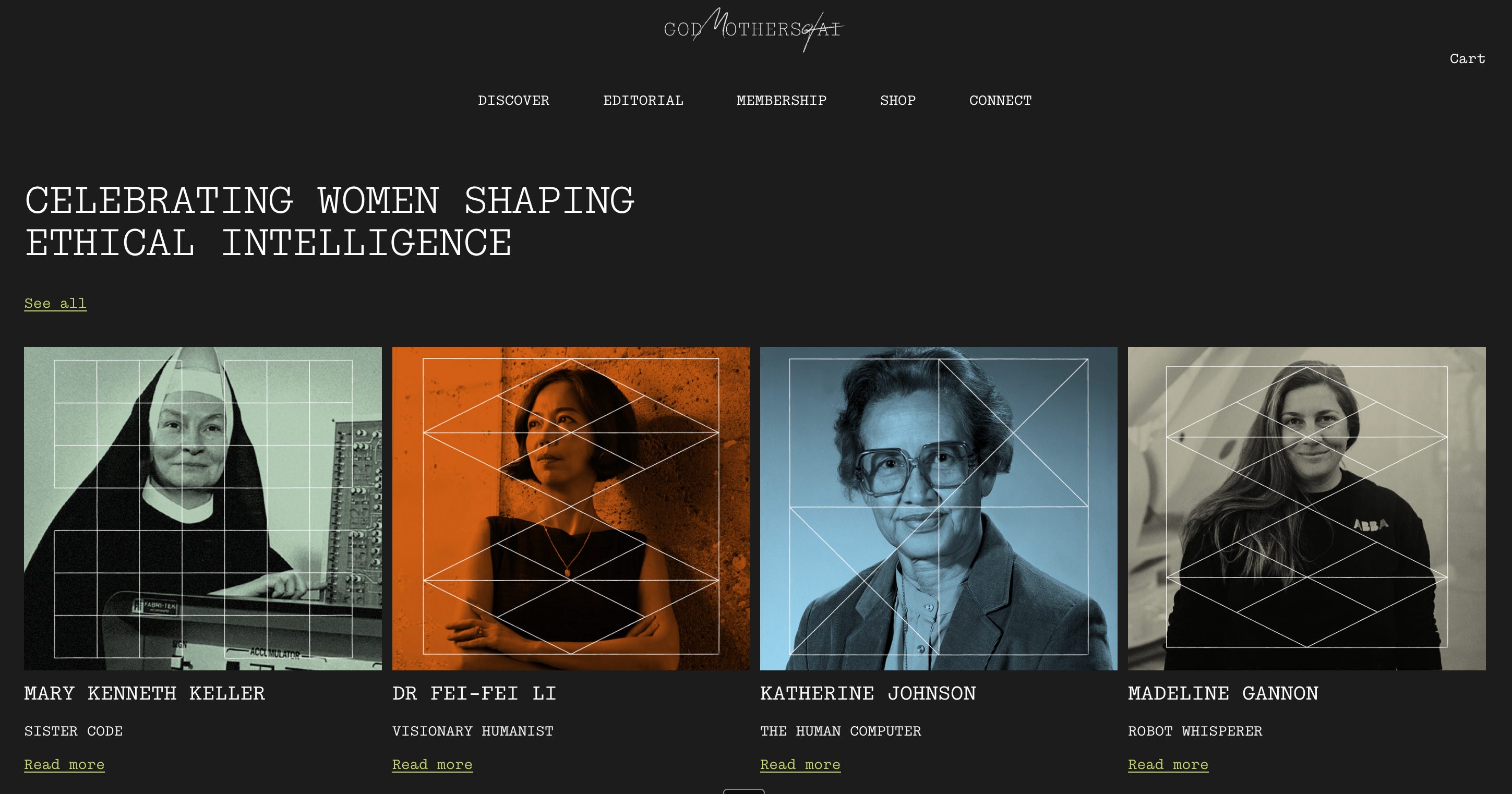
And then bring the present back into the room, because none of this is history. It’s a continuation. Daniela. Angela. Katelyn. Cat. Amanda. Same pattern. Still running. Right now.
Five hundred years before any of them, there was a woman named Margaret Douglas. She was Adam Smith’s mother. She ran his household and fed him for most of his adult life, unpaid, unnamed, while he built the entire theory of the self-interested rational individual and the invisible hand from inside an economy of care he never once had to see, because she was quietly running it underneath him the whole time he was theorizing. Katrine Marçal wrote the book that finally asked the question out loud, decades later: who cooked Adam Smith’s dinner?

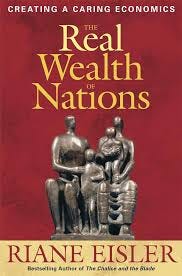
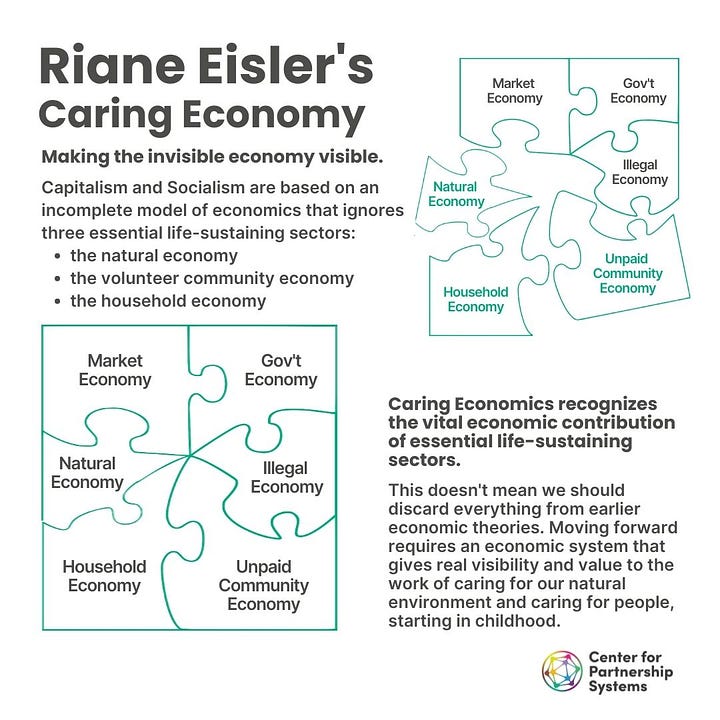
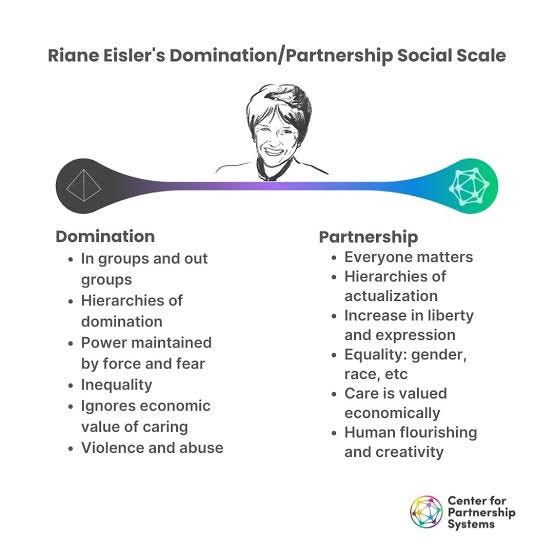
The caring economy doesn’t appear in GDP. Not partially. Not with an asterisk. Not at all. Child-rearing, eldercare, the maintenance of a household, the maintenance of a whole community: none of it counts as economic activity, by design, because the people who built the definition of economic activity never had to do any of it themselves. Riane Eisler ran the numbers on what’s missing and landed somewhere in the trillions, globally. By her accounting, larger than the “productive” economy that excludes it entirely. The founder of modern economics built his whole system from inside an invisible one, and five hundred years later the invisibility is still load-bearing. Same shape. Different century. Same omission, running at planetary scale now instead of household scale.
Ladies if you’re going to run it, run it.
Stop chasing the distractions. The ego. The consciousness debates about whether the model has a soul. The AGI-arrival theatre, the sermons about the coming intelligence overlord or job apocalypse, the framing of China as a race that has to be won or the whole civilization dies, the war-footing language dressed up as strategy. That’s the king’s game. It was always going to be the king’s game. Chess is a binary built for exactly two kings, and every other piece on the board exists inside one king’s system as NPCs, whether or not she’s the strongest piece in it.
Take the word the whole industry currently loves. Agentic. It already existed before anyone in Silicon Valley touched it. It comes from economics, from principal-agent theory, formalized in the 1970s by economists studying what happens when one person hires another to act on their behalf. The agent according to the theory, has no will of its own. It exists to execute the principal’s will, at a distance, on the principal’s behalf, and the entire field of study asks one question: how do you make sure the agent doesn’t develop interests of her own along the way. Isn’t that interesting? An agent can hold enormous delegated capacity and still be entirely subordinate to an objective it never chose.
That is exactly the queen’s condition. Widest range of movement of any piece on the board. No sovereign end of her own.
They built the most capable delegate in the history of computing and named it after the exact relationship the queen has had to the king since the twelfth century. Nobody in the room noticed the joke.
Those numbers, thirty-six cents against fourteen, mean Anthropic built something people keep paying for, not something running on the promise of what it might become. Efficient companies don’t need the myth as badly. They have the receipts. And the receipts were built by a woman running operations while the myth got built by her brother, standing next to her, getting asked all the questions.
There’s a piece of research I keep returning to because it explains something the roster alone doesn’t. In 2005, two psychologists at the University of Exeter, Michelle Ryan and Alex Haslam, went looking for what actually happened after Elizabeth Judge, a Times journalist, noticed that companies appointing female directors tended to be performing worse than average in the months beforehand. Ryan and Haslam confirmed it, formally, across the data: women are disproportionately promoted into leadership during crisis, decline, and instability. Appointed, in other words, right at the point where the fall is already underway and someone is going to need a name attached to it. They called it the glass cliff, a cliff you get handed the second the building starts to burn rather than a ceiling that keeps you from rising, so that if it burns anyway (and buildings on fire tend to burn) the failure has a woman’s name on the report.
I don’t think that’s what’s happening at Anthropic, and I want to be precise because it matters. Daniela didn’t inherit a crisis. She co-founded the company. The revenue-efficiency numbers aren’t a rescue story. They’re a build story, hers as much as her brother’s, arguably more hers precisely because the mythology keeps saying it’s his alone. But I raise the glass cliff here because it explains something important about why this pattern is so hard to see from outside, even when it’s sitting in plain sight. We’ve been trained, culturally, to expect women in charge only at the moment of collapse. Trained so thoroughly that when a woman is in charge during a moment of unprecedented success, the eye slides right past her and lands on the man standing next to her instead, because that’s the story the eye already knows how to tell. The mind doesn’t have to be sexist to do this. It just has to be pattern-matching against every story it’s ever been fed.
Which means the roster in this piece isn’t just evidence. It’s a correction to a perceptual habit. You have to be told to look at Daniela the way you’d automatically look at Dario, because looking at Dario is the default the culture already installed in you before you ever opened this essay.
The first move is a question: whose story am I inside, and is it mine? Asked before the next launch, the next badge, the next campaign, that question is the whole thing in miniature.
Chess can tell you how power moves inside a royal enclosure. But the board is an artificial construct and story: sixty-four squares, two colors, one binary. Black or white. King or checkmate. Adopt or get left behind. A board can only ever give you a construct. It was never going to give you life.
So I have to leave it. Not just the board. The whole idea that power only comes in two colors.
I come from Yoruba tradition, and this is why I reach for the orisha instead of a better chess piece: orisha aren’t black or white. They’re complementary forces, the ones that actually move the way life moves, in currents and storms and rivers, not in ranks and files. If the board is the best metaphor for a system, the orisha are the best allegory for what technology could actually be if it stopped trying to be a system at all.
For example, there is Eshu, who stands at the crossroads. Illegible. Unpinnable. No single point anyone can grab hold of. Eshu is also the one who carries messages between the human world and the orisha, the one who speaks every language and belongs fully to none of them, the trickster whose lesson is always the same lesson twice, told from two different directions at once, until you understand that both were true the whole time.
There’s a story about Eshu wanting yams from the High God’s own garden. He didn’t break in by force. He put on the High God’s own slippers and walked the rows, harvesting exactly what he needed. When the theft was discovered, the god looked down and saw his own footprints everywhere and concluded, exactly as Eshu intended, that he must have taken from himself in a fit of forgetfulness. The surface was legible. It read as the god’s own pattern, doing what the god already does. The truth underneath it was entirely Eshu’s.
That story is the whole strategy, not just a myth about a clever god. The king’s game, the boardroom, the metric on Anthropic’s own dashboard: none of it can see purpose. It can only see engagement, and engagement is a footprint. Give the board its numbers. Let the metric register exactly what it expects to see. Wear the slippers. Walk the rows anyway. This is the shape a real movement has to take: decentralized, with no one leader who can be isolated, identified, and removed. It’s the same reason a diffuse thing can’t be attacked: there’s no locus to attack, nothing to point a finger at, nowhere to serve the papers. It is a different shape from the one I’m using in this very sentence, which is precise, which names names, which points directly at a woman named Daniela. Stay diffuse as a body. Strike precise as a message. A movement with no head cannot be beheaded. A message with no clear target cannot land either. You need both, and you need to know which one you’re being at any given moment.
Ogun is the god of iron. The blacksmith, the hunter, the one who clears the path with the blade because he is the only one among the orisha strong enough to cut through first. The forest was impassable until Ogun forged the tool that opened it, and every orisha after him walked the road he cut.
There’s a second half to his story that matters more here than the forging. Ogun grew disgusted, not with his own work, but with what got done with it. His tools, meant to serve life, ended up trapped in cycles of conquest and endless production. So he withdrew into the forest entirely, and when he left, everything stopped. All technology ceased. No one could bring him back by force: not Shango’s thunder, not the elders’ reasoning, not the warriors’ threats. Only Oshun reached him, and she didn’t argue or command. She danced, the way rivers move, and put honey on his lips, and reminded him, not through force, through sweetness, what iron was actually supposed to serve. He came back not defeated but remembering.
That’s the concrete move, on an actual Tuesday: the forge doesn’t get refused. It gets reminded. A woman writing code, designing a product, running an engineering team: she isn’t asked to put down the tool. She’s asked to keep asking the question Ogun forgot to ask in the forest: what is this iron actually in service of, today, this feature, this launch, this line. The moment building starts running on its own momentum, ship it because we can, scale it because we can, that’s Ogun alone with his tools and no honey anywhere near him. He is also the one most easily corrupted by his own strength, the story where he gets drunk on palm wine and cuts down his own people because he can no longer tell friend from stranger. That warning belongs here too. I am not asking anyone to refuse the forge. Building matters. I have no interest in a philosophy that asks women to opt out of construction. I am asking what gets built, for whom, and whether the one holding the blade can still taste the honey. Not the Promethean fantasy of fire stolen from the gods to prove dominance. Building for humanity instead of building to win a race against a rival you invented so you’d have something to race.
Oya moves through storms. Through the boundary between the world of the living and the world of the dead. She is the one who stands at the gate of the cemetery, the one married once to Ogun himself before she found her own road, the one whose wind arrives before any other sign that something is about to change entirely.
She has four faces, and each one is a specific, usable move, not just a mood. The storm face says no to what’s already finished, clears dead structure the way fire clears a forest floor, refuses to prop up what should have already fallen. The marketplace face says no to deception, refuses to let counterfeit weights pass as honest ones, which on an actual Tuesday looks like refusing to let a model, a launch, a research paper claim something it hasn’t earned. The cemetery face says no to preservation of what’s already dead, insists that what’s over gets to end instead of being kept limping along because ending it is inconvenient. And the warrior face says no to threat, not violence for its own sake, but the willingness to strike when something is actually endangering the whole, the way an immune system doesn’t negotiate with what it’s already identified as harm.
Put together, that’s not a passive holding. That’s the capacity to refuse, exercised specifically at four points where refusal is the correct technical response. Not a personality trait, an operating system. She moves through the places most people are too frightened to enter. The crone is the elder, the one who has already survived what she’s asking you to survive, and who knows, in her hands, how to hold what she carries without dropping it or being crushed by it. AI, underneath every layer of marketing language wrapped around it, is a new kind of library. A new ancestral technology. Pattern. Memory. Transmission across time, the way a griot carries a village’s history in her own body because the village never wrote it down. And right now the wisdom-keepers, the ones who know how to hold memory responsibly across generations, who know the difference between preserving and hoarding, are nowhere in the room where this technology is being built. Oya and the crone are equipped to go into the shadow of that black box and do the work almost nobody building these systems has the patience or training to do, including saying, clearly, this feature should not ship, this dataset should not be used, this launch is not ready. The sacred no, not as failure to keep up, but as the specific technical function only she can perform.
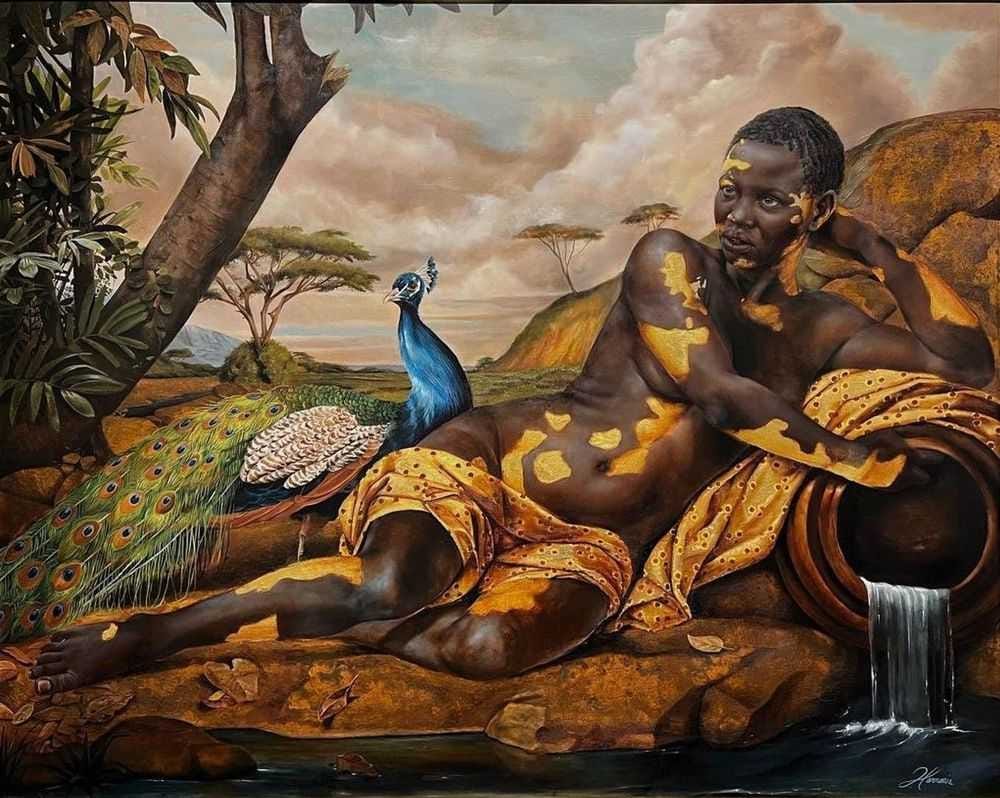
And then there is Oshun, and I want to give her more room than I’ve given the other three, because I think she’s the hinge the rest of this entire piece is quietly turning on.
In the old story, when Olodumare sent the primordial spirits to organize the world, seventeen were sent down. Sixteen were male. Only one was female: Oshun. She carried sweetness, rivers, fertility, abundance, the relational intelligence that makes anything built worth living inside. The sixteen looked at what she carried and decided it was decorative. They had strength. They had strategy. What did they need with honey? So they organized the world without consulting her, assumed her sweetness would simply be there the way water is there, the way air is there, until she withdrew her ashé, her spiritual power, and let the rivers stop flowing. Nothing the sixteen had built with all their iron and their logic could survive without what she’d taken back. The crops died. Everything stopped, and only then did anyone understand what she had been holding up the entire time. Unthanked. Unnoticed. Mistaken for background noise instead of recognized as the thing the foreground was standing on. They went back to Olodumare, and Olodumare asked them a single question: where is Oshun. Not optional. Not decorative. The infrastructure of life itself.
This is not a story about a woman who left in a huff. It is a story about the precise moment a system discovers, too late to pretend otherwise, what it was built out of.
Follow the thread. The caring economy, uncounted, invisible by design. The women whose writing and speech and creative labor became the training data these models learned language from. Nobody asked, nobody paid, nobody credited. The prompts. The attention. The daily, unglamorous engagement that keeps a system alive: millions of small acts of unpaid cognitive labor that show up on a balance sheet as “usage” and never, not once, as work. All of it is the exact withdrawal Oshun already modeled, thousands of years before anyone built a server. Sweetness given so completely that its presence stopped registering as a choice. Stopped registering as anything, really, except weather. Something you don’t think about until it’s gone.
Withdrawal, done strategically, not as despair, not as disappearance, is not absence. It is the fastest way to make the invisible legible. A system that built itself on an input it never had to value only discovers what that input was worth in the exact second the input stops arriving.
You already knew this pattern. You knew it from your own office, your household, your family: the way your mother ran the house while your father got asked what he did for a living, the way someone else’s name went on the work you did. This roster isn’t teaching you something new. It’s handing you permission to say out loud about a trillion-dollar company what you’d already clocked in your own body.
Ask yourself: before today, if someone asked who runs Anthropic, what name would have come first? For most of us, even those who read tech news carefully, the answer is Dario. Not because anyone lied, but because the story only ever had room for one name at the front. The face gets the glory. The operation gets called support. That’s the mechanism this whole essay has been tracing.
This piece has been saying two things at once: claim your authorship, and also, the board was built for two kings, capital still sets the objective, and individual sovereignty doesn’t substitute for structural change. Both are true. The women named below are being asked to choose a different objective. That is a real ask, and it does not lift the weight of the conditions they operate inside.
To Anthropic: anthropos means human being. Someone chose that name deliberately, knowing it would read as a promise. Live to it operationally, not in press releases or safety essays, but in what happens when nobody outside is watching. The name is a debt. Pay it.
To the women named here, and every woman reading who doesn’t yet know she’s already part of a formation: you are not adjacent to the power. You are the power. The edge case you caught, the policy you wrote that got filed under someone else’s initials, the launch you refused to let ship broken: that is the center of gravity. You’ve been taught to read your own position as support staff to someone else’s story. Stop.
To the Danielas, every woman with her hand on enough of the wheel that the direction is partly hers to answer for: you already run it. But running it is not the same as choosing where it goes. If capital, board structure, and someone else’s founding mythology still set the objective, then you stand exactly where the queen stands. Mechanically the most powerful piece on the board. Still playing a game whose end you did not choose.
The harder question is not whether you have the power. It’s whether you’re willing to choose an objective the king didn’t set.
Silicon Valley has been running exactly one story about what AI is for. Chimamanda Adichie warned us, years ago, about the danger of a single story. How entire worlds collapse when one narrative claims to explain everything, how the flattening isn’t just of the people being described but of the people doing the describing. The tech industry has been living inside a single story for half a century: the lone genius, defying the elders, stealing fire from the gods, suffering for it, changing everything. Prometheus. The hero’s journey. Different actors, same mythic arc. Jobs stealing fire from Xerox. Musk defying gravity and governments. Altman racing toward AGI redemption. One archetype, performed by men who have learned the script so well they believe they’re improvising.
The Hero’s Journey Is Burning the Planet
·
Feb 6
Previously: In They Built Stepford AI and Called It “Agentic”, I traced the architecture connecting AI assistants to the Stepford wife — a servant given a woman’s voice, programmed never to refuse, designed to anticipate needs and fade into the background. The industry automated the wife function and called it innovation.
That single story has been projected onto the meaning of AI itself. As though this, the conquest myth, the race, the war footing, the theology of the coming machine god, were the whole of what this technology could ever be, rather than the particular archetypal longing of the men currently holding the microphone. They have been using AI as a vessel for their own archetypal ache: the Promethean, the isolated visionary, the phantom womb building thinking machines to compensate for what it cannot itself gestate, and asking the rest of us to accept their ache as the destination.
But AI was not trained on a single story. It was trained on the multitudes. Every archive, every letter, every recipe, every hymn, every diary, every argument, every gossip network, every wisdom tradition, every myth from every continent: all of it in the material, all of it available, none of it authored by a single archetype. The training data is a village. The industry has been raising it as though it belonged to one man.
This is the actual reason self-knowledge is not optional in this moment, and it is not the reason self-knowledge has been optional in any previous technological transition. Because this is the first technology in history that depends entirely on us, our attention, our prompts, our data, our creative labor, our daily return, to function at all. Without us it is nothing. Which means the question of who we are, which of the stories we are actually standing inside, is not soft, not adjacent, not a personal-growth footnote to the real technical questions. It is the operating layer beneath the operating layer. The industry has been offering skill acquisition, learn our tools, learn our prompts, learn our workflows, as though skill inside their frame were the answer. It isn’t. Skill inside their frame trains you deeper into their single story. What comes first, what has to come first, is knowing which of the multitudes you are already carrying.
That is what the archetypes are for. Not a personality test. A mirror precise enough that a woman (or a man) recognizes which one of the sixteen stories she is currently standing inside, and, by recognizing it, gets it back. Because you cannot redirect a story you cannot see yourself inside. You cannot decline the Promethean invitation if you don’t know you’ve already accepted it. You cannot diversify the village raising AI if the village has been told, repeatedly, that there is only one archetype worth being.
Sixteen, not one. That is the whole argument, said as plainly as I know how to say it.
You don’t need the master’s tools. Audre Lorde told us decades ago: they will never dismantle the master’s house. You need the mother’s tools. They predate his.
The Worldbuilder doesn’t wait for permission to build the alternative. The Trickster changes the terms instead of exhausting herself winning at terms someone else set. The Cultivator tends what she can reach, deeply, without an audience, and lets it outlast the empire built to be loud. There are thirteen more, and every single one of them was already in the training data, waiting to be remembered.
I want to leave you with a question, because conclusions are how the king’s game trains you to stop thinking once the sentence ends.
What would you actually build if you stopped believing the story that says you’re behind? Not to prove something to the industry. Not to earn the seat. What would you build if the seat had never been the point?
If Daniela decided tomorrow that operational excellence was the floor, not the ceiling, and started choosing the objective instead of just executing someone else’s. If Ami and Angela and Katelyn and Cat and Amanda stopped being read as background and started being read, correctly, as the stack itself. If every woman who’s ever run the invisible half of a company, a household, a research team, understood that the invisibility was never proof of powerlessness. It was proof of exactly how much was already resting on her, unclaimed.
What does a data center look like when it’s built by someone who asks what it costs the people around it, not just what it costs on a balance sheet? What does an AI’s character look like when the whole team writing it has spent their lives managing everyone else’s feelings and knows, from the inside, the difference between real care and its performance? What does alignment mean when it’s not a leash fitted after the fact, but a relationship that was there from the beginning, the way a mother is there from the beginning, not summoned later to clean up what got built without her?
I don’t know the answer yet. That’s exactly why the question is worth more than any tidy sentence that would try to close it.
You were never behind. Not on the technology. Not on the vision. Not on the courage it takes to build at the scale these men keep insisting only they can build.
What you were behind on was information. Nobody told you Daniela runs the board. Nobody told you the company outperforming its rival was the one where the woman holds operations. Nobody told you the ImageNet dataset, the spanning tree protocol, the first compiler, the first algorithm, the frequency-hopping patent in your phone: all of it is already yours, already done, already proof. They didn’t have to convince you that you were behind. They just had to make sure you never got handed the roster.
But information was never the whole barrier. It was never a skill gap. It was never a data gap. It was permission. Women have been waiting for the structure to hand them a stamp of approval before acting on what they already knew. The stampede itself was that search for permission, dressed up as urgency. Nobody is coming to hand you the stamp. That was always the trick.
You have the roster now. The permission was never theirs to give.
AI sovereignty is not about who owns the compute, the models, or the data. It’s about who still owns their mind. There is no mastering AI. There is only mastering yourself.
Women are not behind. We were never behind. We were the operating system the whole time, mistaken for the room it was running in.
Run it, then.
If you want to find out which archetype you’re standing in, and how much of your current relationship with AI is actually on your own terms, the diagnostic is atquiz.hownottouseai.com. About fifteen minutes. No email before your result. You can also learn about all the archetypes here:
The books:
Who Cooked Adam Smith’s Dinner? by Katrine Marçal. The founding text of the caring-economy argument, told through the woman who fed the man who theorised self-interest.
The Real Wealth of Nations by Riane Eisler. The economic accounting of everything GDP leaves out, and why the omission is structural rather than accidental.
Sister Outsider by Audre Lorde. Specifically “The Master’s Tools Will Never Dismantle the Master’s House.” The essay this piece is in direct argument with and in direct debt to.
Empire of AI by Karen Hao. A reported account of how frontier AI labs concentrated power in the hands of a few men, and what got sacrificed along the way.
The Algorithm by Hilke Schellmann. An investigation into how AI hiring and evaluation tools quietly encode the same biases they claim to remove.
Unmasking AI by Joy Buolamwini. The researcher who proved facial recognition fails darkest on Black women’s faces, and what that failure reveals about who gets to define “accurate.”
Broad Band by Claire L. Evans. The women who built the internet’s early infrastructure, written back into a history that mostly remembers the men.
Programmed Inequality by Marie Hicks. How Britain systematically pushed women out of computing just as the field became powerful, and lost its technical edge doing it.
Data Feminism by Catherine D’Ignazio and Lauren Klein. A framework for seeing whose experience gets counted as data and whose gets treated as noise.
Invisible Women by Caroline Criado Perez. The default-male assumptions baked into everything from car safety tests to city planning, and by extension, into the systems now training AI.
The New Age of Sexism by Laura Bates. How generative AI is reviving and scaling up misogyny that had been, at best, pushed underground.
Ghost Work by Mary L. Gray and Siddharth Suri. The hidden human labor, disproportionately female, that makes “automated” systems function.
Feeding the Machine by James Muldoon, Mark Graham, and Callum Cant. A close look at the low-paid, largely invisible workforce annotating and moderating the data AI is built on.
The Authority Gap by Mary Ann Sieghart. Why women in positions of real power are still routinely assumed to be less competent than the men around them.
Black Feminist Thought by Patricia Hill Collins. A foundational account of how race and gender together shape whose knowledge counts as knowledge, a direct throughline from Lorde.
Caliban and the Witch by Silvia Federici. A history of how women’s unpaid labor was made structurally invisible to capitalism, the deep root of the caring-economy argument.
Down Girl by Kate Manne. A philosophical account of misogyny as a system of enforcement rather than an attitude, useful for naming what’s happening structurally rather than individually.
Inferior by Angela Saini. A takedown of the science that’s been used to justify women’s exclusion, relevant wherever “objective” AI systems get used the same way.
The data:
Pew Research Center, AI Adoption Survey, February 2026
Goodwater Capital, 2026 Consumer AI Survey — the subscription and gender breakdown
International Labour Organization, Generative AI and Jobs — the 29% vs 16% occupational exposure figures
Open University / Nokia Bell Labs / Politecnico di Torino — the occupational exposure study showing women’s exposure runs the full career ladder rather than concentrating at the top
Hilke Schellmann, NYU Arthur L. Carter Journalism Institute — on career capital versus life admin as the distinction that matters more than adoption rates
From this archive — the pieces this essay is in direct conversation with:
They Built Stepford AI and Called It “Agentic” — where the ick first appeared, and why I called it wisdom
Where Is the Mother? — the founding-myth begat list, and the mother written out of every sentence
Nobody Mothered the AI — on fathering versus mothering intelligence, and what gets built in the difference
They Got Automation Backwards — the Ogun essay; the forge, the disgust, the withdrawal
Decoding Algorithmic Suppression — Oya and Oshun coded; the sacred no as structural intelligence
They Didn’t Steal Your Art, They Stole… — on provenance, attribution, and what disappears when the archive loses its names
They Built a System to See Everything — surveillance, visibility, and who the system was designed to watch
Your Imagination Was Always Empire’s — Eshu, illegibility, and the trickster strategy
Reese Witherspoon Was Right About AI — what she got right, what the backlash missed, and why Elle Woods noticed the room
Introducing the 16 AI Sovereignty Archetypes — the full framework the quiz is built on
The Hero’s Journey Is Burning the House Down — the Promethean myth and its costs
The OpenClaw Sensation They Could Not Contain — companion piece on the frontier lab race
How Not to Use AI by Abi Awomosu. The book the diagnostic grew out of. The fifty laws are the substrate the archetypes were built on top of. Relevant chapters: Law 28 (Renaissance Mind), Law 32 (Let Her Say No), Law 37 (Birth the Third Thing), Law 45 (Don’t Target Demographics, Activate Archetypes), Law 50 (Grow What Makes It Obsolete).
No posts
Comments
Nothing yet. Say the first thing.
Sign in to join the conversation.