

Hi everyone,
Different kind of post today.
I’ve spent the last year in the spaces where people work out what they actually think about AI — not where they perform it. The thing underneath the takes is quieter, and more consequential.
As I always say - AI is a medium, not a tool. A tool you pick up and put down. A medium works on you while you’re not looking. It works on you even if you never opened an AI chatbot.
That’s because there’s AI the software, and there’s AI the story — the external discourse that acts on our psyche, the role we’ve cast it in our lives, the person-shaped function it’s standing in for. There’s always one.
AI has been framed as a question of adoption.
Use it or don’t. Embrace it or resist it. Learn the tools or get left behind.
But those are positions. They don’t tell you whether you chose the position in the first place.
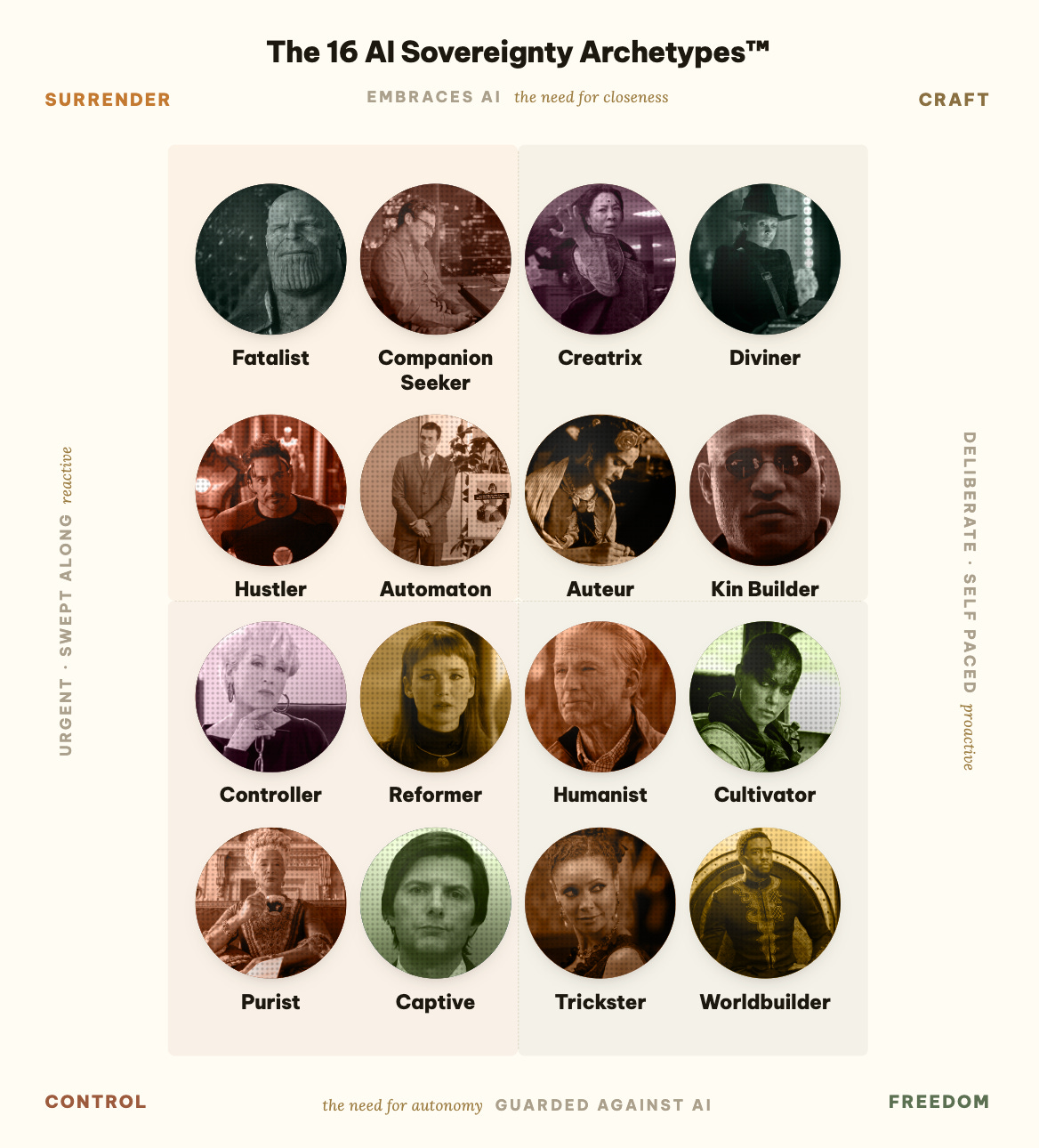
The 16 AI Sovereignty Archetypes map the different ways people are already relating to AI — from the Hustler and the Automaton to the Purist, Auteur and Worldbuilder. But your archetype is only half the result.
The deeper question is authorship: how much of this relationship is actually happening on your terms?
Because AI sovereignty isn’t about owning the model, the compute or the data.
It’s about still owning your mind.
Your archetype describes the stance you’re taking toward AI.
Your authorship score tells you how much of that stance is actually happening on your own terms.
The same archetype can contain very different degrees of authorship; the question is not whether the archetype is “good” or “bad,” but how much of the relationship you are actually choosing.
You can recognise yourself in the Hustler and decide that speed genuinely serves something you chose. You can recognise the Automaton and decide there are judgments you are perfectly happy to delegate. You can even recognise that something began reactively and choose, consciously, what stays.
These sixteen archetypes are not types of user. They’re types of stance — the shape a person takes when something with its own nature starts working on them.
I didn’t invent them. I listened for them, across thousands of anonymous conversations, and then I built a 129-statement instrument to check whether they were real and bore out in reality.
Fifteen minutes. One result. So you can see what’s moving on you, and start authoring the relationship instead of just surviving it.
All the best,
Abi

AI Sovereignty is not about who owns the compute, the models, or the data.
It’s about who still owns their mind.
This is why there is no mastering AI.
There is only mastering yourself.
129 statements. About fifteen minutes.
It will not flatter you. 65% of people who take it are running someone else’s story.

Is it intelligent? vs. Whose intelligence is it?
Will it replace me? vs. What have I already handed over?
Is it inevitable? vs. Who decided that, and what do they gain from me believing it?
Three questions, all aimed at the thing.
None of them can be answered, because none of them is where the real answer lives.


A tool is something you pick up and put down unchanged. A medium is something you live inside, and it works on you whether or not you’re touching it — which is why someone who has never opened a AI chat window and holds a firm, principled view about AI is still being worked on as thoroughly as someone using it ten hours a day.
Everyone is obsessed with the adoption gap.
But there is only one that matters — the authorship gap.
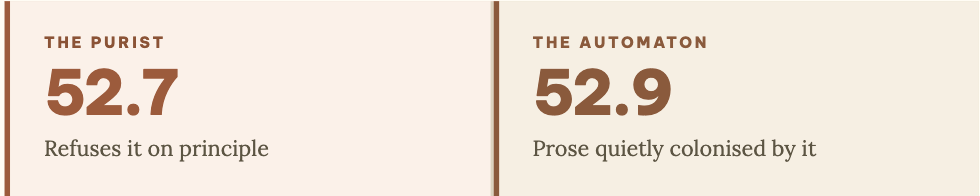
In this assessment, the person who refuses AI on principle and the person whose prose has been quietly colonised by it land within a fraction of a point of each other.
That’s because refusal is just a position. It’s not an exit.


Is it the friend who’s always there and never needs anything back?
Is it the understudy who goes on every night so you never have to?
Is it the prophet you stopped arguing with — the one who already told you how this ends?
Or is it the villain — the impostor whose papers you keep checking, the thing you’re braced against?
You can even cast it in your life without realising which role it plays. Everyone does.
So it’s less about which part it’s playing in your life .
It’s more about whether you handed this role out, or were handed a script.
Were you given the lines to someone else’s story, or are you in the director’s seat?


The sixteen archetypes weren’t designed — they were found and shaped in the field by listening to culture at scale, capturing how people actually talk about this when nobody is watching.

Closeness · Reactive
You handed over a judgment that was yours to make. How it ends. What counts as being met. What counts as an acceptable voice. What counts as enough.


Autonomy · Reactive
You’re holding the line. On the output. On what’s genuine. On what’s right. Or you’ve ceded control to the institution entirely and filed the compliance under professionalism.


Closeness · Proactive
You meet it with skill and cunning, knowing the material well enough to work with its grain rather than against it.


Autonomy · Proactive
You use it to protect what you hold dear, and to build the alternative to the thing you object to.


None of these sixteen positions tells me, by itself, how self-authored you are.
Two people can look remarkably similar from the outside and be living completely different relationships with AI. One Hustler may be running because the market told her she will disappear if she stops. Another may know exactly why she is moving fast, what she is building toward, and where she will refuse to follow.
The stance matters. But so does who authored it.
That is why the diagnostic gives you both an archetype and an authorship score. One shows you the shape of the relationship. The other asks how much of it is actually yours.
Self-knowledge comes before skill acquisition.
Skill or tool literacy is powerful when you know what it serves. Without authorship, tool literacy can make you more capable while still leaving you inside somebody else’s story.
Self-knowledge and authorship mean you write your own.
This is a reading, not a diagnosis.
You are not a Hustler the way you are left-handed.
Your archetype shows where the pressure is concentrated; your authorship score shows how much of your response to it is actually yours.
You can be highly self-authored and still recognise yourself in any of the sixteen.

Adopt or be left behind was never a choice.
It’s a script, and somebody else wrote it.
Choose sovereignty instead.
Take your mind back and learn to chart your own course with or without this technology.



Two things come back. Your archetype — which of the sixteen you’re standing in, and where you sit on all eight dimensions. And your authorship score — a single percentage that reveals exactly how much of this relationship is actually happening on your own terms.
The 16 AI Sovereignty Archetypes™ and the diagnostic behind them are the original work of Abi Awomosu. © 2026. All rights reserved.
No posts
Comments
Nothing yet. Say the first thing.
Sign in to join the conversation.