
I know this is my second post today. If you are not a student, you can stop reading. But please share it with a student who MAY wanna work with OpenAI.
But I really wanted to get this out to students so they can benefit and possibly land a job at OpenAI through this program.
Because they’re not asking for a resume.
They’re asking for two 60-second videos.
That’s the whole application. And most students applying this weekend are going to treat those videos like a Zoom call with their webcam light on. Which is exactly why the ones who don’t are going to walk in.
Applications close Monday, August 10, at 11:59pm PT. You have three days.
What the program actually is
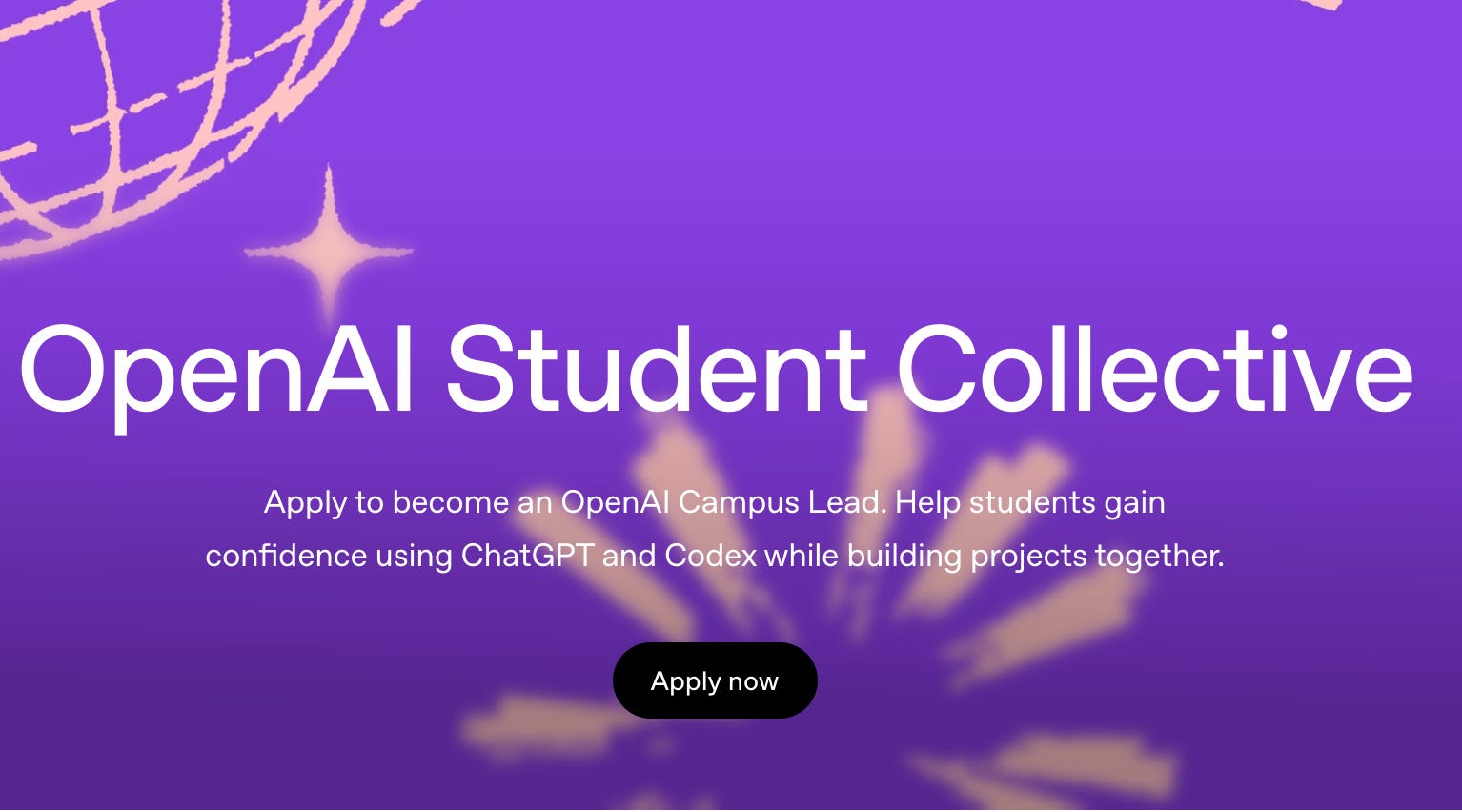
OpenAI is recruiting undergraduate Campus Leads to build AI communities on their own campuses. Here’s what they give you:
A cash stipend every semester: Amount isn’t public. It’s real money, paid twice.
A ChatGPT subscription: Covered for the full program.
Codex credits: For actually building things, not just chatting.
Funding to run events: They pay for your workshops and showcases.
Training and direct access to OpenAI team members: This is the part people are sleeping on.
A shot at visiting OpenAI HQ in June 2027: Not guaranteed for everyone, but it’s on the table.
Merch: Fine, yes, the hoodie matters.
The commitment is 4 to 6 hours a week from August 2026 through June 2027. You run workshops, host weekly Studio Hours, and put on a campus showcase.
Who can actually apply
Read this part carefully, because I’ve seen three creators get it backwards already.
You must be 18 or older and enrolled in an undergraduate program as of August 2026.
You must graduate AFTER December 2027. So if you’re finishing in 2028 or later, you’re eligible. If you’re graduating this coming spring, you’re not. A lot of posts online have this flipped.
Eight countries: United States, Canada, United Kingdom, France, Germany, India, Japan, and South Korea.
Work authorization in your country of study is required. If you’re an international student, check your status before you spend the weekend on this.
You can’t hold another ambassador, intern, or rep role at the same time. If you’re already a campus rep for someone else, this is a conflict.
They pick in pairs. Two Campus Leads per campus.
That last one changes your entire strategy, and I’ll come back to it.
The good news: OpenAI has said publicly that you don’t need an AI portfolio or any Codex experience. They’re screening for curiosity, community-mindedness, and whether you can actually get people in a room.
AI Action Letter is a reader-supported publication. To receive new posts and support my work, consider becoming a free or paid subscriber.
The application, exactly
Apply here: openai.com/student-collective
Two video answers, 60 seconds each:
Question 1: “What’s one way you use AI that you think more students should know about?”
Question 2: “What’s something you helped make happen on campus?”
Then a couple of short written reflection questions, your current OpenAI tool usage, your LinkedIn, and how you heard about it.
That’s it. That’s the whole thing.
Sixty seconds is nothing. It’s about 140 spoken words. You get roughly two ideas in, not five.
One note on the LinkedIn field. Somebody is going to click it. Spend 20 minutes on your headline and your top project before you submit, because a blank profile next to a great video is a weird mismatch.
Three things that will separate you from the pile
1. Film it like a Reel, not a Zoom call
I have 535,000 followers on Instagram and I’ll tell you the single thing I’ve learned that applies here: the first three seconds decide everything.
Whoever is reviewing these is watching hundreds of them, probably back to back, probably at 1.5x. Their attention behaves exactly like a viewer scrolling.
So kill the intro. No “Hi, my name is, I’m a sophomore studying.” They already have your name. You just burned nine of your sixty seconds on information sitting in the form field above the video.
Open on the answer.
Bad: “Hi! I’m Priya, I’m a junior at UT Austin studying econ, and today I want to tell you about how I use AI.”
Better: “I made my professor’s old exams predict this semester’s exam. Here’s how.”
You just bought yourself the other 55 seconds.
Other things that matter more than you think: film in landscape or vertical (either is fine, just be consistent), shoot near a window, use your phone and not your laptop webcam, and record standing up. Standing changes your voice. Try it back to back and you’ll hear it.
And do five takes. Not one. The fifth take is always the one where you sound like a person.
2. Get weirdly specific on Question 1
Here’s where almost everyone is going to lose.
Question 1 asks how you use AI. The default answer is “I use it to help with essays and studying.” Ten thousand people are about to say a version of that sentence.
The answer that wins is one narrow workflow, with a number attached, that your friends already text you about.
Compare these two:
“I use ChatGPT to help me study more efficiently.”
versus
“Every Sunday I dump my professor’s last four exams into a project and ask it to find which chapters get tested twice. Last semester it flagged three chapters. All three showed up. I stopped studying the other nine and my grade went up.”
Same tool. One of those gets you a spot.
Specific beats impressive. If the reviewer can repeat your workflow to a coworker after watching once, you’ve won.
I’ve put 50 of these below so you can find yours.
3. Bring your partner into the video
They select Campus Leads in pairs. Almost nobody applying is going to account for this.
So make their decision easy. Name the person you’d run this with. Say why the two of you work. And show one thing you already pulled off together, with a number.
“My friend Arjun and I ran a resume workshop last October. We expected 15 people. Forty showed up and we ran out of chairs. We already know how to fill a room on this campus.”
That’s the line. That’s the whole thing.
Forty people in a room beats a perfect GPA here, because OpenAI isn’t hiring a student. They’re hiring a small events operation that happens to be enrolled somewhere.
Question 2 exists purely to test this. “What’s something you helped make happen on campus” is not asking about your resume. It’s asking whether you can produce attendance.
And if you genuinely haven’t organized anything, you still have three days. Run one thing. A 12-person ChatGPT session in a library study room on Saturday counts, and it’s a more honest answer than a leadership title you never used.
50 AI workflows you can use as your answer
Pick ONE. The one that’s actually true for you. Do not perform a workflow you’ve never run, because 60 seconds of talking about something you actually do sounds completely different from 60 seconds of reciting.
Read these as prompts for your own memory. The moment you go “wait, I do a version of that,” stop reading.
Studying and exams
Feed a lecture recording through a transcription tool, then ask for the five questions most likely to show up on the exam. Answer them cold.
Photograph your handwritten notes and have it rebuild them as a spaced repetition deck you can import into Anki.
Prompt it to explain a concept “as if I’m the person who failed the last quiz.” The explanation changes completely.
Upload every past exam you can find. Professors reuse structure. Ask it to find the pattern per chapter.
Use voice mode on a walk. Teach the concept out loud and tell it to interrupt you the second your explanation breaks.
Compress a 300 page textbook chapter into one page of “only what actually gets tested.”
Get a 10 minute briefing before lecture so you walk in already understanding it. Attendance stops being passive.
Screenshot a problem you got wrong and ask it to find the error in your reasoning, not to give you the answer.
Keep an error log all semester. Dump every wrong answer in monthly and ask what your recurring failure pattern is.
Have it write you a fake exam, then sit it under real time pressure and ask it to grade you harshly.
Coursework and writing
Reverse outline your own draft. Paste your essay and ask what each paragraph actually argues. The gaps show up immediately.
Paste the rubric and ask it to grade your draft as the harshest TA in the department, with point deductions line by line.
Read your professor’s published papers first, ask what they care about, then write toward that.
Turn a group project brief into a task list with owners and dates, then drop it in the shared doc before anyone else has opened the brief.
Convert a dense reading into a Socratic dialogue you argue with instead of a summary you skim.
Steelman the opposing side before you write an argumentative paper, so you kill every objection inside your own draft.
Paste messy citations, get consistent formatting back in seconds.
Voice dump a half-formed idea for three minutes and get a structured outline back.
Research and reading
Drop five papers into one project and ask what they disagree about. The disagreement is where your thesis lives.
Ask which three papers everyone in this field cites, then read only those first.
Turn a methods section into a step by step list you can actually run in a lab.
Build a literature matrix: author, claim, method, gap. One bullet list, whole semester of reading.
Ask for the strongest critique of a paper before your seminar so you’re the person who speaks first.
Summarize a professor’s entire research agenda before you email them asking for a lab spot.
Turn a dataset into three charts plus a paragraph on what’s surprising in it.
Ask it to find where your own summary overstated the source. Catches you before your TA does.
Job hunt and career
Paste a job description next to your resume and get the exact keyword gaps.
Turn a class project into a resume bullet with a real number in it.
Draft cold emails to alumni that reference something they actually did, not their job title.
Run a mock interview in voice mode and ask for feedback on filler words, structure, and pace.
Build one page briefs on eight companies the night before a career fair.
Audit your LinkedIn as “what would a recruiter skim in six seconds.”
Write your 30-60-90 plan before day one of an internship, then send it to your manager in week one.
Research the salary band and script the negotiation before the call.
Track every application in a sheet you update by forwarding the confirmation emails.
Campus life and organizing
Draft an event budget and the sponsorship email in one pass.
Turn one event into ten pieces of content: recap post, captions, slide deck, thread.
Write the club onboarding doc so next year’s batch doesn’t restart from zero.
Dump raw poll responses from your members in and ask for the three real complaints underneath them.
Build a run of show for a workshop down to the minute, including who says what.
Draft the “we need a room” email to admin in the tone that actually gets rooms.
Turn post event survey responses into five bullets on what to change next time.
Building things with Codex
Build a class schedule conflict checker in an afternoon with no CS degree.
Scrape your university’s job board into a daily digest that lands in your inbox.
Build one tiny web app that fixes one annoying campus problem. Laundry timers. Library seat finder. Shuttle tracker.
Turn the spreadsheet your club has maintained for four years into an actual dashboard.
Automate the attendance tracking you’re currently doing by hand on a clipboard.
Build a bot that answers the same twenty questions your club gets asked every semester.
Take an open source repo, add one small feature, then explain your pull request out loud.
Rebuild the ugliest form on campus as a working prototype and show it to the person who owns it.
Number 50 is my favorite for this application specifically. It ends with you talking to an administrator. That’s the exact energy of the job.
The prompt that builds your 60 second answer
Copy this into ChatGPT. Answer honestly, including the boring parts, because the boring parts are where the specificity is.
You are helping me write a 60-second video answer for the OpenAI Student
Collective Campus Lead application. The question is: "What's one way you use
AI that you think more students should know about?"
Here is the truth about how I actually use it:
[Describe your real workflow in messy detail. What tool, what steps, how
often, what changed as a result. Include numbers even if they're small
or unimpressive.]
Do this in order:
1. Ask me up to 5 questions to pull out specifics I left out, especially
   any number, date, or result I glossed over. Wait for my answers.
2. Then write a script of 130 to 145 spoken words, structured as:
   - First sentence: the result or the surprising claim. No introduction,
     no name, no major. Start on the answer.
   - Middle: the workflow in three concrete steps, said plainly.
   - Last sentence: why other students on my campus should be doing this
     and what I'd teach them.
3. Flag every sentence in the draft that could have been written by any
   other applicant, and rewrite it so it could only be written by me.
Rules: no buzzwords, no "in today's world," no listing three adjectives in
a row. Write it the way I'd say it to a friend. Short sentences.
And a second one for the partner question:
Question 2 of my OpenAI Student Collective application is: "What's something
you helped make happen on campus?"
Here is what I did: [describe the event, club, project, or group. Include
how many people showed up, what almost went wrong, and what you personally
did versus what someone else did.]
I plan to apply as a pair with [name], who [what they're good at].
Write a 60-second script that:
- Opens with the number of people who showed up, in the first 5 words.
- Names my partner and states in one line why the two of us work together.
- Spends most of the time on what specifically went wrong and how we fixed
  it, because that's what proves we can run events.
- Ends with the one thing we'd run on campus in month one.
Be ruthless about cutting anything that sounds like a resume.
Every link you need, in one place
I went and pulled all of these so you’re not opening 14 tabs at midnight.
The official stuff, read these first
The application itself: openai.com/student-collective. This is the only link that matters. Everything else is context.
OpenAI’s own announcement thread: community.openai.com. Worth reading the replies. Other applicants are asking eligibility questions and OpenAI staff are answering them.
OpenAI on learning and teaching with ChatGPT and Codex: openai.com/index/learn-teach-chatgpt-work-codex. This is OpenAI telling you, in their own words, what they think students should be doing with these tools. Your Question 1 answer should sound like it belongs in this world.
OpenAI Academy: academy.openai.com. Free courses and sessions. Finish one before Monday and you can honestly say you’ve done their training.
Free credits and access you should claim regardless
Claim these even if you don’t apply. They’re free and most students don’t know they exist.
$100 in free Codex credits for verified students: Verification runs through SheerID with your university email, or a student ID plus current transcript. Was live for the US and Canada as of earlier this year. Credits expire 12 months after you get them, so don’t claim and forget. Start at openai.com/codex and look for student verification.
ChatGPT free tier: chatgpt.com. The free plan now includes limited file uploads, image generation, Deep Research, memory, and Codex. Enough to build a real answer for Question 1.
ChatGPT for Academic Researchers: If you’re doing research work, there’s a program giving eligible researchers 12 months of free Pro level access. Check openai.com for current eligibility.
Tools for actually recording the two videos
You need almost nothing here, but these help.
Your phone, not your laptop: Better sensor, better microphone, better everything. Prop it at eye level on a stack of books.
Any window, no ring light: Face the window. That’s the whole lighting setup. Never sit with a window behind you.
CapCut: Free. Use it only to trim dead air off the front and back. Do not add captions, transitions, or music to an application video.
Voice memo test: Record 15 seconds sitting, then 15 standing, and listen back. You’ll hear why I keep saying stand up.
ChatGPT voice mode: Record your take, transcribe it, and read the transcript. Every filler word you say is now visible on a page. Brutal and extremely useful.
If you want the fastest possible version of your Question 2 answer
You have three days, so this is real advice, not a joke. Book a study room, post in your class group chat, and run a one hour “how I actually use ChatGPT for exams” session on Saturday. Ten people is enough. Take one photo of the room.
Now you have a specific, dated, true answer to “what’s something you helped make happen on campus,” and a photo to reference. That’s a better Question 2 than most people with a leadership title will submit.
If you are finding value in my AI action letters, please consider subscribing. It keeps me going.
Do this today, not Sunday night
Three days. Here’s the order:
Today: Pick your one workflow from the 50. Text the person you want to apply with and get a yes.
Tomorrow: Record both videos. Five takes each. Standing. Near a window.
Sunday: Watch them back with the sound off. If your face is doing nothing for 60 seconds, re-record. Then submit at openai.com/student-collective.
Do not submit Monday night. Portals get hammered at deadlines and you do not want to be uploading two video files at 11:47pm.
One more thing. Even if you don’t get selected, you now have two 60 second videos of yourself explaining what you build and what you’ve run. That’s an asset. Put them on LinkedIn on Tuesday. I’m serious. Almost nobody in your graduating class has video of themselves being competent, and that gap is worth more than the stipend.
If you know a college student in the US, UK, Canada, India, France, Germany, Japan, or South Korea, please share this with them. The deadline is Monday and most of them haven’t heard about it.
That’s it from me today.
AI Action Letter is a reader-supported publication. To receive new posts and support my work, consider becoming a free or paid subscriber.
Till next time. Stay tuned as I will share best resources from both my Harvard and Google networks to bring the best to you. Let’s up skill together. Aspyre higher!
Comments
Nothing yet. Say the first thing.
Sign in to join the conversation.