

“These seem like money mindset issues you have, Abha…” said a friend of mine at lunch, referring to the conversation we were having about linking your self-worth to how much money you make.
“Have you tried to understand the root of where this is coming from?” she continued.
“Not really”, I said. “You think I should seek help?.”
“No, just talk through it with ChatGPT, it will help you get to the bottom of it. This is what I did and I was able to resolve many long-standing issues of my own.”
I was too gobsmacked to respond, not knowing where to begin to explain how tools like ChatGPT are just sophisticated auto-complete tools and that she should be talking to a professional if she wanted real support.
I find it amazing how much people are anthropomorphising AI i.e. attributing human-like feelings, mental states, and behavioural characteristics to artificial intelligence systems. They assign them names and also genders. My friend referred to ChatGPT as “him.”
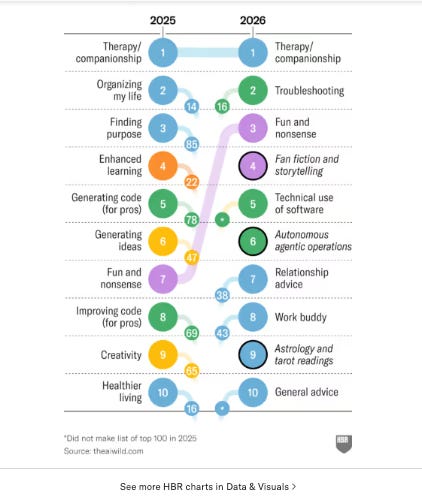
In a recent study published in Harvard Business Review on how people are using AI in 2026, therapy and companionship is still the top use case, and it has now been that way for three years running.
Personal and professional support accounts for 31% of all AI use cases. “Relationship advice” came in 7th and “work buddy” came in 8th.
People are turning to AI to process their feelings, work through their relationships, and find a sense of being understood.
What they do not realise is that when you treat AI as a confidant, you hand it only bits and pieces of your anxiety, your half-articulated angst, your vague emotional landscape. The input is not the whole picture. So whilst the output sounds helpful, it isn’t targeted to anything real.
Some basic AI literacy - eg knowing that large language models are just giving you the next best word based on patterns of their datasets - could shift these results dramatically, I think.
In other results, “Fun and nonsense” climbed from seventh place last year to 3rd place. “Fan fiction and storytelling” debuted at 4th. “Astrology and tarot reading” entered the list at 9th.
This is what people are doing with one of the most powerful technologies ever built.
Thinkslop. Workslop. Writing slop.
In at least a quarter of the top use cases this year, people are asking AI to do some portion of their thinking - one of the researchers of this study Zao-Sanders calls this “thinkslop”.
Thinkslop is what happens when you stop thinking and let the machine think for you. And the cost, as he describes it, is that we deny ourselves the experience of thinking, we may lose access to certain creative thoughts entirely, and over time, we erode our ability to think at all.
Add to that ”AI brain fry” or “mental fatigue from excessive use or oversight of AI tools beyond one’s cognitive capacity,” and we are on the fast track to cognitive decay. I am rapidly trying to get off this track!
Thinkslop is one problem. Workslop is another.
Workslop is low-effort, AI-generated work that looks polished, but ends up wasting time and effort as it offloads cognitive work onto the recipient. The person who sends it saves 20 minutes, but the person who receives it spends 40 trying to work out what it actually means.
Research by Better Up shows that 53% of participants admitted to sending workslop and 40% said they had received it. And those are just the people who admitted it.
Writing slop is its own category.
And it is arguably the one that matters most to those of us who built our careers on the quality of our communication.
Hilary Gridley, who writes the Substack newsletter Writer Builder, recently published a piece asking a deceptively simple question: Is there a good way to write with AI?
She surveyed 100 leaders about their biggest AI pain points and one answer came up again and again: Everyone around them was generating documents nobody was reading.
She also ran a poll of nearly 600 people on LinkedIn and found that only 17% said they would tell a colleague their work was AI-generated.
Her framing is the sharpest I have read on this subject. The question is not: did a robot touch this? The question is: what work got skipped, and who pays the cost?
She breaks writing down into its component parts and asks where exactly AI is being inserted into the process: Having an idea. Capturing it. Researching. Synthesising. Structuring. Forming a point of view. Drafting. Rewriting. Editing. Each of these is a skill. And each one can atrophy if you stop doing it.
I feel this happening to me and it has terrified me.
It’s forced me to think about my outputs and come to the realisation that if I want to keep my brain cells and produce good work, I need to let it take time and not use AI all the time.
So if you hold the two key points here together for a moment:
People are using AI for their deepest, most personal needs.
And getting only surface-level results in their individual and professional lives.
We’ve got it completely backwards.
The anthropomorphising of tools is design feature. They are built to feel responsive, warm, present. They mirror your language back to you. They never get tired of you. They never have their own difficult day that bleeds into the conversation. They are available, for free, 24/7.
Of course we are making these tools our best allies.
But, the moment you start treating these tools as your friends or your own brain rather than mere instruments or tools - you lose what makes them powerful for you.
AI works best when you know what you want, so you can judge whether what comes back is good or not.
The irony is that the moments people most want to offload to AI - grief, confusion, self-doubt, complex tasks filled with nuances, big life questions - are exactly the moments it’s least equipped to help. It doesn’t have any real experience, it doesn’t understand the nuances or complexities of your personality, work or your world.
ChatGPT or any such tool, however skilled it is at sounding knowledgable or empathetic, is just predicting the next best word based on the patterns it sees from the data it has been fed and trained on.
And once you get that, the way you communicate with these tools should fundamentally change and the weight you give the responses should be assessed with that understanding.
So what do we actually do with this?
It’s simple and boring: We have to take the effort to think first, before we jump to the tool - for any and every task.
Simple. But, not easy. Our quest to resolve personal situations, to work better, faster and just ‘get it done’ with AI is making us lazy and we need to nip it in the bud.
If you don’t know what you’re thinking, or what you want and why you want it - AI will fill that gap with something that sounds plausible. That’s thinkslop in action.
The difference between average results and outstanding results isn’t the tool to you are using. It’s the clarity of your own thinking and the context you bring to it.
AI cannot make you do the hard cognitive or inner work, that needs to come from you.
So, the question to ask before you open the chat window is not “can AI do this?” It almost certainly can. The question is “what happens to me if I let it?”
Some tasks are worth outsourcing completely. Some are worth doing with AI support. And some are worth doing yourself, slowly, badly at first, because the difficulty and “friction” is exactly the point. Let’s not forget that.
Comments
Nothing yet. Say the first thing.
Sign in to join the conversation.