
AB updates are for informational purposes only. Do not construe any of the following as investment, financial, or other advice. You make your own decisions.

Disclaimer: AB Research is a culmination of research & insights from the diverse capacity of the AB Team. Ultimately our focus & mission is financial freedom. This is a special edition. Everyone at AB owns ETH

The Bet
In 2016, the first crypto I ever purchased was Ether, the native asset of Ethereum.
This was not the result of deep financial modeling or a tip from a fund manager, rather the product of curiosity and a Google search. Advantage Blockchain Founder and CEO, Marc Paquin, was in university class bored when he prompted Google “how to get rich”. What he found interesting was a thread on blockchain technology, and a new concept called – Ethereum. A decentralized computing platform. Programmable money. A way to redesign the internet itself.
Marc, one of my best friends since Middle School, sent this new finding to me, understanding that I would be open to this new type of money and innovation.
We read the whitepaper, fell down the rabbit hole, and were hooked. As we became students of this technology, it became an obsession. I once delivered a friend food across town at Penn State in exchange for 2 Ether (~$24 at the time).
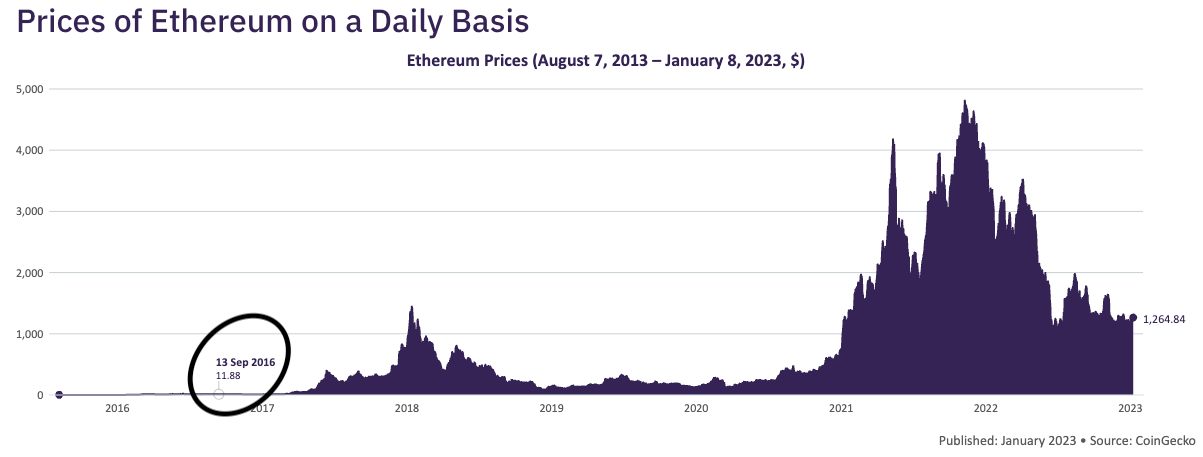
Ethereum represented the foundation of a more efficient, decentralized digital economy. ETH became the centerpiece of our personal portfolios and, eventually, the core position across our investment strategies at Advantage Blockchain Fund.
Over the past few years ETH has had lackluster price performance, underperforming BTC and alternative layer 1s. The Ethereum Virtual Machine continued to improve technically but struggled to translate that into demand for the asset. ETH had no one explaining to institutions why it was valuable. That changed at the beginning of 2025.
Etherealize
In January, Etherealize had its public launch with a goal of pitching the bull case for Ethereum to Wall Street. A mix of core developers and ex wall street professionals, Etherealize speaks both crypto native and traditional finance languages.
Sharplink
In June, SharpLink Gaming, announced a $425M private placement led by Consensys with Joe Lubin, cofounder of Ethereum becoming the Chairman of the Board. The proceeds from this fundraise would transition the company to becoming the first Ethereum treasury strategy, a la “Strategy” with Bitcoin.
ETH Treasuries
More companies began to follow suit, and other publicly traded companies BTBT and BTCS made it known that they have been acquiring ETH for years. These companies were being joined by new Ethereum Treasury Companies such as Tom Lee’s Bitmine Immersion Technologies. As of Monday July 21, Pantera backed “The Ether Machine” announced their plans to buy and yield 400,000 ETH (worth ~$1.5b). GameSquare Holdings has also purchased a significant ETH stake.
There remain several companies that have not publicly announced their ETH treasury strategies yet, but plan to in the coming weeks.
Public Perception
The race to acquire Ethereum is now on. Lower inflation than Bitcoin, a native yield and surging demand from institutions and public markets. I have never been more bullish on Ethereum.
A few days ago, a friend in crypto challenged my outspoken thesis on eth outperforming the market in the foreseeable future, to which we created a low stakes bet. At the time of the bet, ETH/BTC (ETH priced in BTC) sat around 0.025. Today, it is above 0.031 (+28.13%). Still down from 0.075 at the time of the Merge (Q3 2022).
I believe Ethereum is structurally positioned to outperform Bitcoin over the next cycle. It is not because I am anti-Bitcoin. Quite the opposite. I love Bitcoin and hold it. But I believe the digital infrastructure Ethereum is enabling will make ETH the better performing asset over the next several years.
The Case: ETH/BTC
The ETH/BTC price ratio measures the relative value of Ethereum against Bitcoin. Historically, this ratio has fluctuated, reflecting shifts in market sentiment and fundamental developments. My bet is rooted in a belief that Ethereum’s fundamentals:
Economics
Institutional adoption
Expanding use cases
Position it to outperform Bitcoin over time. Below, I break down the key reasons for my optimism, supported by data and market trends.
Ethereum’s Superior Economics
Ethereum’s economic model has evolved significantly since the Merge, which shifted the network from proof-of-work (PoW) to proof-of-stake (PoS). This transition has made Ethereum’s supply dynamics more attractive than Bitcoin’s in several ways:
Lower Inflation Rate: Since the Merge, Ethereum’s net issuance has been remarkably low. Over 1,030 days, only approximately 373,000 ETH have been issued net of burns, thanks to Ethereum’s fee-burning mechanism (EIP-1559), which removes a portion of transaction fees from circulation. In contrast, Bitcoin’s inflation rate, driven by its fixed block rewards, remains higher, with approximately 1.339% annual supply growth compared to Ethereum’s near-zero or deflationary issuance.
ETH issuance post merge annualized - ~0.116%
BTC issuance post merge annualized - 1.339%
Demand Dynamics: Ethereum’s supply is increasingly constrained. As of July 2025, 29.7% of ETH’s total supply (over 35 million ETH) is staked, locking it away from circulation and generating passive income for holders. Exchange balances are at an eight-year low, indicating reduced selling pressure. Meanwhile, demand is surging, with ETF demand reaching a record 231,580 ETH (7/16) compared to a daily production of just 2,008 ETH. Institutions are removing ETH from circulation at a scale that could spark a supply shock. There are also rumors that OTC markets are running out of ETH supply, meaning that larger quantities would have to be purchased on the open market which directly leads to price increases.
Native Yield: Ethereum’s PoS model incentivizes holding and securing the network through staking rewards, which historically yield 2.5-4% annually. Staking, like mining, secures a network through validating the blockchain and transactions. However, unlike Bitcoin miners, who must sell BTC to cover operational costs, ETH stakers do not have overhead with hardware and electricity costs, allowing them to earn rewards without selling, aligning their interests with network security. This creates a virtuous cycle of holding and staking, reducing available supply.
These economic factors make Ethereum a compelling asset for long-term holders, driving demand while constraining supply in ways Bitcoin cannot match.
Institutional Adoption: Treasury Companies and ETF Inflows
Institutional interest in Ethereum is accelerating, driven by its yield-generating potential and role as a foundational layer for decentralized finance (DeFi). Publicly traded companies and exchange-traded funds (ETFs) are increasingly allocating capital to ETH, signaling a shift from Bitcoin-centric strategies.
ETH Treasury Companies: A wave of publicly traded companies are adopting Ethereum as a treasury asset, following the playbook pioneered by MicroStrategy’s Bitcoin strategy.
SharpLink Gaming, led by Ethereum co-founder Joseph Lubin, holds 280.6k ETH, with 100% of its reserves staked to generate yield
BitMine Immersion Technologies, with Fundstrat’s Tom Lee as chairman, holds over 300.7k ETH valued at $1 billion
The Ether Machine plans to buy and hold 400,000 ETH
Bit Digital, pivoting from Bitcoin mining, owns 120.3k ETH
BTCS, a pioneer in ETH treasury strategies since 2021, holds 55.8k ETH
BTCS focuses on ETH infrastructure as a software company.
BTCS helps secure the Ethereum network by running validator nodes, which process transactions and earn rewards, contributing to efficient and decentralized block space usage.
GameSquare Holdings holds a total of 10,170 ETH
Monday (July 21), GameSquare’s Board of Directors has increased the Company's digital asset treasury management authorization from $100 million to $250 million.
This will include an NFT yield strategy, an ETH based assets strategy, and a stablecoin yield strategy.
A major differentiator for GameSquare is the yield generation on their assets, higher than staking, while utilizing stablecoin yield.
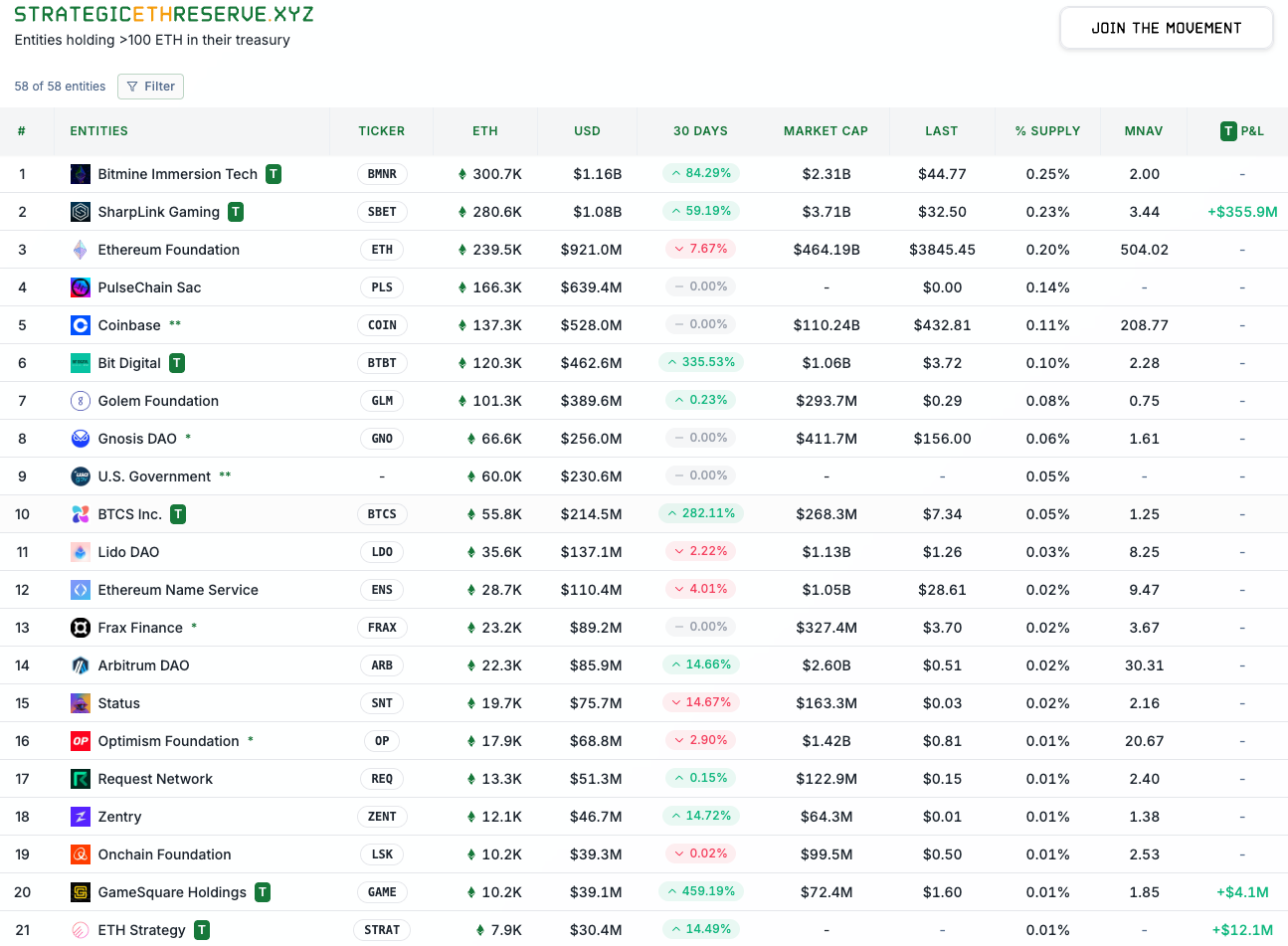
In the last 30 days, 10 ETH treasury companies have purchased over 550,000 ETH ($1.65 billion), absorbing 0.5% of ETH’s supply and deploying it in DeFi protocols. These companies are not selling, creating sustained buying pressure. This has led to Wintermute’s CEO posting on X that they have run out of ETH supply on their OTC desk…

BTC Mining Companies Pivoting to ETH: Even traditional Bitcoin mining firms are diversifying into Ethereum. BTCT, a Nasdaq-listed Bitcoin miner, announced a $1 million ETH reserve, citing Ethereum’s role in stablecoin issuance and asset tokenization. This shift reflects Ethereum’s growing appeal as a productive asset compared to Bitcoin’s passive store-of-value role.
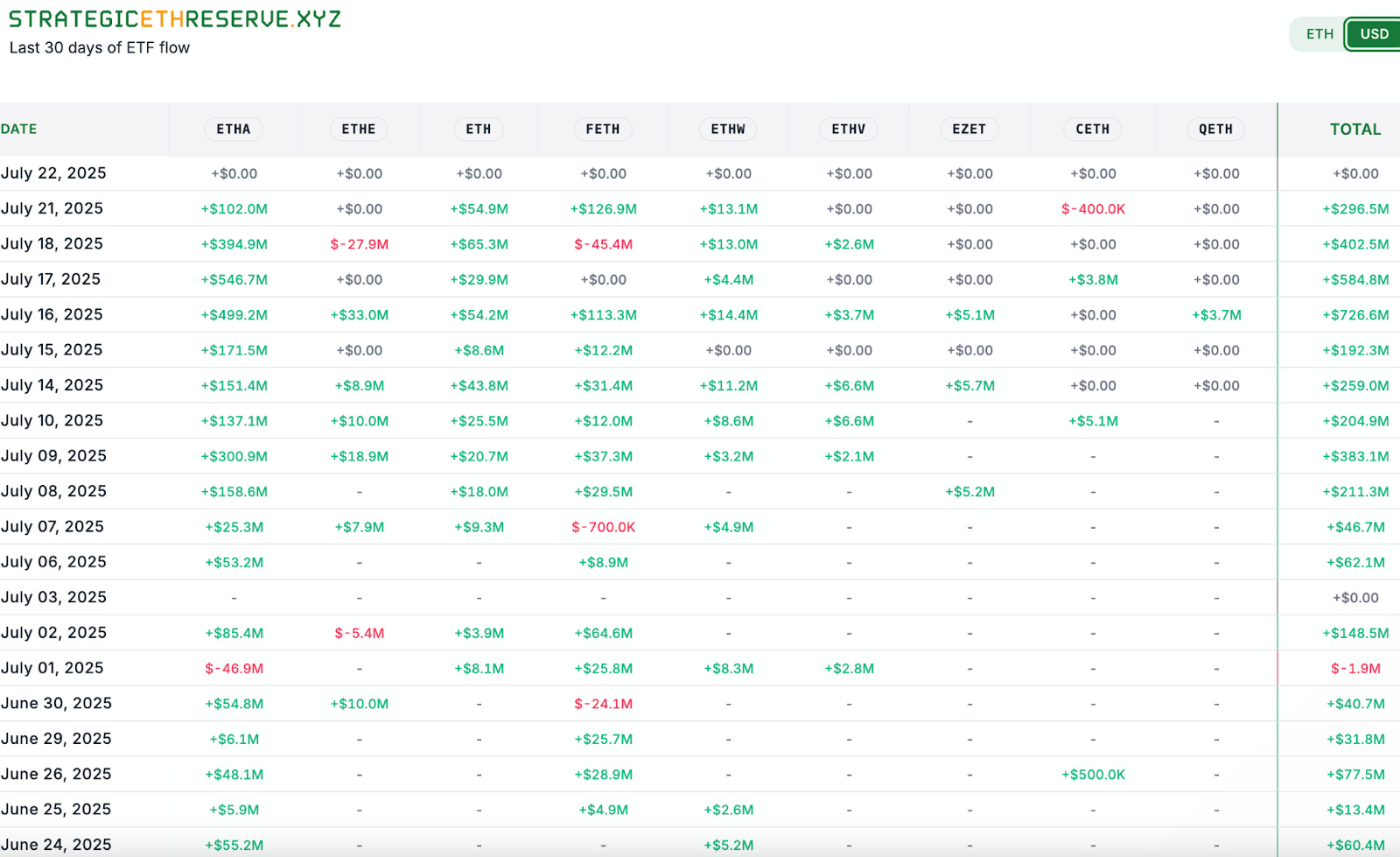
ETH ETF Inflows: Spot ETH ETFs are experiencing parabolic growth. On July 16, 2025, ETFs recorded record inflows of $720 million, with 380,000 ETH absorbed in just nine days—equivalent to three years of net ETH issuance . ETFs currently hold ~4% of ETH’s supply, and if trends continue, they could absorb an additional 10% within a year. This institutional demand, combined with low exchange balances and $50.3 billion in derivatives open interest, underscores Ethereum’s tightening liquidity.
Staking ETF: Simultaneously, ETH is about to get another bump to its popularity among ETF inflows as Blackrock and Grayscale await approval from the SEC on adding native staking yield to their ETH ETFs. Adding yield will generate additional and predictable returns, making this asset class which has seen huge inflows as of late even more attractive.
Notable Endorsements: Prominent investors are backing ETH treasury strategies. Peter Thiel’s 9.1% stake in BitMine Immersion Technologies signals confidence in Ethereum’s corporate adoption. Bank of America has dubbed Ethereum the “new Stablecoin Rail,” recognizing its dominance in tokenized assets.

These trends indicate that institutions view Ethereum not just as an investment but as a strategic asset integral to the future of finance.
Ethereum’s Use Cases: Stablecoins, DeFi, and Real-World Assets (RWAs)
Ethereum’s programmability makes it the leading platform for stablecoins, DeFi, and tokenized real-world assets (RWAs), driving demand for ETH as companies seek to secure the network hosting these activities.
Stablecoins: Ethereum hosts over $135 billion in stablecoin supply, doubling from January 2024. Stablecoins like USDC and Tether (USDT) account for 30% of Ethereum’s gas fees, reflecting their dominance on the network. U.S. Treasury Secretary Scott Bessent predicts the stablecoin market could reach $2 trillion by 2028, with Ethereum as the primary settlement layer. This growth incentivizes companies to hold ETH to participate in and secure the network.
Decentralized Finance (DeFi): Ethereum has historically been the leading blockchain for decentralized finance (DeFi) due to its robust smart contract functionality and first-mover advantage. According to DeFiLlama, a leading DeFi TVL aggregator, Ethereum’s TVL was approximately $87.2 billion as of July 17, 2025, out of a total DeFi TVL of $142.9 billion across all chains, equating to about 61% of the total DeFi ecosystem. When including Ethereum’s Layer 2 (L2) solutions like Arbitrum and Optimism, this share rises to approximately 65-70%, as noted in an X post from August 2024.
Real-World Assets (RWAs): According to rwa.xyz , tokenized RWAs have a total value of $13.68B with $7.72B on Ethereum (~56%). This includes US Treasuries, Global Bonds, Private Credit, Commodities, Institutional Funds, and Tokenized Stocks. Add in that a significant portion of the remaining 44% is tokenized on ZKsync Era, Polygon, Arbitrum, and other L2s, Ethereum and ETH based networks make up closer to 75-80% of the tokenization market.
Why Ethereum Dominates: Ethereum’s first-mover advantage, robust developer ecosystem, and scalability improvements make it the go-to platform for these use cases. Over 2,000 projects are built on Ethereum, spanning finance, gaming, and identity, as tracked by Ethereum Adoption. Companies holding ETH are not just investing in a token but in the infrastructure powering the digital economy.
Historical Analysis of ETH/BTC Ratio
The ETH/BTC ratio has historically reflected shifts in market preference between Bitcoin’s store-of-value narrative and Ethereum’s utility-driven growth. In 2017, the ratio peaked at 0.14 during the ICO boom, driven by Ethereum’s smart contract innovation. It fell to 0.02 in 2022 amid bear market conditions but has since recovered to 0.031 as of July 21, 2025. This rebound aligns with Ethereum’s deflationary dynamics and institutional adoption. Historical data suggests that periods of strong DeFi and stablecoin growth correlate with ETH outperformance, as seen in 2020-2021 when the ratio rose from 0.02 to 0.08. Current trends with ETF inflows, treasury buying, and stablecoin expansion, mirror these conditions, supporting my bet on further upside. If ETH demand can stay consistent and match BTC demand, there is not enough ETH supply being sold to keep the price down, while BTC miners will continue to sell their BTC.
Supporting Data and Trends
Beyond the provided data, additional research reinforces Ethereum’s bullish outlook:
On-Chain Metrics: Ethereum’s accumulation addresses (holders with no selling history) have reached an all-time high of 22.8 million ETH, signaling strong long-term conviction. The Mean Dollar Invested Age (MDIA) is dropping, indicating fresh capital inflows.
Regulatory Tailwinds: The anticipated passage of the GENIUS stablecoin bill in the U.S. House could further legitimize stablecoins, boosting Ethereum’s role as their primary blockchain. A crypto-friendly U.S. administration in 2025 has reduced regulatory risks, encouraging institutional participation. Separately, the Clarity Act passed in the house and is now awaiting vote in the Senate will allow for a framework for better oversight and regulation of stablecoins as a payment system. Stablecoin issuers will now face a certain standard, which will allow better stablecoins to be used, and algorithmic stablecoins (more likely to depeg) to be prohibited.
Market Sentiment: Posts on X highlight Ethereum’s “MicroStrategy moment,” with treasury companies absorbing significant portions of ETH’s new supply. For instance, SharpLink and Bit Digital have purchased 82% of net ETH issuance since the Merge, outpacing MicroStrategy’s Bitcoin accumulation relative to supply.
Why Ethereum Will Outperform Bitcoin
My bet on the ETH/BTC ratio is not a rejection of Bitcoin’s value but a recognition of Ethereum’s unique strengths. Bitcoin remains the premier store of value, akin to digital gold, but Ethereum is the backbone of a new digital economy. Its deflationary economics, institutional adoption, and dominance in stablecoins, DeFi, and RWAs create a compelling case for outperformance. The ETH/BTC ratio’s recent rise from 0.025 to 0.031 reflects these fundamentals, and I expect further gains as treasury buying and ETF inflows intensify.
Ethereum is not just an altcoin; it is the infrastructure for a decentralized world. In five years, banks, apps, and identities may run on Ethereum-powered networks, with ETH as the native asset securing and fueling these systems. My bet is a wager on this future, where Ethereum redefines finance, technology, and trust. For family offices, institutions, and publicly traded companies, the opportunity is clear: Ethereum is not just an investment but a stake in the next era of the digital economy.

Cheers,
Alec Beckman & Co
No posts
Comments
Nothing yet. Say the first thing.
Sign in to join the conversation.