
Hello friends! Oh goodness, how is it over two months since I’ve last posted on here? (My Google calendar could tell you the answer: finals, a trip to the States to see family and attend two weddings, two sermons in two weeks when I got back.) I’ve had a list on my phone from April 21 titled “8 things I learned this term,” but it’s only now that I’m getting to it. I thought about scrapping the idea and just posting a poem or maybe even sunsetting this whole substack while I’m in grad school, but I just can’t. Not having some kind of outlet to process is like soul-drought for me. Or it’s like overwatering too-dense soil (a fate I unwittingly imposed upon one of my poor pothos this spring … rip)—I am being so poured into in my classes and opportunities here, and if I don’t have a way to step back and narrate it, my roots will rot.
So anyway, I am still here and more determined than ever to find a way to keep writing, even if that also feels harder than ever. Without further ado, here is what the first half of 2026 has taught me, in no particular order:



This one was a rude dose of reality. I finally came to terms with the fact that if Instagram is on my phone, I will open it and I will scroll, and no amount of willpower will stop that. It’s built to be addictive, we all know this, and so it’s tapping this thing more primal and fundamental than my will, bypassing it through the power of habit and dopamine. So I still re-download it to save certain memories (or post about the World Cup, of course), but I no longer delude myself into thinking I can keep it there a nanosecond longer than it takes to post. And honestly, I have felt so much freer and happier this term. Surprise, surprise!
A year or two ago, when I was going through a particularly intense season of anxiety, I started using podcasts to quiet my mind enough to fall asleep every night. These podcasts were a grace to me, a simple, easy way to take care of my body and spirit when I was in survival mode. I still think of them as a way that God met me and sheltered me. But last fall, I could sense a nudge, an invitation: You don't need this anymore. That season has passed. But it's hard to break a habit, especially one that is associated with coping and comfort.
My first step was a weekend retreat in my history of spirituality class on a gorgeous Gulf Island where our professors invited us to hand over our phones for the weekend. At first I thought, no way. What if I can't sleep for both nights? That will ruin my experience. But then I thought, so what? You have no responsibilities the next few days. And the thought of not even having the option to use my phone was so attractive. So I gave it up, and I slept well, and I didn’t miss it one bit. At the last meal, our professors lined up our phones on a table, and we all skirted around it like they were live ammunition. No one wanted them back.
Then, for Lent, I decided to try for real to give up the nightly podcasts. I told myself that if I really needed them, I could of course use them, but my default would be to not use them. And, friends, I slept without them all of Lent and now use them only rarely. For those who have had any issues with sleep, you know what a mercy this is. I’m sure there will be seasons when I may need them again, but I’m so grateful right now to have the peace of mind and stability of emotions to let my consciousness drift off in silence and feel that to do so is safe and achievable.
The past few years—the past ten years, really—I have met God in the pit. In crisis mode. I have found him among the shattered things. I have learned to trace his form in the fog of all I did not ask for. He has been the counterpoint, the contrast dye running through my veins in a kind of spiritual MRI. I waited in the dark like the watchmen wait for morning.
But now it is morning. And I realized that I don't know where to look for him when morning comes. When all the prayers are answered, what is there to pray?
God feels diffuse now, like sugar dissolved in water, slipping through my fingers like sunlight or water. I am swimming in contentment, not a storm, and so I no longer need an anchor. Or, at least, I no longer need it in the way I used to. But I miss him. I miss the anchor. I miss the sharp, sweet bite of my need for him. I miss the intimacy of his presence when his presence was all I asked for. I think I even missed the longing, even though I thought the longing would tear me apart. And of course, the longing is still there, dulled perhaps by circumstances, but circumstances are not enough to fill me forever. So anyway, I have no deep thoughts beyond this, only that finding God in this season has been surprisingly hard.
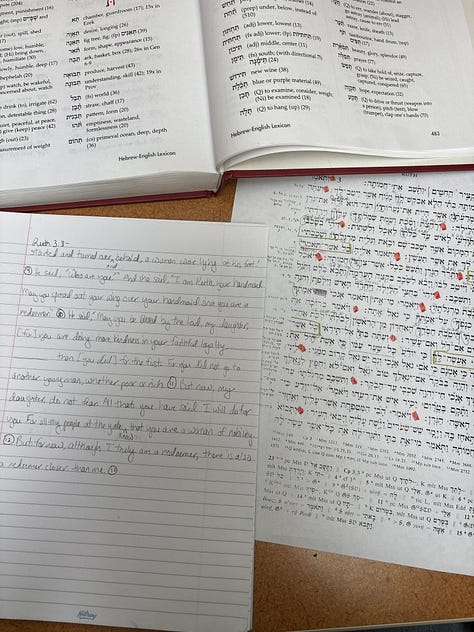
Case in point: We were translating Ruth (yes, I translated the whole book of Ruth! It was exhilarating.) and the phrase “lie down at his feet” has some sexual connotations that are stronger in the Hebrew. When you first hear Naomi tell Ruth to do this in Hebrew, you're supposed to wonder what exactly she means, how far Ruth is exposing herself. Is Ruth basically prostituting herself? But then, it becomes clear that Boaz doesn’t do any of the things he might have done to a woman who approaches him so vulnerably. He doesn't exploit her. He goes above and beyond to take care of her. His character is more powerfully depicted because of the tension of what might have been; the possibility for harm makes his actions of shelter even more striking. And sure, you can get a lot of this in the English. But it moved me to notice these details in the Hebrew; it reveals a lot about what the Torah, God’s law, is for and what God considers important. It made me delight in God's Word more, and I guess anything that helps you do that is a good thing.
Speaking of not delighting in God’s Word, though… Okay, I still delight in the book of John, but honestly, I would be happy to never preach or teach on it again. It's a beautiful thing to just read—it's poetry. But that means that when you try to break it down into something linear or logical, it loses a lot of the beauty. It gets circular and feels repetitive and redundant, and I’m sure many wiser, smarter people than me can teach it just fine but let me just say that I was overjoyed to get to Acts. Give me a narrative any day!
A bit more seriously, a surprise of this whole first year at Regent has been how much I’ve enjoyed preaching (and also how brutally hard it is to write a sermon). Two years ago, I would never have imagined “preach” and my name in the same sentence, so I’m still figuring out what that all means, where God is calling, how I am convicted about women in leadership and ministry. Pray for me if you think of it!
This really changed the game for me this term. I felt like I was going through my days failing left and right, always thinking of the things I wasn’t doing well—working out and sleeping enough and eating healthy, regular meals and praying and reading my Bible and reading my personal-interest books and keeping up with friends and family and being available for people here and laundry and cleaning and personal admin, not to mention my actual jobs of working, ministry, and studying! I was always dropping a ball and feeling terrible about it.
So then I decided to drop a ball and not feel terrible about it. Each day, I would pick a ball to drop. Then I would feel more in control and could just laugh as I watched it bounce instead of beating myself up. Usually by 9 or 10 AM I would be able to tell which ball was going to drop—like, oh, I slept a good eight hours but that means I don’t have time to work out, so that’s the ball that’s dropping today. Or, oh I had a meaningful check-in with a friend but that took up my Bible time, so that’s today’s dropped ball. (And oh yes, some days are multiple-dropped-balls days.) If I kept dropping the same ball, that was a signal that I needed a more serious overhaul of my rhythms. But otherwise, it was a way to embrace being limited, being human. I'm not going to max out of every category of my life every day. And that's OK. Enjoy watching those balls bounce, folks!
A thirteenth-century anchoress. The author of the first theological work in English by a woman. The coiner of the famous, beloved statement, “All shall be well, all shall be well, and all manner of thing shall be well.” The subject of my final research paper. My girl Julian. Reading her Revelations of Divine Love (a short book everyone should read, a perfect devotional!!) was like discovering a sister, a mother, a friend from across seven centuries. Her fears, her longings, her way of relating to Jesus, are both foreign and startlingly familiar.
I wrote about how she understood the suffering body as a portal to connection with God, in comparison with Simone Weil, the twentieth-century philosopher-theologian who essentially starved herself in solidarity with the workers she advocated for. Julian had a similarly radical posture: she prayed to receive a life-threatening disease so that she could better grasp Jesus’s suffering. And she did—she almost died and while on her deathbed received 16 visions from God that she spent the rest of her life reflecting on. All of this is so outside of my tradition and experience, and yet the God she saw and spoke with, a God both incredibly tender and close to her and also beyond her, who sometimes beautifully answered her questions and other times gently told her that some things are to remain a mystery until heaven, is a God I recognize. And most importantly, he is a God who I want to know more, after reading Julian’s book.
This winter, I switched my concentration from Biblical Studies, which has one of the most rigid course plans and would have plunged me into multiple years of Greek and Hebrew and exegesis training, to the Interdisciplinary concentration, which has the most flexible plan with electives upon electives to choose from. In some ways, I'm laughing at myself that I am surprised that this decision—my interests have always been interdisciplinary, from back when I was looking at colleges and trying to find a major that would let me embrace both the arts and the sciences. But there's this part of me that's resisting the interdisciplinary route. I wanted to prove to myself that I could be an expert, that I could go deep in one subject area. I know I could be a good textual scholar. I know I could love it. But I think what I would love more—and what is more appropriate to my interests and experiences, what I uniquely have to offer—is to draw connections across many different fields and ideas.
I think what I fear about giving up the specialist route is criticism from the specialists. But a friend encouraged me to consider the idea of academic friendship, of generosity—the specialists can give me details I won’t have time to dive into, and I can make connections they won’t have time to explore. I know that realistically I still need to have some more specific foundation from which I build connections, so that will be what I'm figuring out this next year. I hope it will still have to do with close reading of texts and exegesis, but this concentration lets me irrigate those fields with water from more sources. Maybe a better way of putting this is that I am an integrator or a synthesizer. A bridge-builder. I like the sound of that.
I have so many book reviews to update you guys on! Buckle up. I wanted to say a little thing about each one but this post is already ridiculously long so peruse the linked reviews at your pleasure and know that I’m always delighted to talk about books. :)
This Teeming Mess of Glory by Matthew Pullar | 5 stars
Julian of Norwich: A Contemplative Biography by Amy Frykholm | 5 stars
The Gods of Winter by Dana Goia | 4 stars
An Impossible Marriage by Laurie and Matt Krieg | 5 stars
The Great Divorce by C. S. Lewis | 5 stars
A Thousand Vessels: Poems by Tania Runyan | 5 stars (check out her substack!)
Holy Feast and Holy Fast: The Religious Significance of Food to Medieval Women by Caroline Walker Bynum | 5 stars
Middlemarch by Mary Ann Evans (George Eliot) | 5 stars
Rifles for Watie by Harold Keith | 4 stars
Northanger Abbey by Jane Austen | 3 stars
The Story of Pain: From Prayer to Painkillers by Joanna Bourke | 4 stars
The Dignity of Dependence by Leah Libresco Sargeant | 4.5 stars (check out her substack!)
Some of the Words Are Theirs: The Art of Writing and Living a Sermon by Austin Carty | 4 stars
The Gift of Pain by Paul Brand | 5 stars
Zero at the Bone: Fifty Entries Against Despair by Christian Wiman | 5 stars
The Covenant of Water by Abraham Verghese | 4 stars
My last Jane Austen and my first Christian Wiman and Dana Goia; two 30+ hour audiobooks; four poetry collections; two books from my personal syllabus (hint: they’re both about pain). It’s been a good first half of reading in 2026!
Friends, thank you for being here and being a witness to my life. I always love to hear how you’re doing as well. May you have summers as sweet as Pacific Northwest berries!
to staying awake—
Aberdeen
Comments
Nothing yet. Say the first thing.
Sign in to join the conversation.