
Well, folks, we knew it would happen—finals and life caught up with me, and I’m just now finding a spare moment to return to this space. I’ve missed it. Below is a pseudo-essay on something I explored in a for-real-serious-academic-essay I wrote this fall, and it’s a good window into some of what I’ve been thinking about. Fuller life update at the very end.
They do not match the beautiful words. The photos are of a body—a sculpture of a body, wax and epoxy, to be exact—and the body is not beautiful.
It is arched over a small pillowed stool. It is headless and one-armed and naked, and it is mottled with bruises. It looks like it is melting, deformed, a crude construction by a sloppy artist. My eyes keep returning to the blurred hand gripping the pillow beneath it the way you do when you’re bracing yourself against a wave of pain.
I pick it because of the arched back, the utter vulnerability of this body laid bare before the world. I pick it because it made my breath stop and my heart clench. I pick it because when I look at it, I can’t imagine that kind of pain, and because I can.
We have to pick an artwork and meditate on it all semester, interrogating it through the lenses of both art criticism and theology, pulling out the theological questions these pieces might be asking. Most art engages with theology, our professor, Jonathan Anderson, tells us. It might not match our particular theology, but it’s theology—which he defines simply as “world-in-relation-to-God.”
I tell him I wanted to study a piece that had to do with bodies and suffering. Berlinde De Bruyckere is the first artist he recommends. I scroll through Google images, half disturbed and half compelled by her fraught sculptures that are simultaneously so brutal and so tender. Then I see the graceful curve of the back of the collapsing body of Romeu, and it is 11 p.m., an hour before I need to submit my proposal, and I think, Sure. I’ll give this one a try.
(I won’t include the image in this post because it’s pretty visceral but you can see it here: Romeu by Berlinde de Bruyckere.)
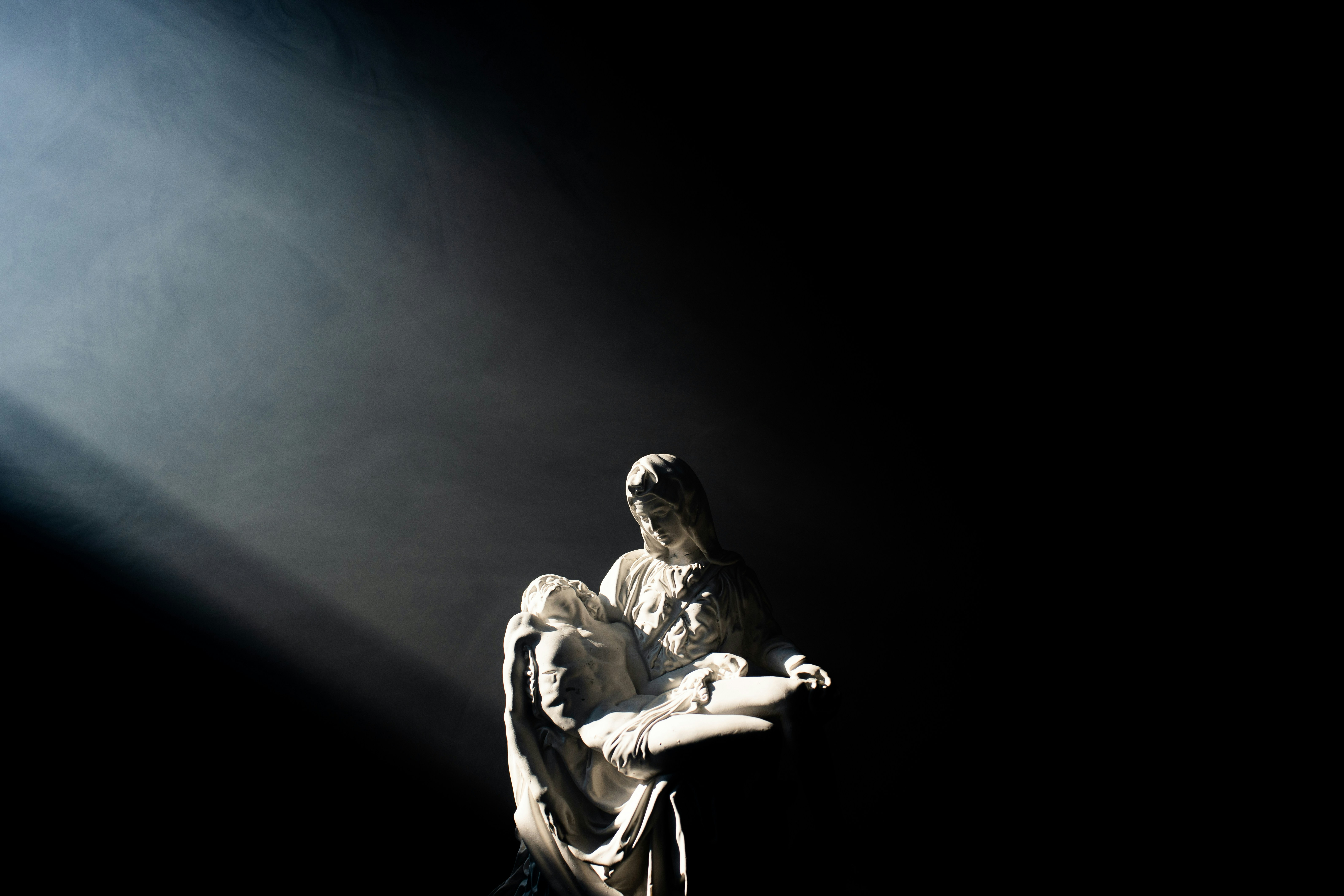
But I don’t know anything about contemporary art; my eyes haven’t been trained to see this world. So I ask Jonathan for some kind of in, for some clue to unlock the traditions she’s engaging with. He takes one look at Romeu and says, oh, it’s a pieta image. A deposition image. Christ’s body taken down from the cross, either by his followers or his mother. The one arm hanging down—it’s unmistakable.
A pieta but without Mary. Christ but without scars or halo or head. Oh, I think, this will be good.
Romeu seems to me to be a visual wrestling with a world in which time stops after the crucifixion, the frozen moment where God is dead and Easter morning is not even a dream.
Berlinde (am I allowed to call her by her first name? after staring at a photo of her artwork every day for three months, I feel like I know her) removed every feature of hope that depictions of Christ’s body typically carry, stripping her sculpture of the redemptive elements of the crucifixion or the triumph of the resurrection. This anonymous body—tied only to Christ through the curved shape it makes in space—forces us to sit with our mortality, and, more hauntingly, with God’s. On Holy Saturday, God is silent. God, it seems, has abandoned God.
I read Hans Urs Von Balthasar, the king of Holy Saturday theology, who says, “At the end of the Passion, when the Word of God is dead, the Church has no words left to say.” And I write about the horror that God has died; that he was fragile enough to die; that he was terribly, inextricably embodied; that he could not avoid the fate of all mortals; that the gamble he made seemingly failed; that death won.
I am hesitant to find any hope in this piece, wary of the impulse to push my own beliefs on it. I want to honor its agony. I want to sit in the discomfort. So the only consolation in Romeu that I feel confident in affirming is the solidarity of God with humans. I end my first paper:
He experienced human suffering to the bitter end. He did not let himself be removed from our pain. As much as we have suffered, God has too, and we as humanity have not been left alone in our mortality. … God has participated in the most human experience of all—death—and perhaps through that removes some of its horror, loneliness, agony, and senselessness.
A bare comfort. But a kind of comfort nonetheless.
And more and more I start to see not just a body laid bare to entropy and death, braced in agony, defenseless against the inevitable, cold and alone, but a body in repose. Not resignation but rest.
In my mind I start to hear the last stanza of the last of Andrew Peterson’s Good Friday songs, “Well Done, Good and Faithful”:
Our Savior cried with David's grief, "In groans I waste my breath
Thy hand has brought me down beneath the bitter dust of death"
And then he gave his spirit up to trust it in Your hand
His dying flesh reposed in hope, to rise at Your command
His dying flesh reposed in hope …
This piece first caught my eye because it seemed to be telling a story stronger than defeat, and no matter how much you celebrate life and fight to accept mortality, if death is the end, then it is defeat.
But wait, I caution myself, wait. Are you seeing only what you want to see?
Then I get feedback on my first paper, and Jonathan says to push harder into what differentiates the pieta image. If Berlinde was interested only in God’s death, why not just use a crucifix? What’s unique about the pieta?
And that unlocks everything else.
Christ’s body is draped in such a way because her arms are holding him. And if the death of God is the second singularity in Christian metaphysics, then the presence of Christ’s very human mother pushes every pieta image to reckon with the first: the incarnation.
In one body, God meets man, divine and human, and somehow instead of annihilating each other or vying for dominance, these two incomprehensibly different natures exist. Equal. Side by side. Impossible. And our only hope.
Suddenly I’m not just reading Von Balthasar but also Athanasius, the fourth-century saint who defended this doctrine in his slim, smoking treatise On the Incarnation. I hate even using the word “doctrine” to talk about the incarnation because it sterilizes what’s really going on. Frederick Buechner says it best:
The Word became flesh. Ultimate Mystery born with a skull you could crush one-handed. Incarnation. It is not tame. It is not beautiful. It is uninhabitable terror. It is unthinkable darkness riven with unbearable light. Agonized laboring led to it, vast upheavals of intergalactic space, time split apart, a wrenching and tearing of the very sinews of reality itself. You can only cover your eyes and shudder before it, before this: “God of God, Light of Light, very God of very God… who for us and for our salvation,” as the Nicene Creed puts it, “came down from heaven.”
Came down. Only then do we dare uncover our eyes and see what we can see. It is the Resurrection and the Life she holds in her arms. It is the bitterness of death he takes at her breast.
The thing about the incarnation, I realize, is that it is inescapably hopeful. This is no rug-swept, rose-lensed wishful thinking. The incarnation is aimed at death. The death of God, this existential horror, is the whole point. Because only through God dying does death die. So yes, Holy Saturday is a moment where love and life freeze like an Alaskan lake—but there are always cracks spreading along the ice, the pressure is becoming unbearable, the fresh and living water underneath is building to the breaking point. A glacier is about to fall.
If this body is echoing pieta images, then it carries with it—whether intentionally or not—the incarnation and therefore it sews into the seams of Holy Saturday the thread of hope.
And it’s not just hope that Christ will rise again, I realize, but hope that our bodies will too. The genius of how Berlinde strips this body of explicit religious imagery is that it lets us enter through our own experiences first.
I look at this body, and at first all I see is my own. My frailty. My fear. How close I live to the edge of non-existence. How easily broken I am.
Only later do I notice the arch of the back and think of Christ’s body. For those who flinch from Christian images because of deep religious wounds, this is a grace—the opportunity to feel seen first, before being asked to see a God they’re not sure they can trust. Perhaps this slow revelation will open them to the possibility of resurrection hope in a way that a blatantly Christian piece would not.
I notice, too, that the contradictions buzzing through this piece, especially the tension between it being Christ’s body and not Christs’ body, are the whole point of the incarnation. The incarnation is the idea that Christ is us and not us—and therein is all our hope. Because he is human, he can suffer a human death. Because he is God, the death does not end him.
The last two pieces of the puzzles for me are the name Romeu and the absence of Mary. Can I really lean into this pieta image theme if Mary is not even in the sculpture, just the suggestion of her? Her absence looms larger over the piece than any full-size depiction of her. This body is not cradled by a mother; it lies alone.
And yet, it is held. Berlinde says this about the collection in which the piece first appears:
What religion should do is give you some comfort and hope, and help with your anger and fears. This is exactly what blankets do. Much more than a material, they are objects—objects that are very close to our skin and to our life, particularly our intimate life, since everything begins on the bed.
This body doesn’t lie on the floor or a bare stool. There’s a pillow, and the figure seems to clutch it. It’s the faintest whisper of hope and comfort, but it’s there.
Next I wonder about the name, Romeu. It’s after the model Berlinde often works with, Portuguese dancer Romeu Runa. Why name it after such a specific person when the rest of it is so anonymous, stripped of any identifying features? What hath a pieta image to do with a dancer?
Then I find one more quote. Berlinde, who grew up in a strict Catholic boarding school and no longer professes faith but regularly uses biblical imagery in her artwork, has another gripping sculpture called to Zubaran. This one is of a foal, bound after the fashion of Spanish master Zubaran’s lamb in Agnus Dei. The foal looks dead, a crushed victim. But Berlinde says:
“It’s not that I am only interested in the dead horse. I am trying to talk about something living. For me, this horse—it’s like a moment that I have frozen. For me, this horse is not dead. If you see the power in his belly, for me, it’s like he still can start breathing again.”
I am trying to talk about something living.
I look at Romeu’s elusive muscles, the feet barely brushing the floor. I imagine them straightening and pressing against it in a burst of vigor. I picture the arm stretching to the sky and color flooding the skin. The potential is all there, humming beneath the surface.
If you see the power in his belly, for me, it’s like he still can start breathing again.
And I don’t think I’m pushing the possibility of hope too far when I think of the man this piece is named after, gathering himself to move in majestic and sinuous grace in a dance that is very much alive.
The final shift of the night watch. We have been waiting, waiting. With Isaiah, we whisper, “In our sins we have been a long time, and shall we be saved?”
For us the incarnation is a historic reality and yet we all press our hands to our chests to feel the thin thump of our fragile hearts, and we wonder if we have been duped. Sometimes the surest thing seems to be that we will end up splayed open to a cruel world, decaying and un-held.
So I end my paper the way we find ourselves ending Advent. I don’t think Berlinde is willing to affirm the certainty of resurrection. This is not a declaration of hope. She is no town crier with a message that death itself has died. It is instead, I write, a holy maybe. She puts her foot in the door of the question, Can these bodies of death be saved? Even mine? She doesn’t cross the threshold of hope but she lets the door swing gently ajar.
If we want to enter, we can.
Well, friends, kudos to you for reading that whole thing (and no judgment whatsoever if you didn’t.) Somehow I’m here, at the end of my first term of grad school, and I am dizzy with gratitude. There have been so many confirmations that this is where I’m supposed to be—Vancouver, Regent, various ministry things—and I don’t take that lightly. You don’t always get those kinds of confirmations.
I wrote in my journal three weeks after my move:
Oh, God, I didn’t think it would be this hard. This feels like a death. Uprooting—so violent, the tearing up of yourself from good soil, a great gaping hole in the ground and the terrible wind against your thin bare roots. I will be replanted in gardens so good I cannot imagine. But right now the uprooting feels like free fall.
I whisper to you, I am so afraid. And you say, I know, I know.
And you say, I have made you brave.
I have begun to see some of those gardens, and I still hear a voice behind me saying, be brave, be brave.
I’m excited to work on some more personal writing over break, and I’m extra excited for my favorite post of the year where I recap what I’ve read. Stay tuned for all that, and as always, thank you for being here.
May the hope of the incarnation be inescapable, may it hunt you down, may it hold and shield you, especially if your Christmas is distinctly un-merry. Much love to you all.
~ Aberdeen
Comments
Nothing yet. Say the first thing.
Sign in to join the conversation.