

Dr. Eric Kim is an Assistant Professor of Psychology at the University of British Columbia (UBC) and a Research Affiliate at Harvard’s Human Flourishing Program and Lee Kum Sheung Center for Health and Happiness. His research aims to identify, understand, and intervene upon the dimensions of psychological well-being (e.g., sense of purpose in life, optimism) and social connection that promote healthy aging.
Sarah: First question: an alien lands and says: Who are you? How do you introduce yourself to an alien?
Professor Kim: My name is Eric, and I am very interested in different aspects of psychological wellbeing, with purpose in life being the main factor I have been studying, and looking at how purpose influences our health outcomes. I'm also really interested in older adults. Personally, I started dancing two years ago, and I really enjoy that. I’ve been learning about the somatic way, instead of just intellectualizing everything. And I enjoy the outdoors too!
Sarah: Lovely. What kind of dancing would you do with the alien?
Professor Kim: It’s called five rhythms!
Sarah: I love five rhythms. It’s such a great way to practice being in our bodies. I actually first learned about it at a wellbeing retreat. I’m really curious to hear how wellbeing became such an area of interest? Why study and spend so much of your career on wellbeing, and purpose in particular?
Professor Kim: There are two reasons. One is external and one is internal. The external reason is that I did notice that when people are retiring so many couldn't find their spark again, and then their health was declining. At the time, people didn't really look at this statistically. I thought that was interesting to look at, and we found that purpose was associated with so many different health outcomes. Personally, growing up, I had a very difficult childhood. So, I struggled a lot with mental health issues. Purpose was something that I was lacking in my own life. So I wanted to study it and see how it can be developed, and what kinds of outcomes it has.
Sarah: Thank you for sharing. What helped you discover purpose? What kinds of things did you find useful in your own life?
Professor Kim: In my own life, figuring out what my own personal values were instead of my parents’ values or my culture’s values, and then exploring my values and experimenting with different activities to see what actually flourished in my own life.
Sarah: I'm curious about how your understanding of flourishing has evolved over time as you've learned more and done more studies. Have there been shifts in your own thinking about what flourishing is?
Professor Kim: I think the field has evolved over time. Happiness has often been associated with hedonic things. Over time, I came to deeply appreciate much more the impact of relationships and also what is called eudaemonic wellbeing — things like purpose, personal growth, and self-acceptance. I’ve also come to appreciate the spiritual side of wellbeing. That doesn’t have to mean religion necessarily, but it certainly can. To me it can mean any type of thing that helps people get in touch with the spirit, and also transcend and connect with something larger than themselves. These are some of the main evolutions in our understanding of wellbeing. In the hedonic type of happiness, that could mean just go off to Las Vegas, which might bring pleasure, but is probably not sustainable or fulfilling in the long run.
Sarah: That really mirrors our own team’s journey into the world of wellbeing. Our teams spend a lot of time in communities listening to folks who are marginalized. We’ve often found that we learn the most about wellbeing from the people who lack material goods. Over four years of research with people living rough in Edmonton, we developed a wellbeing framework. At the heart of it are connections: connection to spirit, to ground, to friends, family & community, to purpose, to culture. It’s been interesting to play back the framework to policymakers, who often assume that material things are the primary outcome, rather than seeing them as enablers of connection.
Professor Kim: Wow, that's fascinating. How did you come about your own work? It's really wonderful what you're doing.
Sarah: Well, my initial background was in public health and anti-tobacco work. That was when I was a teenager. I went to university, and had a bit of a reckoning. I started to learn that the absence of bad stuff doesn’t equal good stuff. So you can avoid tobacco or alcohol, but that doesn’t mean you will feel like your life is going well. And so I spent a lot of time thinking about the difference between policies that are about reducing risk versus enabling a sense of purpose or connectedness. That’s how I ended up in the social policy world, rather than public health, and wondering about how we create the conditions for people to be well. By happenstance, as I was doing my PhD in social policy, I found a group of designers in London who were thinking about how to design interventions from a different perspective — starting with what mattered to people. That’s led me on a bit of a journey for the last 15+ years to build teams that mix design methods with social science theory to find new ways to influence wellbeing.
Professor Kim: Wow, wonderful. The design part is fascinating too, and sounds aligned with the work of IDEO that has done a lot of work on social change and design thinking.
Sarah: Yes! There are a lot of parallels to the work of IDEO and what we do. And, over time, we’ve seen some of the limitations of design consultancies — one of which is around implementation: moving from ideas and experiments into actual, every day practice. Another can be around the outcomes: whether it’s the paying client or people who set them, which maybe brings us back to thinking about this outcome wellbeing and what it means. We’ve been using the language of flourishing and wellbeing synonymously. Are they the same?
Professor Kim: Yes, in academia, it’s become a little political what language we use. I am using the language of flourishing right now because it's multi-dimensional, and it goes beyond happiness. But, what goes into flourishing is a hotly debated topic right now, and I’m glad scientists and society is having these kinds of discussions.
Sarah: You are involved in this big study on flourishing that is happening with 200,000 folks across 22 countries. I’d love to hear more about your involvement in the work, and how you come up with an instrument to measure flourishing.
Professor Kim: Yes, this project started six years ago. At the time, a lot of psychological wellbeing research was being done in WEIRD societies (Western, Educated, Industrialized, Rich, and Democratic). So we really wanted to look at a broader spectrum of countries and also longitudinally so that we could get a better understanding of causality. The lead of the study, Tyler VanderWeele, did a deep literature review and looked at, with philosophers and folk from other disciplines, different aspects that people say make up a flourishing life. They included social relationships, purpose, and meaning, mental and physical health, happiness and life satisfaction. They also included pro-social giving and financial wellbeing. And what we actually see is that our findings and those of the World Happiness Report do not line up particularly well. They did an incredible job of helping people recognize the importance of happiness and well-being and I’m in awe of how they have been able to help advance these kinds of conversations in all kinds of sectors of society. However, there’s more to flourishing than just happiness.
What we have potentially observed is that the way the World Happiness Report measures things is with the Cantril Ladder, and that tool actually primes people to think about power and status.
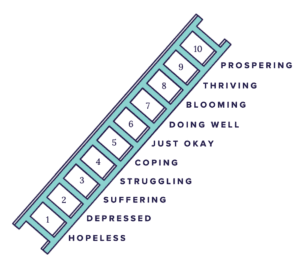
So when we have a tool that looks at other factors, like purpose and relationships, the rankings break down. The Nordic countries which are high in the World Happiness Report don’t fare as well. So it might mean that we shouldn't always look to the Nordic countries to emulate what they are doing — maybe we should look at countries like Indonesia, which did particularly well on many measures of flourishing. That is a much newer idea to the world. We are excited about it because of what we have noticed in our own lives. When we talk to lots of people in some of the “happiest countries” they are not doing well in many, many indicators.
Sarah: I love how the research turns what have been fairly simplistic narratives about who is happy and why on its head. Could we talk about some of the indicators that I know are quite important in your research. In particular, I’d like to talk about meaning & purpose. How do you define and measure it?
Professor Kim: There is the tripartite meaning model. It’s actually fascinating — two groups of researchers published papers at the same time after doing a deep review of the literature, and they found a lot of agreement in the underlying construct. In order to have a meaningful life, there are three pillars: (1) purpose, which is having sense of direction that is anchored in values (2) comprehension: do I have a philosophy of life that helps make sense of the world around me, as well as the world inside of myself? (3) sense of significance: do I think what I am doing is important to other people? Do I matter within a broader context?
Sarah: Those are meaty elements to meaning & purpose. I am curious about the ways in which you enable people to reflect on them? They are hard questions to say ‘yes’ or ’no’ too. How have you found trying to measure these things in different kinds of population groups?
Professor Kim: Yes, it is difficult. When you ask people whether they have purpose, lots of people think they do not. When we are able to discuss more, we find many people definitely do have a purpose — whether it’s family or a religion, or sometimes, even if its just survival. I remember talking to someone who was suffering domestic abuse, and just getting out of that situation was their purpose. So unfortunately the measures don't always tap in correctly to people's purposes in a deep way. We have noticed that, and are working on different items to help people reflect this. I would say our measures are imperfect right now.
Sarah: Yes, that is why I’ve become a little more skeptical over the years of survey methodologies, especially working with folks with developmental disabilities or for whom English isn’t a first language. When you are trying to learn about something that is as juicy and meaty as purpose, it feels like you often need to have a conversation to unpack it, first. Of course, there is value in having standardized measures so that you can aggregate and compare data, but it feels like a lot gets lost.
On your website, you talk a lot about evidence and scaling up interventions. Do you find there is a tension between what it takes to have meaningful or quality data and what it takes to have a lot of quantitive data?
Professor Kim: That's something I'm struggling with right now because I have been a super quantitative person, but I’ve been evolving personally as well, and wondering about the qualitative and quantitative. You’ve thought a lot more about it, actually! So this is something I'm thinking about too.
Sarah: We struggle too! I’d love to invite you to come to our studio space and see some things we’ve tried. Policymakers have a great desire for quantitative data, and we are always trying to figure out how to talk about what the quantitive data can and cannot tell us. From your perspective, what do you think the quantitative data can’t really tell us at the moment?
Professor Kim: I think wellbeing assessments are not particularly good right now at capturing different types of suffering. I told you that I witnessed the Lapu-Lapu tragedy in Vancouver, and so I started thinking about what we didn’t know about the driver … Other things that are hard to measure are personal growth and self-acceptance.
Sarah: Let’s just take a moment to pause. I want to acknowledge that incredibly difficult experience.
Professor Kim: I’d like to ask you the same question. What do you find hard to measure?
Sarah: Similar things! One of the top values that comes up in our ethnographies is sense of control. People who are marginalized often feel they don’t have a lot of control over the things that are happening, or perhaps they are exercising control over things that professionals and policymakers don’t see as important. Getting nuanced about the types of control people have or want, or feel they lack, is hard to do — and gets at broader perspectives about what any of us have control over.
In these hard times, the question of control feels even harder to grasp. When you look at the research and discourse at the moment, I wonder where you see some bright spots?
Professor Kim: I think people are more open to the idea of flourishing and wellbeing, especially after the pandemic, because during that time many people were forced to confront what mattered most to them and others, and also reflect deeply on different aspects of life. And I think that broke people open quite a bit. That’s been a bright spot, and another is the concept of social health. I think broadening our idea of health has been really needed, and I am so glad that multiple organizations at different levels are taking it up.
Sarah: Is there a favourite intervention you have been part of designing?
Professor Kim: Yes, the last US Surgeon General was going around the country and talking with people about isolation and loneliness, and meaning & purpose kept coming up organically with people. So then I had a chance to help with the final report, with the parting prescription! With the election, our timeline was super abbreviated, but that was really nice to work on — and the idea of government support to spread conversations about meaning & purpose.
Sarah: I am also interesting in some of the work you’ve been doing lately on loneliness amongst adolescents. You concluded that paper talking about the need to test more scalable interventions. What would you like to see tested?
Professor Kim: I think school spaces are not used maximally on the weekends and other times as well. I’d like to see us open those spaces up and resource them to engage people.
Sarah: One thing we keep learning as we design interventions is that the impact often comes from designing the intervention, not just participating in it. Being part of research can give people a sense of meaning & purpose. But, in some ways, having people participate n designing interventions flies in the face of highly scalable interventions. What’s your thinking around that?
Professor Kim: I totally agree with that. Being part of research, having agency and having a voice, getting put into the mix and seeing your ideas implemented, and being appreciated for helping with it, I’ve seen how that can make a difference. I totally believe it.
I would love to see interventions have modular components — say 20 modules created by speaking with people from all kinds of backgrounds. And that when an intervention is scaled out, local communities can choose a module that best fits with their local values & customs, and go from there. I don’t think cookie cutter interventions are all that great. I haven’t seen examples of modularized interventions in this way. I think a big hesitation has been how do analyze these kinds of things. But there is a new analytical model coming from Penn State that can help us analyze the effects of these kinds of things. I am very excited about it.
Sarah: Obviously things have changed in the US since you worked with the last Surgeon General. Where are you seeing some traction with flourishing at a policy level?
Professor Kim: I also don’t know if this is current. But at one point when New Zealand was considering a highway, they were thinking about how it affected people’s wellbeing. They did a wellbeing analysis, rather than just a costing analysis. I know Ireland was thinking about similar things… Even in Canada, they [the Census] is measuring things like purpose, so that data is being tracked at least. Also, Statistics Canada's put out new Quality-of-Life Framework.
Sarah: Can you tell us about some of the research you are currently doing?
Professor Kim: We are continuing to look at how purpose is associated with different outcomes across different cultures. We're using the same data set of 22 countries and looking at something like 50 outcomes, and seeing how purpose and meaning are associated with different outcomes across cultures. And I'm really interested because, for example, with depression, it can show up psychologically or somatically or as social withdrawal, depending on the culture. And so I am wondering if purpose is showing up in different ways in different cultures. And so I am wondering if purpose is showing up in different ways in different cultures. I'm also interested in the topic of social wellbeing, and that’s something I’m spending quite a bit of time on with collaborators.
Sarah: Thank you so much for taking the time to talk, Eric. I look forward to continuing to learn more from each other!

Comments
Nothing yet. Say the first thing.
Sign in to join the conversation.