
Scroll down to read this month’s Spores & Sparks interview with jazz pianist, cognitive psychologist, and creativity researcher Dr. Keith Sawyer. Then, join us Thursday, November 6th from 2:30-3:30pm PST on this zoom link to unleash our inner improvisational selves.

So many of us dislike uncertainty. We want to know where we are going and how we will get there. I am that person who reads the last chapter of a good novel, first. I just have to know what will happen! And yet, try as we might, in real life, we cannot flip to our last chapter first. Getting through life requires constant zigzagging - or iteration. And that means, whether we recognize it or not, all of us are creatives. Creativity is the act of starting somewhere, taking steps forward and back, and making our way from one idea to the next. So how do we debunk unhelpful creativity myths, tap into our inherent creative sensibilities, and create new possibilities, together?
These questions brought me to Dr. Keith Sawyer, whose latest book, Learning to See, rigorously examines how art and design professors teach creativity. Over the past decade, our team has been experimenting with how to teach and nurture creativity within human services. We still have lots to learn!
A leading scientific expert on creativity, Dr. R. Keith Sawyer is the Morgan Distinguished Professor in Educational Innovations at the University of North Carolina in Chapel Hill. His 2025 book Learning to See: Inside the World’s Leading Art and Design Schools is a groundbreaking account of how nationally known artists and designers teach in the world’s top art BFA and MFA programs. His 2024 book Explaining Creativity: The Science of Human Innovation, known as “the creativity bible,” provides you with more creativity research than any other book available! His 2013 book Zig Zag identifies the 8 stages of the creative process, and contains over 100 techniques to enhance your personal creativity.
Sarah: Keith, I’ve been asking all of our interviewees the same introductory question. An alien lands next to you and says, ‘Who are you?’ How do you describe yourself to this alien?
Dr. Sawyer: I’m a human being, and I live on the planet Earth. I’m a white male. I live in the United States. I have this thing called a job that I need to make money and pay for food. But, the job I do to make money and buy food is something I really love doing. I get in the flow state. I live the dream. I would say that if you do what you love and make money doing it, then you’re one of the lucky ones because many people are not able to do that.
Sarah: What do you love?
Dr. Sawyer: I’m a creativity researcher. So my whole life is creativity. My creative outlets are music, writing, research, and scholarship. I get to think about creativity all the time, which takes me everywhere. Creativity is everyday life. Creativity is science. Creativity is jazz improvisation, which is how I got into this research in the first place. I’m a jazz pianist. More recently, I’ve been studying artistic creativity and design creativity. I’m a cognitive psychologist so it’s about what goes on in the mind when people are being creative.
Sarah: What do you think are the questions we haven’t asked about creativity that your research tries to get to?
Dr. Swayer: I’ve been collecting powerful stories from artists and designers, and I feel like these stories haven’t been told. I’m talking to them about how they teach others to create the way they do. This has been my past 15 years of research. I’ve been interviewing professional artists and designers who are very successful, but they also teach in BFA and MFA programs. What you get from talking to people who teach other people how to be artists and designers is that they have reflected on it more than most people. They’ve been able to put language to it and develop practices and exercises that other people can do. By doing that, they gradually learn how to engage in creative practice. If you are a professional artist and you’re really good at it, how would you help someone else to be like you? You can’t lecture them. You can’t tell them how to do it. So what do you do? And I don’t think that story has been told, which is why I wrote my most recent book, Learning to See.
Sarah: What do you think we need to learn to see?
Dr. Sawyer: I interviewed over 100 people in 20 different creative fields from architecture to typeface design to advertising to fine art to painting. Part of it is learning to see yourself; it’s learning to see action, expression, and behaviour. It’s also learning to see visually. You see the world in a different way. There are some basic principles that most artists will talk about: learning how to see space and the space in-between things, learning how to see visual balance and coherence, and how to see colours. So you start to notice things that most people don’t notice because they haven’t learned to see the world in this way. At a basic level, it’s about how to see things visually, and then at a deeper level, it’s about how to see your own practice.
Sarah: I’m curious about what you learned to see along the way of writing the book, or even how your own insights changed from beginning to end of the project?
Dr. Sawyer: I went through a lot of change as I was working on the book, and it took two more years than I thought it was going to! In 2010 I started doing interviews, and then I used rigorous methodologies to analyze those interviews and videotapes. I started submitting academic journal articles and had some success getting published in the top journals. That’s when I thought about putting it together as a book. I was working on an academic book, with all of the methods and theoretical frameworks. And it wasn’t working. I realized that the stories were so much more compelling than the academic stuff. And every time I went from a story into the analysis of what they’re talking about, all the air and energy would leave. It took me a while to realize that I needed to leave out all the academic stuff and just let these people tell their stories. It took a long time. I had to let it emerge from everything I had. So for me, it really was a process of iteration.
Sarah: Let’s get into that word, iteration! For folks who aren’t from the art and design world and maybe aren’t familiar with that concept, how would you describe it? And why is it important?
Dr. Sawyer: I’ll start with what it’s not. There’s a mythical view of creativity as going from idea to realization. So creativity as having a great idea and then executing the idea such that what you have at the end is basically the idea that you had at the beginning. That’s the linear view of creativity. And it’s not how it happens for real artists and designers. It’s not a linear process.
The artists I talked to say things like: if you end up in the place you started, there’s something wrong! You haven’t learned anything along the way, and there’s been nothing that surprises you.
So people who are exceptional creators, who do creativity for a living, don’t know where they are going to end up when they start. They learn how to get more comfortable with that, even to welcome that. You try something, and maybe it will work out, and maybe it won’t work out, but whatever you try will be a small step. It won’t be the big whole thing.
Creating is a practice of having small ideas, and then those ideas lead to the next ideas, and it’s a zigzagging path. You often go back and revisit ideas you had a week or two ago because something that happened this week makes that older idea resonate differently. So for me, that’s the iteration. It’s a wandering path. It doesn’t mean you’re doing the same thing over and over. You are evolving.

Sarah: Where do you think this myth of creativity as linear comes from? Who does that myth serve?
Dr. Sawyer: It’s very closely tied to the myth of insight and to the myth of solitary genius. I think they go closely together. Why is it that we keep believing these myths? Here’s a couple of hypotheses. One is the real work of creativity can be boring. It’s just hard work. You get up in the morning and you go into your studio. Maybe you have a small idea, maybe you don’t, and you come back the next day, maybe you have two ideas that day. You don’t know where you’re going. Two months later, something comes out and it’s very hard to tell that story. We could be talking about the cognitive psychology of how we represent narrative in the mind. So the narrative of creativity as being linear has the structure of a hero’s journey. You are lost and then you are found.
Sarah: You are suggesting our brains have this need to narrativize things, and we leave out maybe a lot of the messy middle?
Dr. Sawyer: Yes. How do you tell a story about iteration? In my books I am trying to talk about real world creativity, like how Pixar generates their movies, which is very much through iteration and improvisation. Even the origin story of Facebook or Instagram are stories of iteration and improvisation. But the public story that is told is that one person had a big idea, and then went off and got some venture capital, and now they’re a billionaire. When you scratch beneath the lone genius myth, you always see all of this iteration and improvisation. I have to work to make those stories interesting too. Because it can get too granular, but you need to go beneath the linear view to get at the truth of what’s really going on.
Sarah: You are using the word improvisation alongside iteration. What do you see as the relationship between these two words? Are they the same or distinct in some way?
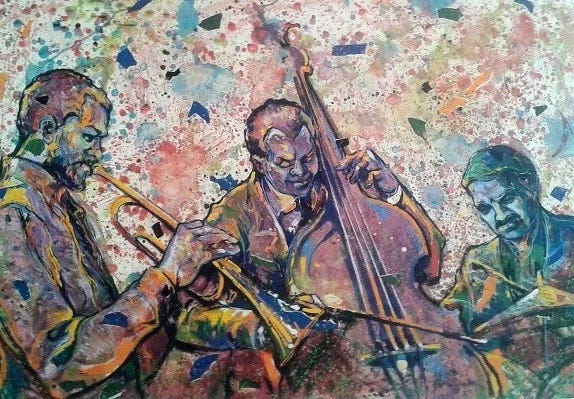
Dr. Sawyer: Yes, I think everything is improvisation, all human action. It started with my own experience as a jazz pianist, which is fundamentally an improvisational art form. For the first half of my career, I was primarily interested in group improvisation. That’s when you are improvising, and others around you are too, and you have to respond. You have to listen and respond when you’re not fully in control. And that’s the whole point of ensemble. Creativity comes from being inspired by others. You want to get ideas from them. You don’t know where it’s going, and it wanders. There’s uncertainty and there’s ambiguity, and that creates the space to come up with a range of different possibilities that no one knows ahead of time. You don’t know ahead of time what you’re going to do, and then when you do it, you often don’t know what you’ve done. This is pure improvisation. You do it, you don’t know what you’ve done, and you don’t know what it means until a few seconds or minutes later, as the interaction unfolds further. There’s a great quote from Miles Davis, the jazz trumpeter. He said that when you play a note you don’t know if it’s a mistake until you play the next note. The next note determines what it is that you were actually doing.

Sarah: I love that. That opens up a question that our team faces all the time about how to measure the value of action. If you don’t have linearity, how do you measure what you are doing? If things are constantly changing, what do you measure against? What are the metrics of success in an improvisational and iterative context?
Dr. Sawyer: I think a lot of creativity in science and engineering is also iterative and improvisational. When you scratch beneath the surface of the discovery of a new pharmaceutical or the theory of relativity, every one of these stories turns out to be one of iteration and improvisation. So it’s not only in the arts. Just because you are evaluating and assessing doesn’t mean that iteration and improvisation is not involved. I am not opposed to quantitative metrics if they are being used, in certain contexts, to improve a process. But, it’s about the time and place for process improvement, and the time and place for creativity. They are different. I would not say everything that everyone does forever has to always be iterative and improvisational. Sometimes you really do need to make something be more efficient and cost less. But, that’s not what I study!
Sarah: One of our lessons is that if you are work in the human services space, it may always and forever need to be iterative and improvisational. Because humans are always changing. They are not widgets in a factory! So I wonder what you think it looks like to hone our creativity outside of art and design spaces?
Dr. Sawyer: That seems like it’s a question about organizational design. Whether you are in a nonprofit or for profit, every organization has to balance getting the work done, which often is not creative. You’ve got to make a certain number of products to get out the door. You need to improve your products. So often the business of work means there is not any time left for creativity or innovation. But if you don’t put some portion of the resources of the organization, including time and people towards this improvisational process of discovery that I would call creativity, you won’t be able to stay relevant. From the research, it seems that you need between 5% and 20% of organizational resources going towards creativity and innovation.
Sarah: One of the things I found most interesting about your book ‘Learning to See’ is how professors and teachers hone their students’ creative mindsets and practices. I really wish that kind of teaching was prevalent across all disciplines, not just for artists and designers.
Dr. Sawyer: Right? I don’t know if I want to call it pure, but the process of these artists and designers is that they are 100% about creativity and innovation and 0% of producing widgets for the factory. That said, when you study jazz ensembles and improvisational theater groups, there’s always some structure guiding the process. Even if you start an improvisation without any ideas and without any script, after a few minutes some structures have emerged and they start to guide what you do. Some possibilities are shut down, and other things are enabled by those emergent structures.
All social action and all creativity takes place within guiding structures.
I think that’s true for the artists and designers that I’ve talked to. They would say they create structures and constraints for themselves because it enhances creativity. Teachers say that constraints are important to help people learn how to be creative. One of my nine chapters is called constraints, in fact. It’s surprising to a lot of people who might think that the way to teach creativity is to remove all the constraints, right? That is absolutely not what I see anywhere. There’s a whole lot of structure and constraints and parameters.
Sarah: Is there a particular practice that you learned about through your research that you think non-designers and artists could incorporate into their repertoires?
Dr. Sawyer: I think there’s a real power to this idea of starting without knowing where you’re going, and then being receptive to what emerges from the process. And that gets back to what I said at the beginning of our interview about learning to see what is emerging from your efforts. If you can’t see what’s emerging from your work then that power is lost. So you need a certain kind of awareness of yourself and what you’re doing, even though you don’t know what’s going to happen and surprising things emerge, you need to be able to recognize what has emerged and and notice which things are promising and have potential.
Sarah: How do you think you get comfortable with that level of emergence and ambiguity?
Dr. Sawyer: It’s really hard. Ambiguity is frightening. It’s terrifying even for people who are artists and designers, especially the new and upcoming ones who might have the technical skills, they submitted a portfolio to get into art school, but they are terrified by not knowing what to do. I think that’s one of the benefits of having a guide, a mentor, a professor there to help you through that. I guess I haven’t given you the answer yet. There is not an easy answer. Part of it is learning to trust that the process will lead to the emergence of something good, or at least to the next thing.
Sarah: Can I ask you personally have gotten more comfortable with ambiguity and emergence over time?
Dr. Sawyer: I think I’ve always been OK with it in some ways. When I think back to my PhD program in the 1990s, my dissertation emerged accidentally. Maybe I’ll connect it to this concept of flow, or peak experience. When you’re in this state of peak experience, I think you can trust it will lead somewhere and you’re more able to face that ambiguity. It’s helped that I’ve always worked in spaces where I just loved what I was doing.
Sarah: For those not familiar with flow, maybe give us just a quick synopsis of the concept and how it relates?
Dr. Sawyer: Flow, or optimal or peak experience, is a concept developed by a Hungarian professor, Mihaly Csikszentmihalyi. He wrote a book called Flow. In my dissertation, I studied group improvisation or what I called group flow. It’s a peak state of experience where you lose track of time, you have absolute concentration, but it’s effortless concentration. At the core is that you engage in the activity for the activity itself, not for what you’re going to get out of the activity, and not for the place you’re going to. So you could say it’s living in the moment — but it’s not the same thing as joy and happiness.
Mihaly started his book by asking: What is peak experience? Is it having fun? Is it being happy? What is a good life? Is a good life being able to sit on the beach, watch TV anytime you want, and have all the money you want? And he said no. Going back hundreds of years, the great philosophers and wise men and women said that is not the essence of a good life. It is something more intense, deep, and profound. Mihaly studied this using empirical methods, and what he found was you get in peak experience when you engage in an activity where the skills you have available are perfectly balanced with the challenge of the task. Your skills match the challenge. If your skills are greater than the challenge you’re facing, then it’s too easy and it’s just boring. If the challenge is then the skills you have available, then you get anxious and frustrated. It’s a very fine line.
This is at the heart of living a good life: being able to guide yourself through that tension between boredom and anxiety, and finding peak experience or flow.
Sarah: What’s the relationship between flow and creativity?
Dr. Sawyer: There’s a lot of research showing that when people are in the flow state, they are more creative. And by research, I mean, a lot of it is historical. It’s biographical. When you talk to people about where their good ideas come from, they will often describe this flow state in terms of losing track of time and effortless concentration — that tends to be when good ideas emerge. A more technical term for flow is intrinsic motivation. So what is your motivation for engaging in a task? A lot of us are motivated by what we’re going to get out of it, like money or fame. That is called extrinsic motivation. There is lots of research contrasting extrinsic and intrinsic motivation. A solid finding is that being extrinsically motivated interferes with creativity, while intrinsic motivation enhances creativity.
Sarah: These are concepts we use in our work, and it’s helpful to hear you describe them so succinctly. In our prototypes we ask: how do we create the conditions for intrinsic motivation, particularly for folks that are have been marginalized and haven’t had the opportunity to try new things, express themselves, or find their passions?
Dr. Sawyer: It’s very hard when survival is at stake and you’re just trying to get by. Flow theory comes from scientists in the first world. But, it does go back to the wisdom of the ancients as well: you don’t have to be affluent and rich to approach life in this way.
Sarah: You mentioned that your own research looks at group flow, and I’m curious what you’ve learned are the conditions for group creativity?
Dr. Sawyer: That’s when improvisation becomes essential. No one person is in charge and no one person is in control of the process. Everybody participates equally. An idea emerges from the collective. I call it group genius.
I wrote a book on the power of group improvisation. I call it group genius because the group collectively develops an idea. Groups can have peak experience. So that’s the parallel with individual flow. It’s the psychology of optimal experience. So you want groups that have the peak group experience. That absolutely happens in improvisational theater and in jazz improvisation, which comes from close listening where you have to be incredibly attentive to the things that people are doing around you and then be able to respond, maybe not effortlessly, but to respond to the essence of what the other people are doing and not responding as filtered through what you already thought you wanted to do. You are truly listening and responding to that action.
Sarah: That makes so much sense. We draw on improvisational techniques in our team. We can see when people are attuned to each other, listening and responding to one another, rather than trying to come up with the answer themselves. People really feel like they need to know the answer.
Dr. Sawyer: What have you found works?
Sarah: Acknowledging people’s anxiety and removing the sense that the stakes are high. We try to permission that it’s okay to be silly and to not know the answer.
Dr. Sawyer: It’s hard at first when you haven’t learned to trust the process.
Sarah: That’s right. It’s an especially tricky thing for folks who don’t have many reference points and haven’t seen processes play out. That takes us to another question: what do you think people in positions of leadership or management might learn from artists and designers?
Dr. Sawyer: It’s the idea of relinquishing control, or at least relinquishing some control, and enabling the best to come out of your people. A lot of leaders put too many constraints and too many controls, which squeezes out improvisation because people are all focused on the one goal. It becomes linear. So if managers want innovation, then it’s not going to come from that. The only way you’re going to get creativity and innovation is to relinquish some control and allow for new ideas to emerge. It’s always a balance between structure and improvisation. If it’s pure improvisation, it’s chaos. So the role of the leader is to provide constraints and guidance and structure, but the challenge of leadership is to identify the right level of constraints.
Sarah: I like how you described the dialogue between thinking and making in your book. We work in spaces that are very dialogical: a lot of talk, a lot of meetings where you’re just talking about stuff, or maybe you have a piece of paper and you’re writing stuff on a piece of paper, but the idea of making is absent. Why is making important?
Dr. Sawyer: That is a big theme in my book — artists and designers will both talk about the importance of materials and artifacts, especially physical things. A lot of them work with computer tools in their professional career, but they still try to stay connected to the material environment, and especially when they’re teaching people how to be creative. And there is a lot of cognitive psychological research on what’s called extended cognition, the idea that cognition, or thought, isn’t only in your head. It’s in a process of interaction and dialog with the material world around you. In a sense, it extends your mind out into the world. That’s what I see these artists and designers doing. They get ideas from working with materials, and the materials talk back to them, and that’s again, the iteration and improvisation.
So if you are working in an organization where everybody’s talking all the time, it really does help to create a task where the group has to make something physical. I teach college classes all the time, and I will put my students in groups and task them to make a concept map. There’s a real power to the process of drawing and visualizing.
Sarah: That leads nicely into my last question. What’s your response to folks that say: ‘I can’t draw. I am not the creative type!’
Dr. Sawyer: Oh, well, those are very different things. I’m not a drawer, but I think I’m creative. And I would say to everyone, yes, you are creative. What goes on in the mind when people are being “creative” is the same stuff that goes on when you’re just getting through your day, or driving to work or shopping for groceries, and unexpected things happen. And it’s the nature of cognition that you are always balancing script and structure and intention with improvisational action just to get through every day. And that’s creativity. So the mind won’t work without its ability to be creative.
The cognitive psychology research says what people are doing when they’re being creative is the same thing that they are doing on a daily basis. So it’s a matter of learning to combine those cognitive capabilities in a new way.
You have them, but you can learn how to use them in a new way by taking creativity workshops or engaging in training or reading a book like mine!
Sarah: I really enjoyed the conversation. Thank you so much. I love your ability to use storytelling and cognitive psychology concepts and language!

Comments
Nothing yet. Say the first thing.
Sign in to join the conversation.