
Some of the most interesting pieces on The PLAYlist this year have come from our brilliant guest writers.
They have shared research, challenged some very familiar assumptions and given us practical ideas that we can take straight back into our settings.
From attention, communication and neuroinclusion to handwriting, play and the ongoing battle to protect Reception from becoming Year One, there has been lots to think about!
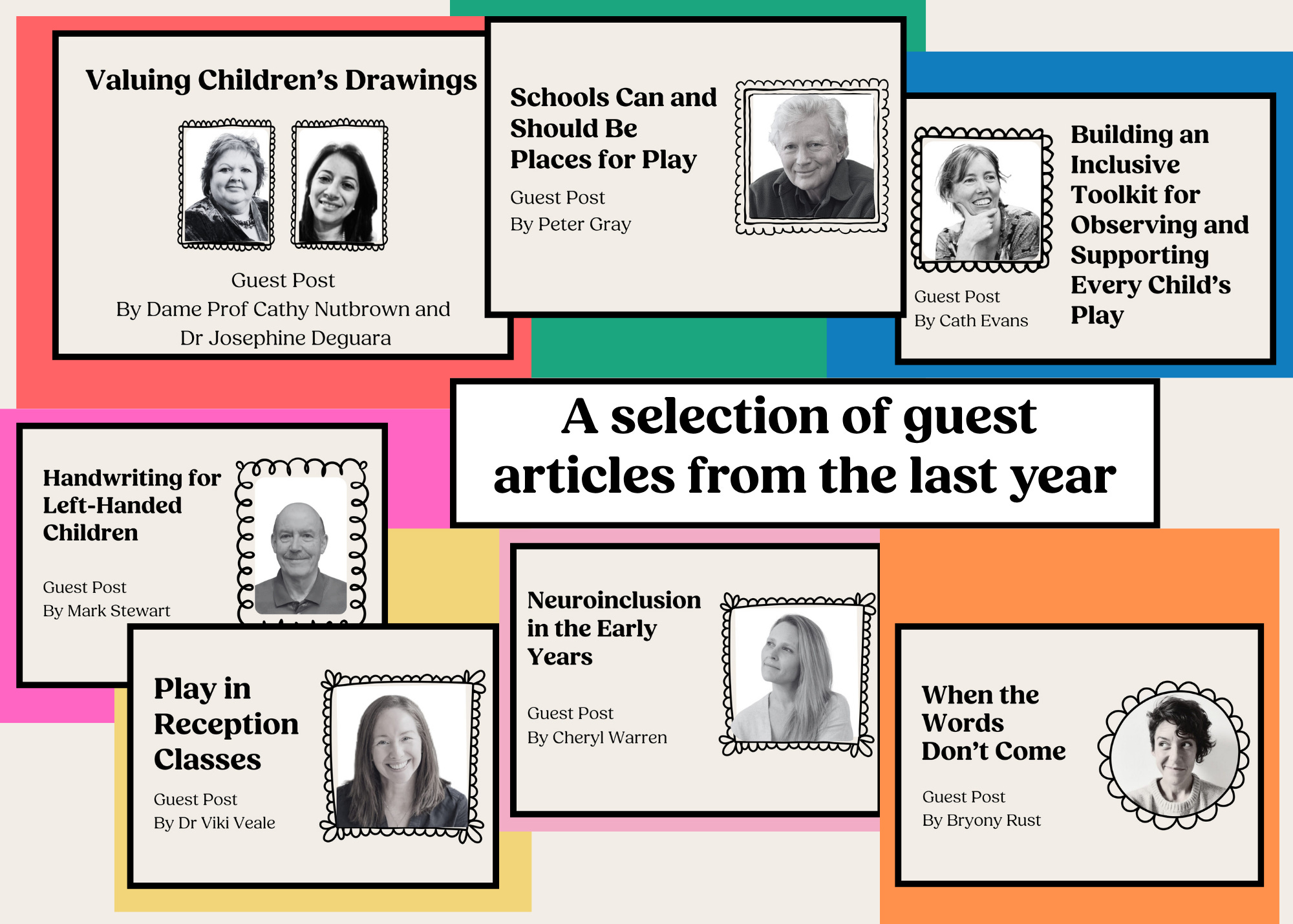
Cheryl talks about moving away from compliance, conformity and control and to become curious about what children’s behaviour might be communicating. One thought that really stayed with me was her reminder that movement can be regulation rather than misbehaviour, sometimes rocking, pacing, climbing or fidgeting is exactly what enables a child to engage.
Being left-handed isn’t simply the mirror image of being right-handed, and a few small adjustments can make an enormous difference. Mark encourages us to look not only at what a child has written, but how they have written it, particularly their grip, wrist position and the angle of their paper.
As Cath brilliantly points out, there really is no such thing as an ‘average child’, just as you will never meet a family with precisely 1.74 children! This article helps us build a much more complete picture of individual play by beginning with wellbeing, sensory preferences and the fascinations that make each child ‘light up’.
What if a child’s drawing is not simply a picture, but a glimpse into how they are making sense of their world? Cathy and Jo explore drawing as a powerful language for thinking, storytelling, memory and identity, and reveal why the conversations that happen while children draw can be even more fascinating than the finished image. It is a brilliant reminder to pause, look beyond the marks and listen carefully to the stories hidden within them.
Viki makes a powerful case for keeping play at the heart of Reception without pretending that play and teaching have to sit at opposite ends of the room. One particularly useful suggestion is that more access to active outdoor play might develop children’s physical foundations for writing more effectively than all the dough gym and funky fingers interventions we can squeeze into the timetable.
Bryony writes about how communication is a two-way street and that the adult also has to work at being understood. Rather than continually asking children to copy us or “use your words”, she suggests that we begin by sitting quietly, noticing the smallest signals and reflecting the child’s sounds, gestures or actions back to them.
Peter Gray is a true early childhood icon! He argues that real play, initiated and managed by children themselves, is where they learn to negotiate, solve problems, manage emotions and build friendships. His example of mixed-age Play Clubs is wonderfully simple - give children time, space and choice, keep the rules to a minimum, and ask the adults to behave more like lifeguards than entertainment officers!
Choosing only these guest articles was no easy task because there have been so many brilliant contributions over the year. Each one has brought their own expertise, experience and perspective, but all of these articles have something important in common - they encourage us to look more closely at the child in front of us and think carefully about the environments, expectations and interactions we create around them.
A huge thank you to all of our guest writers for sharing their knowledge so generously, and to all of you who have read, commented, shared and carried those ideas back into your own practice.
There are plenty more guest articles in The PLAYlist archive, so this might be the perfect moment to make yourself a brew and have a little rummage!
Comments
Nothing yet. Say the first thing.
Sign in to join the conversation.