
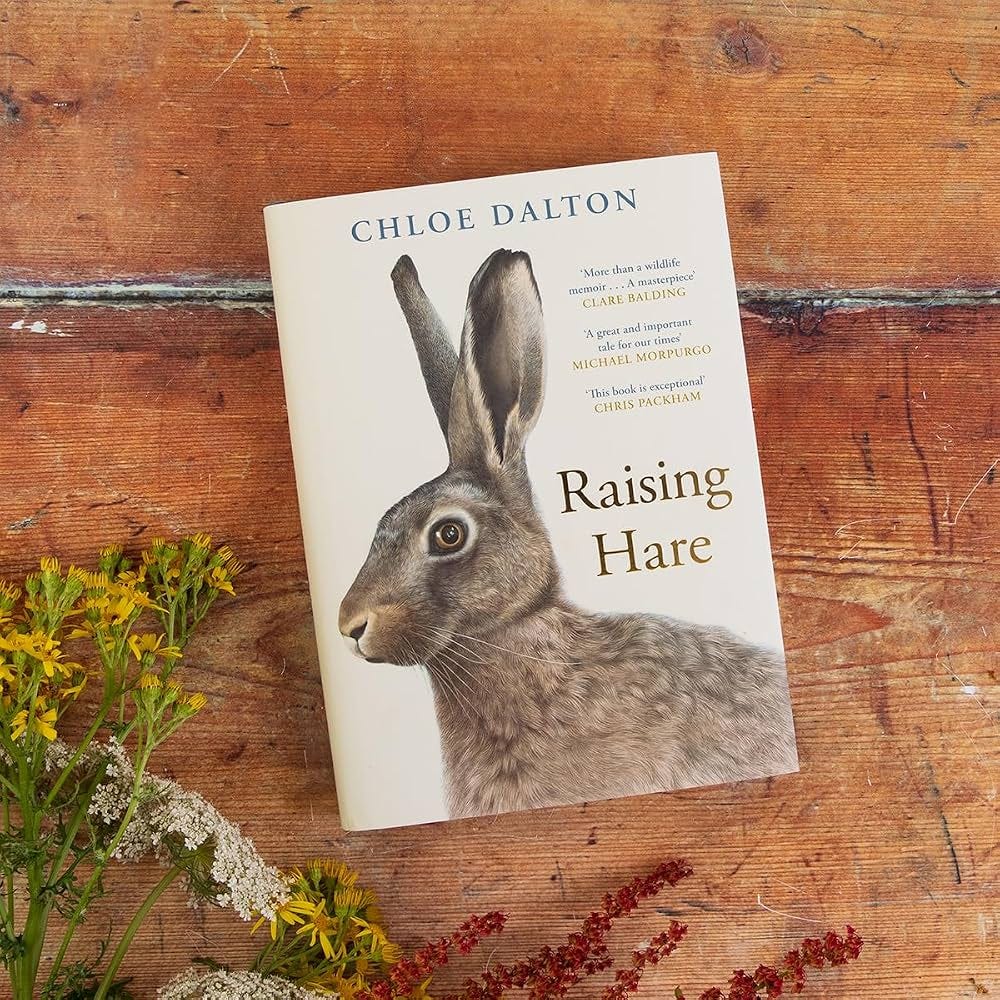
I’ve spent the last few days immersed in a memoir about a topic I never in a million years thought I would care about: wild hares.
Chloe Dalton’s breakout memoir, Raising Hare, is a simple story about a woman who stumbles upon a leveret (i.e. a baby hare) in the English countryside and raises it to independence.
Not exactly one for animal books (my children joke I have AID – Animal Identification Disorder), I was shocked to find myself enamored by this one. And I’m hardly alone. The gutsy editor at Vintage Books who received this manuscript in their inbox and responded with, A memoir about rabbits? Please tell me more! is certainly pleased to know the gamble paid off.
(For the record, a hare is not a rabbit – a fact I might have lived my life ignorant of, if I hadn’t read Dalton’s book.)
The unexpected success of Raising Hare has made me think hard about why we find some stories compelling and others lifeless. For many readers, the mechanisms of great storytelling are invisible. They may not be able to name what’s in the secret sauce, but they certainly know when a book lacks it.
A writer, however, leans into the mystery, puts stories under the microscope, and finds out what makes them tick. Only then can they aim to write a truly great story of their own.
How is it that a memoir about something as seemingly irrelevant as hares can succeed and go on to become an international bestseller while so many others die in a slush pile?
The answer, of course, isn’t that hares are inherently more interesting than illness, loss, adventure, survival, or any of the other experiences that compel people to write memoirs.
It’s that subject matter alone has remarkably little to do with whether a story is compelling.
What matters is what the writer sees in that subject—and what questions she uses it to investigate.
Which brings us to the first question every memoirist should be able to answer:
Over the years, I’ve had the privilege of laying my eyes on many memoirs-in-progress. Some were terrific, others were a bit of a slog. The surprising trend I’ve observed? The topic had very little to do with what bucket it ended up in.
Think for a moment about a memoir you love. Chances are it tackles at least one hard subject. Chances are also that you love it not because you weirdly love cancer, divorce, illness, abuse, or even hares. It’s because you’re intrigued by what the book is observing and asking.
A memoir, by definition, is about someone’s life. But a great memoir is never a play-by-play diary entry of what happened first, second, third, etc. Great memoirs are far more interested in studying a phenomenon closely and investigating it from a unique angle.
Let’s use Eat Pray Love as a case study. Whether you loved the book or hated it, you’ve probably heard of it, which is why it’s an easy one to reach for.
What is Elizabeth Gilbert’s bestselling (to the tune of 15 million copies) memoir about?
On the surface: A newly divorced woman travels to Italy, India, and Indonesia
Observed up close: One woman’s identity transformation following her divorce and travels
Curious about: How do women define their identities outside the structure of marriage, and how might it compel them to live differently?
Do you see the difference?
Through this lens, we see that no matter how “interesting” one’s life story is, to become a compelling memoir, it must reach further.
Here’s how I’d evaluate Raising Hare (which, for the record, is beautifully written) using the same test:
On the surface: Hares (????)
Observed up close: What it means to be a wild animal, elementally connected to nature
Curious about: How humans understand their own place in the natural world and how we navigate the tension of letting go of those we raise
I’ll never forget the day I got the final pass of my memoir, Love You Hard, back from my publisher and discovered they’d classified the ISBN number under the category “brain damage.” It was just as perplexing to me as the day I saw it on Amazon listed as a “hot” medical biography.
Who wants to read about brain injuries? I thought to myself. Certainly not me!
Publishing categories are a necessary evil, but that one gave me unexpected clarity about what I believed the book was actually investigating.
On the surface: My husband’s traumatic brain injury and our family’s recovery from it
Observed up close: What happens to a marriage when one person becomes someone neither partner recognizes
Curious about: When one partner undergoes an unwanted and irreversible change, how must the other partner transform, too?
Notice what’s missing from that final sentence?
Brain injury.
That’s the point.
Great memoirs don’t simply recount experiences. They use lived experiences to observe larger phenomena and investigate questions that extend beyond the author’s life.
Dalton didn’t persuade millions of readers to suddenly become interested in hares. She used her experience of raising one hare to make us interested in something we’re inherently curious about: ourselves.
I’m unlikely to ever raise a hare. But in three years, I’ll send my firstborn off to college. And when that time comes, I suspect my heart will return to Raising Hare and Dalton’s wistful, beautiful account of what it means to love something deeply while preparing to set it free.
That is the magic of this genre: the more closely a memoirist observes the particular, the more likely they are to uncover something universal.
Take your current writing project (memoir or fiction) and fill in these three lines:
On the surface: What happens?
Observed up close: What phenomenon does this experience allow you to study?
Curious about: What question about being human won’t leave you alone?
If all three answers are essentially versions of the same thing:
Cancer / my experience with cancer / what it was like to have cancer
You probably haven’t found the book yet.
The good news, however, is that you now have a framework to ground your writing. It’s worth repeating this exercise to evaluate what language feels truest and most resonant — and if it’s hard to do with your own book, what about putting one of your favorite reads through the test?
Writing a memoir but struggling to figure out what it’s really about?

I’ve just opened five spots for my new Memoir Diagnostic: a close read of up to 25 pages, personalized written feedback, and a private 60-minute conversation focused on what’s working, what’s missing, and what to do next.
Comments
Nothing yet. Say the first thing.
Sign in to join the conversation.