
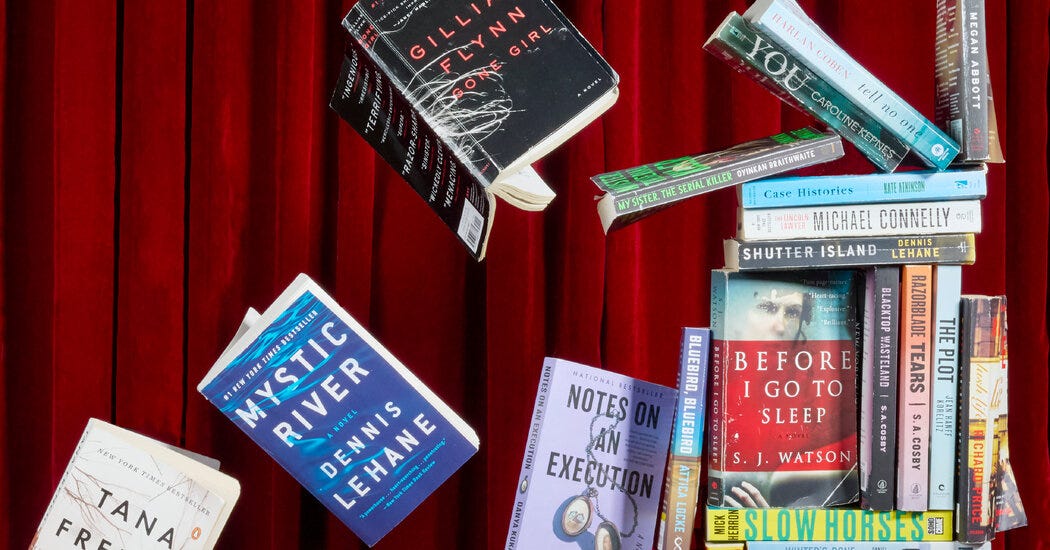
When my husband strode into the kitchen the other day, announcing that the NY Times had just published a list of this century’s 50 best thrillers, it felt like kismet.
All summer, he’s observed me in a state of obsessive study over my latest craft endeavor: learning the architecture of a perfect plot twist.
What better timing for a list aggregating the books that did it best?
I have a distinct memory from 2015, ignoring my family for two days straight as I tore through The Girl on the Train. We were vacationing in Northern California, but even the majestic redwoods were no match for my steely-eyed commitment to inhale that book. I had no interest in sightseeing. No interest in engaging with humans. I just needed to see the story through to the end.
The podcast accompanying the NY Times list addresses that heady rush readers feel while consuming a great thriller. It’s an all-encompassing experience, one that effectively freezes the outside world, unsettles your gut, and leaves you feeling as if you’ve just competed in a Hunger Games-like competition. Tired, undone, and self-satisfied.
It’s kinda the best.
I’ve loved thrillers since long before I ever considered writing fiction myself, and I was thrilled (pun intended) to see many beloved titles on this list, including The Goldfinch, which is probably my favorite book of all time, but not one I would have necessarily classified as a thriller, raising the question of how we define this genre in the first place.
Whether it’s a whodunit or a more subtle unknowing, all books contain mystery. But the ones that have stayed with me long after finishing are the ones that challenged my experience of reading in the first place. They’re the books that turned the story on its head, revealed multiple interpretations, and made me understand that sometimes the reader can be as unreliable as the narrator.
Magicians will confess that in a magic trick, the reveal has been in front of the audience the whole time. The secret is misdirection — controlling where the audience looks and what they think. The same is true for the masters of fiction.
Here are some broad architectures to help us categorize these types of stories:
The Inside-Out Story: You understand what is happening, but have fundamentally misunderstood who the protagonist is / what situation they’re in. (Shutter Island, The Silent Patient)
The Hidden-Motive Story: You understand the events but misunderstand why someone is doing what they’re doing. Think Gone Girl.
The Narrator-Blind-Spot Story: The narrator’s own self-deception prevents us from correctly interpreting what we’re seeing. (The Little Stranger, In the Woods)
The Missing-Piece Story: One withheld fact suddenly reorganizes everything else. This is where mysteries often live—and where twists can feel cheap if the reader never had a chance. (i.e. The Girl with the Dragon Tattoo, The Da Vinci Code)
This is by no means a complete list — they’re just a few archetypes that have helped me better understand what’s under the engine.
I’ve been revisiting a lot of the books from the top 50 list this summer to better understand the craft behind them, and an emerging theme has been the degree of intentionality and planning required. While it might not be a first-draft concern, embedding information is a delicate art.
For example, after rewatching Shutter Island, I went straight to interviews with Dennis Lehane. I wanted to know how to lay down a story that could be believed through two dramatically different interpretations. He said,
“It's the first book I ever outlined in my life. I knew everything that was going to happen before I wrote it.”
I appreciated this insight because it showed how tightly these stories must be conceived. An author must understand the architectural framework from which they’re working in order to successfully execute such a story.
For those of us prone to “pantsing", fear not. There’s still value in letting yourself roam into a draft, unsure where it might lead. For most of us, that’s how we discover what a book wants to be. The outlining part can come next.
There is nothing (well, very few things) less satisfying than a twist that just doesn’t land. And a common explanation for a twist that falls flat is that it simply wasn’t earned. Perhaps,
It comes out of nowhere. The reader couldn’t reasonably have seen it coming because the groundwork isn’t there.
It relies on concealment rather than misdirection. The writer withheld crucial information instead of showing it and allowing us to misinterpret.
It’s too obvious. The breadcrumbs all point in one direction without a convincing alternative explanation.
It’s a twist for twist’s sake. The revelation is surprising but doesn’t deepen the character, theme, or story.
It breaks the story’s own rules. The reveal contradicts what we’ve already been explicitly shown rather than recontextualizing it.
It doesn’t change enough. We learn something surprising, but it doesn’t meaningfully alter our understanding of what came before.
It requires an explanation dump. If the author needs five pages to explain how the trick worked, the architecture probably wasn’t doing enough work.
When I taught elementary school, I cautioned my students against “universe solves everything” resolutions. These are the kind in which, poof, the football player’s arm miraculously heals before the game, or the protagonist wakes up to find it was all a dream.
Unsatisfying twists and resolutions can leave a reader feeling cheated. They can undermine any powerful storytelling that came before.
Thrillers may make for quick reads, but a brilliantly executed one requires thought, intention, and a superb ability to thread the needle. It’s a marvel when it works.
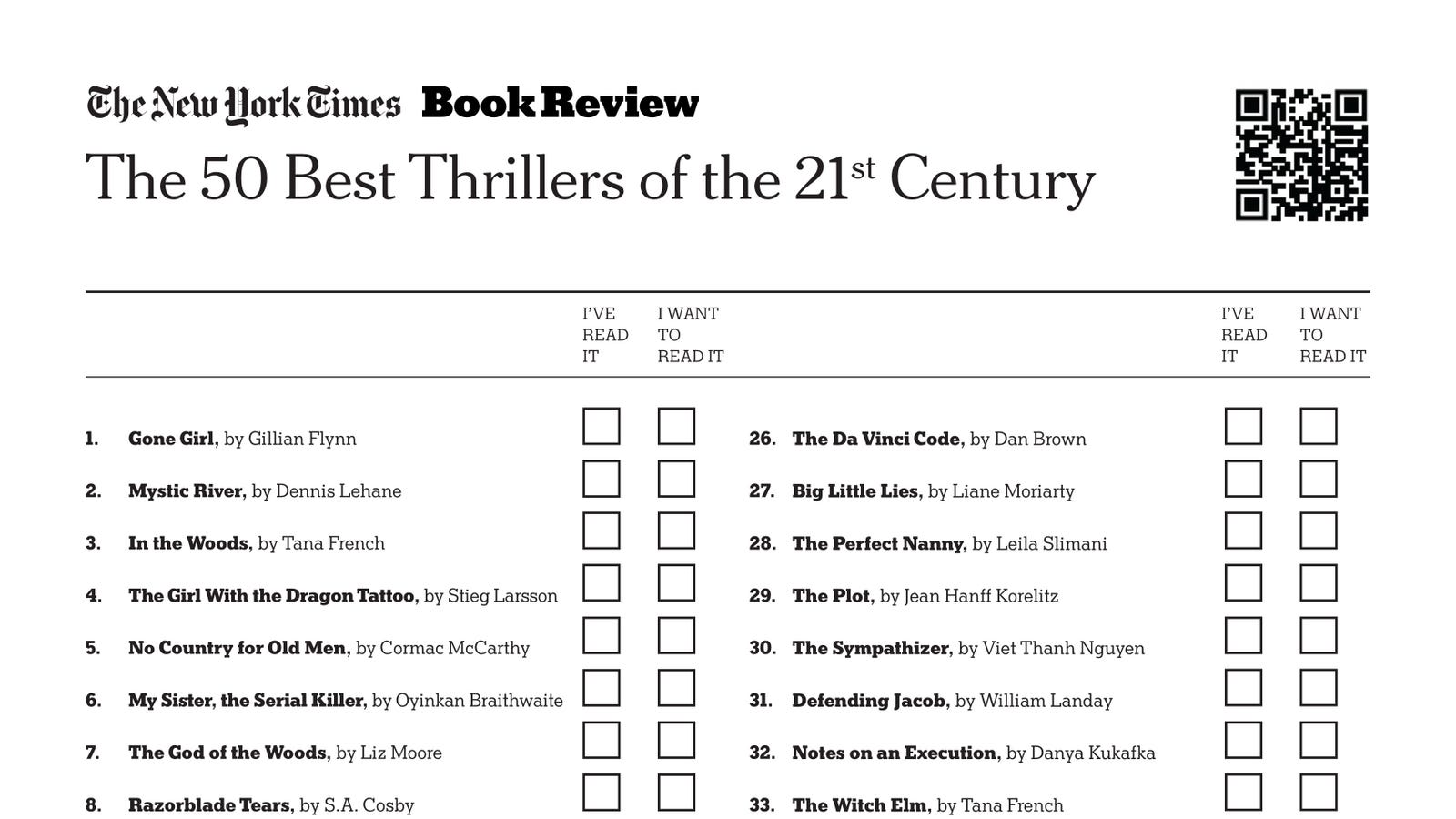
If you haven’t checked out the list, please do.
I’d love to know your favorites and any you think were missed (my ballot would have also included The Little Stranger and Leave the World Behind)!
Comments
Nothing yet. Say the first thing.
Sign in to join the conversation.