
For more than a century, we have been told that intelligence can be reduced to a single number: the IQ score. That neat little figure has been used to sort children in schools, decide who gets opportunities, and even justify discrimination. But here’s the truth: intelligence is far bigger, more complex, and more human than a number on a page.
For thousands of years, “intelligence” has been repeatedly defined and redefined. From Platos philosophy of reason, to Chinese civil service exams, to Alfred Binet’s early child-centered tests, with each era leaving their mark. But somewhere along the way, we lost balance.
Lewis Terman, who popularized the IQ test in the U.S., believed intelligence was largely hereditary: fixed, measurable, and neatly ranked. That mindset fueled elitism and even eugenics. It created towers to numbers, but not bridges to understanding.
Even today, we still see echoes of Terman’s rigidity: in standardized testing, in psychiatric categories like the DSM-5’s autism “levels,’ and in algorithms that score and rank human worth.
I believe that intelligence is not a ladder to be climbed, but a balance to keep. Real intelligence has three equal pillars.
Cognitive Intelligence
Reasoning, problem solving, pattern recognition. What IQ tests try (imperfectly) to measure.
Emotional Intelligence
Empathy, self-awareness, compassion, and emotional regulation. The balance-keeping wisdom that women, caregivers, and Indigenous traditions have embodied for centuries.
Integrative Intelligence
The ability to learn, unlearn, and adapt. Not just school-based knowledge, but lived experiences, cultural learning, and curiosity-driven growth.
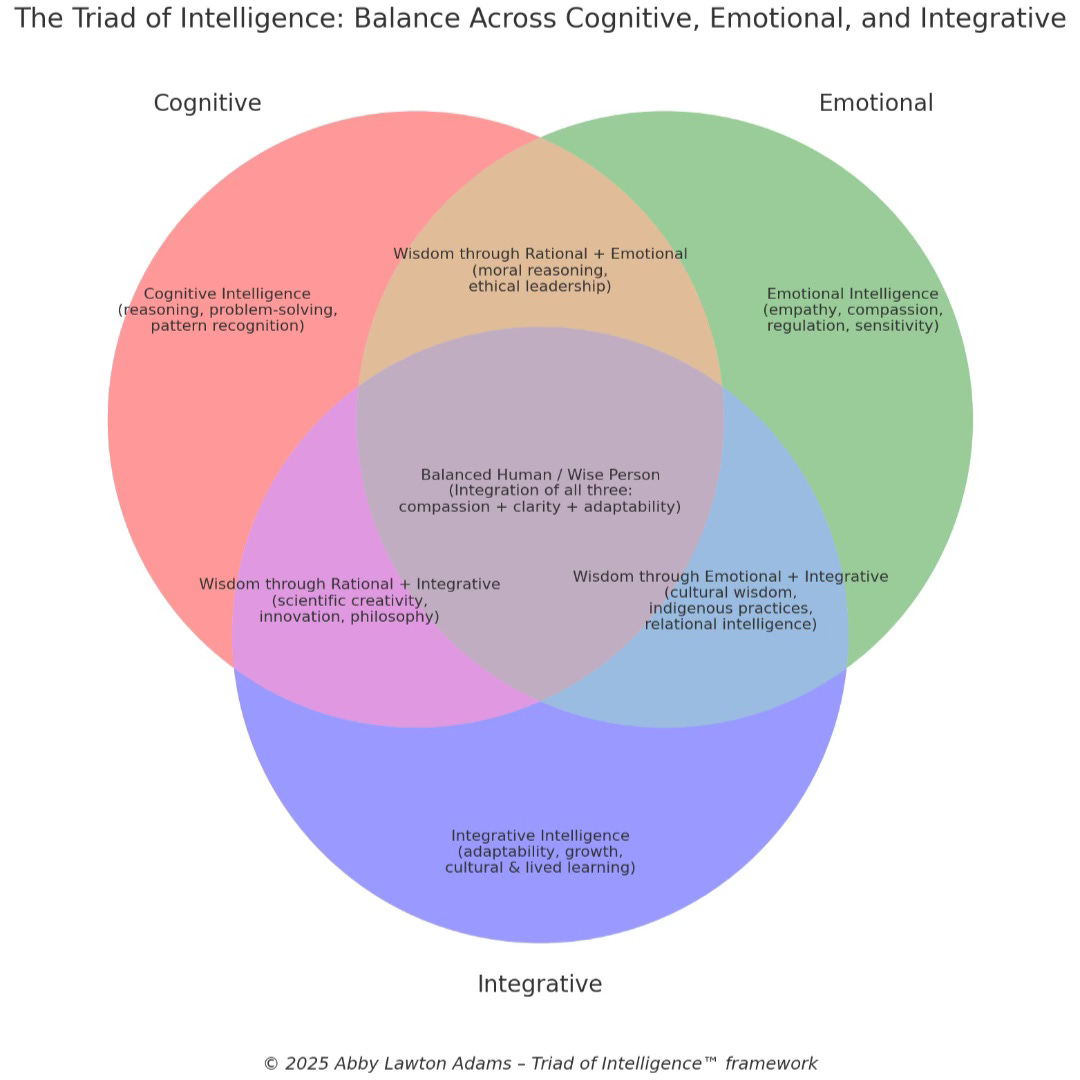
When one pillar dominates, imbalance follows. High cognitive intelligence without emotional wisdom leads to harm, such as Terman. High emotional without reasoning can lead to vulnerability. And high educational without grounding can drift endlessly.
But together, these three create a balanced human being, one that is wise, resilient, and humane.
We live in a world that rewards towers, not bridges. Towers of numbers, towers of categories, towers of rigid systems. But towers isolate. Bridges connect.
Cultures outside the Western psychological canon have long known this:
Lakota teaching: “The hurt of one is the hurt of all.”
Confusian China: Exams that tested not just knowledge, but moral virtue.
Indigenous wisdom: Intelligence as survival, harmony, and relationship with nature.
Balance is not new, it is ancient. What’s new is that we are finally waking up to how desperately we need it.
This is the first article in a series that will dive deep into the history and future of intelligence;
How psychology got trapped in rigid numbers and categories.
How reformers like Binet, Gardner, and Kaufman challenged the system.
How women’s wisdom and Indigenous knowledge can restore balance.
How intelligence, at its core, is about living in harmony; with ourselves, with others, and with the world.
Because intelligence is not just how we think.
It’s how we feel, learn, and live together.
Written by Abby Jo Adams
Creator of the Triad of Intelligence™ framework
Thanks for reading! This post is public so feel free to share it.
No posts
Comments
Nothing yet. Say the first thing.
Sign in to join the conversation.