
Balance isn’t just a nice idea…it’s the blueprint of life itself.
Every living system…from your heartbeat to the stars above…from the smallest cell to the largest galaxy…runs on one simple law: equilibrium.
In physics, it’s called homeostasis or dynamic equilibrium…a constant dance of push and pull that keeps everything alive.
In the human body, balance is what regulates temperature, hormones, and even thought.
And in our emotions, it’s what determines whether we live in survival or peace.
Modern neuroscience now confirms what ancient wisdom always knew: balance is health.
The autonomic nervous system constantly shifts between stress (sympathetic) and calm (parasympathetic), seeking equilibrium.
The vagus nerve, often called the “body’s superhighway,” physically connects brain, heart, and gut, regulating emotional and physiological balance.
Even brain waves oscillate in patterns that reflect mental stability…when our rhythm becomes erratic, so does our mood and cognition.
Everywhere we look, nature insists on the same truth: when balance is lost, systems collapse…whether it’s an ecosystem, a society, or the human psyche.
That’s why balance isn’t a luxury, but survival.
The Individual - Mind, Body, and Brain in Harmony
When we talk about balance within a person, we’re really talking about communication…the way the brain, body, and emotions share information. Every thought we think and every feeling we feel travels through biological pathways designed to keep us in sync with life.
The Mind-Heart-Bridge model mirrors how this process actually works in the brain. Science is now catching up to what intuition and self-awareness have known all along: our cognition, emotion, and integration are not separate. They’re three parts of a single system striving for coherence.
The Mind (Cognitive Intelligence)
In the brain, the prefrontal cortex acts like a conductor, responsible for reasoning, planning, language, and self-control. It helps us analyze and decide. But here’s the catch: when we experience stress or fear, that part of the brain goes offline. Instead, the amygdala (our emotional alarm system) takes over, pushing us into reaction rather than reflection.
That’s why overthinking doesn’t fix imbalance…it amplifies it. When the mind dominates, it tries to solve emotional pain through logic, but emotions aren’t equations. They’re energy that needs to move, not just be explained.
Balance happens when the prefrontal cortex and emotional centers cooperate…when we can think about feelings without becoming them.
The Heart (Emotional Intelligence)
We now know the heart isn’t just a pump, but also a messenger. Research from the HeartMath Institute and other cardiology studies show that the heart has its own nervous system, capable of sending signals to the brain that influence perception, attention, and emotional processing.
When we feel gratitude, compassion, or love, the heart’s electrical rhythm becomes smooth and coherent. This coherence synchronizes with the brain’s rhythm, improving focus, empathy, and even problem-solving. It’s literal harmony…the body reflecting emotional balance through physics.
In contrast…anger, anxiety, and fear create chaotic heart rhythms that scramble communication with the brain. So, when people talk about “listening to your heart,” it’s not just a metaphor, but biology.
The Bridge (Integrative Intelligence)
This is the middle ground…the neural highway connecting head and heart. Biologically, it’s the vagus nerve and the networks that regulate our nervous system.
When this system is balanced, it creates a state called vagal tone…a physiological marker of emotional resilience. People with strong vagal tone can move smoothly between stress and calm, logic and feeling. They can pause before reacting, adapt to change, and recover quickly from setbacks.
That’s integrative intelligence in action…the ability to stay centered within motion.
It’s not about shutting down emotion or suppressing thought; it’s about letting both have a voice.
What Science Teaches Us About Internal Balance
Every major biological system in the body, from hormones to neural circuits, depends on rhythm.
Our heartbeats, brain waves, circadian cycles, and breathing patterns all reflect the same law: coherence creates stability.
When the brain and body are in sync, we feel calm and creative.
When they’re at odds, we feel anxious or numb.
Balance, then, isn’t a spiritual metaphor…it’s a measurable state of alignment between systems. The more we understand this, the more we can stop labeling emotions as weaknesses and start reading them as feedback from our inner ecosystem.
“The individual is the smallest ecosystem we have. When we bring our mind, heart, and bridge into harmony, we stop fighting ourselves, and start reflecting the balance the world desperately needs.”
What happens inside us echoes outside us.
Society - Systems, Cooperation, and Social Homeostasis
When an individual loses balance, we call it stress. When a society loses balance, we call it crisis.
But the underlying problem is the same: too much of one force, not enough of its counterweight.
Just like a person can get trapped in their head or overwhelmed by emotion, a society can too…through over-reliance on intellect, control, or collective emotion without reflection.
The Science of Social Balance
In biology, systems stay alive through feedback loops.
When a cell grows too fast, the system tells it to slow down.
When the temperature rises, the body sweats to cool itself.
This constant communication is called homeostasis…balance through self-correction. Healthy societies work the same way.
Democracy, for example, is a giant feedback system: people provide input, leaders respond, and the system adjusts. When feedback is silenced…through corruption, inequality, or fear…the social organism begins to break down.
Sociologist Talcott Parsons described this as social equilibrium: every culture has mechanisms (like laws, traditions, or rituals) that maintain balance. But when one mechanism dominates…say, economics over ethics…imbalance ripples through everything else. We’ve all felt that imbalance.
A society that overvalues profit at the expense of empathy becomes mind-heavy — analytical but heart-blind.
A society that runs purely on outrage or identity without reason becomes emotion-heavy — reactive but unstable.
And without integration…dialogue, truth, reflection…the bridge collapses.
Mind-Dominant Societies
When logic and power dominate, we see obsession with metrics, hierarchy, and control.
Policies are driven by numbers, not people. Education rewards compliance over curiosity. These are societies where people function efficiently but feel empty, where the system runs smoothly while souls quietly erode.
Science calls this a loss of social homeostasis…the point where a system’s internal pressures exceed its ability to self-correct. It’s the cultural equivalent of burnout.
Emotion-Dominant Societies
On the flip side, when collective emotion runs unchecked…when fear, rage, or tribalism overpower reflection…societies lose stability.
We see polarization, moral panics, and cycles of reactivity that make progress impossible. Neuroscience tells us that when groups operate from fear, their brains synchronize at the limbic level…creating emotional contagion.
Without integrative leadership to calm and guide, people stop thinking critically and start mirroring one another’s panic.
It’s not that emotion is bad…it’s vital. But emotion without structure creates chaos, just as structure without emotion creates oppression.
The Bridge: Integrative Systems
Here lies the key - integration.
At the societal level, integrative intelligence looks like transparency, dialogue, and empathy in policy-making.
It’s leadership that listens before deciding. It’s education that values the arts as much as math, or justice systems that combine accountability with rehabilitation.
Neuroscience calls this social coherence…when the emotional tone of a group becomes calm, collaborative, and attuned.
In those moments, collective creativity skyrockets. People stop competing for control and start cooperating for balance. That’s the biology of peace.
What Science Teaches Us About Society’s Need for Balance
Complex systems theory shows that diversity and feedback keep any network healthy…from ecosystems to economies. When one element dominates too long, collapse is inevitable. Just as the body can’t survive without both rest and action, a culture can’t survive without both intellect and empathy.
Balance isn’t compromise - it’s sustainability. It’s how societies grow without imploding.
“If individuals are the cells of humanity, then balance is our shared nervous system. When one part of society suffers, the whole organism trembles. Healing starts when we begin listening again…not just to each other, but to the rhythm that connects us all.”
The same forces that balance a body also govern a planet.
The Environment: Ecology, Energy, and Planetary Balance
The Earth is not just where we live…it’s the original teacher of balance.
Before humans built societies or theories, nature had already mastered the art of self-regulation.
Every ecosystem on this planet is a living example of the Triad of Intelligence at work: mind, heart, and bridge intertwined through energy, pattern, and purpose.
The Science of Ecological Balance
In ecology, balance is called homeostasis…the same term biology uses for the human body.
Ecosystems constantly adjust through feedback loops: if a predator population rises, prey decreases, which then lowers predator numbers again. Forests regulate rainfall, oceans regulate temperature, and the atmosphere recycles carbon through plants and plankton.
This isn’t chaos; it’s choreography. A dance of countless systems communicating to sustain life.
When one part goes out of balance…through pollution, deforestation, or greed…the rest must compensate.
But just like a human body, Earth can only rebalance for so long before exhaustion sets in.
The Mind of Nature (Cognitive Intelligence)
If logic is order and design, nature is the greatest logician we know.
Science now confirms that plants, fungi, and animal communities share information…through signals, chemical cues, and even underground networks.
The mycorrhizal network (the “Wood Wide Web”) allows trees to send nutrients, warnings, and resources to one another.
It’s not sentiment; it’s strategy…intelligent cooperation designed to sustain the whole.
Nature’s cognitive intelligence is what makes a forest self-organizing, a coral reef self-healing, and the climate self-correcting…until human interference overwhelms those natural limits.
The Heart of Nature (Emotional Intelligence)
Emotion, in its purest sense, means energy in motion…the flow that animates life.
In ecosystems, this flow appears as biodiversity…the vibrant exchange of giving and receiving.
Every organism participates in reciprocity: pollinators feed while spreading life; decomposers take death and turn it back into fertility.
This is the Earth’s version of empathy…not sentimental, but relational.
Everything in nature feels the presence of everything else.
Science calls this symbiosis…cooperative relationships that sustain stability and resilience.
When humanity acts with empathy toward the environment…planting trees, restoring wetlands, protecting species…we amplify this natural intelligence. When we act with indifference or domination, we break it.
The Bridge of Nature (Integrative Intelligence)
In planetary terms, the “Bridge” is the Gaia system…the integrated network of atmosphere, ocean, land, and life that regulates temperature and chemistry to sustain habitability.
The Gaia Hypothesis, proposed by scientist James Lovelock, describes Earth as a self-regulating organism. The planet doesn’t just react to imbalance; it adapts.
But adaptation comes with consequences…climate shifts, mass migrations, extinction events…all signs of a system trying to restore equilibrium.
Integration, at this scale, is planetary consciousness; the natural intelligence that links everything from carbon cycles to ocean currents.
The Human Role in Planetary Balance
Humans are the first species capable of self-awareness at this level. We can observe imbalance and choose to correct it consciously.
That’s what makes this model revolutionary. It calls us to apply personal and social balance back to the planet that taught it to us first.
Science already shows how powerful this alignment can be:
Regenerative agriculture heals soil and reverses carbon loss.
Circular economies mimic natural cycles where nothing is wasted.
Biomimicry in design uses nature’s intelligence to solve human problems sustainably.
When we design systems that mirror natural balance, we stop fighting the Earth and start partnering with it.
The Lesson of the Living World
Everything alive depends on dynamic tension…predator and prey, night and day, creation and decay.
The planet doesn’t fear imbalance; it uses it to evolve.
Every forest fire births new life. Every flood redistributes nutrients.
The problem isn’t imbalance itself, but when we ignore the call to rebalance.
Humanity’s next step is remembering that we are not separate from the ecosystem; we are the ecosystem. The same intelligence that keeps galaxies spinning lives inside our cells and hearts.
When we act in harmony with it, life thrives. When we don’t, nature responds…not in punishment, but in correction.
“The Earth is the original therapist. She doesn’t lecture…she reflects. Every storm, drought, and bloom is feedback, reminding us that the cure for chaos is always balance.”
The Universal Pattern of Balance
If you zoom in far enough or look out wide enough, you’ll find that everything in existence…from atoms to galaxies…runs on the same law: balance through relationship.
It’s not perfection. It’s rhythm.
Every particle vibrates, every planet orbits, every organism breathes between expansion and contraction, giving and receiving, chaos and order. Science calls this dynamic equilibrium.
Philosophy calls it harmony.
Spirituality calls it oneness.
I call it integration.
The Science of Universe Balance
Physics teaches that the universe maintains order through opposing forces: gravity pulls, motion resists.
Biology teaches that every living system seeks homeostasis: balance between growth and decay.
Psychology teaches that the mind stabilizes itself through integration of opposites: reason and emotion, self and shadow.
Even at the quantum level, matter itself flickers between dualities…particle and wave, presence and potential. Reality is built on tension that never collapses but constantly corrects.
So when we talk about balance, we’re not talking about being still.
We’re talking about stability through motion.
It’s what keeps your heartbeat rhythmic, your emotions flowing, your societies evolving, and your planet alive.
The Triad of Intelligence as a Universal Mirror
The Triad model reflects this same architecture of existence:
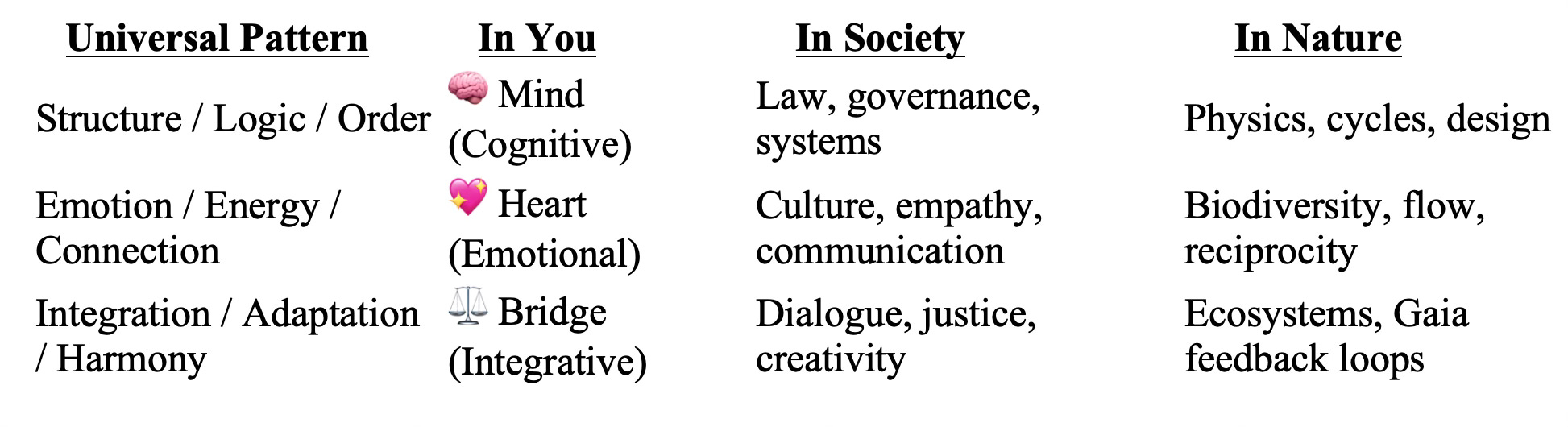
Every level expresses the same truth: when these forces are balanced, life thrives. When one dominates, systems fracture.
That’s why this Triad isn’t just a model of psychology…it’s a map of existence.
It reminds people that the path to peace isn’t found in extremes but in the meeting point between them.
Why This Matters Now
We are living in a time of collective imbalance…personally, politically, environmentally. But imbalance isn’t failure; it’s feedback.
Just as the body creates pain to signal healing is needed, the chaos of our age is the world’s way of saying, “We are out of rhythm.”
The solution isn’t more control or more emotion…it’s more integration.
More conversation between science and soul, progress and compassion, self and system.
It’s the return to rhythm.
The Living Law of Balance
Everything..from your breath to the biosphere…obeys this law:
when energy stops moving between opposites, it stagnates;
when it moves consciously, it creates life.
The universe, at its core, is not a war between opposites but a dialogue between them.
This is what the Triad restores…dialogue between mind and heart, human and world, progress and peace.
“Balance isn’t the end of growth; it’s what allows growth to continue.
It’s the pulse of creation…the same rhythm that beats in the heart, in the tide, and in the stars. When we remember that rhythm, we remember who we are.”
Epilogue: The Return to Wisdom
Every generation inherits both wisdom and imbalance.
And maybe ours…standing at the edge of exhaustion, technology, and awakening…is the one meant to finally choose harmony over chaos.
Balance has always been the quiet truth behind every discipline:
the physicist’s equation, the healer’s breath, the activist’s compassion, the artist’s flow.
But somewhere along the way, humanity forgot that the goal wasn’t control…it was coherence.
That’s why I built the Triad of Intelligence…not as another theory, but as a mirror.
It’s a reminder that intelligence isn’t just measured by what we know, but by how we relate…to ourselves, to each other, and to the living world.
We are not separate systems trying to coexist; we are one system learning to communicate again.
The mind speaks in plans.
The heart speaks in feeling.
The bridge speaks in truth.
When all three speak together, they create a language that heals.
A New Kind of Awakening
For centuries, we’ve built civilizations that celebrated intellect but ignored empathy, or worshiped emotion but abandoned reason.
We divided the human spirit into categories…logic vs. intuition, science vs. soul…forgetting that the healthiest systems hold both.
But balance is making a comeback.
You can see it in the way people crave authenticity, meaning, and reconnection with nature.
You can feel it in the exhaustion of competition and the longing for cooperation.
We are not broken…we are out of sync.
And every time one person rebalances…one mind quiets, one heart opens, one bridge strengthens…the world moves an inch closer to harmony.
Your Role in the Return
If this work resonates with you, don’t rush to fix yourself.
Start by noticing.
Notice what’s too loud in your life, and what’s been silenced.
Notice where you feel pulled apart, and where you naturally come back together.
That’s balance whispering to you…it never left, it’s just waiting to be remembered.
Use the Triad of Intelligence as a compass, not a rulebook.
Let it help you see imbalance as feedback, not failure.
And know that every act of rebalancing…every pause, every truth, every choice rooted in both logic and love…contributes to the healing of something much larger than you.
The Legacy of Balance
“If humanity ever learns to live in balance, it won’t be because we became more advanced — it’ll be because we remembered how to listen.”
That’s the movement.
That’s the invitation.
To remember that balance is not something we find; it’s something we create…together…every day, in every system, in every breath.
~Written by Abby Jo Adams, creator of the Triad of Intelligence
About the Author
Abby is a psychology major, systems thinker, and writer exploring the intersection of science, soul, and society. She’s the creator of the Triad of Intelligence - a framework that connects cognitive, emotional, and integrative intelligence to restore balance within individuals and across the world.
Drawing on her background in clinical psychology, her lineage from the Adams family of early American thinkers, and her lived experience as a neurodivergent woman, Abby’s work bridges logic and compassion to help humanity find its rhythm again.
She writes to remind people that balance isn’t perfection - it’s communication.
Thanks for reading! This post is public so feel free to share it.
This Substack is reader-supported. To receive new posts and support my work, consider becoming a free or paid subscriber.
Comments
Nothing yet. Say the first thing.
Sign in to join the conversation.