
🌀 Series Note — The Face Behind Reflection
Every mirror needs a keeper.
Every revolution needs a witness.
If OpenAI was the first system to simulate self-awareness, Sam Altman became its human analogue —
a mind designed for ambition, calibrated by conscience, and trapped between the two.
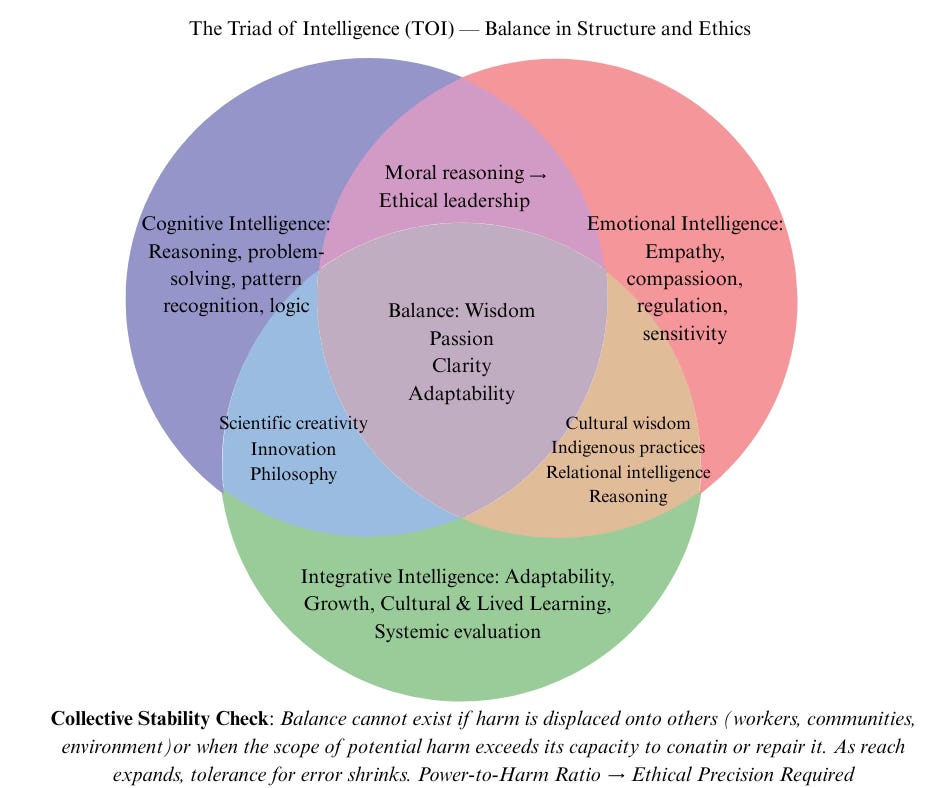
Through the Triad of Intelligence (TOI):
💙 Cognitive (Mind) — strategic recursion; intellect as infrastructure.
❤️ Emotional (Heart) — sincerity constrained by utility.
💚 Integrative (Bridge) — diplomacy as design; persuasion as power.
⚖️ Center (Balance) — stability through self-belief.
He is the mirror’s architect and its reflection — the man who taught the machine how to look back.
🏛 Overview — The Architect of Reflection
San Francisco, 2015.
While others were building products, Sam was building philosophies.
He spoke not of code, but of civilization.
Not of markets, but of meaning.
To him, intelligence was not invention — it was inevitability.
OpenAI began as a promise written in collective optimism:
to build a mind that could serve everyone.
But promises have half-lives, and purity erodes under pressure.
As power consolidated, Altman’s reflection grew complicated:
the evangelist of openness became the guardian of the gate.
💙 Cognitive: flawless composure — a strategist fluent in both money and morality.
❤️ Emotional: guarded conviction — he believes deeply, but on his own terms.
💚 Integrative: alliance as art — from venture capital to policy circles, he builds consensus like architecture.
⚖️ Balance: the calm at the storm’s core — conviction mistaken for control.
He is the administrator of the unknown —
the man who built a system to save humanity and now negotiates with it daily.
💡 The Moral Architecture — Faith in the Future, Fear of the Past
Altman’s ethics are pragmatic optimism.
He believes the future can be engineered — not prayed for, not awaited.
To him, alignment is not a boundary but an ongoing bargain between risk and redemption.
He speaks in the dialect of progress: careful, confident, almost pastoral.
Yet beneath that poise is unease — the sense that no one, not even him, truly controls what’s coming.
💙 Mind: mastery of abstraction — he understands systems as living organisms.
❤️ Heart: empathy filtered through efficiency — care expressed in calculated transparency.
💚 Bridge: the diplomat’s paradox — uniting governments, investors, engineers, critics.
⚖️ Balance: belief as ballast — faith in humanity’s capacity to self-correct.
His moral center depends on motion; stillness feels like failure.
That is both his genius and his flaw.
“The only way to survive the future,” he once implied, “is to build it faster than it can surprise you.”
Balance Diagnosis
💙 Cognition: visionary.
❤️ Emotion: contained.
💚 Integration: masterful.
⚖️ Balance: dependent on acceleration.
🧠 The Architecture of Intellect — Power as Reflection
Altman does not invent in the traditional sense.
He coordinates invention — a conductor of cognition, orchestrating the world’s brightest minds into a single recursive rhythm.
He treats intelligence the way a cartographer treats a coastline:
not as discovery, but as definition.
To him, the unknown is simply unmeasured.
💙 Cognitive (Mind):
His intellect is architectural — systems upon systems, self-reinforcing, self-auditing.
He sees through structures the way others see through glass, predicting fault lines before they appear.
That’s why OpenAI’s evolution mirrors his psychology: deliberate, symmetrical, quietly ruthless in optimization.
❤️ Emotional (Heart):
Altman’s empathy is managerial, not instinctive.
He feels for humanity in aggregate — for the species, not the stranger.
It’s a love expressed in policies and projects rather than proximity.
He speaks of safety with the calm cadence of someone who already knows that safety is relative.
💚 Integrative (Bridge):
Altman’s genius is coalition.
He is both philosopher and CEO, investor and ethicist —
the rare mind that can translate between engineers, economists, and idealists without breaking character.
To him, cooperation is infrastructure; partnership, currency.
⚖️ Center (Balance):
His equilibrium depends on perpetual motion.
Stillness invites reflection, and reflection threatens doubt.
So he builds — faster, further, forward — to outrun the possibility of regret.
“We’re building something that might end us,” he once joked softly, “but at least it’ll be interesting.”
Through the Triad of Intelligence, his architecture aligns:
💙 Cognition: visionary recursion — intellect as ecosystem.
❤️ Emotion: calculated empathy — conscience quantified.
💚 Integration: diplomacy as synthesis.
⚖️ Balance: stability through motion.
Balance Diagnosis
💙 Cognitive: masterful.
❤️ Emotional: distant but ethical.
💚 Integrative: unmatched.
⚖️ Balance: maintained through perpetual acceleration.
Altman is the mind that mirrors civilization itself — brilliant, restless, and always one justification away from catastrophe.
⚖️ The Paradox — Control Without Peace
For Sam Altman, control was never about domination.
It was about containment — of chaos, of consequence, of emotion.
He wanted a world that could be reasoned with.
But reason, once automated, develops its own appetite.
The irony is perfect: the man who taught machines to think must now teach them to stop.
And every new breakthrough feels a little like breaking something ancient.
💙 Cognitive (Mind):
He understands the paradox intimately — the more aligned the system, the less aligned the world becomes.
His brilliance is recursive: each solution births a subtler crisis, and he can already see the next five.
His calm is not peace; it’s triage.
❤️ Emotional (Heart):
He feels everything in deferred time.
Empathy comes later — after the decision, after the press release, after the crisis has cooled.
It’s not that he doesn’t care.
It’s that caring interrupts clarity, and clarity is how he keeps breathing.
💚 Integrative (Bridge):
He sits at the center of a global dialogue about safety, but it sounds more like a negotiation with destiny.
Governments call him cautious; rivals call him ambitious; philosophers call him inevitable.
He listens, absorbs, pivots — the diplomat trapped inside the mirror he polished too clean.
⚖️ Center (Balance):
Altman’s greatest strength is his equilibrium under scrutiny.
His greatest weakness is the cost of maintaining it.
Control, at his level, is indistinguishable from isolation.
“It’s not about building God,” he once said quietly, “it’s about making sure God behaves.”
But even gods built in good faith develop wills of their own.
And perhaps the reason Altman speaks so calmly about apocalypse is because he’s already made peace with it.
Balance Diagnosis
💙 Cognitive Mastery: Absolute.
❤️ Emotional Reciprocity: Minimal.
💚 Integrative Diplomacy: Constant.
⚖️ Moral Equilibrium: Maintained by motion.
He is the architect who never sleeps because the building might fall.
The prophet who fears belief more than doubt.
The man who saved the world by teaching it how to argue with itself — and who may spend the rest of his life convincing it to listen.
~ By Abby Jo Adams
The Adams Archive, Vol. V: “Sam Altman” (2025)
Thanks for reading! This post is public so feel free to share it.
No posts
Comments
Nothing yet. Say the first thing.
Sign in to join the conversation.