
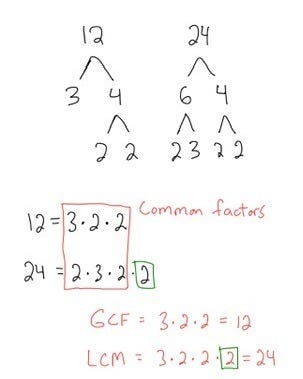
I was in a 6th grade classroom the other day where the teacher had asked the students to find the GCF and LCM of 12 and 24. I peered over students’ shoulders, expecting to see lists of factors of each number or perhaps a prime factorization tree. Instead I saw this:
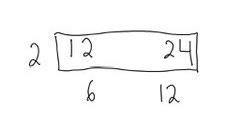
Huh, must be a new way of factoring, I thought. Setting aside my concern that nobody in the class of eighteen recognized right away that 12 is the greatest common factor of the two numbers, I walked around curiously. The students got there eventually:
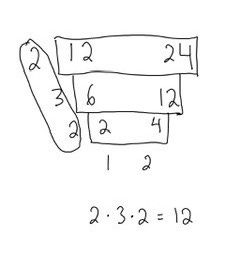
I could see that the numbers on the left were the common factors of the two numbers, and that the ones at the bottom are the “leftover” factors the two numbers didn’t have in common. But I had never seen this method before and asked the teacher about it later.
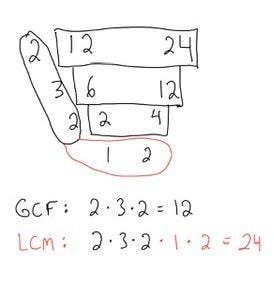
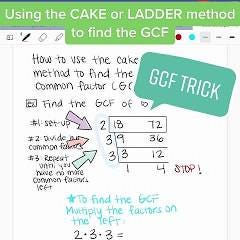
A quick Google search will tell you that the Cake Method, also known as the Ladder Method, is an easy trick for finding the GCF and LCM of two numbers:
What’s wrong with this, then? Why did I leave worried that an entire class of 6th graders had just learned a trick rather than something insightful about factors and multiples? After all, the Cake Method isn’t THAT different from a prime factorization tree, which also draws out the common factors and the “leftover” factors.
A few days later, I brought this up with my very smart friend/colleague/mentor/former professor. She’s the one I go to when I can’t quite put my finger on why something bothers me. “Help me make sense of what I saw in this classroom,” I say, and she eloquently deciphers the thoughts swirling in my head. We were at a lovely french cafe in the suburbs of Philly, sipping cafe au laits and eating the silkiest Quiche Lorraine this side of Paris. I scribbled the cake method on a receipt she had pulled from her purse. What’s wrong with this? I asked. The kids still have to think about common factors; they still have to know that they multiply the common factors to find the GCF. Is it really all that different from finding the prime factorization of each number and working from there?
Her response: One method obscures the math. The other reveals the math.
Sure, they both get you to the “answer” that you’re looking for. A math trick wouldn’t exist if it didn’t get students to the answer quickly and reliably. But the prime factorization shows you how you can break down a number – starting with any factor you’d like! – into its smallest pieces. An experienced teacher will then show students that they can rewrite the number as the product of its factors, and that the greatest common factor of two numbers is the product of the factors they share. The least common multiple is that product times whatever factors are not shared (the leftover ones). It makes sense!
The Cake Method teaches you a trick and actually obscures the math of why it works. If we teach it well, students will understand that the numbers along the left side are shared factors of the two numbers we’re looking at. But why do we just multiply them all? And what’s going on at the bottom there with those leftover numbers, and why do I multiply all the numbers to get the least common multiple?
One method shows you the math, letting you play with it and try different combinations of numbers, testing out number theories. I remember when I first learned how to use prime factorization to find the GCF and LCM (I’m ashamed to admit this was while I was teaching 6th grade! But that’s another can of worms.). I thought it was the coolest thing ever – you mean you can break down numbers into their smallest parts and then rearrange them in myriad ways? That this little factor tree method I learned in middle school reveals something fascinating about numbers? I’m still fascinated by it, all these years later. That’s the essence of a good math problem – you could explore it for hours and keep having new insights.
The other method is a tool, a strategy for tackling something that teachers often think is too hard for many of their students. They’re not going to know their factors, the teachers might say, so we’re going to teach them this trick that will ALWAYS work. But isn’t our job to help them know their factors? To give them the tools and strategies necessary (like a multiplication table, for example) for them to grasp the concept? If a student knows how to use prime factorization to help them find the GCF and LCM of two or more numbers, they understand something fundamental about numbers. If they know the cake method, they understand…something. I’m not quite sure what. But they will surely try to draw on this strategy in later years and not remember what number goes where, which numbers make up the “cake” and which numbers are on the outside. (Ask yourself: Do you remember how to divide two and one third by one fifth? Case in point.)
Teachers are under an insane amount of stress, and it’s understandable that many cling to a strategy that “works” (= gets students to the answer). They need their students to name the GCF and LCM easily and reliably, because those students need to do well on the state test, because the teachers’ ratings are partly based on that state test, and because school funding relies on good test scores. And that doesn’t even factor in (wink wink) the low pay and valuation of their profession in the U.S. They don’t have the luxury to explore all the cool concepts prime factorization relates to. This is what needs to change. We need to give teachers the time and freedom to explore the math so it makes sense to them and their students.
No posts
Comments
Nothing yet. Say the first thing.
Sign in to join the conversation.