
In New York City high-school classes, students are deep into Regents prep right now. I’ve written about the Regents before – how they determine whether or not kids can graduate from high school, how students sit for the Algebra I Regents two, three, even four times, exhibiting more perseverance than most adults I know.
Many teachers approach Regents prep with drill and kill: review the skill, then practice practice practice. This may or may not be effective, but it surely kills the soul.
The question I think about most of the year – are the students engaged in the math lesson? – becomes irrelevant to teachers who think the kids just need to sit quietly and do Regents problems all day every day. If they put their heads down and refuse to work, well, that’s on them.
But one teacher I worked with last week knows that part of the teacher’s job is to help the students want to do well, to make the lessons interesting enough that they stay engaged for all those weeks of test prep.
I arrived at her Algebra I class a few minutes after the period had started, and the kids were already so into the activity that most of them didn’t even notice me enter the room. She had them playing a group version of “Heads Up” (is this a game that exists or did she make it up? I’m really not sure. It’s basically a class version of Taboo) where one student was the “guesser” at each table. The other group members’ job was to give clues for the vocabulary word or phrase that the teacher displayed on the board, trying to get the guesser to say the right word. The guesser had their back to the board; the others faced the board. She encouraged them to use their notes, to talk to each other, to get into it. The only thing they couldn’t do was use a word that was on the board. Whichever guesser said the word or phrase first got points for their team.
An example: The teacher put “zeros or solutions” on the board. The students facing the board at each table started spewing out everything they knew about finding zeros (or solutions) in a quadratic equation without saying the words “zeros” or “solutions.” They could say “the point where the line crosses the x-axis” or “what you’re trying to find when you factor a quadratic equation” or anything else that might help the guesser.
The students were wildly into it. The teacher started giving double and triple points towards the end of the period, trying to make it so that each team still had a chance to win. Kids were shouting, jumping up when they got the answers, arguing over who said it first.
Several times, the hall monitor poked his head in and asked if everything was ok. That’s how loud it was.
Every single student was engaged in the game. Nobody put their head down, nobody asked to go to the bathroom and didn’t come back, nobody put their headphones on and zoned out.
That level of noise and rowdiness would make many teachers uncomfortable. They would say the class was out of hand, not listening, maybe bordering on unsafe (these are big kids!). But the teacher had total control. When one boy started arguing too vehemently about his team not getting a point, she settled everyone down with her voice and her body language, reminding them that they had to play calmly and fairly or not at all. It worked; they settled down.
This class got me thinking about how wide the range is from teachers who go all in on engagement, with classes bordering on “rowdy,” and those who are more comfortable when students are silent, working alone and without a peep. We often use the words “engagement” and “compliant” in opposition – as in, “Well sure, the students were compliant, but were they actually engaged?” Or “They were really engaged working at the whiteboards, but that teacher had no control over the behavior.”
This is an unhelpful dichotomy. What teachers really want is students who are engaged and compliant.
I think it’s more helpful to think of engagement and compliance as two axes on a plane. We can have classes that are engaged and compliant (quadrant I); classes that are one or the other (quadrants II and IV); and classes that are neither (the dreaded quadrant III).
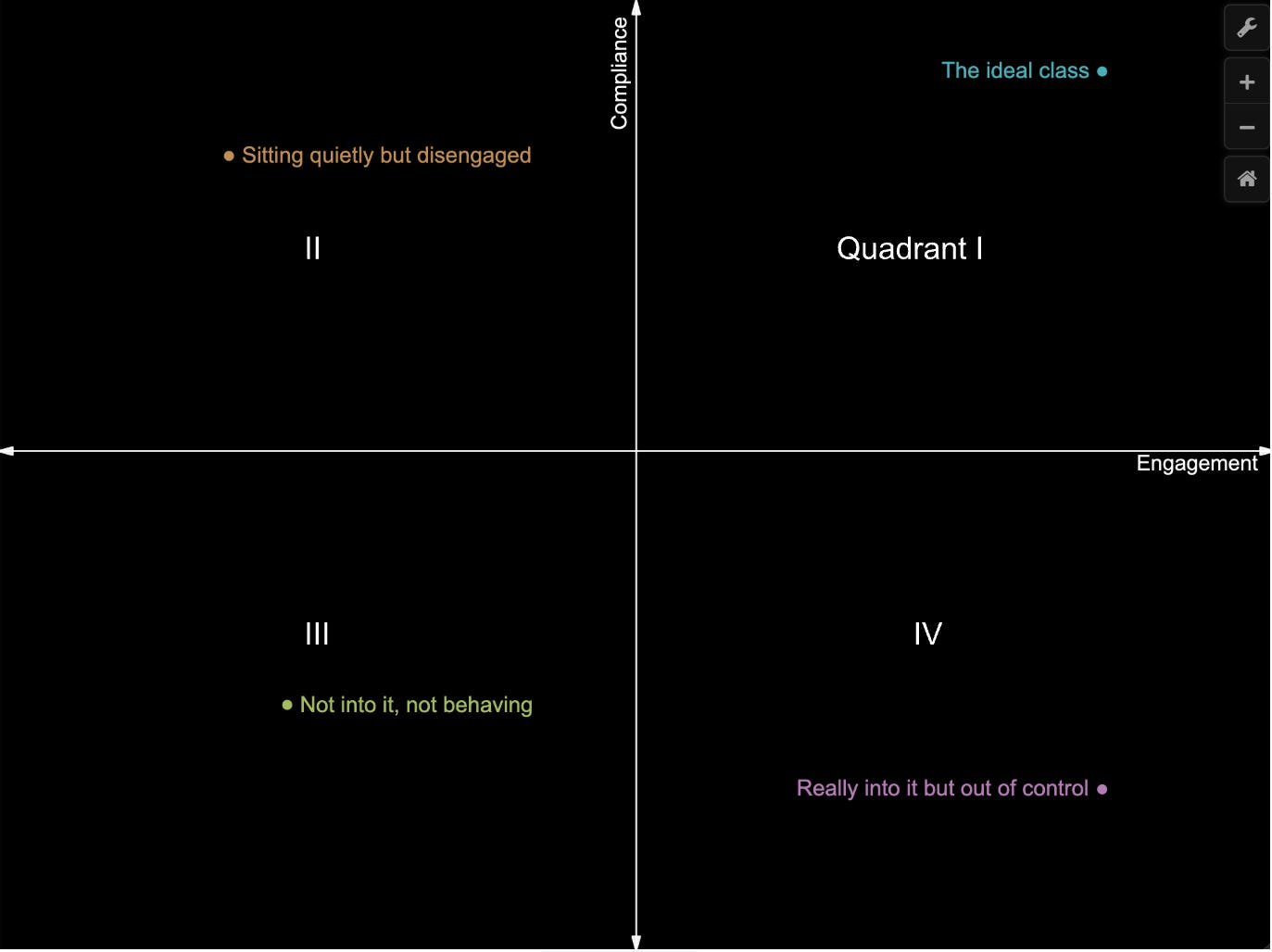
Classes in Quadrant II are the ones where students are quietly doing their work – usually a worksheet – but maybe not getting much out of it. Sure, they can follow directions, but can they explain the math they’re learning? Do they have any interest in what they’re learning? Classes that lean too heavily on compliance risk making students hate math. These are the classes that make people think math is all about memorization and right answers, that it’s boring and irrelevant to daily life.
Classes in Quadrant IV are like the one I was in last week, but if the teacher didn’t have control. If that boy who was a little too into it had started a fight or derailed the game, we’d be saying the teacher had lost control.
And I think we’ve all been in a class in Quadrant III. That’s the one where the students are on their phones or talking, not doing their work, listening to music, or otherwise checked out. They’re not compliant and they’re not engaged. Picture Michelle Pfeiffer at the beginning of Dangerous Minds, or any of those other 90s movies where the hero teacher transforms an unruly class (before the transformation, obviously).
I’m not sure I have a point here, other than to say let’s stop defining students as engaged or compliant. They can be both. While we’re at it, let’s also stop judging based on appearances. That class I was in seemed like it might have been off the rails, but the students left it stronger mathematicians than when they went in. And that’s really what the whole point of this is.
Thanks for reading Make Math Make Sense! This post is public so feel free to share it.
No posts
Comments
Nothing yet. Say the first thing.
Sign in to join the conversation.