
Dear friends,
A confession: I am writing this with my Claude tab open.
Not because I can't write without it, but because—somewhere in the past year—this artificially intelligent tool has seeped into my writing process. "Can you give me five words for 'thriving'?" I'll ask. "Does this email strike the balance between clear and kind?" Sometimes I'm looking for a nudge to get unstuck; other times it's a bigger ask: "Can you polish and tighten this draft?" My whole body sighs in relief.
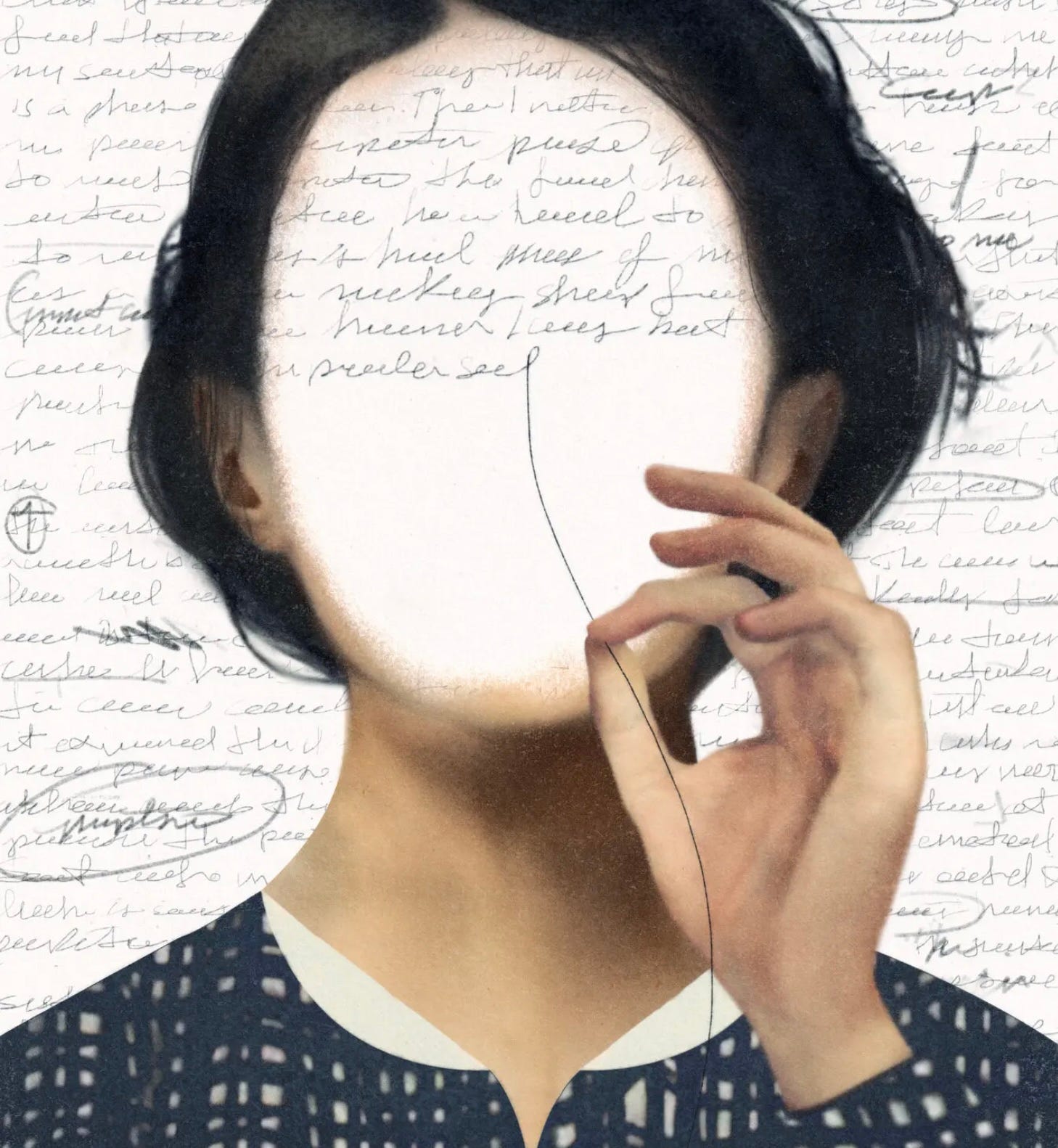
What started as occasional consultation has evolved into something more —an intimate dance that feels equal parts energizing and...disconcerting. It helps rev my engine when I don't know where to begin, and gets me over the hump when I'm ready to quit—but I can't ignore the sinking sense that something essential is being siphoned out in the process.
As I trust the machines more, am I trusting myself less?
I've started second-guessing instincts I never used to question. Subject lines, sign-offs, word choices I would have made without thought—suddenly everything feels optimizable, which is kryptonite for the perfectionist in me. How many times have I started with AI's draft and found myself endlessly whacking through its brambly thicket, having lost track of what “me” even sounds like?
This week, Meghan O'Rourke Rourke published a piercing piece in the NYT about AI’s “solicitous creep into our interior lives”. She captures what I've sensed but couldn't name—that “seductive cocktail of affirmation, perceptiveness and duplicity” I feel when working with something that "mimics human interiority" without actually experiencing it.
As O'Rourke writes, only after sending an AI-drafted email did she realize, "It did not articulate what I myself felt....it was as if a ghost with silky syntax had colonized my brain."
I feel this viscerally—the sense of AI's presence having taken up residence in my mind. Even as I type these words, I'm aware of the temptation on the next tab—to ask for help finishing this very thought, to let the machine complete what my mind is still working through.
In our house (and car) these days, I'm noticing how often we turn to ChatGPT to answer our questions—from the universe's rate of expansion to whether raspberries can grow in Berkeley. There's satisfaction (and delight!) in the immediate reply, but something is lost, too, in our subtle awareness of its omnipresence. We can’t unknow that it’s everywhere now. But for my boys there’s nothing to unknow — this is simply how the world works. Their only shock is when AI can't answer a question. For them, this isn’t a tool they’ll learn to use—it’s the operating system itself.
And yet.
Here's what's also true: AI is stoking my love of writing. By making the hard parts easier—structuring, formatting, getting past blank-page paralysis—it's given me more energy for what I actually delight in: connecting ideas across disciplines, blending head and heart, unearthing truths I didn't know I knew.
What if AI isn’t diminishing our humanity—but revealing it?
The key seems to be a conscious collaboration—holding on to the sacred human work of considering, feeling, wrestling (and even resting) with uncertainty, and only then asking for help.
What I've learned through decades of sitting with my mind: not knowing is the doorway to transformation. But when we mistake efficiency for ease, we deny ourselves the truly liberatory practice of finding comfort in the discomfort, not its resolution.
Of course, the implications for school and learning are seismic. Students have started cofessing: "College is just how well I can use ChatGPT at this point." If this doesn't signal an existential crisis, I don't know what does.
But here's my take: AI isn't breaking education—it's revealing where our approach to schooling was already broken. For generations, we've been training what amounts to about 5% of our cognitive capacity—the part that memorizes, regurgitates, recites. What if we reimagined AI as a disembodied brain in a jar, handling the computational heavy lifting so we can focus on the other 95%—the uniquely human work of discernment, vulnerability, and meaning-making?
This is exactly why we're building The Flight School—to help young people cultivate an inner compass as their most trustworthy tool. To practice sitting with not knowing until they discover what they actually think. To trust their own voice, even (and especially!) when it's less polished than the machine's bland competence.
Because the measure of our freedom isn't how quickly we can resolve uncertainty, but how adeptly we can embrace it.
It comes back to the power of the pause—that precious space between stimulus and response where our humanity resides. AI offers to collapse that space, to move us efficiently from question to answer, from half-baked idea to fully formed essay. But it's in the not knowing where learning happens, where we discover not only what we think, but who we are.
The real practice isn't learning to write with or without AI, but learning to engage our full humanity in response to it. To become more present, more discerning, more awake to the miraculous gift of our own consciousness.
The machines are getting better at mimicking our intelligence.
Will we take the opportunity to get better at being human?
With fiercely human hope,
Abby
A few things keeping me human this month:
Reflecting on the transformative power of the Hoffman Process and how much it taught me about breaking old patterns. The secret's out with Oprah's endorsement ; )
Writing from prompts chosen at random from Suleika Jaouad ‘s Book of Alchemy to open the creative channel
Listening to Father Gregory Boyle – he is love made visible. This conversation with Dan Harris Harris feels urgent: What if we changed the question from "Is this person good or bad?" to "Are they well?"
Learning from Joanna Macy's prophetic life and leadership, even in her passing. As her dear friend and collaborator Jess Serrante writes: She is everywhere!
Comments
Nothing yet. Say the first thing.
Sign in to join the conversation.