
Dear Friends,
We’re living through the fastest technological acceleration in human history. And we’re asking the wrong questions.
What can AI do? (vs. What problems need solving?)
How fast can we build it? (vs. What’s wise to build?)
Does it scale? (vs. What kind of future do we want?)
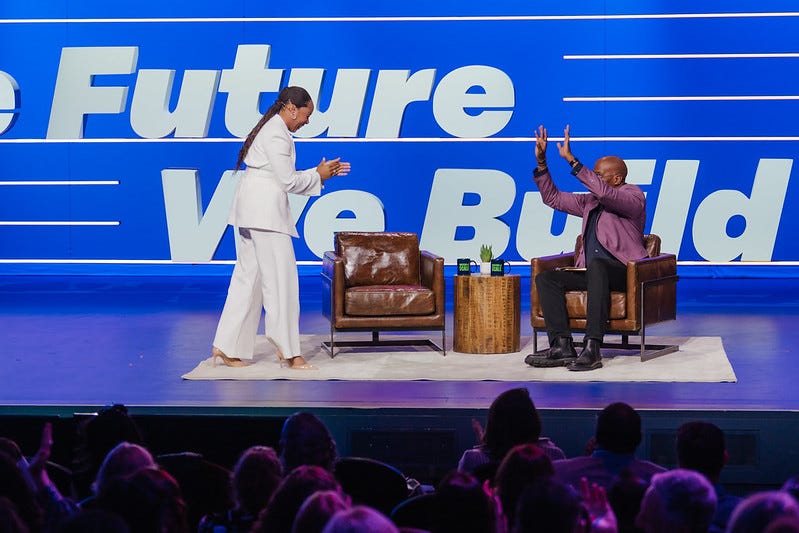
Last week I had the opportunity to attend the Masters of Scale Summit, surrounded by some of the world’s most ambitious builders. The energy was palpable—billion-dollar ideas. Exponential growth. AI breakthroughs – in gene editing, military technology, animal communication – that will reshape civilization as we’ve known it.
But a question kept gnawing at me—one I’d recently heard Harvard philosopher Michael Sandel and tech ethicist Tristan Harris of the Center for Humane Technology pose:
How would an enlightened society approach this transition?
Many of our most celebrated entrepreneurs are optimizing for what’s easy to measure: quarterly earnings, efficiency gains, competitive advantages. But too often it’s at the expense of what matters more—dignified work, meaningful connection, and lives worth living.
Sean White, CEO of Inflection AI, said it perfectly: “We’ll get what we’re aiming for. So, is the goal AGI? Or human flourishing?”
Right now it feels like we’re not even pausing to aim.
When Andrew Ng, who co-founded Coursera and Google Brain, was asked about his most aspirational vision for AI, he didn’t skip a beat: “Just go build, build, build!”
The applause was thunderous—and telling.
As an entrepreneur, I get it. There’s something intoxicating about summoning new things into being. The urgency. The audacity. The sense of possibility.
But we’re treating AI like a solution searching for problems—caught in an arms race that can’t end well.
We’re acting like we have time to break things and fix them later. But we don’t.
At every turn, the conversation was about speed, scale, and removing friction—especially the human kind.
“Government should be AI first.”
“The problem with education? The teacher at the front of the classroom.”
“The beauty of crypto? Taking humans out of the loop.”
I sat in the theater like a tuning fork—tracking resonance and dissonance, sensing the spirit beneath the words. Phrases like “one throat to choke,” “loneliness is profitable,” “we just need sharper elbows”—rolled off tongues without a second thought, but landed in me with an incongruous thud.
These aren’t fringe voices. They’re people actively building one version of our future—what the late and prophetic Joanna Macy called our “Business as Usual Future.”
The words we use create the worlds we inhabit. They aren’t just metaphors – they’re blueprints. And blueprints determine what gets built.
The most jarring moment for me was during a session called Today’s Choices, Tomorrow’s Leaders.
The president of Alpha Schools took the stage alongside a seventeen-year-old student—living proof, he said, of the model’s early success. In just months, the student had built an AI-powered teddy bear therapist for children. Today, he was announcing he was seeking investors. His intent was earnest, but the performance was deeply disconcerting: not a mention of the implications of outsourcing kids’ emotional support to algorithms.
The crowd applauded his hustle. I shifted uncomfortably in my seat.
Minutes later, the head of content at Sesame Street described decades of deep, empathetic field research—understanding child development, cultural context, and age-appropriate design. The contrast couldn’t have been clearer – a kid optimizing for speed to market, and a seasoned professional optimizing for what’s best for kids.
Here’s what scares me: we’re passing our “build, build, build!” mentality down the generations, teaching young people that success means winning at a zero-sum game.
But the real game is infinite—and it’s not about winning. It’s about playing in a way that keeps the game (and ourselves) alive.
And yet—there were glimpses of another way!
Reid Hoffman, serial entrepreneur, beloved investor and host of the event, didn’t shy away from the hard truth: “Our technological renaissance needs more humanism; we can’t let our humanity fall by the wayside.”
Stan McChrystal, retired four-star general, on what leadership requires: “The common denominator every time I’ve gotten it right? Character.”
Fawn Weaver, entrepreneur and truth-teller, on freedom: “I have all the confidence in the world. And I know this: I don’t know anything.”
Brené Brown, researcher turned cultural force, on emotional intelligence: “Emotional granularity—the capacity to name what we’re feeling—is the only way we’ll understand ourselves and each other.”
These talks weren’t about metrics or valuations. They were human signposts—showing us what it looks like to source, not just build. Drawing from inner capacities, beyond external validation. Listening for what wants to emerge, beyond what the market will bear. Channeling what the world truly needs, beyond growth for growth’s sake.
An enlightened society would ask: What are we sourcing? Human thriving or endless productivity? Deep meaning or mindless consumption? Shared abundance or concentrated wealth?
From there, we can design what comes next: Reciprocity over extraction. Regeneration over depletion. Enough over more.
As we grapple with our godlike technologies, here’s what gives me hope: What if they prompt us to ask better questions? Not just of Siri or Claude, but of ourselves?
What if AI turns us toward everything it can’t answer—ancient wisdom, human connection, the mysteries that make life meaningful and magical?
Once the technology stops dazzling us, perhaps we’ll rediscover delight, divinity, and what deserves our devotion. Something higher than our metrics, deeper than our algorithms. Something worth aiming toward.
That’s the world I want to build.
One where we slow down before we sprint. Where we aim before we leap. Where mutual liberation—not blind accumulation—becomes our north star.
The question isn’t what to build, or how fast we’ll scale.
It’s what we’re building toward — and why.
With burning patience,
Abby
Listening to Rabbi Sharon Brous bring moral clarity and fierce courage to our modern moment. My Yom Kippur ritual includes hiking while absorbing her sermons. This exquisite talk calls all of us to the holy work that transcends identity or religious affiliation: Practice grace. Choose humility. Be brave.
Celebrating Joanna Macy’s immeasurable legacy. I had the honor of attending her memorial at Grace Cathedral last week—full of music, poetry, practice, and awe for a woman who lived her life in widening circles. Her family graciously shared the recording.
Learning from Brené Brown’s conversation with Dan Harris on How to Succeed Without Being an Asshole. Sage advice for navigating fear, staying ‘above the line’, and reclaiming sovereignty over our nervous systems.
This piece is part of a new series, Are we asking the wrong questions? About how changing the questions, changes everything.
Comments
Nothing yet. Say the first thing.
Sign in to join the conversation.