
“It feels like a nightclub. I wish it felt like a treehouse.”
Last week at The Flight School, we asked students to choose metaphors for their online lives. I can’t stop thinking about this response.
It points to the disconcerting disorientation I’ve been feeling more and more often: that my mind and body are in completely different places.
Our minds are wired for restlessness—rehashing the past, rehearsing the future. But what's happening now feels different. Our screens don't just distract us; they bypass the need for our minds to show up at all.
The extent of this offloading would shock my younger selves. Google Maps has replaced my spatial memory. Cars drive themselves. AI writes meeting notes and completes next steps. We’re completing increasingly complex tasks without having been present for them.
When we lose connection to our interiority, we lose what makes us human. The capacity to be fully present. The ability to detect signal from noise. The discernment to know when something sounds right but feels wrong.
Technology’s gifts are seductive—ease, support, speed. But as my friend reminds me, we should be suspicious of efficiency. What’s all this so-called optimization costing us?
Everything.
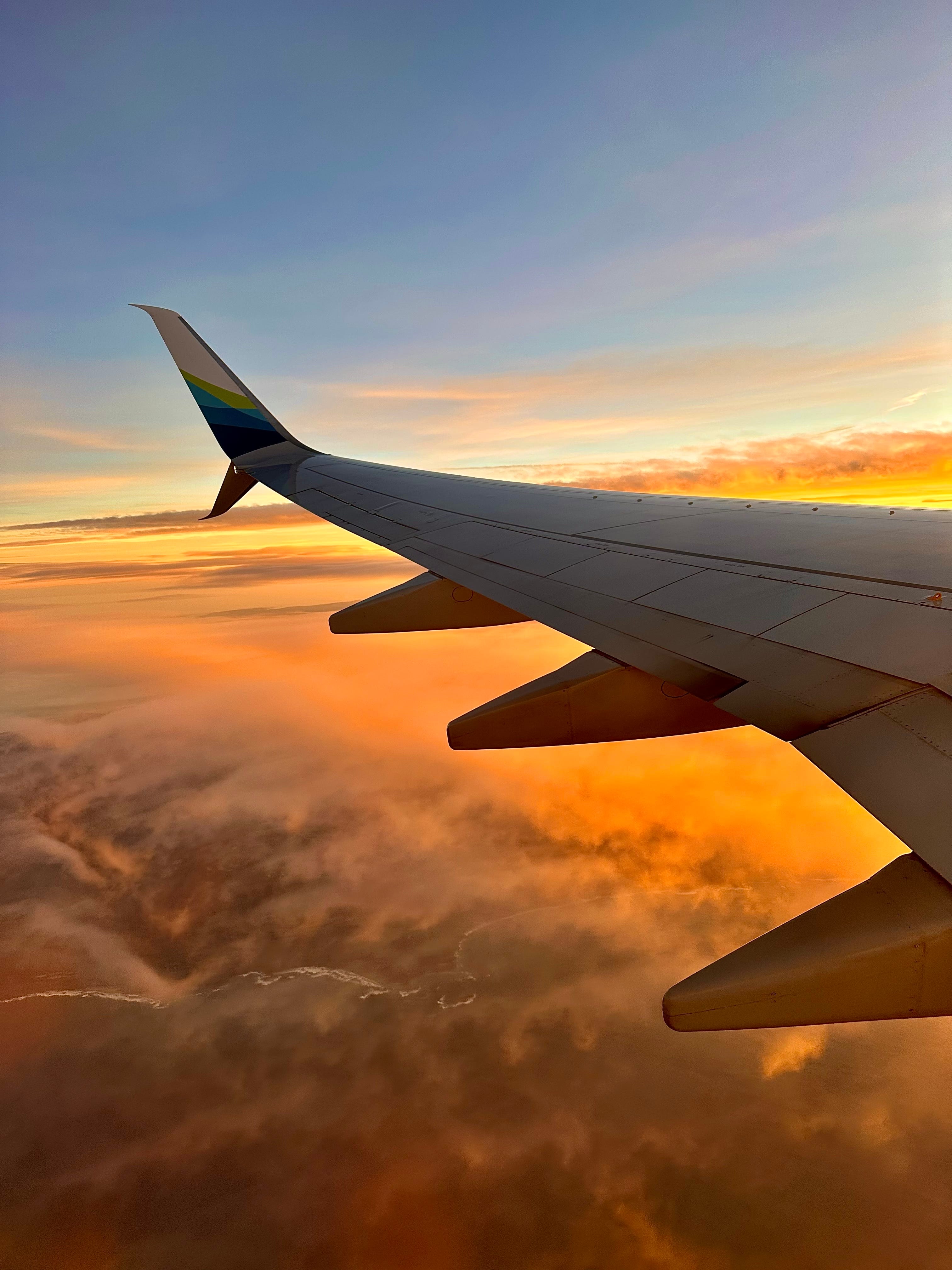
I'm writing from an airplane. I loved "airplane mode" before it became something we had to intentionally toggle. Now I protect it fiercely — I've made a pact to never buy wifi on flights.
But I’d be lying if I said I’m just letting it roll. I’m never not prepared with plane-specific tasks: reports to read, responses to write, blue-sky dreaming about The Flight School that feels most appropriately done from the actual sky.
I used to feel superior watching a seatmate play Candy Crush for hours. Now I wonder are we really that different? Both absorbed in our devices. How much time do I spend actually watching the sky, beyond snapping a photo? Vanishingly little.
There’s a vacancy I’m beginning to notice everywhere. The barista who blankly asks for my name after I’ve just said it —as though I’m an extension of her touch screen. The woman who stopped me for directions this morning—eyes on me, mind in her phone.
We’re all doing it. Looking at each other while not quite here.
What have we done to our minds?
names our modern dilemma exquisitely: “We live in an age of potentially infinite deferral.” Every time discomfort stirs, we can deflect it with a scroll, a notification, a next distraction that queues automatically. He calls it “technologically mediated dissociation”—functional enough to meet obligations, but systematically disconnected from the depths where real transformation occurs.
Feel familiar? Going through the motions without the pulse of feeling. An absence of presence. A presence of absence.
The result? We’re more active and productive than at any time in human history—but existentially hollowed out. Present enough to function, but absent enough to miss the call to descend.
Those of us old enough to remember analog life sense what’s slipping away. Wrestling with an essay in a dimly lit library cubicle. Getting lost at night in the rain without a map. Taking a walk in the redwoods without the silent tug of the demon in my pocket.
What about generations that haven’t known life any other way? What are they losing without knowing it? The writer who never discovers they are one. The artist who never meets their own mind. The knowing that gets drowned out in the numbing.
But gradually, gradually, suddenly—something is palpably shifting. A hunger to reclaim what is real. Articles celebrating the friction of offline life. Books calling for an attention revolution. Gen Z ditching their phones.
We’re stirring from our trance.
Machines will do more and more. We’ll forget how to parallel park, how to navigate without maps, how to write a cover letter from scratch. (I’ve already forgotten everyone’s phone number and how to spell.) But we need to remember what we can't afford to lose: the capacity to sit with uncertainty, to dwell in discomfort, to notice beauty, to witness suffering and actually respond.
This is what I most fiercely want to protect—for myself, my kids, all of us: our allegiance to ourselves, not to the algorithms.
We get better at what we practice. And we’re always practicing something.
So here’s what I’m asking:
What parts of your life are you ready to take offline?
Not forever. Not necessarily for long. But long enough to break the spell.
What sanctuaries are you protecting?
Bedrooms and bathrooms. Classrooms and elevators. Airplanes, sunsets, Saturdays.
What practices bring your mind and body into the same place?
Headstands and eye contact. Cold water and meditation. Singing, sweating, writing Letters from Love.
My hope for 2026? That it’s the year we look back on as our collective awakening. The year we chose presence over productivity, connection over consumption, reality over the feed.
Bringing our minds back isn’t self-care—it’s survival. Time to act as though our humanity depends on it.
Because it does.
A few antidotes:
Attensity! My friend Graham Burnett’s new book launches today. It’s a manifesto for an attentional revolution that treats attention not as a resource to optimize, but as aliveness itself.
Nature Practice: Natasha Deganello Giraudie’s podcast offers “soulful sips”—guided practices that shift our relationship to nature. I’m starting the year with an intention to watch ever sunset — or at least step outside when the sun dips below the horizon. No phone, no photos. Just presence with what one of my teachers calls “the one sky show playing every night.”
What We Can Know: I loved Ian McEwan’s most recent novel—a literary detective story that toggles between 2014 and 2119. Weeks later, I’m still haunted by its questions about freedom, memory, and our digital lives.
How to End Your Extremely Online Era: Tommy Dixon holds up a mirror to our online lives and provides practical nudges for anyone ready to take more of their life offline. He predicts a future where "You still scroll?" will sound like "You still smoke?!"
If you’re new here, welcome!
Taking Flight, this is a space where I share monthly-ish provocations, prompts and practices that might help us remember what matters most. It’s offered freely (no paywall, ever) and if what you read resonates, I hope you’ll share it freely, too.
I started writing here a year ago, and it’s been a delight to feel this community grow.
If you’re exploring for the first time, a few favorites from 2025:
Comments
Nothing yet. Say the first thing.
Sign in to join the conversation.