
Lately, it feels like everyone is thinking about their relationship with technology.
We’re more aware than ever of the costs of constant screen time — the toll on our attention, our mental health, and our relationships. Conversations about digital wellness are everywhere, and many of us are actively searching for ways to spend less time glued to our technology.
And yet, we’re still living through a technological revolution. AI is reshaping how we learn, work, and understand the world around us. Among my peers, this contradiction has produced a familiar, uneasy question: Wait… are we okay?
The reactions to that question vary dramatically. Some people are pushing technology further and further away, while others are embracing innovation as inevitable and necessary. Caught between these extremes, I’ve been asking a different question: what if the choice between “going analog” and engaging with innovation is the wrong one altogether?
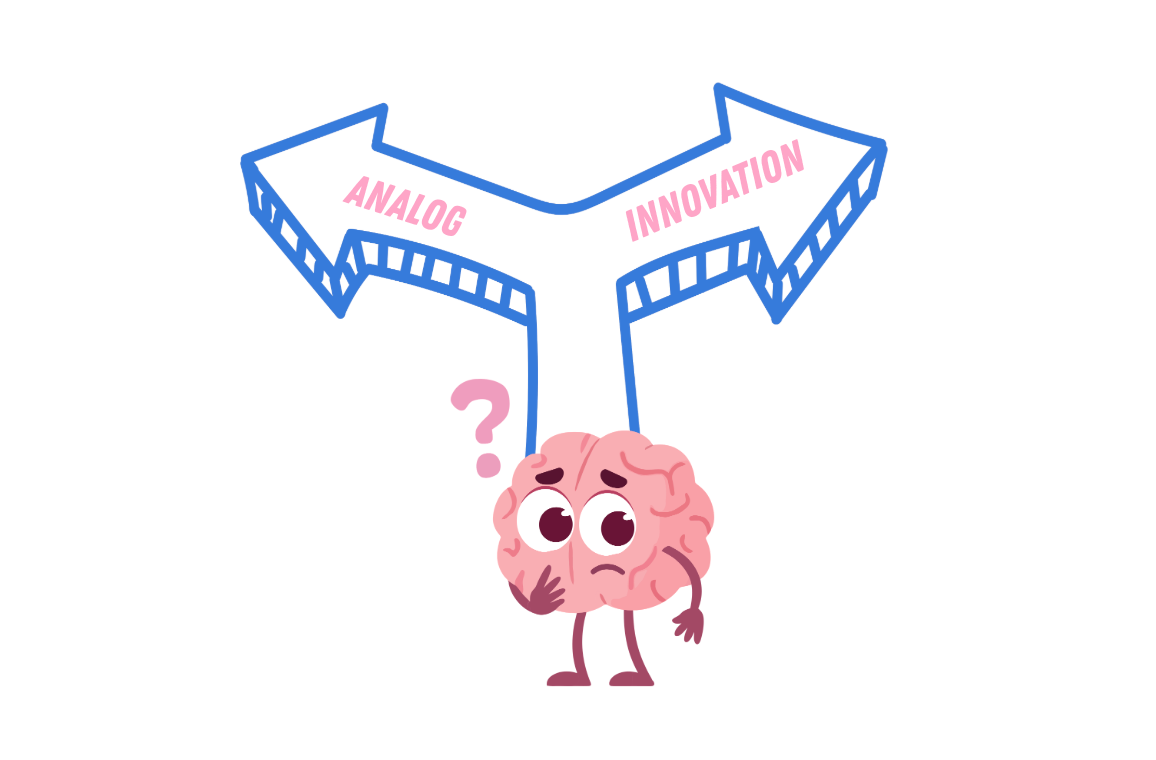
One cohort of people is trying to majorly reduce their use of tech. I’ve been intrigued by the growing movement of “going analog” – buying flip phones, picking up “granny-hobbies” like crocheting and mahjong, joining poetry clubs, and romanticizing a slower, more tactile life. (Side note: it’s funny that this trend is itself trending because people are posting about their decision to go “analog” on social media. I love the irony…and it’s also a perfect example of the tension I’m unpacking here.)
At the same time, others feel this age of innovation has great positive potential, and they are changing their careers or whole ways of life to accommodate more technology. Friends from all sorts of academic backgrounds are hopping over to startups that use AI to streamline systems, are buying more wearables, and are excited by new products that will optimize, track, and automate all types of things.
Even within my inner circle, I see this difference clearly. Some friends want nothing to do with AI and feel disappointed in people who use it. Others are building their entire personalities around AI and wearables. It seems like there’s a choice to be made about where I stand. But neither of those vibes feel like me.
So how do I make sense of this moment? And more importantly, how should we all be acting within it – as individuals, and as a generation?
In December, I made a 2026 bingo board on which I wrote down all types of goals for the new year, like running a half marathon, being a good plant mom, and spending time with family. Looking back at the whole board, I found two goals that seemed to be contradictory: lower my screen time and become more AI literate.
On the surface, those seem completely incompatible with each other. But to me and my generation, they both are essential. We have to hold space for both technological learning and screen-free time.
Because…
If we were to completely reject AI – never experiment with it, never learn how it works, never try to understand how it’s reshaping our information ecosystem – we’d be choosing ignorance in a world that’s rapidly changing. AI-generated content is already blurring the line between real and fake, with serious implications for trust, democracy, and shared reality for all humans. AI is already having tangible effects on childhood development and education, something we really can’t ignore if we want our children to grow up well adjusted. Disengagement doesn’t protect anyone from those realities, it simply leaves fewer people equipped to notice and speak up when something is wrong. And for Gen Z, we are beginning our careers in a workforce environment where using AI for efficiency is the expectation, so disengagement could have dramatic effects on our professional outcomes.
And…
At the same time, if I spent all my time immersed in technology, either using it or thinking about the consequences, my mental health would suffer, my creativity would shrink, and my social wellbeing would erode. And if we, as a society, continue to accept all innovation as inevitable and necessary, we could miss more important unintended consequences that arise from unethical innovation (like deepfake harms for women and girls, chatbot dangers, and environmental damages, etc).
Obviously, I’ve romanticized throwing my phone into the Hudson River, putting on a flowy skirt, and crocheting barefoot in Prospect Park until the sun sets. But in reality, I have a job, need to make money, and have family members that I want to be able to FaceTime.
When I sat and thought about how I can cross off these two bingo board goals by the end of the year, I noticed that what I wrote is too simple. My goal can’t really be centered on the time I spend on AI or technology. It should be about being intentional with that time – choosing balance, discernment, and responsibility in a world that rarely encourages any of those things.
I can be a person who spends my Saturday barefoot in the park until the sun sets with my phone turned off (not thrown into the Hudson River), while spending my Sunday doing AI literacy modules, reading about how we can make AI more sustainable, and uplifting the good actors who are trying to prepare us for what’s ahead. And maybe I scroll just a little bit on Monday…it’s a process, people!

(That brings me back to how “going analog” and “digital detox suggestions” are trending on social media. While it’s easy to roll your eyes because of the irony, I do think it’s cool that some creators are encouraging people to reconsider their habits. If their content causes people stop in their scroll and think, “oh yeah, maybe I should go outside today,” then that’s a win. That’s meeting people where they are at.)
For me, I’m at the point of really trying to avoid the brain-rot and instead be as intentional as possible with how I’m spending time with tech. Getting into this mindset has helped ground me and sooth my day-to-day anxieties (AI-anxiety, climate-anxiety, and generalized anxiety – triple whammy!).
On a bigger level, we should be thinking about how to support ethical innovation.
At Civics Unplugged, we run a lesson during our Fellowship called “Is English Class Dead: Education in the Age of AI.” We ask our young leaders, many for the first time, to pause and think critically about the risks and benefits of AI in their classrooms and for homework, all the way up to alternative schooling completely powered by AI. They read case studies of teachers who are having their students interact with ChatGPT’s written content and figure out its power and limitations. They learn about entire schools that are adopting AI powered instruction (AlphaSchool) and think about what outcomes should be considered when deciding whether or not it is an ethical innovation.
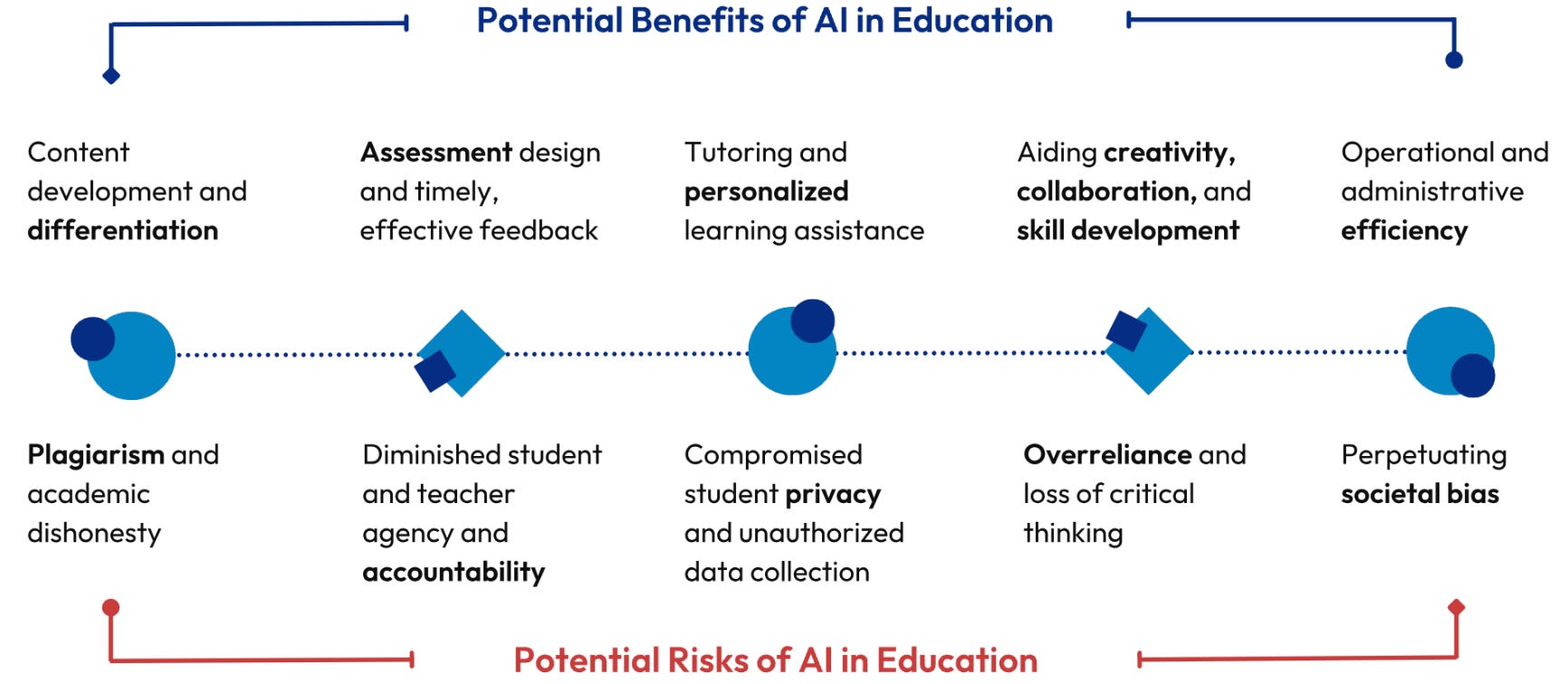
Innovation, or AI itself, isn’t inherently the enemy. In fact, we desperately need innovation in healthcare, in government, in education, and so on. The important question is whether the power of these technologies is being used in ways that actually help communities, or whether it’s doing more harm than good.
That’s not something that can be resolved in a single Substack post. But it is something we should all be thinking about more seriously. What do you know about AI, and how could this innovation intersect with (or even solve) problems in your community? There absolutely will be tradeoffs and nuance, but that shouldn’t be a reason to shy away from the conversation altogether.
If only I could have fit all of this on my bingo board! (Lol.)
“Analog” and “Innovation” need to be balanced by intention if we want to build a positive personal and collective future. It’s an ongoing practice that requires regular check-ins with ourselves and the world around us.
Lately, here are some questions that I am using to help me explore this:
Am I using AI in a way that is enhancing or hurting my creativity and intellectual agency?
Am I working to understand what’s going on in the background of the AI systems?
Am I being a passive consumer of innovation without realizing it? Can I learn more about the “why” behind certain innovations?
Am I flexing my attention span muscles?
Am I spending time outdoors, with friends, reading books, and trying new hobbies, or am I reaching for my phone out of habit?
I hope you will join me on this journey! It’s ok to take small steps. I love this quote from an article I read: “You can’t go from 3 hours of daily scrolling to 3 hours of reading War and Peace – just like you can’t go from lifting 5 kilos to lifting 50.”
Even when it’s inconvenient or uncomfortable, we have to stay sharp and curious about tech innovation, while still making time to frolic in the park.
For now, this feels like a good place to start.
— Have other thought provoking questions you are using to help yourself or others navigate this time? Drop them in the comments!
No posts
Comments
Nothing yet. Say the first thing.
Sign in to join the conversation.