
Above, I have included a recording of myself reading this article, in case you want to listen to it podcast style. I love storytelling, so thank you for giving me the space to do so!
My sister recently came back from Japan and told me something that challenged me. Apparently, if you take a to-go cup from a café, you can’t throw it away in another business’s trash. Japan taxes garbage by business, so each shop limits the waste it holds. Take a cup with you, and you’re carrying it home. The result: way less takeout culture. People actually sit in the café.
My brain lit up. Yes. That’s it. People taking a moment to sit. People sharing space instead of retreating to their apartments with DoorDash bags. Community!
“No,” my sister cut me off. “They actually have a really bad loneliness crisis. Everyone is sitting in the café alone, heads down, watching their phones.” Almost half of Japanese nationals have experienced loneliness and isolation1.
So much for cracking the connection code.
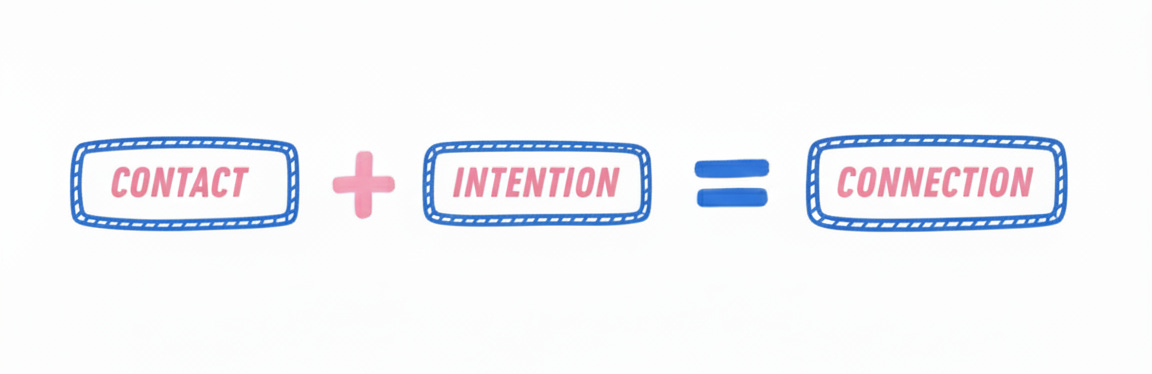
Here’s what that story made me realize: when thinking about solving the loneliness crisis, we often talk of getting people back into the room with one another. But I think we are at risk of forgetting that contact is not the same as connection.
Contact is proximity — the cashier handing you change, a stranger’s shoulder on the subway, your roommate passing through the kitchen. Connection is something that requires contact plus intention. It needs a moment of actual acknowledgment — of two people briefly choosing to see each other.
Connection doesn’t spontaneously generate. (Cue the maggots from meat visual from high school bio class.) You need both the opportunity and the will to reach toward it.
This is why the Japanese café doesn’t solve anything on its own. People are physically present, in contact, sharing space — but there’s no intention behind it. No one is actually reaching. So no connection happens, and everyone goes home just as alone as they arrived.
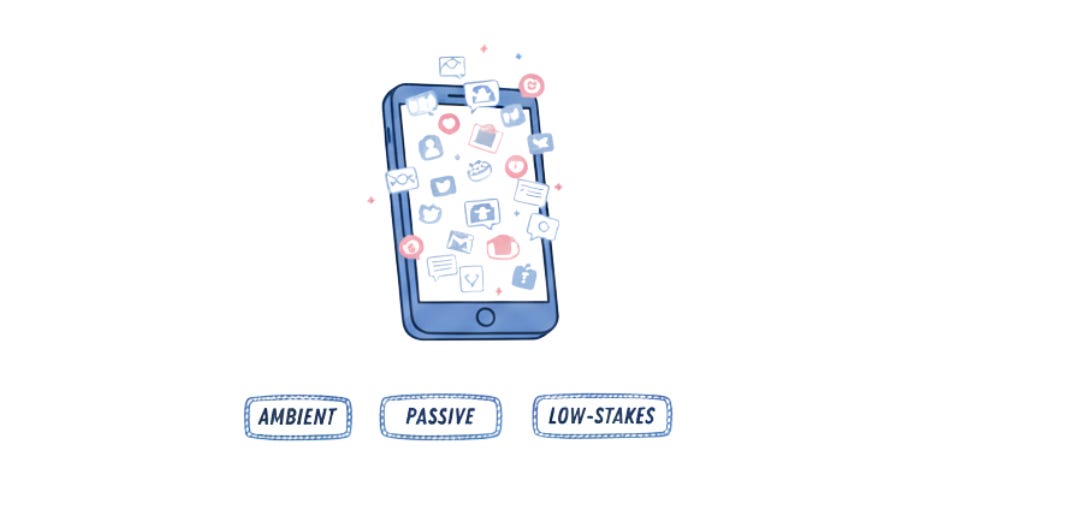
What makes this so hard right now is that modern life has handed us a paradox: we are drowning in contact and starving for connection.
Our phones ring constantly. We can see what everyone we’ve ever met ate for lunch. We’re technically “in touch” with hundreds of people at any given moment, but almost none of that contact carries intention. It’s ambient, passive, low-stakes in the worst way — giving us just enough social stimulation to take the edge off the hunger without actually feeding it.
It’s easier to just keep going back to the phone “for a snack” than to plan your next full “meal of connection.” You’d have go to exert more energy: think about the ingredients, go the grocery store, prep it all, and cook before you can eat. So I don’t blame us when we’ve been being told by society that optimizing for convenience is better.
From experience here in NYC, the spaces that used to house the potential for the right type of contact if we brought the intention have been quietly redesigned. The neighborhood restaurant counter that once buzzed with regulars is now stacked with to-go containers. The cashier you used to chat with has been replaced by a self-checkout lane. Ordering on kiosks, delivery apps, ghost kitchens — all of it is more convenient, and all of it costs us something we didn’t fully notice we were losing: the small, unremarkable friction of having to interact with other people.
We didn’t consciously opt out of community. It just got quietly rerouted around us. But we can consciously route back.
I’m not here to tell you to delete Instagram or cold-call an old friend you haven’t spoken to in four years. That advice is well-intentioned and also deeply exhausting to hear for the hundredth time. Those tasks feel too large when your connection battery is at zero.
What I want to talk about instead is something much smaller: the micro-connection.
A micro-connection is exactly what it sounds like — a tiny, low-stakes moment of choosing to see and converse with another person. Commenting on someone’s jacket in an elevator. Asking the person making your lunch how their day is going, and actually waiting to hear the answer. Making eye contact and smiling at a neighbor instead of staring at your phone while you wait for the elevator. A sincere “how are you — really?” to someone you see every day but never actually ask.
These moments feel almost embarrassingly small. But they’re not.
Dr. David R. Hamilton, the author of The Joy of Actually Giving a F*ck, describes how micro-connections produce measurable biological shifts: oxytocin and dopamine levels rise, cortisol drops. Your nervous system genuinely responds to these brief moments of human acknowledgment. Not dramatically and not all at once — but over time, consistently, the way small deposits quietly build into something real.
The loneliness we’re feeling didn’t arrive overnight either. It accumulated gradually, as one small human interaction after another got replaced by a screen or a machine or an app.
The path back is probably the same: gradual, small, incremental.
Here’s the mindset shift that might help: most people actually want to be talked to. We’ve somehow absorbed the idea that approaching strangers is cringe, that people are annoyed by small talk, that everyone wants to be left alone. But that’s mostly not true. Most people are lonely too, and starved for the same thing you are.
Try it for a day. Talk to someone in the elevator. Comment on the weather to the person next to you in line. Ask your server if they have any exciting plans for when their shift ends. You might get a one-word answer. You might feel briefly awkward. That’s fine — awkward is survivable, and it gets easier.
The goal isn’t to have a profound conversation with every stranger you meet. The goal is just to practice choosing intention over autopilot. To notice that there are actual people around you, and to occasionally let them know that you noticed.
That’s where our journey back towards connection can start.
And maybe, with enough practice, those micro-connections re-charge your battery enough to call that friend you haven’t seen since childhood.
Source: https://www.japantimes.co.jp/news/2025/12/12/japan/science-health/loneliness-isolation-survey/
Comments
Nothing yet. Say the first thing.
Sign in to join the conversation.