
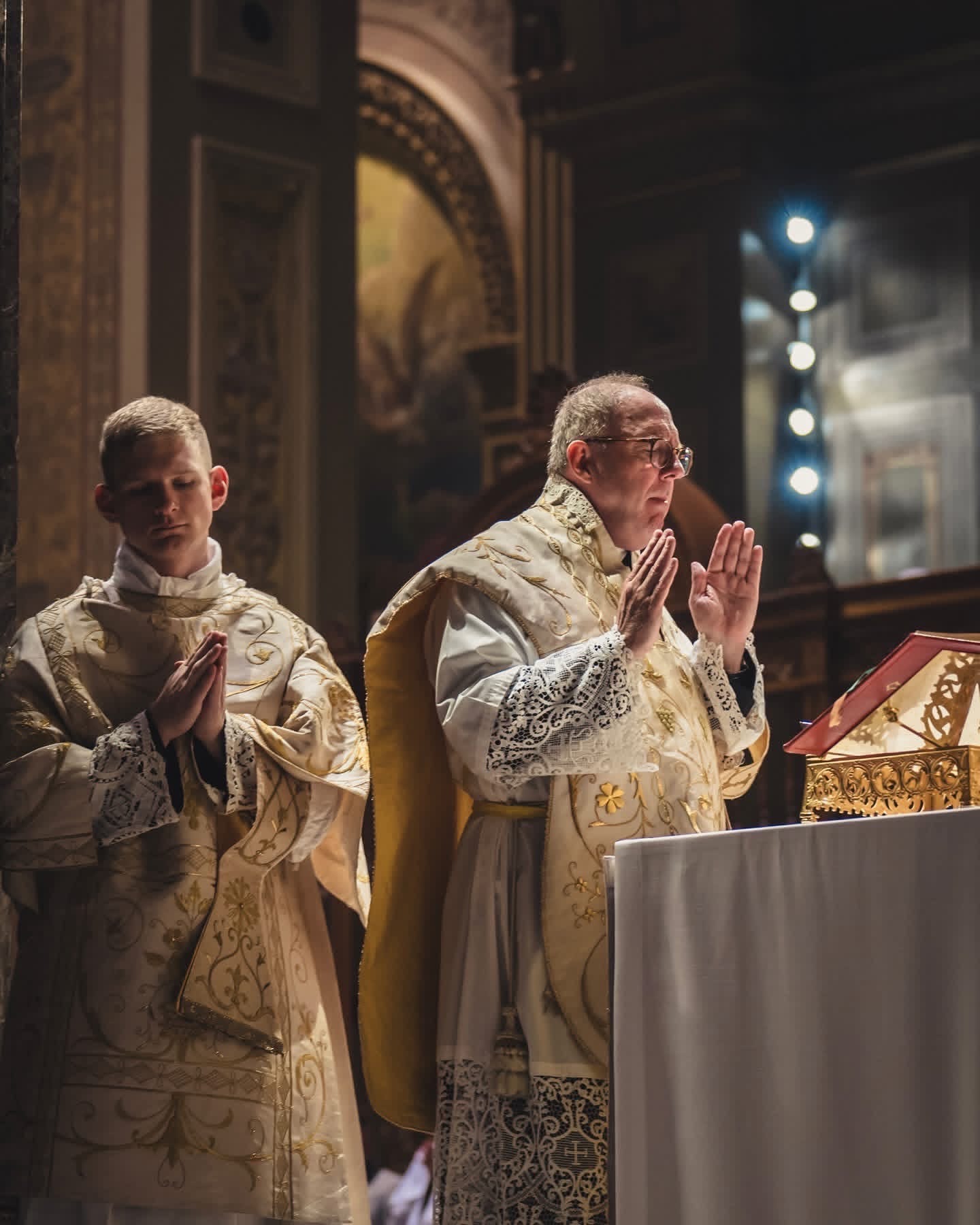
The Apostles clearly instituted an altar and a priesthood that directly mirrored the Temple structure of the Hebrew tradition, establishing a continuity of sacrifice that Modernists seek to obscure. To understand the early Church, one must recognize that an altar is an entirely different thing than a dining table, and a first-century Jew would have known the difference.
The Sacrifice of the Eucharist would have happened at a dedicated blessed altar with the ritual exclusion of catechumens and ornate liturgy, conducted perhaps even in a separate room in the house. Given that Roman houses of the period all had oratories with altars, these spaces could easily have been used for the solemnity of the oblation. Once the sacrifice was completed, they would move to the dining area to bless their food and eat together. There is simply no reason to conflate these two parts of the original direction from the Apostles; the Eucharist and the Agape were separate things from the very beginning.
Scripture and the Church Fathers bear witness to this essential distinction. In the Epistle to the Hebrews, the author explicitly states, "We have an altar from which those who serve the tent have no right to eat," establishing a blessed altar that is exclusive and sacrificial. St. Paul further clarifies this in his first letter to the Corinthians when he rebukes the community for their disorder. By telling them to "eat at home" if they are hungry, he makes it clear that the Sacrifice of the Eucharist was not essentially tied to the Agape meal and that they were not ritually coupled.
The meal was not ritualized, it did not have a Seder-style liturgy to follow, and it was never considered part of the Sacrifice of the Eucharist. St. Clement of Rome, writing in the first century, reinforces this by noting that the Lord commanded offerings to be performed at appointed times and by specific ministers, directly echoing the High Priest, priests, and Levites of the Temple. Likewise, St. Ignatius of Antioch warns that being "outside the sanctuary" or "outside the altar" means being deprived of the Bread of God, emphasizing a localized, sacred space of sacrifice.
Modernists like to imagine that the early Christians blessed all the food and, while sitting at a common table, they just whipped out the Eucharist, blessed it with the same Jewish table blessings, and had a nice meal. This was never the case, even from the time of the Apostles. This Modernist imagination ignores the distinction between the "Holy of Holies" atmosphere of the Eucharist and the social charity of the Agape.
The offering of the Eucharist was always a separate ritual that followed the Temple attitude of the High Priest entering the sanctuary. It was a formal act of the priesthood, performed at an altar, requiring a separation from the world that a common dining room could not provide. By maintaining the separation between the altar in the oratory and the table perhaps in the dining area, the early Church preserved the sacrificial nature of the New Covenant as the true fulfillment of the Hebrew tradition. Because the meal was not ritualized and held no sacrificial character, it was naturally discarded as the Church grew and the practicalities of maintaining such feasts became a burden or a source of disorder.
Image courtesy of Latin Mass Photographer
Comments
Nothing yet. Say the first thing.
Sign in to join the conversation.