
The Connecting Point (TCP) | Words: ~1,566 | Reading time: 7 minutes
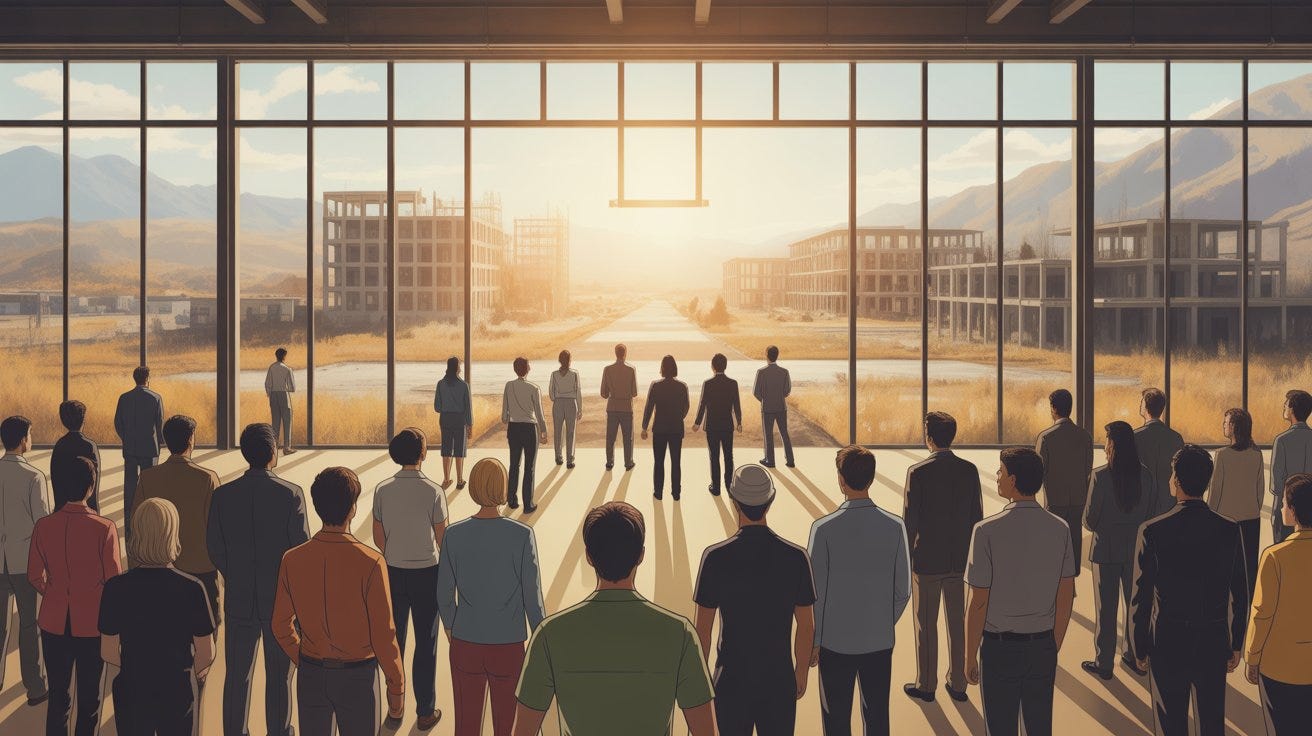
Most people experience disruption as loss first.
The layoff. The reorg. The leader who quietly relocates. The team that gets disbanded. The product that gets sunset. The industry that shifts underneath you while you’re busy doing your job well.
Only later—sometimes much later—does the same disruption reveal what it actually cleared the ground for.
We’re watching this pattern play out in Silicon Valley right now; loudly, publicly, and at a speed that makes it impossible to ignore. But Silicon Valley is the accelerant, not the exception. The same dynamics are visible in every industry being reshaped by AI, in every region where capital is concentrating or retreating, in every organization discovering that the governance frameworks it built for a stable world don’t work in a destabilizing one.
The billionaire exodus made the pattern visible. The pattern itself is everywhere.
And the question it’s forcing—who fills the void when power exits, and what do they build—is not a Silicon Valley question. It’s the question of this moment, in every sector, in every region where disruption has cleared the ground and left people deciding whether to wait or move.
Let’s be specific about what disruption clears, using Silicon Valley as the example, because nowhere else makes the pattern more visible right now.
When capital concentrates at the top of an ecosystem, it shapes everything below it — which problems get funded, which voices get amplified, which solutions get built, which risks get taken and which get avoided.
Silicon Valley’s founder-worship era wasn’t just a cultural quirk. It was a resource allocation system. Attention, capital, talent, and narrative all flowed toward a remarkably small number of people making a remarkably large number of decisions.
That concentration is loosening.
Not because the people who left had a change of heart. Because mobility, once used as leverage, creates a vacuum and vacuums get filled. The question is by whom, with what values, and on what timeline.
What’s opening up:
Decision-making space that was previously occupied by founder mythology is now genuinely contested. Organizations that run on a single visionary’s risk tolerance are discovering they need distributed judgment. That’s uncomfortable and it’s also an opening for people who’ve been developing judgment quietly, without the title to match.
Governance architecture that was never built because the founders didn’t need it and investors didn’t require it and now has to be constructed from scratch. Someone has to build it. The people who understand where systems break, who’ve watched gray-zone decisions get made badly for years, are not starting from zero.
Narrative authority about what Silicon Valley is and what it’s for is up for grabs in a way it hasn’t been in decades. The people who stay—who remain embedded in the region’s institutions, communities, and networks—now have standing to shape the story that the people who left no longer do.
None of this is automatic. None of it is guaranteed. But it’s real.
Here’s what I want to resist in Silicon Valley and everywhere else where this conversation is happening: the idea that reinvention looks one particular way.
The exodus narrative has a shadow version that’s just as reductive as the original — the story where billionaires leave, workers rise up, and Silicon Valley emerges as a more equitable innovation ecosystem. Neat. Satisfying. Unlikely to unfold that cleanly.
Real reinvention is messier, more plural, and more dependent on individual decisions made under uncertainty than any macro narrative captures.
I’ve participated in this scenario before. When semiconductor manufacturing left Silicon Valley in the late 1970s and 1980s—accelerating through the 1990s as global competition intensified—the people who stayed didn’t follow a single reinvention script. Some pivoted into adjacent industries. Some built new expertise on top of what they’d already developed. Some started over entirely. Some absorbed the loss and rebuilt slowly, without fanfare. Some left eventually, after the window had already moved.
What distinguished the people who navigated that transition well wasn’t that they saw it coming or that they had a perfect plan. It was that they understood their own relationship with uncertainty well enough to move intentionally rather than reactively.
That’s a specific skill. It’s not evenly distributed. And in a moment like this one, it matters more than almost anything else on a resume.
Let’s name both honestly, because anyone selling you only the upside of this moment isn’t serving you well.
Organizations rebuilding governance structures need people who can design for ambiguity, who understand that AI systems produce ranges, not binaries, and that the frameworks to manage them have to be built for that reality. That expertise is rare and it’s in demand.
Companies that lost founder stewardship are discovering they need leaders who can hold strategic direction without a single visionary at the center. Distributed leadership, collaborative decision-making, the ability to build trust across functions were undervalued in the founder-worship era. They’re not undervalued now.
The narrative around what Silicon Valley is for is being written in real time. Workers, educators, community institutions, and practitioners with deep regional knowledge now have standing in that conversation that they haven’t had in years. That’s a form of influence worth taking seriously.
The window is not evenly accessible. People with financial cushion, professional networks, and geographic flexibility can take risks that people without those resources cannot. Reinvention that ignores structural inequality doesn’t produce a more equitable ecosystem — it just produces a different concentration of power.
Moving too early or without sufficient grounding is its own trap. Disruption creates noise. Not every signal is a genuine opportunity. The people who thrive in this moment will be the ones who can distinguish between the two: who can read the terrain clearly enough to know when to move and when to wait.
And the window will close. New concentrations of power are already forming. The governance frameworks being built right now will shape the next decade. The narrative being written right now will calcify into conventional wisdom. The people who move intentionally in this moment will have shaped those outcomes. The people who wait for certainty will inherit them.
I want to push back on something implicit in a lot of reinvention rhetoric: the idea that staying is passive and leaving is bold. This is as true in Detroit as it is in San Jose. As true in a mid-size healthcare system navigating AI implementation as it is in a Silicon Valley startup losing its founder. The geography changes. The calculus doesn't.
Staying in a destabilizing environment—and choosing to build something in it rather than waiting it out—requires a specific relationship with risk and pace that doesn’t get named often enough.
It requires the ability to tolerate uncertainty without being paralyzed by it. To make decisions with incomplete information. To build trust in environments where the old rules no longer apply. To know the difference between friction that’s telling you something important and friction that’s just noise.
These aren’t personality traits. They’re developed capacities. And they’re not evenly distributed across an organization or an ecosystem which is exactly why some people are positioned to lead reinvention and others, despite talent and experience, find themselves frozen at the moment when movement matters most.
The people who navigate this transition well won’t necessarily be the most credentialed or the most connected. They’ll be the ones who understand their own relationship with change clearly enough to move when the window is open — and to bring others with them.
Silicon Valley is the place where this is most visible right now. But it’s not the only place where the ground has shifted.
Every industry being reshaped by AI is producing the same dynamics: power concentrating or exiting, governance frameworks lagging, and the people left standing deciding whether to wait for stability that isn’t coming or build something in the disruption that’s already here.
The architecture of who leads. Who governs. Who builds. Who gets to decide what the innovation economy is for and who it serves. That redesign is happening right now in Silicon Valley, yes, but also in healthcare systems and financial institutions, in manufacturing corridors and university research labs, in every organization discovering that the old frameworks don’t map to the new terrain.
The people in the room when the new frameworks get built will shape outcomes for the next decade. The people who wait for the dust to settle will find that the decisions were made without them.
I’ve been involved in Silicon Valley’s reinventions long enough to know that the moment after a major disruption is both the most uncomfortable and the most generative. And I've been inside enough disruptive environments to know that's not unique to one region. It’s the nature of the moment we’re all in.
The reinvention window is open. It won’t stay that way.
The question isn’t whether you’re ready. It’s whether you know yourself well enough to find out.

No posts
Comments
Nothing yet. Say the first thing.
Sign in to join the conversation.