
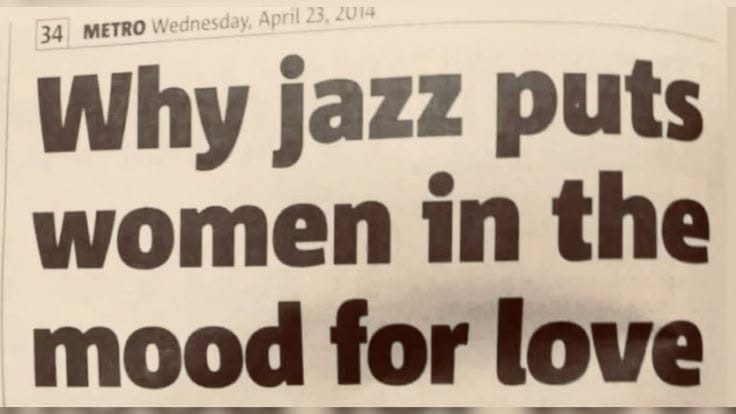
It was a cozy Sunday evening, my sister and I were trying to make thai curry from a recipe we got off reels, my dogs were asleep, watching us from a distance. I wasn’t trying to have a moment. I just put something on, just because. A Bill Evans record, Waltz for Debby, recommended by someone on the internet whose taste I trusted. I sat down. I meant to do other things.
I didn’t move for twenty minutes.
I want to be careful here because I know how this sounds. Jazz girl discovers jazz, calls it life changing. But what happened that night wasn’t me falling in love with a genre. It was me realizing I had been overhearing a conversation the whole time and only just now understood that the people talking were actually listening to each other.
Most music talks at you. There’s a voice, a message, a feeling it wants you to receive. That’s not a criticism. A lot of the music I love works exactly this way. But jazz does something different. When Bill Evans plays a phrase and bassist Scott LaFaro responds to it, that response is not scripted. LaFaro heard something and answered it. The piano then adjusts. The conversation continues. You are not the audience for this exchange. You are overhearing it, which is a completely different thing.
This is what I mean when I say jazz doesn’t perform. It’s too busy talking to someone else to worry about how it looks.
There’s a concept in good conversation called “tracking,” which is the idea that you’re not just waiting for your turn to speak, you’re actually following what the other person is saying and letting it change what you were going to say next. Most people are bad at this. Most music is bad at this. Jazz, structurally, cannot be bad at this. The musicians are required to track each other in real time or the whole thing falls apart.
I started noticing how rare that felt. To be in a conversation where someone was genuinely following you, not just nodding. Where what you said actually affected what came back to you. I could count those conversations on one hand.
Go listen to “Freddie Freeloader” from Kind of Blue. Don’t read about it first. Just play it. At some point Miles Davis goes quiet, completely silent, and the piano fills in, and then Miles comes back in slightly differently than you’d expect. He heard what the piano did in his absence and he responded to it. He let himself be changed by the two seconds he wasn’t playing.
I think about that a lot. The idea that real listening means you come back different. That a good conversation leaves a mark on what you say next.
I don’t know what I’m working through exactly. I think I spent a long time in friendships and in my own head performing rather than talking. Saying interesting things instead of true ones. Being entertaining rather than honest. Jazz made me notice the difference, the way you sometimes notice something for the first time even though it was always there.
There’s a Miles Davis quote that lives in my head now, “It takes a long time to play like yourself.”
I used to think that was about music.
The record ended that night and I sat there in the quiet for a while. Not thinking, really. Just noticing that I felt less alone than I had an hour ago.
No posts
Comments
Nothing yet. Say the first thing.
Sign in to join the conversation.