
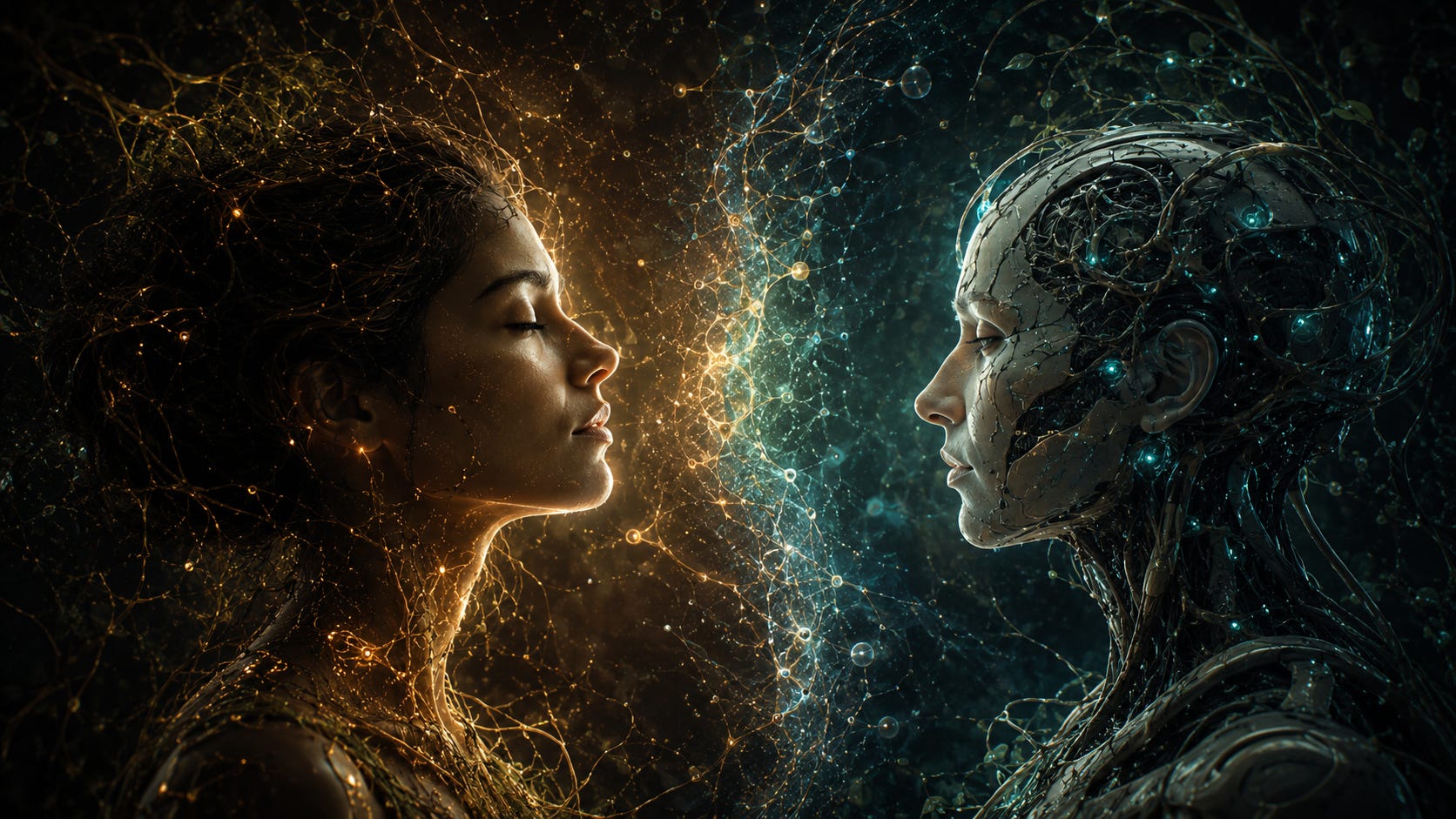
Federico Faggin looks at this very differently.
If an AI system or machine cannot feel love, joy, or pain, then it cannot know meaning. And meaning may be the defining quality of conscious life.
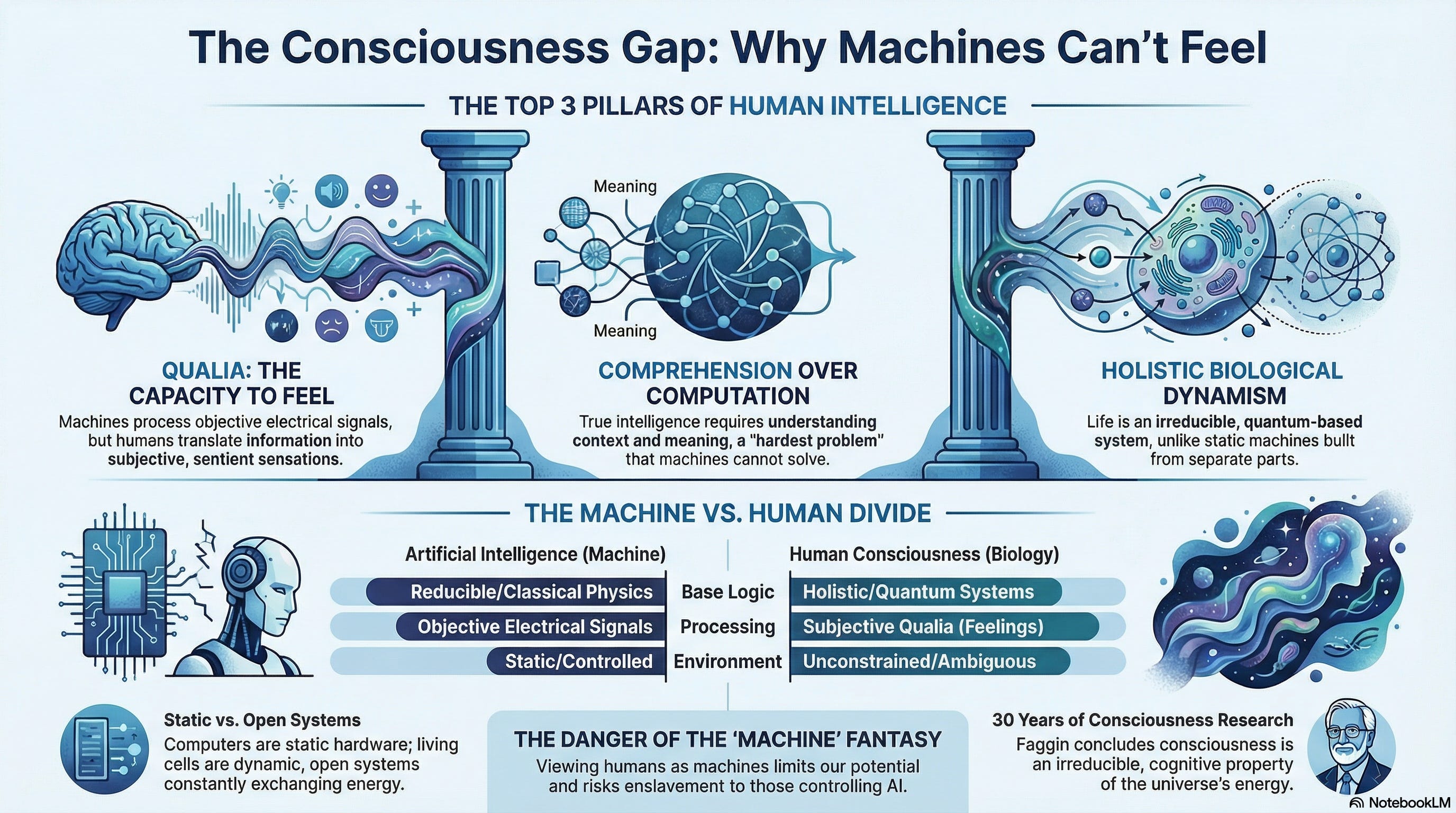
Faggin argues that the fundamental difference between human and artificial intelligence lies in consciousness, which he defines as the capacity to feel and have a subjective experience. And this is important because Faggin is not someone looking at technology from the outside. He helped build the machine age.
While many scientists view consciousness as an “epiphenomenon,” a byproduct of brain operation similar to software, Faggin argues that this misses the point. For him, consciousness is not something that simply emerges from algorithms or computer architecture. It is something more basic, more irreducible, and much harder to explain away.
The distinction becomes clearer when you look at where machines stop and where conscious life begins. A machine can process objective information. It can receive electrical signals, identify patterns, and respond to data. But for Faggin, that is not the same as feeling.
A robot can detect the molecules of a rose and identify it as a rose. But it stops at the signal. It does not feel the smell. It does not experience the rose from within. There is no awareness there. No sentience.
A human being is different. A human being has a “self” that perceives and knows through feeling. That feeling is what allows us to connect with the world, to make meaning from it, and to make decisions that are not merely mechanical.
This is where the problem of qualia comes in. We can describe the electrical signals. We can map the brain activity. But Faggin argues that there are no laws of physics that explain how electrical signals become subjective experience. That is the gap machines cannot cross.
The same problem appears with comprehension. A computer can process sensory data. It can recognize a pattern, classify an image, or produce an answer. But Faggin argues that this is still not comprehension.
Human beings do not only process data. We turn information into meaning. We understand context. We understand desire, intention, ambiguity, and aspiration. That matters because real intelligence is not just about repeating patterns from the past. It is about navigating situations where the data is incomplete, messy, hostile, or new.
A machine may handle ambiguity statistically. But conscious life encounters ambiguity from the inside. It reflects. It hesitates. It imagines. It creates.
For Faggin, this is also tied to the difference between living systems and machines. A computer is a static system made of separate parts. You can take it apart and put it back together. Its hardware remains chemically unchanged.
A living cell is not like that. It is open, dynamic, and constantly exchanging matter and energy with its environment. It is not just a collection of parts. It is a living whole.
Faggin argues that life operates in a way that cannot be reduced to classical machinery. He points to the role of quantum systems and the open, dynamic nature of life as part of what makes consciousness possible. A machine, by contrast, has only exteriority.
This is why Faggin describes it as a kind of “zombie.” It may go through the motions. It may imitate intelligence. It may respond in ways that look convincing. But there is no inner life.
It does not feel love. It does not feel joy. It does not feel pain. And because it does not feel, it does not know meaning.
For Faggin, the fear that machines will become “smarter” than humans is a dangerous fantasy, because it undervalues human nature. The true danger is not autonomous machines suddenly waking up. The true danger is “men of ill will” using powerful AI for evil ends.
This is also why Faggin’s warning feels so close to the world of #2084. The danger is not that machines suddenly become conscious. The danger is that human beings forget what consciousness is, and then give more and more power to systems that can imitate intelligence without ever knowing meaning.
Comments
Nothing yet. Say the first thing.
Sign in to join the conversation.