
On behalf of Informed Consent Action Network (www.icandecide.org), we have sent yet another letter to the FDA asking it to simply require that all drug ads disclose all risks of the product. Will the FDA Commissioner do the right thing…
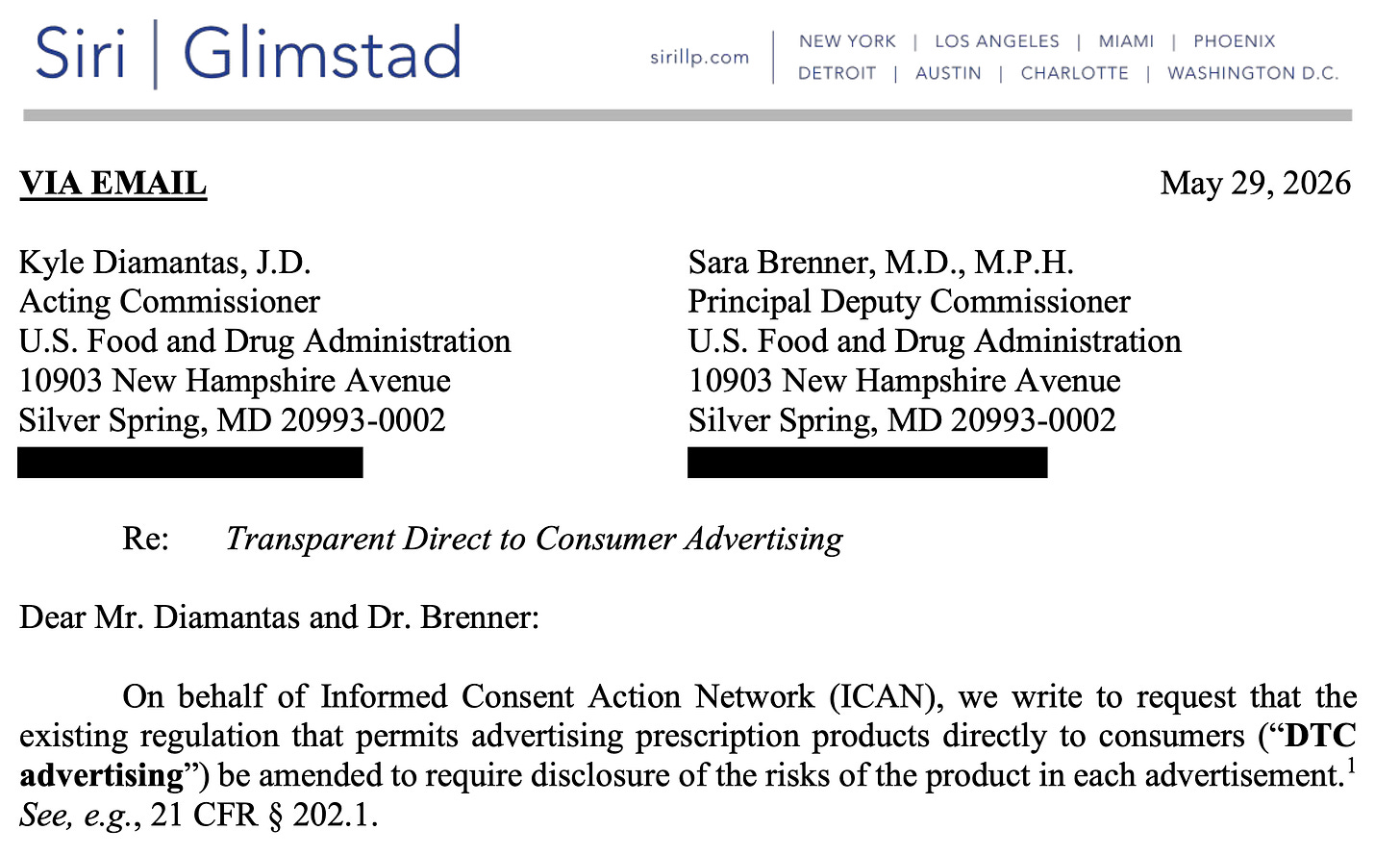
Here is a full text of that letter:
Dear Mr. Diamantas and Dr. Brenner:
On behalf of Informed Consent Action Network (ICAN), we write to request that the existing regulation that permits advertising prescription products directly to consumers (“DTC advertising”) be amended to require disclosure of the risks of the product in each advertisement.1 See, e.g., 21 CFR § 202.1.
Other than New Zealand, the United States is reported to be the only developed country that permits DTC advertising. The American Medical Association has even called for a ban on DTC advertising because, among other reasons, it fuels escalating drug prices and inflates demands for new and more expensive drugs that are equally (or even less) effective than existing drugs.2
At the least, FDA should require that DTC advertising for all drugs, biologics, and medical devices fairly and equally disclose all risks along with any benefits related to the product. The FDA can effect this change within its existing regulatory authority by amending 21 CFR § 202.1, titled “Prescription-drug advertisements,” and clarifying the types of products and platforms it applies to.
Below is model language that can be used to effect this regulatory change.
Very truly yours,
Aaron Siri, Esq.
Elizabeth A. Brehm, Esq.
MODEL LANGUAGE:
REQUIRING DIRECT TO CONSUMER ADVERTISING OF PHARMACEUTICAL PRODUCTS TO DISCLOSE ALL RISKS TO REDUCE COSTS AND PREVENT DECEPTIVE ADVERTISING
SEC 1. Purpose. Direct to consumer advertising of prescription pharmaceutical products (DTC advertising) that does not reasonably disclose risks results in deception to consumers, escalating drug prices, and inflation of demand for new and more expensive drugs over generics, even when the generics are more effective than the new drugs. The government has a substantial interest in keeping drug prices affordable for Americans, lowering healthcare costs, and ensuring that consumers are provided appropriate risk information concerning drugs, biologics, and medical devices so as not to mislead consumers. In addition, the government has an interest in ensuring that information that is advertised is done so in a non-misleading way to prevent deception to consumers and decrease the likelihood that Americans who do not genuinely need drugs will not receive them. Accurate disclosure of risks in DTC advertising also increases the likelihood that such information will match the information consumers receive from pharmacists and physicians who have professional obligations to provide patients with accurate information. Critically, studies have shown that DTC advertising is more likely to deceive than inform the public. The American Medical Association opposes permitting DTC advertising and no other country, with one exception, permits DTC advertising. Prescription drug costs are typically not paid directly by consumers but are often paid for by government programs and taxpayer dollars, providing the government a significant economic interest in assuring that advertisements for these products directed to consumers do not result in improper increased government spending on prescription drugs. This sets apart pharmaceutical products from other consumer products which are directly purchased by the public and whose costs are not typically absorbed by the government and taxpayers.
SEC. 2. Policy. All direct advertising to consumers of drugs, biologics, and medical devices shall require a statement of all the contraindications, pre-and-post marketing adverse reactions, and warnings and precautions for the product contained in its package insert. This disclosure shall be presented in a way designed to reduce misleading information, including that it shall be made (i) in the same manner as the portion of any advertising seeking to promote the product; (ii) in a manner that is reasonably calculated to ensure that it is understood by a reasonable consumer; and (iii) for any audio or visual advertisement, shall be communicated in the same manner that any benefits are communicated and over a sufficient period of time to ensure that it will be understood by a reasonable consumer.
SEC. 3. Implementation. FDA shall re-open rulemaking for 21 CFR § 202.1, et. seq., titled “Prescription drug advertisements,” and enact sufficient measures to implement the foregoing policy, including (i) an assessment of whether it should eliminate the “adequate provision” language from section (e)(1)(i)(B); (ii) determine whether to clarify the applicability of this section to biologics and medical devices; (iii) clarify whether the term “broadcast advertisements” includes internet and social media advertising and (iv) determine whether it should provide that all direct advertising to consumers of drugs, biologics, and medical devices shall require disclosure of all the contraindications, pre-and-post marketing adverse reactions, and warnings and precautions for the product listed in its package insert. Any required disclosures should be evaluated to ensure that such disclosures are a clear and unambiguous statement that is communicated for a sufficient time and at a sufficient speed to be understood by a reasonable consumer as well as communicated in the same manner as the portion of any advertising seeking to promote the product. In addition, to the extent permitted by law, a “time, place, or manner” restriction shall be put in place to limit advertisements on television.
It’s time for the FDA to stop yielding to the pharmaceutical industry and start protecting the public by ensuring full risk disclosure for every medical product.

Thanks for reading Informed w/ Aaron Siri: Injecting Freedom! This post is public so feel free to share it.
Comments
Nothing yet. Say the first thing.
Sign in to join the conversation.