
We fund the government. We pay the salaries of its employees. They work for us—though they often seem to forget that. One of the ways we keep tabs on what they are doing is a tool called the Freedom of Information Act (FOIA). Congress passed this law specifically so that anyone can request emails, documents, records, etc., regarding the work our government is doing.
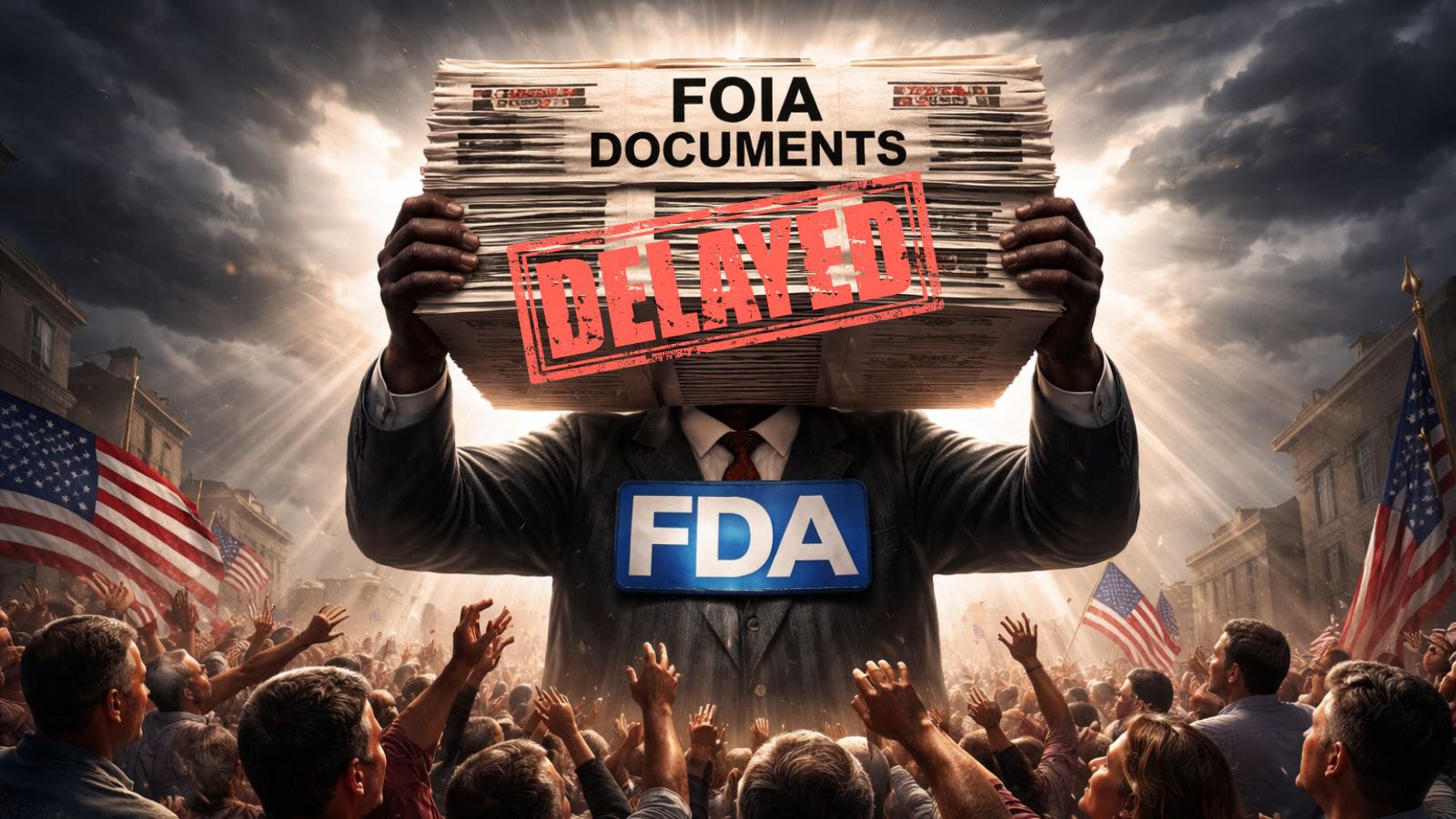
For years now, FDA has been dragging its feet when it comes to producing documents in response to FOIA requests. And not just dragging its feet—burying them in concrete. So much so that my firm has brought over 100 lawsuits against the federal government, on behalf of ICAN, just to get documents that should clearly have been produced. And even then, the government still drags its feet, wasting taxpayer money fighting us in court to generate more delay.
Many of you are likely familiar with the FOIA case we filed for the Covid-19 vaccine licensure documents in which FDA wanted 75 years to produce the documents! Sadly, that was not an outlier. It was business as usual for the government in responding to FOIA requests.
Here is just one other example of FDA’s FOIA behavior. In a court filing on January 30, 2026, FDA told a federal judge that the FOIA request at issue, which was originally submitted on January 26, 2024, was “currently positioned 471” in the Center for Biologics Evaluation and Research (CBER) Complex Track. Meaning, it was behind 470 other requests. FDA then conceded it “cannot reasonably estimate” when that request will reach the top of the track. Let that sink in. It cannot even estimate when it will comply with the law.
It gets worse. FDA then asked the Court to pause the litigation for “at least eighteen months, through and including June 25, 2027.” By then, FDA explained, it “anticipates” that it “will be in a better position to evaluate when it might be able to respond” to the FOIA request. Read that again. It doesn’t even commit to producing the documents by 2027—instead that’s the date it will evaluate the request’s status. That is not a commitment. That is a dodge.
While FDA pretends it cannot provide an estimate, we can reasonably estimate when it will produce these documents based on recent movement in the queue. In a 6-month period, the request at issue advanced just 11 positions in the queue—from number 482 to 471. If that rate continues, it will take more than 21 years before this request reaches the top of CBER’s Complex Track.
So much for transparency. And this is a FOIA request under the jurisdiction of a federal court. Imagine those requests that are stuck at the administrative levels.
At the time of this writing, my client ICAN has 271 outstanding FOIA requests submitted to FDA. Of those:
20 are in litigation
Of those 20 in litigation, FDA has sought and obtained a stay in 12 of them
18 are at the administrative appeal level
Of those, 8 appeals have been outstanding for more than 1 year
233 are at the request level
Of those, 67 have been outstanding for more than 1 year, 40 have been outstanding for more than 2 years, and 83 have been outstanding for 3 or more years
The Freedom of Information Act requires agencies to determine within 20 working days whether they will comply with a request (with defined exceptions). Twenty working days. Not 21 years.
It also requires agencies to provide meaningful, trackable status information for requests that will take more than ten days: an individualized tracking number and a phone line or internet service that provides status updates including an estimated completion date.
But when we asked how to access FDA’s portal to view the requests we submitted, the FDA merely replied: “At this time there is no public facing version of our tracking system.” FDA has such little regard for the public that it, in writing, admits it is openly violating the law by not having a publicly available tracking system.
FDA’s court filings explain that it uses a multi-track system, describing its approach as “first-in, first processed.” Multi-track processing can be used for legitimate triage—for example, to process small simple requests without needing to wait to complete unusually large ones. But it can also function as an accountability shield when the number of tracks and the resources allocated to each one are hidden from public view.
FDA also explains that outsiders cannot reliably audit its processing practices using its published annual report data because the reports do not capture the internal multi-track details—details which FDA insists it is not required to make public.
That is the opposite of transparency. It is pretending to be transparent. Publishing a report that the agency itself admits doesn’t reflect its actual FOIA processing practices, while citing that same report when seeking delays is, at best, inept. At worst, it is deliberate obfuscation.
FDA also repeats the familiar refrain that FOIA compliance is an “unfunded mandate.” But—and here is the kicker—it also stated it “has not made a request for supplemental funding.” You read that correctly: FDA says it cannot comply with FOIA because it doesn’t have the resources, but it refuses to ask for the resources. That combination—“we cannot comply” plus “we do not request the resources to comply”—is not an excuse. It is an indictment that brings to mind this quote, often attributed to Abraham Lincoln: “Hypocrite: The man who murdered his parents, and then pleaded for mercy on the grounds that he was an orphan.”
Between April 2025 and April 2026, ICAN’s internal tracking shows the following: 68 FOIA requests were submitted to FDA. Determinations of denial, for various reasons, were issued for 15 of them (22%). Records were actually produced for only 7. That is 10%. And the remaining 46 requests—a full 68%—were merely acknowledged as received. Many have been pending for months with no estimated completion dates provided.
Transparency is necessary for genuine informed consent. Yet here is the reality: FDA’s position to a federal court is that a requester can be number 471 in a queue and it does not need to provide any estimated completion and the court should pause the lawsuit until 2027 so that maybe then FDA can give an estimate. That is the direct opposite of transparency.
If the Department of Health and Human Services is serious about its promise of transparency, here is where it must start:
Publish the data on every internal processing track used in each department. For each track, disclose when and why it was created, the criteria for assignment of requests to the track, and the resources allocated it.
Provide requesters with the status information required by statute in a timely manner—especially a good-faith estimated completion date—and update it as conditions change.
Stop treating litigation stays as a default safety valve for chronic noncompliance. A “stay culture” converts statutory rights into agency discretion. And “delay” becomes “denial” by another name.
If resources are truly insufficient, request more support transparently—and do it on the record.
Because until transparency becomes more than a slogan, informed consent is illusory. And FDA knows it.

Thanks for reading Informed w/ Aaron Siri: Injecting Freedom! This post is public so feel free to share it.
Comments
Nothing yet. Say the first thing.
Sign in to join the conversation.