
SOME STORIES HAVE A STORY OF THEIR OWN. This one certainly does.
It began life as a serialized feature for Cigar Journal. Ultimately, the magazine declined to publish it, concluding that it was simply too long for the confines of a quarterly publication. A perfectly understandable editorial decision, if one is in the business of counting pages rather than turning them.
Undeterred, I moved on.
A substantially revised version eventually became part of the “CIGARS: a saga” chapter of CIGARS: a biography. Yet even then, the story did not feel complete. Time has a way of enriching certain narratives; fresh perspectives emerge, overlooked details assume new significance, and broader patterns gradually come into focus. What follows is the latest—and, I rather suspect, not the last—iteration.
Certain stories resist a single telling. They deserve to be revisited because history has an unfortunate habit of compressing decades into tidy anecdotes while reducing complex chains of events to convenient myths. This is one of those tales.
The Cigar Boom of the 1990s has suffered precisely that fate. This is one of its defining stories, alongside the launch of Cigar Aficionado magazine in 1992, the introduction of the first commercial Dominican puro, the Fuente Fuente OpusX in 1995 (a story I’ve recounted in two book: ARTURO FUENTE From Dream to Dynasty, and, as a condensed chapter in CIGARS: a biography.), and the founding of La Flor Dominicana the following year. Each has become part of modern cigar lore. Yet, like all enduring legends, each is rather more nuanced than popular memory suggests.
I count myself unusually fortunate. I did not merely witness the Cigar Boom—I enjoyed a front-row seat. Immersed in the premium cigar industry throughout those extraordinary years, first as one of the managers of Davidoff Beverly Hills flagship with its extraordinary celebrity clientele and later as the founding editor of SMOKE magazine, I experienced the period not as mythology, but simply as everyday life. At the time, none of us imagined we were living through what would become one of the defining chapters in the modern history of premium cigars. We were simply too busy doing the work.
Three decades later, what fascinates me is not only the Boom itself, though it was a marvelous time, but the invisible architecture beneath it: the people, the decisions, the calculated risks, and the remarkable foresight that made such an extraordinary moment possible. The origins of the Boom lie years before the headlines—in quiet acts of conviction, thoughtful stewardship, and an unwavering belief that premium cigars deserved recognition alongside the world’s great luxury goods and enduring epicurean traditions.
Few individuals deserve greater credit for laying that foundation than Dr. Ernst Schneider and Zino Davidoff. Their names have become legendary, yet their greatest achievement was not simply building a remarkable business. Together, they transformed the way premium cigars were perceived.
The American cigar market that exploded during the 1990s did not appear overnight; it had been patiently cultivated for years. The Boom was merely the visible crescendo. The more compelling story is what happened long before the applause began. -SIG
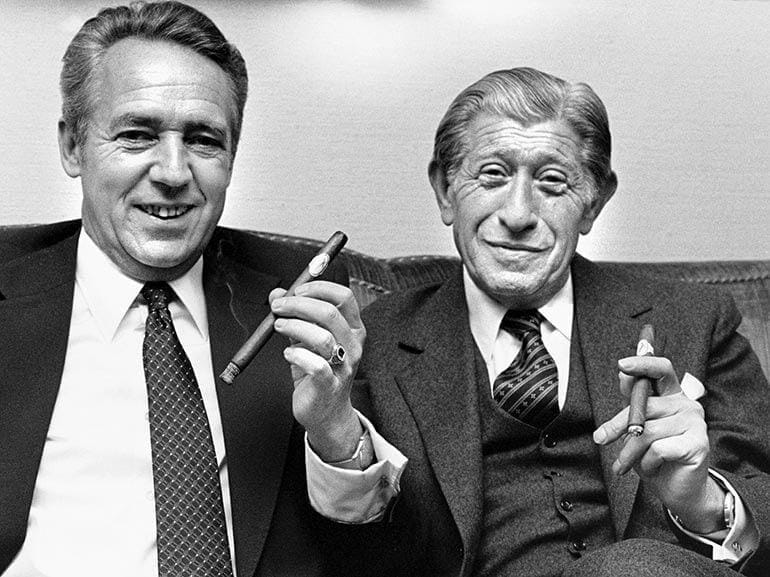
DR. ERNST SCHNEIDER AND ZINO DAVIDOFF (above) were not merely successful men, individually or collectively; they were the sort of formidable visionaries who tend either to reshape industries or crash spectacularly in the attempt. And while the most brilliant partnerships rarely guarantee lasting harmony or enduring alignment—even when reinforced by disciplined Swiss strategy, relentless ambition, and a shared disdain for mediocrity—it nonetheless remains an exceptionally promising place to begin. The conceptual axiom that convention is often tantamount to inertia, while iconoclastic innovation yields momentum, is relevant here. The key remains whether that momentum will carry forward or backward—something only time will tell.
In the late 1960s and throughout 1980 the Davidoff [White Label] brand flourished, particularly in airport duty free, and select European capitals—Geneva of course, but London and Paris too. (1980 saw the back-to-back openings of Davidoff London on May 29 and Boutique 22—intended as Davidoff Paris—on June 12, a pace of expansion that suggested neither hesitation nor modest ambition. (Zino attended both inaugural fêtes—an appearance that, in fairness, suggested a man both deeply committed to expansion and admirably unwilling to miss a proper celebration.) Still, while its reputation spread throughout the Continent it was far lesser known in the United States, except a privileged set of jet set cigar connoisseurs.
Comments
Nothing yet. Say the first thing.
Sign in to join the conversation.